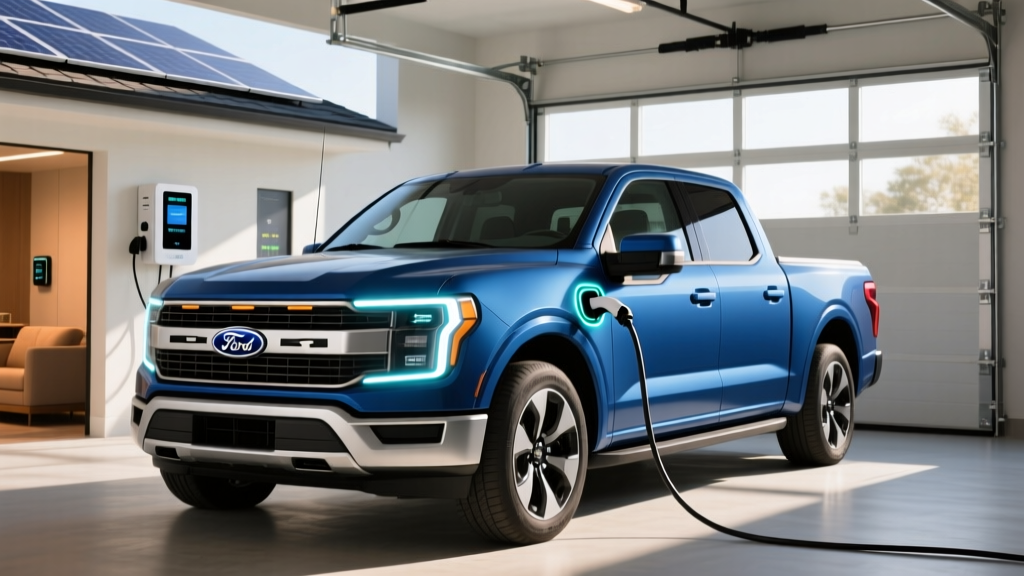
The Ford F-150 Lightning isn't just an electric truck — it's a rolling power plant. With up to 9.6 kW of bidirectional output, Ford's Intelligent Backup Power system can keep your home running during an outage for days. But bidirectional charging involves more than plugging in. You need the right home charger, a transfer switch, and an electrical panel that can handle the load. This guide breaks down exactly what Ford F-150 Lightning bidirectional charging requires in 2026, what it costs, and how the truck's general charging ecosystem stacks up.
What Bidirectional Charging Actually Means on the F-150 Lightning
Bidirectional charging lets energy flow both ways: from the grid into the truck's battery (charging) and from the battery back out to power devices, job sites, or your entire home (discharging). Ford offers three flavors on the Lightning:
- V2L (Vehicle-to-Load): Powers devices directly through onboard outlets — 120V and 240V plugs in the bed and cabin. Available on all trims with the Pro Power Onboard option. Output: 2.4 kW (standard) or 9.6 kW (extended).
- V2H (Vehicle-to-Home): Powers your home's electrical panel through the Ford Charge Station Pro and a home transfer switch. Output: up to 9.6 kW continuous. Available on Lariat and above with the extended-range battery, or as an option on lower trims.
- V2G (Vehicle-to-Grid): Sends power back to the utility grid for demand-response programs. Ford has announced limited V2G pilot partnerships but this is not widely available to consumers as of 2026.
F-150 Lightning Charging Levels: Speeds and Range Added
Whether you're charging the truck or planning to use it for backup power, you need to understand how energy gets into the battery in the first place. Here's how each level performs with both the standard-range (98 kWh) and extended-range (131 kWh) packs:
| Level | Power (kW) | Miles of Range/Hour | 10–80% Time (Ext. Range) |
|---|---|---|---|
| Level 1 (120V/12A) | 1.4 kW | ~3 mi/hr | ~65+ hours |
| Level 2 (240V/48A) | 11.5 kW | ~25 mi/hr | ~8 hours |
| Level 2 (240V/80A — Charge Station Pro) | 19.2 kW | ~42 mi/hr | ~4.8 hours |
| DC Fast (CCS, peak) | 150 kW (ext.) / 120 kW (std.) | N/A (session-based) | ~41 min (ext.) / ~36 min (std.) |
Ford F-150 Lightning Bidirectional Charging: Home Setup Requirements
To enable V2H (Vehicle-to-Home) backup power, Ford requires three components working together:
- Ford Charge Station Pro (80A): The wall-mounted bidirectional charger. This is not a standard EVSE — it contains the inverter hardware that converts the truck's DC battery output to AC household power. MSRP: approximately $1,395 (hardware only, before installation).
- Home Integration System (transfer switch): A professionally installed automatic transfer switch that connects the Charge Station Pro to your home's main electrical panel. During an outage, it disconnects your home from the grid (preventing backfeed to utility lines) and routes Lightning power to your circuits. Hardware cost: ~$1,500–$2,000.
- Electrical panel capacity: Your home needs a 200A (minimum) main service panel to support the 80A charger circuit plus existing household loads. Many older homes with 100A or 150A panels will require an upgrade.
Electrical Requirements for the Charge Station Pro
The Ford Charge Station Pro at 80A requires a dedicated 100A circuit (per NEC 80% continuous-load rule: 80A continuous draw requires a 100A breaker). This is a hardwired, 240V connection — not a plug-in unit. Key specs:
- Voltage: 240V single-phase
- Amperage: 100A dedicated breaker
- Wire gauge: Typically 2 AWG copper or 1/0 AWG aluminum (varies by run length and local code)
- Connection type: Hardwired (no NEMA plug)
- Location: Indoor or outdoor-rated (NEMA 4 enclosure)
Home Charger Installation Cost Breakdown
Bidirectional-capable home charging is the most expensive residential EV setup available. Here's a realistic cost range based on 2026 electrician rates and equipment pricing:
| Component | Low Estimate | High Estimate |
|---|---|---|
| Ford Charge Station Pro (hardware) | $1,395 | $1,395 |
| Home Integration System (transfer switch) | $1,500 | $2,000 |
| Electrician labor (install charger + transfer switch) | $2,000 | $4,500 |
| Permit and inspection fees | $150 | $500 |
| Electrical panel upgrade (if needed: 100A → 200A) | $2,000 | $4,500 |
| Conduit, wiring, and miscellaneous materials | $300 | $800 |
| Total (without panel upgrade) | $5,345 | $9,195 |
| Total (with panel upgrade) | $7,345 | $13,695 |
The wide range reflects variables like wire-run distance (a charger mounted 10 feet from the panel costs far less in conduit and wire than one 80 feet away), local labor rates, and whether your panel has spare breaker slots. Always get at least three quotes from licensed electricians who have EV charger and transfer-switch experience.
Connector Compatibility: What Plugs Into the Lightning
For 2025 and 2026 model years, Ford transitioned the F-150 Lightning to the NACS (North American Charging Standard) connector — the same plug used by Tesla. This is a significant shift from the CCS1 connector used on 2022–2024 models.
| Model Year | Native Connector | Tesla Supercharger Access | CCS Adapter Needed? |
|---|---|---|---|
| 2022–2024 | CCS1 | Yes (with Ford-provided NACS adapter) | No (native CCS) |
| 2025–2026 | NACS | Yes (native) | Yes — CCS adapter needed for Electrify America, EVgo, and other CCS-only stations |
For home Level 2 charging, the Charge Station Pro uses a NACS plug on 2025+ trucks and a CCS/J1772-compatible plug on 2022–2024 models. For bidirectional V2H operation, the Charge Station Pro is required regardless of model year — third-party chargers do not support Ford's Intelligent Backup Power protocol.
CHAdeMO is effectively obsolete in North America and was never supported on the Lightning. If you own a 2022–2024 Lightning and plan to use CCS public chargers, you're fine natively. If you own a 2025+ model, purchase a NACS-to-CCS adapter ($200–$300) to access the remaining CCS-only networks.
Cost to Charge: Per-Mile Economics vs. Gas F-150
The F-150 Lightning Extended Range has an EPA efficiency rating of approximately 48 kWh/100 miles (combined), or roughly 70 MPGe. Here's how that translates to real fuel costs compared to a gas-powered F-150 with the 3.5L EcoBoost V6 (EPA combined: 20 MPG):
| Scenario | Cost per kWh / Gallon | Cost per Mile | Cost for 300 Miles |
|---|---|---|---|
| Home charging (off-peak, $0.12/kWh) | $0.12/kWh | $0.058 | $17.28 |
| Home charging (peak, $0.22/kWh) | $0.22/kWh | $0.106 | $31.68 |
| Public Level 2 (ChargePoint, avg. $0.25/kWh) | $0.25/kWh | $0.120 | $36.00 |
| DC Fast Charging (avg. $0.40/kWh) | $0.40/kWh | $0.192 | $57.60 |
| Gas F-150 EcoBoost (20 MPG, $3.40/gal) | $3.40/gal | $0.170 | $51.00 |
At off-peak home rates, the Lightning costs roughly one-third per mile what a gas F-150 costs. Even at DC fast-charging rates, the Lightning is competitive with gas. The savings are most dramatic for owners who charge at home on time-of-use plans — a full 131 kWh extended-range charge at $0.12/kWh costs about $15.72 and delivers ~275 real-world miles.
How Long Can the Lightning Power Your Home?
Ford advertises up to 10 days of backup power from the F-150 Lightning. That figure assumes very conservative usage (~1.5 kW average draw). Here's a more realistic breakdown based on actual household consumption patterns:
- Essential circuits only (refrigerator, furnace fan, lights, router, phone charging): ~2–3 kW average → Extended-range pack lasts 36–50 hours
- Moderate usage (above + microwave, TV, space heater intermittently): ~4–5 kW average → Extended-range pack lasts 22–28 hours
- Heavy usage (above + electric oven, dryer, central AC): ~7–9 kW average → Extended-range pack lasts 12–16 hours
The Home Integration System automatically manages load shedding — it prioritizes essential circuits and can be configured via the FordPass app to extend runtime. If you pair the Lightning with a solar array and home battery (like a Ford-branded Sunrun system), you can extend backup duration significantly by recharging the truck during daylight hours.
Equipment Recommendations: Chargers for the Lightning
If bidirectional V2H is your priority, the Ford Charge Station Pro is mandatory. But if you only need standard Level 2 charging (no home backup), several third-party options work well:
Ford Charge Station Pro (80A)
- Power output: 19.2 kW (80A at 240V)
- Connector: NACS (2025+), J1772/CCS (2022–2024)
- Bidirectional: Yes — V2H capable
- Cable length: 25 feet
- Smart features: FordPass integration, scheduled charging, energy monitoring
- Price: ~$1,395
Best for: Owners who want V2H backup power and maximum Level 2 speed.
ChargePoint Home Flex (up to 50A)
- Power output: Up to 12 kW (50A at 240V), adjustable
- Connector: J1772 (NACS adapter included with 2025+ models)
- Bidirectional: No
- Cable length: 23 feet
- Smart features: Wi-Fi, app scheduling, Alexa, load sharing
- Price: ~$599
Best for: Budget-conscious owners who don't need bidirectional and have a 60A circuit available.
Grizzl-E Smart (48A)
- Power output: 11.5 kW (48A at 240V)
- Connector: J1772 (NACS version available)
- Bidirectional: No
- Cable length: 24 feet
- Smart features: Wi-Fi, OCPP support, firmware updates
- Price: ~$499
Best for: Durable, cold-climate charging on a 60A circuit. Built in Canada with a 3-year warranty.
Safety and Electrical Code Considerations
Installing an 80A or even 48A EV charger is a major electrical project. Here's what your installation must comply with:
- Dedicated circuit: NEC Article 625 requires EV chargers to be on a dedicated circuit — no sharing with other appliances or outlets.
- GFCI protection: The 2023 NEC update requires GFCI protection for all receptacle-based EV chargers (NEMA 14-50 outlets). Hardwired units like the Charge Station Pro are exempt from this requirement but must still meet ground-fault protection standards at the breaker.
- Outdoor rating: If your charger is mounted outside or in an unconditioned garage, it must carry a NEMA 4 (or higher) weatherproof rating. All three chargers recommended above meet this standard.
- Permit and inspection: Virtually all jurisdictions require an electrical permit for EV charger installation. The work must pass a final inspection before the utility will authorize bidirectional interconnection (for V2H systems).
- Utility notification: For V2H systems, your utility company must approve the transfer-switch installation to ensure safe islanding during outages. Some utilities also offer demand-response programs that compensate you for V2G-style discharge.
Ford F-150 Lightning: Key Specs at a Glance
| Specification | Standard Range | Extended Range |
|---|---|---|
| Battery capacity (usable) | 98 kWh (NMC) | 131 kWh (NMC) |
| EPA range | 240 miles | 320 miles |
| Horsepower | 580 hp | 580 hp |
| 0–60 mph | ~4.0 sec | ~3.8 sec |
| Max DC fast charge rate | 120 kW | 150 kW |
| Max Level 2 rate | 19.2 kW (80A) | 19.2 kW (80A) |
| Bidirectional output (V2H) | Up to 9.6 kW* | Up to 9.6 kW |
| Max towing capacity | 7,700 lbs | 10,000 lbs |
| Starting MSRP (2026, Pro trim) | ~$54,995 | ~$69,995 (Lariat+) |
| Battery/powertrain warranty | 8 yr / 100,000 mi | 8 yr / 100,000 mi |
*Standard-range V2H availability depends on trim and Pro Power Onboard option package.
Tax Credit and Incentive Notes
The F-150 Lightning's eligibility for the federal §30D clean vehicle credit depends on battery-component and critical-mineral sourcing requirements that change annually. As of 2026, the credit can be up to $7,500, but is subject to:
- MSRP cap: $80,000 for trucks/vans/SUVs (most Lightning trims qualify)
- Buyer income cap: $150,000 single / $300,000 joint AGI
- Battery sourcing: Must meet escalating critical-mineral and battery-component thresholds per IRS §30D rules
- Point-of-sale transfer: Eligible buyers can transfer the credit to the dealer at purchase for an immediate price reduction
Additionally, the Alternative Fuel Vehicle Refueling Property Credit (§30C) can cover up to 30% of home charger installation costs (maximum $1,000) if you live in an eligible census tract. Consult a tax professional to confirm eligibility for your specific situation.
Frequently Asked Questions
How much does it cost to install a home EV charger for the F-150 Lightning?
For a bidirectional-capable setup (Ford Charge Station Pro + Home Integration System), expect $5,300–$9,200 without a panel upgrade, or $7,300–$13,700 if your home needs a 200A panel upgrade. A standard Level 2 charger (non-bidirectional) on a 48A circuit typically costs $1,200–$3,000 installed.
How fast will each charging level add range to the Lightning?
Level 1 (120V) adds about 3 miles per hour — barely enough for daily driving. Level 2 at 48A adds ~25 miles/hour; at 80A (Charge Station Pro) it adds ~42 miles/hour. DC fast charging peaks at 150 kW (extended range), adding roughly 50 miles in 10 minutes at peak rate, though the charge curve tapers significantly above 80% SoC.
Which connector and charger are compatible with my F-150 Lightning?
2025–2026 models use the NACS connector natively and access Tesla Superchargers directly. 2022–2024 models use CCS1 and need a Ford-supplied adapter for Superchargers. For bidirectional V2H, only the Ford Charge Station Pro is compatible — no third-party charger supports Ford's Intelligent Backup Power.
How much does charging cost per mile vs. a gas F-150?
At home off-peak rates ($0.12/kWh), the Lightning costs about $0.058/mile — roughly one-third the cost of a gas F-150 at $3.40/gallon and 20 MPG ($0.17/mile). At public DC fast chargers ($0.40/kWh), the cost rises to $0.192/mile, slightly above gas. Home charging is where the economics overwhelmingly favor electric.
What electrical upgrades might I need for bidirectional charging?
The Charge Station Pro requires a 100A dedicated breaker on a 200A main panel. If your home has a 100A or 150A panel — common in homes built before 2000 — you'll likely need a panel upgrade ($2,000–$4,500). You may also need a service-drop upgrade from your utility if the incoming wire can't support 200A. A licensed electrician can assess this during a site visit.
Can I use a generator or solar to recharge the Lightning during an outage?
Yes, indirectly. A solar-plus-inverter system can charge the Lightning through your home's Level 2 charger during an outage, as long as the solar inverter supports grid-independent (islanded) operation. A portable generator with a 240V/30A or 50A outlet can also charge the Lightning via a mobile EVSE, though at reduced speed (typically 3.6–7.2 kW depending on generator output).