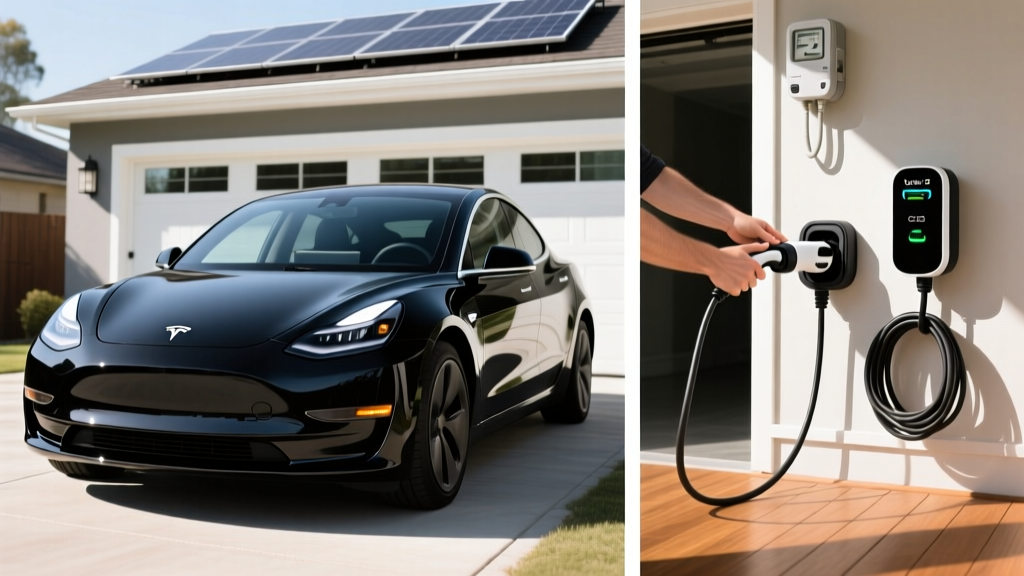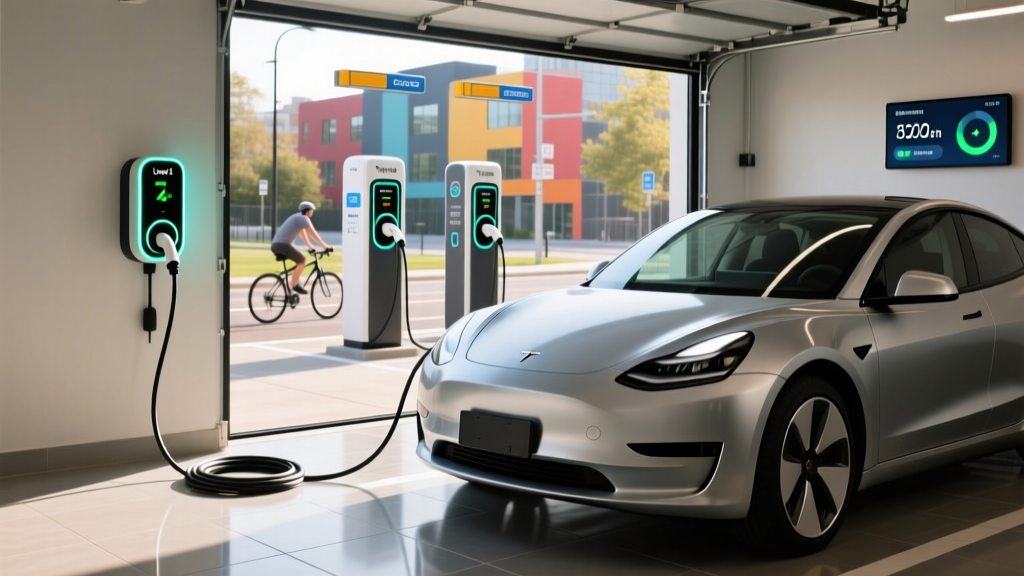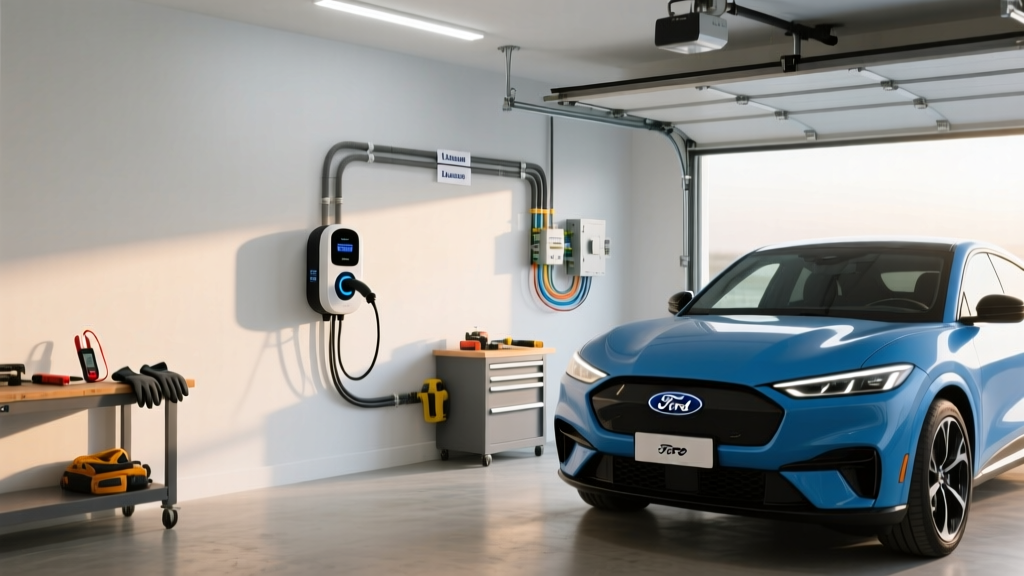
If you own a Ford Mustang Mach-E, F-150 Lightning, or the newer E-Transit, plugging into a standard 120V outlet works in a pinch — but for daily driving, a dedicated 240V Level 2 home charger is practically mandatory. The question most Ford EV buyers face isn't whether to install one, but how much it will cost, what electrical work is involved, and which charger to buy. This guide breaks down every element of Ford EV charger installation with real numbers, from panel capacity to per-mile charging costs.
Understanding Charging Levels: What Speed Are You Actually Getting?
Before discussing installation, you need to understand the three charging tiers and how they translate to real range added to your Ford EV. The critical distinction: kW (kilowatts) measures power — the rate of energy flow — while kWh (kilowatt-hours) measures energy capacity, the size of your battery. Think of kW as the width of a pipe and kWh as the size of the tank you're filling.
| Level | Voltage | Max Power (kW) | Miles of Range Added Per Hour | Typical Use Case |
|---|---|---|---|---|
| Level 1 | 120V AC | 1.2–1.9 kW | 3–5 miles/hr | Overnight trickle, PHEVs, emergencies |
| Level 2 | 240V AC | 7.2–19.2 kW | 20–65 miles/hr | Daily home & workplace charging |
| DC Fast Charging | 400–800V DC | 50–270+ kW | 150–400+ miles/hr (peak) | Road trips, highway corridors |
For a Ford Mustang Mach-E with its 91 kWh usable battery (Extended Range), a Level 1 outlet would take roughly 4–5 days for a full charge — essentially useless for daily driving. A 48-amp Level 2 charger delivering ~11.5 kW can refill that same battery from 10–80% in approximately 6–7 hours, making overnight charging effortless. The F-150 Lightning Extended Range (131 kWh usable) needs even more: a 48A charger adds about 30 miles of range per hour, reaching 10–80% in roughly 9–10 hours. According to fueleconomy.gov, Level 2 home charging is the most cost-effective and battery-friendly method for daily use.
Ford EV Charger Installation Cost: The Full Breakdown
The total cost of installing a home Level 2 EV charger varies dramatically depending on your home's existing electrical infrastructure. Here's what you're actually paying for:
| Component | Simple Install (Panel Nearby) | Moderate Install (50–100 ft run) | Complex Install (Panel Upgrade Needed) |
|---|---|---|---|
| Level 2 Charger Equipment | $400–$700 | $400–$700 | $400–$700 |
| Electrician Labor | $300–$600 | $600–$1,200 | $800–$1,500 |
| Electrical Permit | $50–$150 | $50–$200 | $100–$300 |
| Wiring & Conduit Materials | $50–$150 | $200–$500 | $300–$800 |
| Panel Upgrade (if needed) | — | — | $1,500–$3,500 |
| Total Estimated Cost | $800–$1,600 | $1,250–$2,600 | $3,100–$6,800 |
The single biggest cost variable is your electrical panel. Most homes built after 1990 have a 200-amp service panel, which typically supports a dedicated 40A or 50A circuit for EV charging without an upgrade. Older homes with 100-amp panels often require an upgrade to 200 amps — adding $1,500–$3,500 to your project. Even with a 200-amp panel, if your existing loads (HVAC, electric oven, dryer) are already consuming most of the capacity, an electrician may recommend a panel upgrade or a smart load-management device like the Emporia VUE or Span smart panel to avoid overloading the system.
Ford's own recommendation: Ford offers the Ford Connected Charge Station (48A, 11.5 kW) as its official home charger, priced around $599. It uses a NACS (North American Charging Standard) connector on 2025+ models and CCS1 on 2021–2024 models. However, you are not locked into Ford-branded equipment — any quality Level 2 charger with the correct connector will work.
Electrical Requirements: What Your Home Needs for a Ford EV Charger
A proper Level 2 installation for a Ford EV requires the following electrical specifications:
- Voltage: 240V AC (same as your dryer or oven circuit)
- Circuit amperage: 40A, 50A, or 60A dedicated breaker (sized to 125% of the charger's continuous draw — a 48A charger requires a 60A breaker per NEC Article 210.20)
- Wire gauge: 6 AWG copper for 50A circuits; 4 AWG for 60A circuits (your electrician will size this based on run length and local code)
- Dedicated circuit: The EV charger must have its own breaker — not shared with other appliances
- GFCI protection: NEC 2020 and later require GFCI (Ground Fault Circuit Interrupter) protection for all EV charging outlets. Hardwired chargers often have built-in GFCI; receptacle-installed units may need a GFCI breaker ($50–$100 more than a standard breaker)
- Outdoor rating: If your charger is installed outside (garage-free homes, driveways), it must carry a NEMA 4 or NEMA 4X weather-resistance rating. Most quality chargers meet this, but verify before purchase
For the F-150 Lightning, Ford specifically recommends a 48A or higher charger to make overnight charging practical given the truck's large battery. The Lightning's onboard charger accepts up to 19.2 kW on AC (with the optional dual onboard charger on certain trims), meaning a hardwired 80A circuit could deliver up to 80 miles of range per hour — a significant advantage for heavy-use truck owners. Most Mach-E models accept up to 10.5 kW on AC (with an 11.5 kW option on newer model years), so a 48A circuit is the sweet spot.
Connector Compatibility: NACS, CCS1, and What Your Ford EV Uses
Ford made a pivotal switch starting with 2025 model-year vehicles: all new Ford EVs now ship with the NACS (North American Charging Standard) connector — the same plug Tesla uses. This gives Ford owners native access to Tesla Superchargers without an adapter, a major advantage for road-trip charging. However, 2021–2024 Ford EVs use the CCS1 connector and require Ford's complimentary NACS adapter (or a purchased third-party adapter) to access Superchargers.
| Ford Model | Model Years | Native Connector | Supercharger Access | Adapter Needed? |
|---|---|---|---|---|
| Mustang Mach-E | 2021–2024 | CCS1 | Via adapter | Yes — Ford NACS adapter (complimentary or ~$230 aftermarket) |
| Mustang Mach-E | 2025+ | NACS | Native | No — CCS adapter needed for older CCS stations (~$100–$200) |
| F-150 Lightning | 2022–2024 | CCS1 | Via adapter | Yes — Ford NACS adapter |
| F-150 Lightning | 2025+ | NACS | Native | No |
| E-Transit | 2022–2024 | CCS1 | Via adapter | Yes |
For home Level 2 charging, this connector distinction matters when selecting your charger. If you drive a 2025+ Ford with NACS, buy a NACS-connector Level 2 charger (Ford Connected Charge Station, Tesla Wall Connector, or Emporia J1772 with NACS adapter). If you drive a 2021–2024 model with CCS1, you'll want a J1772-connector charger (the universal AC standard) and use your vehicle's J1772-to-NACS or native CCS inlet — or simply buy a NACS charger and use Ford's adapter. The J1772 standard is being phased out in favor of NACS, so investing in NACS-native equipment is the forward-looking choice for 2026 and beyond.
Equipment Recommendations: Best Level 2 Chargers for Ford EVs
Not all Level 2 chargers are equal. Here are the top picks for Ford EV owners, evaluated on power output, connector availability, cable length, smart features, and value:
Ford Connected Charge Station
- Power: 48A / 11.5 kW (hardwired, 60A breaker)
- Connector: NACS (2025+ models)
- Cable Length: 25 ft
- Smart Features: FordPass app integration, scheduled charging, energy tracking
- Price: ~$599
- Best For: Ford loyalists wanting seamless app integration
Tesla Wall Connector (Gen 4)
- Power: 48A / 11.5 kW (hardwired, 60A breaker)
- Connector: NACS native
- Cable Length: 24 ft
- Smart Features: Wi-Fi updates, power sharing (link multiple units), load management
- Price: ~$450
- Best For: Best value NACS charger; ideal for 2025+ Ford EVs
ChargePoint Home Flex
- Power: Up to 50A / 12 kW (configurable 16A–50A; NEMA 14-50 plug or hardwired)
- Connector: J1772 (NACS adapter available)
- Cable Length: 23 ft
- Smart Features: App scheduling, Alexa integration, detailed energy reports
- Price: ~$550–$700
- Best For: Flexibility — adjustable amperage fits any panel; plug-in option avoids hardwiring
Emporia Vue 2 EV Charger
- Power: 48A / 11.5 kW (hardwired, 60A breaker)
- Connector: J1772 or NACS (select at purchase)
- Cable Length: 24 ft
- Smart Features: Whole-home energy monitoring integration, solar-aware charging, TOU scheduling
- Price: ~$399–$499
- Best For: Budget-conscious buyers; solar homeowners wanting integrated energy management
For F-150 Lightning owners with the dual onboard charger option (19.2 kW AC capability), consider the Grizzl-E Smart or a hardwired 80A charger to unlock faster home charging — though this requires a 100A breaker and heavy-gauge wiring, adding to installation cost.
Charging Cost Per Mile: Ford EV vs. Gasoline
One of the strongest arguments for home EV charging is the per-mile fuel cost advantage. Here's how Ford EVs compare to their gasoline equivalents using 2025–2026 energy prices:
| Scenario | Energy Cost | Mustang Mach-E (ER AWD, ~3.0 mi/kWh) | F-150 Lightning (ER, ~2.0 mi/kWh) | Gas Equivalent |
|---|---|---|---|---|
| Home Level 2 (national avg) | $0.16/kWh | $0.053/mile | $0.080/mile | — |
| Home off-peak TOU rate | $0.08/kWh | $0.027/mile | $0.040/mile | — |
| Public Level 2 (network avg) | $0.30/kWh | $0.100/mile | $0.150/mile | — |
| DC Fast Charging (avg) | $0.42/kWh | $0.140/mile | $0.210/mile | — |
| Gasoline (Ford Edge AWD, 24 MPG combined) | $3.30/gal | — | — | $0.138/mile |
| Gasoline (F-150 4WD, 20 MPG combined) | $3.30/gal | — | — | $0.165/mile |
At home on an off-peak time-of-use (TOU) rate, a Mach-E owner pays roughly 2.7 cents per mile — about one-fifth the cost of a comparable gasoline crossover. Even at public DC fast-charger rates, the Mach-E undercuts gasoline on a per-mile basis. The F-150 Lightning, being heavier and less efficient, sees a narrower gap but still saves significantly when charging at home. Over 15,000 annual miles, a Mach-E owner charging primarily at home on a TOU plan saves roughly $1,300–$1,600 per year compared to a gasoline Edge. According to the U.S. Department of Energy, the average EV driver saves $600–$1,200 annually on fuel depending on local electricity rates.
Charging Time Examples: How Long Does It Really Take?
Here are real-world 10–80% charging times for common Ford EV battery sizes across different charging scenarios:
| Vehicle | Usable Battery (kWh) | Level 1 (1.4 kW) | Level 2 (11.5 kW / 48A) | DC Fast (peak rate) |
|---|---|---|---|---|
| Mustang Mach-E SR | 70 kWh | ~35 hours | ~4.5 hours | ~26 min (150 kW peak) |
| Mustang Mach-E ER | 91 kWh | ~45 hours | ~5.5 hours | ~32 min (150 kW peak) |
| F-150 Lightning SR | 98 kWh | ~49 hours | ~6 hours | ~36 min (150 kW peak) |
| F-150 Lightning ER | 131 kWh | ~65 hours | ~8 hours | ~41 min (150 kW peak) |
These DC fast-charging times assume you arrive at roughly 10% SoC, the charger can deliver its peak rate, and the battery is preconditioned (warmed to optimal temperature). In cold weather (below 32°F), DC fast charging can be 30–50% slower unless the vehicle has actively preconditioned the battery during navigation to the charger. The Mach-E and Lightning both support battery preconditioning when a DC fast charger is set as your navigation destination — always use this feature in winter.
Frequently Asked Questions
How much does it cost to install a Ford EV home charger?
Most homeowners spend between $1,200 and $2,600 for a complete Level 2 installation including a quality 48A charger, electrician labor, permit, and wiring. If your home requires an electrical panel upgrade from 100A to 200A, add $1,500–$3,500. Homes with a modern 200A panel and a garage close to the panel can see costs as low as $800–$1,200.
Do I need a permit for EV charger installation?
Yes. Virtually all jurisdictions in the U.S. require an electrical permit for a new 240V circuit. The permit typically costs $50–$200 and ensures your installation is inspected for NEC compliance. Skipping the permit can void your homeowner's insurance coverage for electrical fires and cause issues during a home sale. Your electrician will typically pull this permit on your behalf.
Can I install a Ford EV charger myself?
Unless you are a licensed electrician, no. A 240V, 40–60A circuit involves significant shock and fire risk if wired incorrectly. The NEC requires specific wire gauges, breaker sizing (125% of continuous load), torque specifications, and GFCI protection. DIY errors here can damage your vehicle's onboard charger or cause an electrical fire. Always hire a licensed, insured electrician — and verify they have EV charger installation experience.
Does the federal tax credit cover home charger installation?
The Alternative Fuel Vehicle Refueling Property Credit (IRS Form 8911) can cover up to 30% of home EV charger equipment and installation costs, capped at $1,000. However, this credit is subject to census-tract eligibility requirements (the installation must be in a qualifying low-income or non-urban census tract) and has specific rules around placed-in-service dates. Consult a tax professional and check the IRS website for current-year eligibility, as these rules have been updated multiple times since 2023.
What if my garage is far from the electrical panel?
Long wire runs increase cost due to heavier-gauge wire requirements (to minimize voltage drop over distance) and additional conduit and labor. A 100-foot run of 6 AWG copper through conduit might add $400–$800 to your installation compared to a 20-foot run. Some homeowners opt for a sub-panel installation closer to the garage, which can be more economical for very long runs. Your electrician will calculate voltage drop and recommend the most cost-effective approach.
Will a Ford EV charger work with non-Ford EVs?
Yes — if the connector matches. A NACS-connector charger (like the Tesla Wall Connector or 2025+ Ford Connected Charge Station) will charge any NACS-equipped vehicle, including Tesla, Rivian (with adapter), and other brands adopting the standard. A J1772-connector charger works with virtually every EV sold in North America from 2011–2024. The charger itself is brand-agnostic; only the physical connector needs to match your vehicle's inlet.