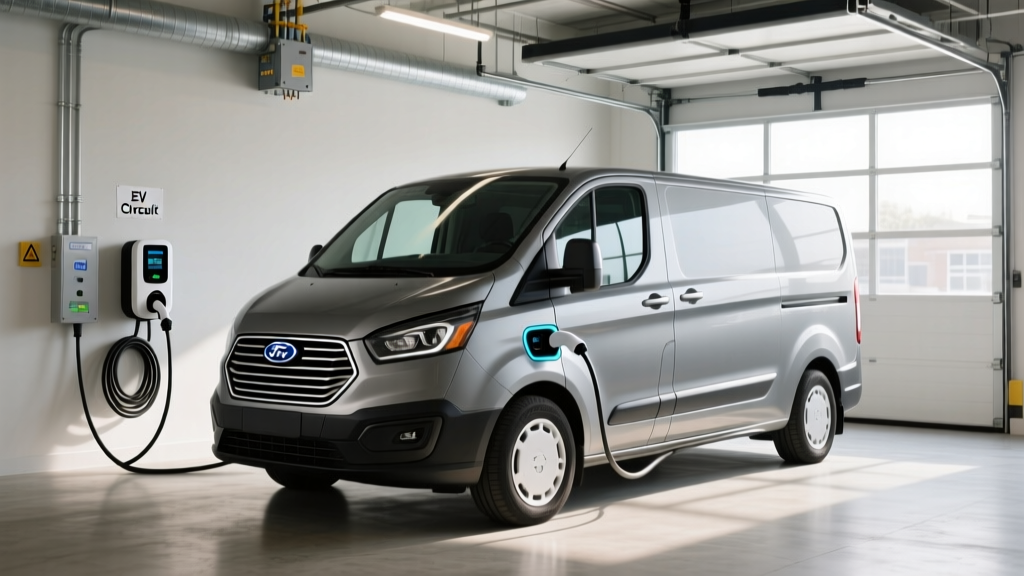
The Ford E-Transit is the commercial workhorse of the electric van world, but its real-world utility hinges on one thing: how you charge it. With a 68 kWh usable battery pack (NMC chemistry) and an EPA-estimated range of 126 miles for the low-roof cargo van, the E-Transit is purpose-built for last-mile delivery and urban route work — not cross-country hauls. Getting the charging infrastructure right is what separates a productive fleet vehicle from an expensive garage ornament.
This guide breaks down exactly what the Ford E-Transit range means in daily operations, what charging hardware you need at your depot or home, what it costs to install, and how per-mile energy expenses compare to the gas-powered Transit.
Understanding Ford E-Transit Range in Real-World Operations
The low-roof E-Transit cargo van carries an EPA rating of 126 miles. In real-world urban delivery use with frequent stops, regenerative braking helps recover energy, and many fleet operators report achieving 100–120 miles on a full charge. Highway-speed driving at 70 mph reduces that to roughly 90–105 miles. In cold weather (below 32°F), expect a 20–30% reduction, bringing effective range to approximately 85–100 miles. Source: fueleconomy.gov.
| Specification | Value |
|---|---|
| Battery (usable) | 68 kWh, NMC lithium-ion |
| EPA Range (low-roof cargo) | 126 miles |
| Real-World Range (urban delivery) | 100–120 miles |
| Real-World Range (cold weather) | 85–100 miles |
| Max DC Fast Charge Rate | 115 kW peak |
| DC Fast Charge 10–80% | ~45 minutes |
| Level 2 Onboard Charger | 10.5 kW (single-phase AC) |
| Motor Output | 266 hp (198 kW), 317 lb-ft torque |
| 0–60 mph | ~8.0 seconds (unladen) |
| Max Payload | 3,880 lbs (cargo van) |
| Base MSRP (T-150 Cargo, low roof) | ~$47,000 |
| Battery Warranty | 8 years / 100,000 miles (≥70% capacity retention) |
For context, the average last-mile delivery route in the U.S. covers 60–90 miles per day, which means the E-Transit can complete most routes on a single overnight charge — provided your depot or home charging is properly spec'd.
Charging Levels Explained: Speeds, Power, and Range Recovery
The most common mistake new EV owners make is confusing kW (kilowatts — the rate of power delivery, like water pressure from a hose) with kWh (kilowatt-hours — the total energy stored, like the size of the water tank). Charging speed is measured in kW; your E-Transit's battery capacity is 68 kWh. A 10 kW charger delivers 10 kWh of energy per hour, meaning a full 0–100% charge would theoretically take about 6.8 hours (real-world times are slightly longer due to charging-curve taper above 80% SoC).
| Charging Level | Power (kW) | Miles of Range per Hour | E-Transit 10–80% Time | Typical Use Case |
|---|---|---|---|---|
| Level 1 (120V household outlet) | 1.0–1.4 kW | 3–5 mi/hr | ~55+ hours | Emergency top-up only |
| Level 2 (240V home/depot) | 7.2–19.2 kW | 22–55 mi/hr | ~5–7 hours (at 10.5 kW) | Overnight depot/home charging |
| DC Fast Charging | 50–115 kW (E-Transit peak) | 120–190 mi/hr | ~45 minutes | Mid-day route top-up, public stations |
Connector Compatibility: What Plug Does the E-Transit Use?
The Ford E-Transit uses the CCS1 (Combined Charging System) connector for both Level 2 AC charging and DC fast charging in North America. As of 2025, Ford has begun transitioning new light-duty models to the NACS (Tesla-style) connector, but the E-Transit currently ships with CCS1. This matters for your charging hardware decisions.
| Connector Type | Used By | AC Level 2 | DC Fast | Adapter Available? |
|---|---|---|---|---|
| CCS1 | Ford E-Transit, VW ID.4, Hyundai Ioniq 5 (pre-2026), BMW iX | J1772 upper portion | CCS lower pins | CCS-to-NACS adapters emerging (check mfr. approval) |
| NACS (Tesla) | Tesla all models, Ford F-150 Lightning (2025+), GM Ultium vehicles (2025+), Rivian (2025+) | NACS AC pins | NACS DC pins | Tesla provides CCS-to-NACS adapter for Supercharger access |
| CHAdeMO | Nissan Leaf (legacy), Mitsubishi Outlander PHEV | J1772 (separate port) | CHAdeMO connector | Limited; network phasing out |
Practical takeaway for E-Transit owners: Install CCS1-compatible Level 2 chargers at your depot. If you plan to use public DC fast-charging networks like Electrify America or EVgo, CCS1 is natively supported. For Tesla Supercharger access (now opening to non-Tesla vehicles via the "Open Supercharger" program), you may need a Ford-approved CCS-to-NACS adapter — check with your Ford Pro dealer for the latest compatibility updates.
Home and Depot Charger Installation: Costs, Electrical Requirements, and Upgrades
Whether you're installing a single charger in your home garage for a personal E-Transit or outfitting a multi-bay fleet depot, the electrical fundamentals are the same. The E-Transit's onboard charger accepts up to 10.5 kW on Level 2 AC, which requires a 240V circuit rated at a minimum of 48 amps (to deliver ~40 amps continuous to the vehicle, per NEC 80% continuous-load rule).
Electrical Requirements for E-Transit Level 2 Charging
- Voltage: 240V single-phase (split-phase residential or commercial)
- Circuit amperage: 50-amp dedicated breaker (delivers 40A continuous / ~9.6 kW) or 60-amp breaker (delivers 48A continuous / ~11.5 kW, matching the E-Transit's 10.5 kW onboard max)
- Wire gauge: 6 AWG copper (for 50A) or 4 AWG copper (for 60A), run in conduit per local code
- Outlet vs. hardwired: Hardwired is preferred for commercial/depot use (more reliable, no plug wear); NEMA 14-50 outlet acceptable for home garage flexibility
- GFCI protection: Required by NEC 2020+ for outdoor installations and many jurisdictions for indoor EV circuits
Panel Upgrade Considerations
This is the cost variable most guides gloss over. If your home or depot has a 100-amp electrical panel (common in older buildings), adding a 50–60 amp EV circuit may exceed available capacity. A panel upgrade to 200 amps typically costs $1,500–$3,500, and in some cases a full service upgrade from the utility can run $3,000–$5,000+. Always have a licensed electrician perform a load calculation before committing to a charger install.
| Cost Component | Simple Install (near panel, no upgrade) | Complex Install (long run, panel upgrade) |
|---|---|---|
| Level 2 Charger Equipment | $500–$800 | $600–$1,200 |
| Electrician Labor (2–6 hours) | $400–$900 | $1,200–$3,000 |
| Permit & Inspection | $100–$300 | $150–$500 |
| Electrical Panel Upgrade (if needed) | $0 | $1,500–$5,000 |
| Conduit, Wiring, Misc. Materials | $100–$300 | $300–$800 |
| Total Estimated Range | $1,100–$2,300 | $3,750–$10,500 |
For fleet depots installing multiple chargers, consider a load-management system (offered by manufacturers like ChargePoint and Wallbox) that dynamically distributes available power across multiple vehicles, avoiding the need for a massive service upgrade. A 4-charger depot install with load management and a 400-amp service can run $15,000–$30,000 depending on site conditions.
Level 2 Charger Equipment Recommendations for the E-Transit
Not all Level 2 chargers are equal. For the E-Transit's 10.5 kW onboard charger, you want a unit that can deliver at least 48 amps (11.5 kW) to maximize charging speed. Here are proven options for 2025–2026:
ChargePoint Home Flex
- Power Output: Up to 12 kW (50A, 240V)
- Connector: J1772 (CCS1 compatible for AC)
- Cable Length: 23 feet
- Smart Features: Wi-Fi, app scheduling, Alexa, energy tracking
- Price: ~$699
- Best For: Home garage, single-vehicle owner-operators
Wallbox Pulsar Plus (48A)
- Power Output: Up to 11.5 kW (48A, 240V)
- Connector: J1772 (CCS1 compatible for AC)
- Cable Length: 25 feet
- Smart Features: Wi-Fi/Bluetooth, app control, Power Sharing for multi-charger setups
- Price: ~$649
- Best For: Small fleet depots (2–4 chargers with load sharing)
Emporia Level 2 EV Charger
- Power Output: Up to 11.5 kW (48A, 240V)
- Connector: J1772 (CCS1 compatible for AC)
- Cable Length: 24 feet
- Smart Features: Wi-Fi, energy monitoring, solar integration, budget-friendly
- Price: ~$399
- Best For: Budget-conscious home installs, solar-equipped properties
All three units are UL-listed, rated for indoor and outdoor installation (NEMA 4 enclosure), and compatible with the E-Transit's J1772/CCS1 AC inlet. For outdoor depot mounting, verify the unit's operating temperature range — most are rated from -22°F to 122°F.
Cost to Charge: Per-Mile Energy Cost vs. Gas Transit
The economic case for the E-Transit rests on fuel-cost savings. Here's how the numbers break down across different charging scenarios, based on the E-Transit's efficiency rating of approximately 2.0 kWh/mile (derived from its EPA combined rating of ~2.01 kWh/mi, per fueleconomy.gov).
| Scenario | Energy/Fuel Cost | Cost Per Mile | Annual Cost (15,000 mi) |
|---|---|---|---|
| E-Transit — Home charging (off-peak utility rate) | $0.12/kWh | $0.024/mi | $360 |
| E-Transit — Home charging (standard rate) | $0.18/kWh | $0.036/mi | $540 |
| E-Transit — Public Level 2 (commercial network) | $0.30/kWh | $0.060/mi | $900 |
| E-Transit — DC Fast Charging (public) | $0.42/kWh | $0.084/mi | $1,260 |
| Gas Transit 3.5L V6 (16 MPG combined) | $3.40/gallon | $0.213/mi | $3,195 |
Even at the most expensive public DC fast-charging rates, the E-Transit costs less than half per mile compared to the gas Transit. For fleet operators charging primarily at the depot overnight on off-peak utility rates, the annual fuel savings can exceed $2,500 per vehicle. Over the E-Transit's expected 150,000-mile service life, that translates to $25,000+ in fuel savings alone — before factoring in reduced maintenance (no oil changes, fewer brake replacements thanks to regenerative braking, no transmission fluid).
Safety, Electrical Code, and Best Practices
EV charger installation is electrical work that must comply with the National Electrical Code (NEC) and your local jurisdiction's amendments. Key requirements and best practices:
- Dedicated circuit: Your Level 2 charger must be on its own dedicated breaker — never shared with other appliances or outlets. A 50A or 60A breaker with appropriately sized wire is standard for E-Transit charging.
- GFCI protection: NEC 2020 (Article 625.54) requires GFCI protection for EV charging outlets rated 150V to ground or less and 50A or less. Hardwired units may have GFCI built into the charger itself — verify with the manufacturer.
- Outdoor rating: If your charger is mounted outside (common for depot parking), the unit must carry a NEMA 4 or NEMA 4X enclosure rating for weather resistance. All three recommended chargers above meet this standard.
- Permit and inspection: Most municipalities require an electrical permit for EV charger installation. The inspection verifies proper wire sizing, breaker rating, grounding, and GFCI compliance. Budget $100–$500 for this step — skipping it can void insurance coverage in the event of an electrical fire.
- Cable management: For depot installations, use retractable cable management systems to prevent trip hazards and cable damage from vehicles running over cords.
- Ventilation: Level 2 EV chargers do not produce exhaust, but the E-Transit's battery thermal management system may activate cooling fans during charging. Ensure adequate clearance around the vehicle in enclosed spaces.
Frequently Asked Questions
How much does it cost to install a home EV charger for the Ford E-Transit?
For a straightforward installation near your electrical panel with no panel upgrade needed, expect $1,100–$2,300 total (charger + electrician + permit). If your home needs a panel upgrade from 100A to 200A or has a long wire run from panel to garage, costs can reach $3,750–$10,500. Always get a load calculation from a licensed electrician first.
How fast will each charging level add range to the E-Transit?
Level 1 (120V) adds roughly 3–5 miles per hour — impractical for daily use. Level 2 (240V at 48A) adds approximately 25–30 miles per hour, fully replenishing the 68 kWh battery overnight in about 7 hours. DC fast charging at 115 kW peak can add up to 190 miles per hour of charging, taking the battery from 10% to 80% in roughly 45 minutes.
Which connector and charger are compatible with the Ford E-Transit?
The E-Transit uses a CCS1 connector. Any J1772-equipped Level 2 charger is compatible for AC charging (the upper portion of the CCS1 plug). For DC fast charging, use stations with CCS1 cables — Electrify America, EVgo, and most non-Tesla networks support this natively. A CCS-to-NACS adapter may be needed for Tesla Supercharger access as the network opens to non-Tesla vehicles.
How much does charging the E-Transit cost per mile vs. a gas Transit?
At a typical home electricity rate of $0.12–$0.18/kWh, the E-Transit costs $0.024–$0.036 per mile to operate. The gas-powered Ford Transit at 16 MPG combined costs approximately $0.21 per mile at $3.40/gallon. That's a per-mile savings of 80–85% on energy costs with the E-Transit when charging at home.
What electrical upgrades might I need for E-Transit charging?
The most common upgrade is a panel capacity increase. If your existing panel is 100A and already near capacity, adding a 50–60A EV circuit may require upgrading to 200A ($1,500–$3,500). Older homes with knob-and-tube or aluminum wiring will need new copper runs. For commercial depots, a service upgrade to 400A three-phase may be needed for multi-charger installations. A licensed electrician's load calculation is the definitive answer for your specific site.
Can I use the E-Transit's Pro Power Onboard to run tools?
The E-Transit offers an available Pro Power Onboard system with up to 2.4 kW of exportable 120V AC power through bed-mounted outlets — enough to run power tools, job-site lighting, or small equipment. This is separate from the traction battery's charging system and does not require V2H/V2G infrastructure. However, running Pro Power Onboard does draw from the 68 kWh battery, reducing available driving range.