Ford E-Transit Range: The Numbers That Matter for Your Route
The Ford E-Transit is not a long-haul vehicle. It is a purpose-built urban delivery van, and understanding its real-world range is the single most important factor in determining whether it fits your fleet's daily routes. The EPA-estimated range for the 2025 E-Transit (low-roof cargo van, 130-inch wheelbase) is 126 miles on a full charge from its 68 kWh usable battery (NMC lithium-ion chemistry).
EPA sticker: 126 miles. In practice, expect 95–110 miles on highway-heavy routes (sustained 65+ mph driving), 105–120 miles in mixed urban stop-and-go (where regenerative braking recovers energy), and as low as 80–95 miles in cold weather (below 30°F) when cabin heating and battery thermal management draw from the pack. Payload weight matters too — a fully loaded E-Transit (up to 3,800 lbs payload capacity) will reduce range by roughly 5–10% versus an empty van.
That 126-mile EPA figure applies to the low-roof, short-wheelbase configuration. The medium-roof and high-roof variants carry a slight aerodynamic penalty, and the extended wheelbase models weigh more — both reduce the EPA estimate to roughly 116–121 miles depending on configuration. Always check the specific window sticker for your exact build on fueleconomy.gov.
| Specification | Value |
|---|---|
| Usable Battery Capacity | 68 kWh (NMC chemistry) |
| EPA Range (Low-Roof Cargo Van) | 126 miles |
| EPA Range (High-Roof / Extended WB) | 116–121 miles |
| Motor Output | 266 hp (198 kW) / 317 lb-ft torque |
| Max DC Fast Charge Rate | 115 kW peak |
| 15–80% DC Fast Charge Time | ~45 minutes |
| Level 2 Onboard Charger | 10.5 kW (48A) |
| Level 2 Full Charge Time (0–100%) | ~8 hours |
| Payload Capacity | Up to 3,800 lbs |
| Base MSRP (Cutaway, 2025) | ~$51,000 (varies by body style) |
| Battery Warranty | 8 years / 100,000 miles |
Charging Levels Explained: How Fast Will Each Add Range?
Before discussing hardware, it is critical to understand the difference between kW (kilowatts) and kWh (kilowatt-hours). Kilowatts measure power — the rate at which electricity flows into the battery. Kilowatt-hours measure energy — the total capacity stored. Think of kW as the flow rate of a hose and kWh as the size of the bucket. The E-Transit's 68 kWh bucket fills faster with a higher-kW hose.
| Charging Level | Power (kW) | Voltage / Amperage | Miles of Range Added Per Hour | Typical Use Case |
|---|---|---|---|---|
| Level 1 (Standard Outlet) | 1.4–1.9 kW | 120V / 12–15A | ~3–5 miles/hr | Emergency/trickle only — 20+ hours for full charge |
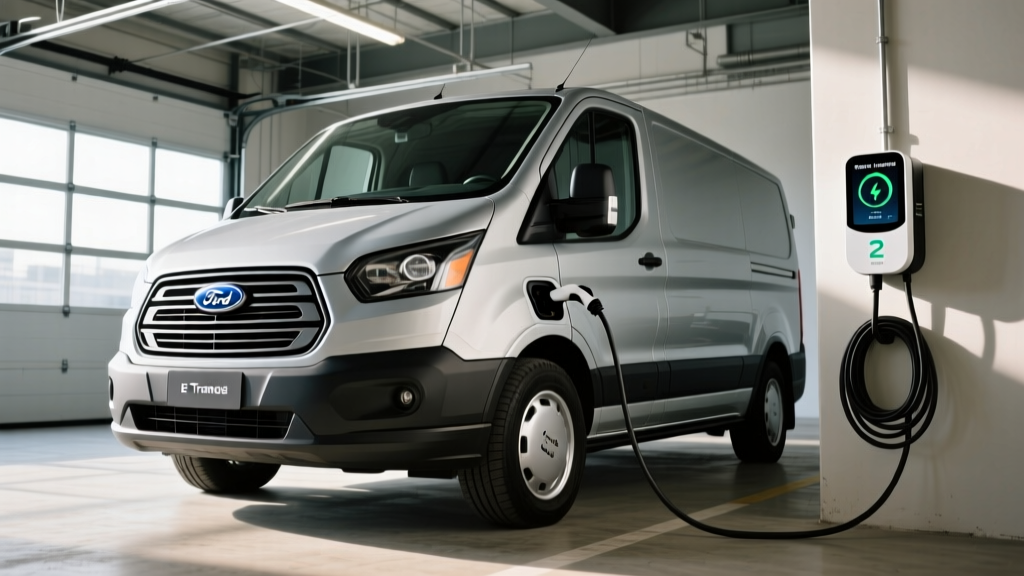
| Level 2 (Home/Depot) | 10.5 kW (max onboard) | 240V / 48A | ~23–28 miles/hr | Overnight depot charging — full charge in ~8 hours |
| DC Fast Charging | Up to 115 kW peak | 400V+ DC direct | ~130–180 miles/hr (at peak) | Mid-route top-ups — 15–80% in ~45 min |
Level 1 charging is functionally useless for fleet operations. At 3–5 miles of range per hour, a full recharge takes over 20 hours — impractical for any daily-use commercial vehicle. Every E-Transit fleet operator should plan around Level 2 depot charging as the backbone, with DC fast charging available for mid-day top-ups on longer routes.
The E-Transit's onboard charger caps at 10.5 kW, meaning even if you install a 19.2 kW Level 2 station, the van will only draw 10.5 kW. Do not overspend on higher-output Level 2 equipment unless you are also charging other EVs with faster onboard chargers at the same depot.
On DC fast charging, the E-Transit peaks at 115 kW but does not sustain that rate for the entire session. Like all EVs, the charge curve tapers significantly above 80% state of charge to protect battery health. Expect the 15–80% session to take roughly 45 minutes, but pushing from 80–100% on DC fast charging can add another 25–30 minutes — it is almost always faster and cheaper to unplug at 80% and return to your depot Level 2 charger.
Home and Depot Charger Installation: Electrical Requirements and Costs
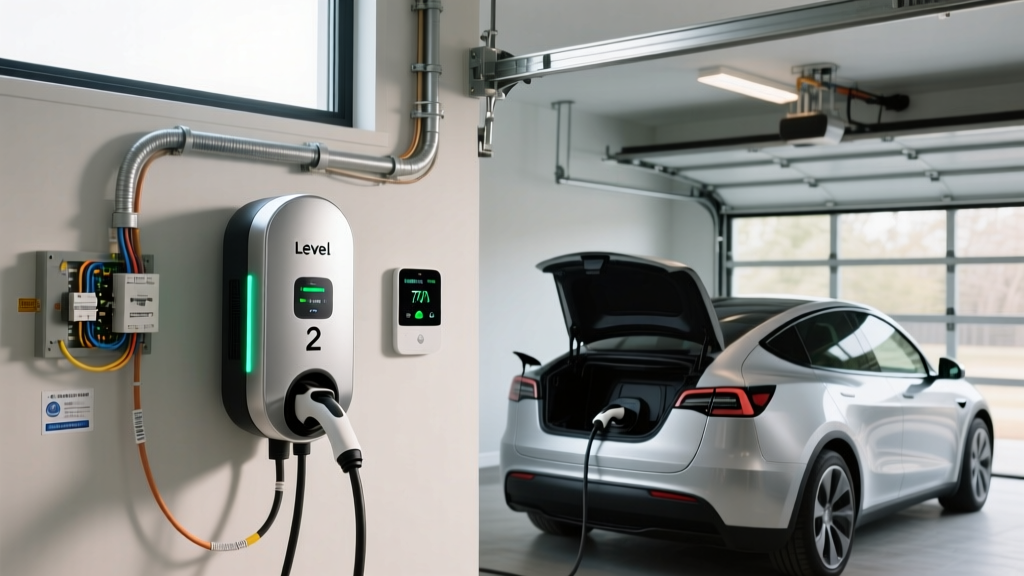
Installing a Level 2 charger at a home garage or fleet depot requires a dedicated 240-volt circuit. For the E-Transit's 10.5 kW onboard charger, you need a 240V / 60-amp circuit (which delivers up to 48 amps continuous to the vehicle, per the National Electrical Code's 80% rule for continuous loads). Here is what the installation process involves:
Electrical panel capacity: Your existing panel must have enough spare capacity to add a 60-amp breaker. Many older residential panels (100-amp service) cannot support this alongside existing loads like electric ranges, dryers, and HVAC. A panel upgrade to 200-amp service is a common requirement and a major cost driver. Commercial depot installations typically have three-phase 200A+ service already, but each additional charger still requires its own dedicated breaker and may trigger a utility service upgrade.
Permitting: Virtually every jurisdiction requires an electrical permit for a new 240V circuit. The permit ensures the work is inspected and meets local code — critical for commercial properties and insurance compliance. Permit fees vary widely by municipality.
Conduit and wiring: The run from your panel to the charger location requires appropriately gauged copper wire (typically 6 AWG for a 60A circuit) in conduit if run outdoors or through unfinished spaces. Longer runs increase material cost and may require thicker wire to prevent voltage drop.
| Cost Component | Typical Range | Notes |
|---|---|---|
| Level 2 Charger Equipment | $400 – $1,200 | Varies by brand, power output, smart features |
| Electrician Labor | $600 – $2,500 | Depends on run length, conduit, wall penetration |
| Electrical Permit | $50 – $300 | Varies by municipality |
| Panel Upgrade (if needed) | $1,500 – $4,000 | 100A to 200A upgrade; not always required |
| Utility Service Upgrade (if needed) | $2,000 – $8,000+ | Rare for residential; possible for multi-charger depot |
| Total (no panel upgrade) | $1,050 – $4,000 | Most common scenario for modern homes |
| Total (with panel upgrade) | $2,550 – $8,000 | Older homes or multi-charger commercial installs |
For fleet operators installing multiple Level 2 chargers at a depot, costs scale but can benefit from shared conduit runs, commercial electricians with EV experience, and utility demand-management programs that may offset infrastructure costs. Contact your local utility about commercial EV charging incentives — many offer rebates covering 50–100% of make-ready infrastructure costs.
Connector Compatibility: NACS, CCS, and What the E-Transit Uses
The 2025 Ford E-Transit uses the CCS1 (Combined Charging System) connector for DC fast charging and the standard J1772 connector for Level 2 AC charging. This is the same connector used by most non-Tesla EVs sold in North America through 2024. However, the industry is rapidly transitioning to the NACS (North American Charging Standard) connector — the Tesla-designed plug now adopted by Ford, GM, Rivian, and most major automakers.
Ford has confirmed that future E-Transit model years will transition to NACS, but current 2024–2025 models ship with CCS1. Here is what that means for your charging access:
| Connector Type | Use Case | E-Transit Compatibility | Adapter Needed? |
|---|---|---|---|
| J1772 | Level 2 AC charging (home, depot, public) | Native — plug and charge | No |
| CCS1 | DC fast charging (Electrify America, EVgo, public stations) | Native — plug and charge | No |
| NACS (Tesla) | Tesla Supercharger network | Not native (2024–2025 models) | Yes — CCS-to-NACS adapter (Ford-provided or third-party, ~$200–$250) |
| CHAdeMO | Legacy DC fast charging (Nissan Leaf, older stations) | Not compatible | No practical adapter exists |
The practical takeaway: if your fleet routes pass Tesla Supercharger stations (which now number over 6,000 in North America and are increasingly opening to non-Tesla vehicles), a CCS-to-NACS adapter is a worthwhile $200–$250 investment. Ford has offered a complimentary adapter to some F-150 Lightning owners; check with your Ford Pro dealer about E-Transit adapter programs.
For depot charging, CCS1/J1772 is all you need. Virtually every commercial Level 2 charger sold in North America uses J1772, so your E-Transit fleet will plug into any standard Level 2 station without adapters.
Charging Cost Per Mile: E-Transit vs. Gas Transit
The economic argument for the E-Transit hinges on fuel-cost savings. Here is how charging costs compare to gasoline for the conventional Ford Transit, broken down by charging scenario:
| Scenario | Cost per kWh or Gallon | E-Transit Cost/Mile | Gas Transit Cost/Mile (16 MPG combined) | Savings per Mile |
|---|---|---|---|---|
| Home/Depot Level 2 (off-peak utility rate) | $0.12/kWh | $0.041 | $0.219 | $0.178 |
| Home/Depot Level 2 (average residential rate) | $0.17/kWh | $0.058 | $0.219 | $0.161 |
| Public Level 2 (commercial network) | $0.30/kWh | $0.102 | $0.219 | $0.117 |
| DC Fast Charging (public network) | $0.42/kWh | $0.143 | $0.219 | $0.076 |
Calculations based on E-Transit efficiency of ~2.9 kWh/mile (EPA combined) and gas Transit at 16 MPG combined with $3.50/gallon regular. Actual rates vary by utility, region, and time-of-use plan. Source: fueleconomy.gov.
At depot rates ($0.12/kWh off-peak), the E-Transit costs roughly $0.04 per mile to "fuel" versus $0.22 per mile for the gas Transit. Over a 25,000-mile/year fleet vehicle, that is roughly $4,450 in annual fuel savings per van. Over five years, that nearly closes the E-Transit's higher purchase price — before factoring in reduced maintenance (no oil changes, no transmission fluid, significantly less brake wear from regenerative braking).
The key insight: depot charging is where the economics work. Relying on public DC fast charging at $0.42/kWh erodes the savings dramatically. Fleet operators should treat DC fast charging as a mid-route supplement, not the primary fueling strategy.
Recommended Level 2 Chargers for E-Transit Fleet and Home Use
Since the E-Transit's onboard charger caps at 10.5 kW (48A), you want a Level 2 station that delivers at least 48 amps on a 60-amp circuit. Here are proven units suited for E-Transit charging:
ChargePoint Home Flex
Power Output: Up to 12 kW (50A) — adjustable down to match circuit
Connector: J1772 (NACS version available)
Cable Length: 23 feet
Smart Features: Wi-Fi, app scheduling, energy tracking, Alexa integration
Price: ~$699
Best For: Single-van home-based operators who want scheduling and energy monitoring via app
Grizzl-E Smart
Power Output: Up to 10 kW (40A) on a 50A circuit
Connector: J1772
Cable Length: 24 feet
Smart Features: OCPP-compatible, works with fleet management platforms, outdoor-rated (NEMA 4)
Price: ~$549
Best For: Outdoor depot installations in harsh climates; built in Canada for extreme cold
Emporia Vue Level 2 Charger
Power Output: Up to 11.5 kW (48A)
Connector: J1772
Cable Length: 24 feet
Smart Features: Integrates with Emporia energy monitoring for whole-panel visibility, solar-aware charging
Price: ~$399
Best For: Budget-conscious operators who want energy monitoring without a subscription
Ford Connected Charge Station
Power Output: Up to 10.5 kW (48A)
Connector: J1772
Cable Length: 25 feet
Smart Features: Deep integration with FordPass app, scheduled charging, vehicle-specific optimization
Price: ~$799 (often discounted through Ford Pro)
Best For: Fleet operators already in the Ford Pro ecosystem who want seamless telematics integration
For multi-van fleet depots, consider networked commercial chargers like the ChargePoint CT4000 or ABB Terra AC series, which offer RFID access control, load management across multiple units, and fleet-telematics integration. These typically cost $2,500–$5,000 per unit before installation but are purpose-built for commercial duty cycles.
Safety, Code, and Installation Best Practices
EV charger installation is electrical work that must comply with the National Electrical Code (NEC Article 625) and your local jurisdiction's amendments. Key requirements:
- Dedicated circuit: Your Level 2 charger must be on its own dedicated breaker — not shared with other appliances. A 60-amp breaker for a 48A continuous load is the correct sizing for the E-Transit.
- GFCI protection: NEC 2020 and later requires GFCI (ground-fault circuit interrupter) protection for all EV charging outlets. Hardwired chargers with built-in GFCI protection satisfy this; plug-in units on NEMA 14-50 receptacles require a GFCI breaker, which adds $50–$100 to the panel cost.
- Outdoor rating: If your charger is installed outdoors, it must carry at minimum a NEMA 4 (weather-resistant) rating. NEMA 4X adds corrosion resistance for coastal or salted-road environments.
- Cable management: For commercial depot installations, OSHA and local fire codes may require cable retraction systems or bollard protection to prevent trip hazards and vehicle damage to the charger.
- Ventilation: The E-Transit's NMC battery does not require ventilated charging spaces (unlike lead-acid batteries), but the charger unit itself generates heat. Install in a location with adequate airflow and avoid direct afternoon sun exposure on the unit.
Always hire a licensed electrician experienced with EV charger installations. Ask for a load calculation on your panel before committing to equipment — this $150–$300 upfront assessment can save you from a surprise $3,000 panel upgrade. The National Fire Protection Association publishes the NEC reference that governs EV charging installations.
Is the E-Transit's Range Enough? A Practical Decision Framework
Choose the E-Transit if:
- Your daily routes total under 100 miles round-trip (leaving a 20% buffer for traffic, detours, and climate load)
- You have depot or home charging available overnight at off-peak utility rates
- Your operation is urban/suburban with frequent stops (regenerative braking extends real-world range)
- You want to eliminate per-van fuel spend ($4,000–$5,000/year savings at depot rates)
- Your municipality or utility offers commercial EV infrastructure rebates
Stick with the Gas Transit if:
- Your daily routes regularly exceed 130+ miles with no mid-day charging opportunity
- You operate in extreme cold climates (sustained sub-20°F) where range loss exceeds 30%
- You lack access to overnight depot charging and would rely entirely on public DC fast charging
- Your routes include long highway segments at sustained 70+ mph speeds (major range penalty)
- You need to tow — the E-Transit is not rated for significant towing
The E-Transit's 126-mile EPA range is tight compared to consumer EVs, but it aligns with data from Ford Pro showing that the average commercial van in urban delivery service drives 74 miles per day. If your fleet's telematics data confirms your daily mileage falls under 100 miles, the E-Transit is a compelling economic proposition — especially as commercial electricity rates remain far more stable than gasoline prices.
Frequently Asked Questions
How much does it cost to install a home EV charger for the E-Transit?
For a standard Level 2 installation on an existing 200-amp panel with a short conduit run, expect $1,050–$4,000 all-in (equipment, electrician, permit). If your home has an older 100-amp panel that needs upgrading to 200A, add $1,500–$4,000. Commercial depot installations vary more widely based on the number of chargers and existing electrical infrastructure.
How fast will each charging level add range to the E-Transit?
Level 1 (120V outlet): approximately 3–5 miles per hour. Level 2 (240V, 48A): approximately 23–28 miles per hour. DC fast charging (at peak 115 kW): approximately 130–180 miles per hour, though this rate tapers above 80% state of charge.
Which connector does the E-Transit use, and will it work at Tesla Superchargers?
The 2024–2025 E-Transit uses CCS1 for DC fast charging and J1772 for Level 2. It is not natively compatible with Tesla NACS Superchargers, but a CCS-to-NACS adapter (~$200–$250) enables access. Future model years are expected to ship with NACS natively.
How much does charging the E-Transit cost per mile versus gas?
At depot off-peak rates ($0.12/kWh), the E-Transit costs roughly $0.04 per mile versus $0.22 per mile for a gas Transit at 16 MPG and $3.50/gallon. That is approximately $4,450 in annual fuel savings per van driven 25,000 miles. Public DC fast charging ($0.42/kWh) narrows the gap to $0.14 per mile.
What electrical upgrades might I need for a depot charger?
The most common upgrade is a panel capacity increase from 100A to 200A service ($1,500–$4,000). For multi-charger depots, you may need a utility service upgrade ($2,000–$8,000+), additional subpanels, and load-management hardware that staggers charging across vehicles to avoid peak-demand charges. A licensed electrician's load calculation will determine your exact requirements.
For the latest E-Transit specifications, consult the official Ford Pro E-Transit page. For federal commercial EV tax credit details (up to $40,000 under IRC §45W for commercial vehicles), review current guidance at IRS.gov. Eligibility depends on vehicle weight, battery sourcing, and your business's tax liability — consult a tax professional for your specific situation.