If you own or are shopping for a Ford EV—whether it's the F-150 Lightning, Mustang Mach-E, or the E-Transit commercial van—you've likely encountered the term "Ford charging network" and wondered what it actually covers. The answer in 2026 is a layered ecosystem: Ford's BlueOval Charge Network aggregates access to tens of thousands of public chargers across multiple providers, while Ford's physical charging hardware spans home Level 2 units and DC fast-charging partnerships. This guide breaks down every layer of the Ford charging network with the exact numbers, costs, and equipment specs you need to plan your charging strategy.
What the Ford Charging Network Actually Includes
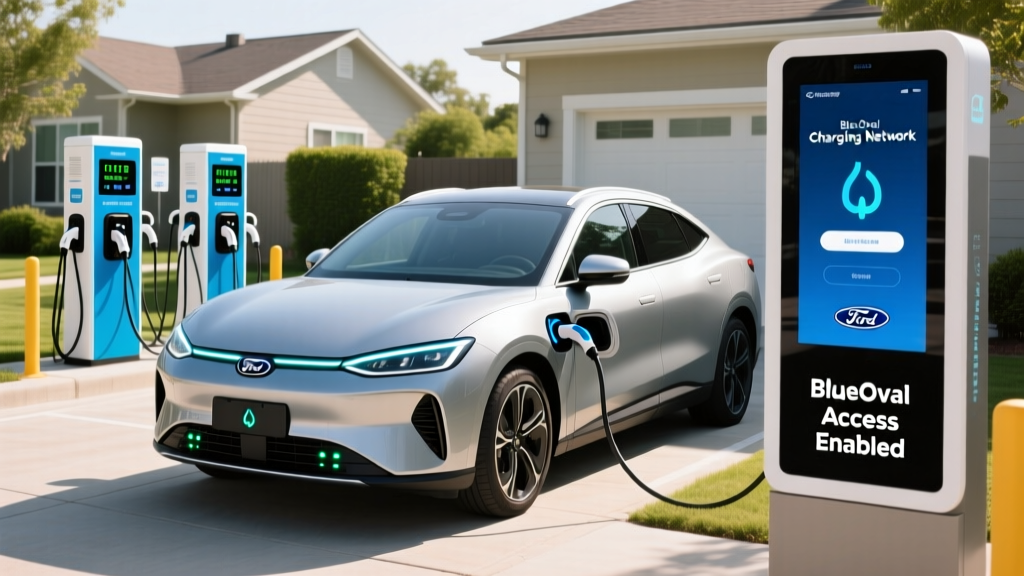
The Ford BlueOval Charge Network isn't a single branded charging station network like Tesla's Superchargers. Instead, it's an aggregated access platform that connects Ford EV owners to over 100,000 public chargers across North America through the FordPass app. Partner networks include Electrify America, EVgo, ChargePoint, Shell Recharge, and others. Ford also provides the BlueOval Home Charge Station for Level 2 home charging and, critically for 2026, native NACS (Tesla) charging-port access on new models plus adapters for older vehicles.
The practical result: a Ford EV owner can use one app to find, activate, and pay for sessions on most major public networks, while also managing scheduled home charging. Let's break down each tier of the system.
Charging Levels Explained: Speeds, Power, and Real-World Range Added
Before mapping the Ford charging network's capabilities, here's a precise look at what each charging level delivers. Remember: kW (kilowatts) measures power—the rate at which electricity flows into your vehicle. kWh (kilowatt-hours) measures energy—the total capacity of your battery. A 100 kWh battery charged at 10 kW takes roughly 10 hours from empty to full (minus charging-curve taper near the top).
| Level | Voltage / Amperage | Power (kW) | Miles of Range per Hour | Typical Use Case |
|---|---|---|---|---|
| Level 1 | 120V / 12A | ~1.4 kW | 3–5 mi/hr | Overnight top-off, PHEVs, emergencies |
| Level 2 (Home/Public) | 240V / 32–48A | 7.7–11.5 kW | 25–40 mi/hr | Daily home charging, workplace, destination |
| DC Fast Charge | 400–800V DC | 50–350 kW | 150–1,200+ mi/hr (peak) | Road trips, rapid top-ups |
For context, the 2026 Ford Mustang Mach-E (Extended Range, 91 kWh usable battery) gains roughly 30 miles of range per hour on an 11.5 kW Level 2 home charger, taking about 8 hours from 10% to 90%. On a 150 kW DC fast charger, that same battery reaches 10–80% in approximately 35–40 minutes, though charging speed tapers significantly above 80% State of Charge (SoC) due to battery-protection protocols.
Public Charging Through the BlueOval Network
The BlueOval Charge Network's core value proposition is unified access. Through the FordPass app, you can:
- Locate chargers across Electrify America, EVgo, ChargePoint, Shell Recharge, and regional providers
- Filter by connector type (CCS1 or NACS), power output, and availability
- Activate sessions and pay through a single FordPass account
- Track charging history and costs in one dashboard
Tesla Supercharger access became a defining feature of the Ford charging network starting in 2024. Ford EVs with the NACS charge port (standard on 2025+ Mustang Mach-E and F-150 Lightning models) can charge natively at Tesla Superchargers. Owners of 2021–2024 Ford EVs equipped with CCS1 ports can use Ford's official Fast Charging Adapter (approximately $230) to access Superchargers. As of 2026, Tesla's Supercharger network includes over 28,000 stalls in North America, many now equipped with the Magic Dock CCS adapter for non-Tesla vehicles.
Real-world charging cost at public DC fast chargers varies widely. Electrify America typically charges $0.43–$0.56/kWh depending on location and time of day. EVgo ranges from $0.35–$0.52/kWh. Tesla Superchargers average $0.25–$0.40/kWh for non-Tesla vehicles. For an F-150 Lightning with a 131 kWh Extended Range battery, a 10–80% session (roughly 92 kWh added) at $0.45/kWh costs about $41—comparable to filling a gas truck at current fuel prices, but delivering that energy in 35–45 minutes.
Home Charging: BlueOval Charge Station and Electrical Requirements
Home Level 2 charging is where most Ford EV owners do 80% or more of their charging. Ford's BlueOval Charge Station (manufactured in partnership with Wallbox) is the flagship home unit in the Ford charging network ecosystem.
BlueOval Charge Station Specs
- Power output: Up to 11.5 kW (240V / 48A)
- Connector: NACS (on 2025+ models) or J1772/CCS1 (on older units—check model year)
- Cable length: 25 feet
- Smart features: Wi-Fi enabled, FordPass app integration, scheduled charging, energy monitoring
- Price: Approximately $799 (hardware only, before installation)
- Indoor/outdoor rating: NEMA 4 (suitable for outdoor installation)
Electrical Requirements and Panel Considerations
A 48A Level 2 charger requires a dedicated 60-amp circuit on a 240V line (National Electrical Code requires circuits to be rated at 125% of continuous load: 48A × 1.25 = 60A). This typically uses 6 AWG copper wire run from your electrical panel to the charger location.
Panel upgrade reality check: Many older homes have 100-amp or 150-amp main service panels. Adding a 60A dedicated circuit to an already-loaded panel may require a panel upgrade to 200A service, which costs $1,500–$3,500 depending on your utility and local code requirements. Before purchasing any home charger, have a licensed electrician perform a load calculation on your existing panel.
Lower-amperage alternatives exist: a 32A charger (requiring a 40A circuit) delivers 7.7 kW and may fit panels with less headroom. The trade-off is slower charging—roughly 20–25 miles of range per hour instead of 30–35.
Home Charger Installation Cost Breakdown
The total installed cost of a home Level 2 charger depends on your electrical panel capacity, the distance from panel to charger location, and local permit fees. Here's a realistic range based on 2026 market data:
| Component | Low-End Estimate | High-End Estimate | Notes |
|---|---|---|---|
| Charger hardware (BlueOval or equivalent) | $500 | $800 | Varies by brand and power output |
| Electrician labor (standard install, <30 ft run) | $400 | $800 | Shorter runs = lower cost |
| Electrician labor (long run, >50 ft or conduit) | $800 | $1,800 | Trenching, conduit, longer wire runs |
| Electrical permit | $50 | $250 | Varies by municipality |
| Panel upgrade (if required) | $1,500 | $3,500 | 100A→200A service upgrade |
| Total (no panel upgrade) | $950 | $1,850 | Typical scenario for newer homes |
| Total (with panel upgrade) | $2,450 | $5,350 | Common in pre-1990 homes |
According to the U.S. Department of Energy, most straightforward home Level 2 installations fall in the $1,000–$2,000 range when no panel upgrade is needed. Always get at least two quotes from licensed electricians and confirm they pull the required permit—unpermitted electrical work can void your homeowner's insurance coverage.
Connector Compatibility: NACS, CCS1, and Adapter Needs
The connector landscape for Ford EVs shifted significantly between 2023 and 2026. Here's where things stand:
| Ford Model | Model Year | Built-In Port | Tesla Supercharger Access | Adapter Required? |
|---|---|---|---|---|
| Mustang Mach-E | 2021–2024 | CCS1 (J1772 combo) | Yes, via adapter | Ford Fast Charging Adapter (~$230) |
| Mustang Mach-E | 2025–2026 | NACS (native) | Yes, native | None (CCS adapter available for non-Tesla DCFC) |
| F-150 Lightning | 2022–2024 | CCS1 (J1772 combo) | Yes, via adapter | Ford Fast Charging Adapter (~$230) |
| F-150 Lightning | 2025–2026 | NACS (native) | Yes, native | None (CCS adapter available for non-Tesla DCFC) |
| E-Transit | 2022–2026 | CCS1 | Yes, via adapter | Ford Fast Charging Adapter |
Key adapter note: If you own a 2025+ Ford with a native NACS port, you may need a NACS-to-CCS adapter (such as the Lectron or A2Z adapter, ~$150–$200) to use non-Tesla DC fast chargers that still use CCS1 connectors. Electrify America and EVgo are gradually adding NACS cables to new stations, but CCS1 remains widespread at existing installations through 2026.
Cost to Charge: Per-Mile Comparison with Gas
The economics of EV charging depend heavily on where and when you charge. Here's a data-driven comparison for a 2026 Ford F-150 Lightning (Extended Range, EPA-estimated 320 miles, ~2.0 kWh/mile efficiency in mixed driving):
| Charging Scenario | Rate ($/kWh) | Cost per Mile | Full "Tank" Cost (0–100%) |
|---|---|---|---|
| Home (off-peak utility rate) | $0.09–$0.14 | $0.018–$0.028 | $12–$18 |
| Home (standard residential rate) | $0.15–$0.20 | $0.030–$0.040 | $20–$26 |
| Public Level 2 (ChargePoint, etc.) | $0.25–$0.39 | $0.050–$0.078 | $33–$51 |
| DC Fast Charge (Electrify America) | $0.43–$0.56 | $0.086–$0.112 | $56–$73 |
| Tesla Supercharger (non-Tesla rate) | $0.25–$0.40 | $0.050–$0.080 | $33–$52 |
Gas comparison baseline: A 2026 Ford F-150 with the 3.5L EcoBoost V6 averages approximately 20 MPG combined (source: EPA fueleconomy.gov). At $3.40/gallon, that's $0.17 per mile. Even at public DC fast-charging rates, the Lightning costs less per mile. At home off-peak rates, the EV costs roughly 85% less per mile to "fuel."
For a driver covering 12,000 miles per year with 80% home charging at $0.13/kWh and 20% public DCFC at $0.48/kWh, annual charging cost is approximately $1,440—compared to $2,040 for the gas F-150. That's roughly $600 in annual fuel savings, though actual savings vary by local electricity rates, driving patterns, and gas prices.
Recommended Home Charging Equipment for Ford EVs
Beyond Ford's own BlueOval Charge Station, several third-party chargers work seamlessly with Ford EVs and offer competitive features:
Ford BlueOval Charge Station
- Power: 11.5 kW (48A / 240V)
- Connector: NACS (2025+ units) or J1772
- Cable length: 25 ft
- Smart features: FordPass integration, scheduling, energy dashboard
- Price: ~$799
- Best for: Ford EV owners wanting seamless app integration
ChargePoint Home Flex
- Power: Up to 12 kW (50A / 240V, adjustable down to 16A)
- Connector: J1772 (NACS adapter available) or NACS (newer units)
- Cable length: 23 ft
- Smart features: ChargePoint app, Alexa, flexible amperage settings
- Price: ~$649
- Best for: Multi-EV households, adjustable amperage for panel-limited homes
Wallbox Pulsar Plus
- Power: Up to 11.5 kW (48A / 240V)
- Connector: J1772 or NACS
- Cable length: 25 ft
- Smart features: myWallbox app, load balancing, solar integration
- Price: ~$599
- Best for: Budget-conscious buyers wanting full smart features
Emporia Level 2 EV Charger
- Power: Up to 11.5 kW (48A / 240V)
- Connector: J1772
- Cable length: 24 ft
- Smart features: Emporia app, whole-home energy monitoring integration
- Price: ~$399
- Best for: Lowest-cost smart charger; pairs with Emporia Vue home energy monitor
All of these units are hardwired or NEMA 14-50 plug-in compatible. Hardwired installations are generally preferred for 48A+ chargers because NEMA 14-50 receptacles are rated for 50A but not all installations deliver consistent contact at sustained 48A draws—hardwiring eliminates that variable and is required by code in some jurisdictions for 60A circuits.
Charging Time Examples for Common Ford Battery Sizes
How long does it actually take to charge a Ford EV? These estimates assume typical charging-curve behavior, where peak kW is sustained only between approximately 10–60% SoC and tapers progressively above 80%.
| Vehicle | Battery (kWh usable) | Level 2 (11.5 kW) | DC Fast (150 kW peak) | DC Fast (350 kW peak)* |
|---|---|---|---|---|
| Mustang Mach-E (Standard Range) | 70 kWh | ~4.5 hours | ~30 min | N/A (vehicle caps ~150 kW) |
| Mustang Mach-E (Extended Range) | 91 kWh | ~5.5 hours | ~38 min | N/A (vehicle caps ~150 kW) |
| F-150 Lightning (Standard Range) | 98 kWh | ~6 hours | ~38 min | N/A (vehicle caps ~150 kW) |
| F-150 Lightning (Extended Range) | 131 kWh | ~8 hours | ~45 min | N/A (vehicle caps ~150 kW) |
*Note: Current Ford EVs are limited to approximately 150 kW peak DC fast-charge rates. Higher-power 350 kW chargers will not charge these vehicles faster. Future Ford EV platforms may support higher charge rates.
Safety, Code, and Installation Best Practices
Home EV charging involves sustained high-current electrical loads—similar to running an electric oven for 8 hours straight. Safety and code compliance are non-negotiable:
- Dedicated circuit: Your Level 2 charger must be on its own dedicated circuit—never shared with other appliances.
- GFCI protection: The 2023 National Electrical Code (NEC) requires GFCI protection for all EV charging receptacles. Hardwired units with built-in ground-fault protection satisfy this requirement in most jurisdictions.
- Outdoor rating: If your charger is mounted outdoors, it must carry at minimum a NEMA 4 rating (protection against splashing water and ice). NEMA 4X adds corrosion resistance for coastal or high-humidity environments.
- Permit and inspection: Most municipalities require an electrical permit and post-installation inspection. Skipping this risks insurance claim denial in the event of an electrical fire.
- Wire gauge: 48A continuous load on a 60A circuit requires 6 AWG copper wire minimum. Longer runs (over 50 feet) may require 4 AWG to minimize voltage drop.
Frequently Asked Questions
How much does it cost to install a home EV charger for my Ford?
A typical Level 2 home charger installation costs $950–$1,850 when your electrical panel has sufficient capacity (a 200A panel with available breaker slots). If your home requires a panel upgrade from 100A to 200A service, total cost can reach $2,450–$5,350. Always get a load calculation from a licensed electrician before committing to a charger purchase.
How fast will each charging level add range to my Ford EV?
Level 1 (120V standard outlet) adds roughly 3–5 miles per hour—suitable for PHEVs or overnight top-offs of less than 40 miles. Level 2 (240V home charger at 11.5 kW) adds 25–35 miles per hour depending on vehicle efficiency. DC fast charging at 150 kW can add 150+ miles in 15–20 minutes at peak rate, though the charge curve tapers significantly above 80% SoC.
Which connector is compatible with my Ford EV?
2025 and newer Ford Mustang Mach-E and F-150 Lightning models use the NACS (Tesla-style) connector natively. Model years 2021–2024 use CCS1 (J1772 combo). Ford sells an official NACS adapter (~$230) for older CCS1-equipped vehicles to access Tesla Superchargers. If you have a 2025+ NACS-equipped Ford, you may need a NACS-to-CCS adapter for non-Tesla DC fast chargers still using CCS1 cables.
How much does charging cost per mile compared to gas?
For a Ford F-150 Lightning averaging 2.0 kWh/mile: home charging at $0.13/kWh costs about $0.026/mile. Public DCFC at $0.48/kWh costs about $0.096/mile. A comparable gas F-150 at 20 MPG combined and $3.40/gallon costs $0.17/mile. Home charging saves roughly 85% per mile; even public DCFC is 40–45% cheaper per mile than gasoline.
What electrical upgrades might I need for a home charger?
The most common upgrade is a panel capacity increase (from 100A or 150A to 200A service), required when your existing panel cannot accommodate a new 60A breaker without exceeding safe load limits. Other potential upgrades include: replacing an outdated fuse box with a breaker panel, adding a sub-panel for a detached garage, or upgrading the utility service drop if your home's incoming service is below 200A. A licensed electrician can determine requirements with a load calculation per NEC Article 220.
Can I use the Ford BlueOval Charge Network without a Ford EV?
The BlueOval Charge Network's aggregated access through FordPass is designed for Ford and Lincoln EV owners. Non-Ford EV drivers can access the same underlying charging networks (Electrify America, EVgo, ChargePoint) through each provider's own app or through aggregator platforms like PlugShare or A Better Routeplanner.
Does the Ford F-150 Lightning support vehicle-to-home (V2H) power?
Yes. The F-150 Lightning with the Extended Range battery and the available Ford Intelligent Backup Power system (requiring the Charge Station Pro and Home Integration System, installed by a licensed electrician and Sunrun partner) can supply up to 9.6 kW of power to your home during an outage—enough to run essential circuits for approximately 3 days based on average 30 kWh/day household consumption. This is a premium feature requiring significant additional hardware and installation investment ($3,000–$5,000+ beyond the charger).
For the latest Ford EV specifications and BlueOval Charge Network coverage details, consult Ford's official EV hub or your local Ford dealer. For federal tax credit eligibility on new EV purchases and home charger installations, review current IRS guidance on clean vehicle credits (§30D) and the alternative fuel vehicle refueling property credit (§30C), which can cover up to 30% of home charger hardware and installation costs (capped at $1,000) if you meet income and census-tract eligibility requirements.