If you own or are shopping for a Ford EV — the Mustang Mach-E, F-150 Lightning, or E-Transit — you have probably encountered the term Ford Blue Oval Charging Network. It sounds like a proprietary web of chargers, but the reality is more nuanced and, frankly, more useful than a single-brand network. The Blue Oval Charging Network is Ford's aggregated access layer to more than 90,000 public charge points across North America, stitched together from third-party providers, Tesla Superchargers (via adapter), and Ford's own dealer-installed destination chargers.
This guide breaks down exactly what the Blue Oval network gives you, how fast each charging tier adds range to your Ford EV, what home Level 2 installation really costs in 2026, and how per-mile charging expenses compare to gasoline. We will also cover connector compatibility, panel upgrades, and specific equipment recommendations.
What the Ford Blue Oval Charging Network Actually Includes
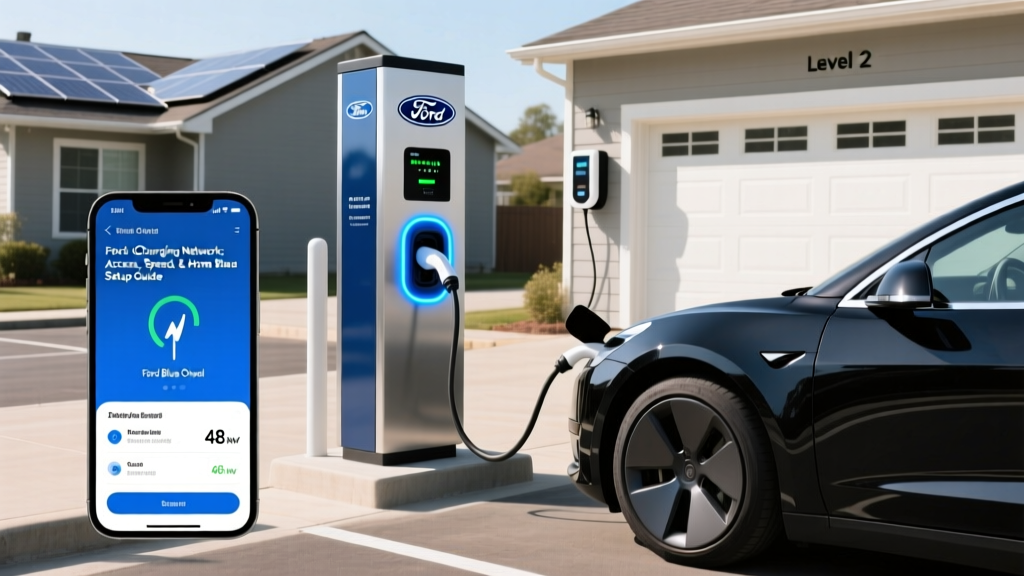
The Blue Oval Charging Network is not a physical network of Ford-branded chargers in the way Tesla Superchargers are Tesla-branded stalls. Instead, it is a roaming access and navigation layer integrated into FordPass and the SYNC infotainment system. It aggregates availability, pricing, and routing across:
- Tesla Superchargers — Ford EVs gained NACS access starting in early 2024 via a Ford-provided adapter, and 2025+ Ford EVs ship with native NACS ports. As of 2026, over 17,000 V3/V4 Supercharger stalls (250 kW peak) are accessible to Ford drivers.
- Electrify America — Ford included a complimentary charging period with early Mach-E and Lightning purchases; in 2026, standard pay-per-use applies at EA's 350 kW-capable stalls.
- EVgo, ChargePoint, and Shell Recharge — Hundreds of DC fast-charging plazas and Level 2 destination chargers are mapped and routable through FordPass.
- Ford dealer destination chargers — Select Ford dealerships have installed Level 2 (typically 19.2 kW) chargers available to customers.
The practical benefit is single-app trip planning: Ford's navigation system can route you through any of these networks, show real-time stall availability, and estimate state of charge (SoC) at arrival. You still pay each provider's rate unless you have a promotional plan.
Charging Levels Explained: Speeds, kW, and Miles Per Hour
Before we get into costs, you need the foundational distinction that trips up many new EV owners: kW (kilowatts) measures power — the rate of charging, like water pressure from a hose. kWh (kilowatt-hours) measures energy — the battery capacity, like the size of the tank. A 91 kWh battery charged at 10 kW gains roughly 10 kWh per hour (minus losses).
| Level | Voltage / Amperage | Power (kW) | Miles of Range Per Hour | Typical Use Case |
|---|---|---|---|---|
| Level 1 | 120V / 12A | ~1.4 kW | 3–5 mi/hr | Overnight trickle, emergency top-up |
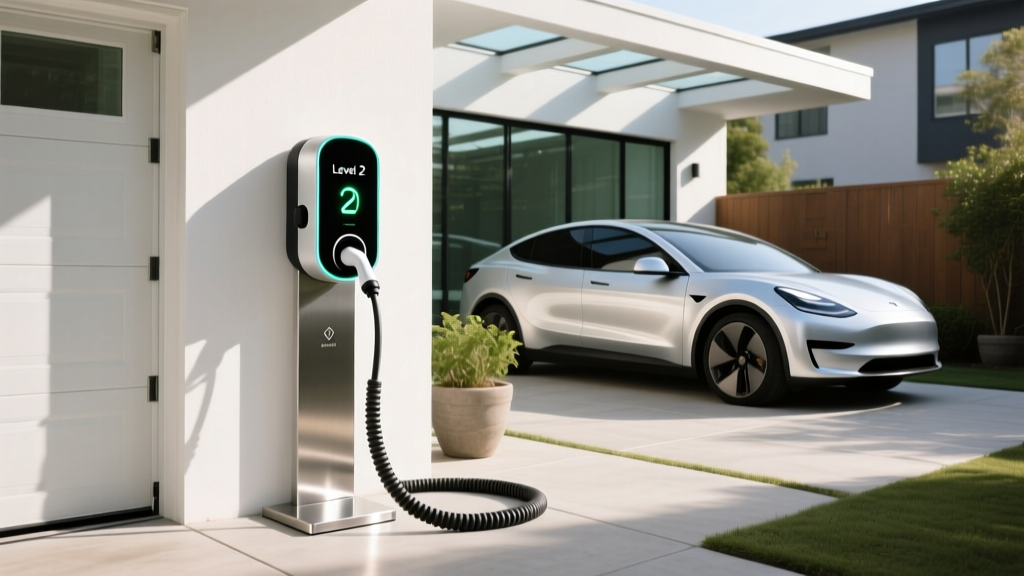
| Level 2 (standard home) | 240V / 32A | ~7.7 kW | 20–25 mi/hr | Daily home charging |
| Level 2 (high-power home/public) | 240V / 48A | ~11.5 kW | 30–38 mi/hr | Faster home fill, workplace, hotels |
| Level 2 (Ford Connected Charge Station) | 240V / 80A | ~19.2 kW | ~50 mi/hr (Mach-E) | Premium home install (requires 100A circuit) |
| DC Fast Charge (CCS / NACS) | 400V+ DC | 50–150 kW peak | 150–300+ mi in 20 min | Road trips, rapid top-up |
- Ford Mustang Mach-E Extended Range (91 kWh usable, NMC): Level 2 at 7.7 kW — 0–100% in ~12 hours. DC fast at 150 kW peak — 10–80% in ~38 minutes (charge curve tapers significantly above 80%).
- Ford F-150 Lightning Extended Range (131 kWh usable, NMC): Level 2 at 7.7 kW — 0–100% in ~17+ hours. DC fast at 150 kW peak — 10–80% in ~55 minutes. The larger battery makes high-power Level 2 (19.2 kW) far more practical for overnight fills (~7 hours).
Home Level 2 Charger Installation: Costs, Electrical Requirements, and Gotchas
Home Level 2 charging is where 80%+ of EV charging happens for most owners. It is also where costs vary the most, depending on your home's electrical panel, the distance from panel to charger location, and local permit requirements.
Electrical Requirements
A standard 32-amp Level 2 charger requires a 240V, 40-amp dedicated circuit (the National Electrical Code requires circuits rated at 125% of continuous load, so a 32A charger needs a 40A breaker). A 48-amp charger needs a 60-amp circuit. Ford's own Connected Charge Station at 80 amps requires a 100-amp circuit — feasible in newer homes with 200A service, but a potential dealbreaker in older houses.
Panel Upgrade Reality
Homes built before the 1990s often have 100A or even 60A main service panels. Adding a 40A or 60A dedicated EV circuit may push total calculated load beyond panel capacity, requiring a panel upgrade to 200A. This is the single biggest cost variable in home EV charging:
| Component | Low End | High End | Notes |
|---|---|---|---|
| Level 2 Charger (hardware) | $350 | $750 | 32A–48A smart chargers; Ford station ~$600 |
| Electrician labor (standard install) | $500 | $1,500 | Short run from panel to garage; longer runs cost more |
| Electrical permit | $50 | $250 | Varies by municipality; some bundle with inspection |
| Panel upgrade (if needed) | $1,500 | $4,000 | 100A → 200A service upgrade; not needed in most newer homes |
| Conduit/wire (long runs, 50+ ft) | $200 | $800 | Detached garages, underground runs |
| Total (no panel upgrade) | $900 | $2,500 | Most common scenario for 200A-panel homes |
| Total (with panel upgrade) | $2,400 | $6,500 | Older homes needing service upgrade |
Always get a load calculation from a licensed electrician before committing to a charger amperage. Some utilities offer rebates of $250–$750 for Level 2 installations, and a few states offer additional incentives — check your utility's EV program page and AFDC's state incentive database for current programs.
Connector Compatibility: NACS, CCS1, and What Ford EVs Use
Ford was the first major automaker to commit to Tesla's NACS (North American Charging Standard) connector, and by 2026, the transition is largely complete. Here is where each Ford EV stands:
| Vehicle | Model Years | Native Port | Tesla Supercharger Access | CCS Network Access |
|---|---|---|---|---|
| Mustang Mach-E | 2021–2024 | CCS1 | Via Ford-provided NACS adapter | Native CCS1 plug |
| Mustang Mach-E | 2025+ | NACS | Direct plug-in | Via NACS-to-CCS adapter (sold separately) |
| F-150 Lightning | 2022–2024 | CCS1 | Via Ford-provided NACS adapter | Native CCS1 plug |
| F-150 Lightning | 2025+ | NACS | Direct plug-in | Via NACS-to-CCS adapter |
What this means practically: If you buy a 2025+ Ford EV with a native NACS port, you can plug directly into any Tesla Supercharger — a massive advantage for road-trip charging reliability. However, some Electrify America and EVgo stations still have CCS-only cables, so carrying a NACS-to-CCS adapter (roughly $150–$200) is smart for the transition period.
For home Level 2 charging, NACS and CCS1 vehicles both use a J1772-to-NACS or J1772-to-CCS adapter as needed. Most Level 2 home chargers sold in 2026 come with either a J1772 connector (universal, with adapter included) or a native NACS connector.
Cost to Charge: Home vs. Public vs. Gas — The Per-Mile Math
The economic case for EV charging rests heavily on home electricity rates. Public DC fast charging, while convenient for road trips, can approach or even exceed gasoline per-mile costs in some regions. Here is the breakdown using the 2026 Mustang Mach-E Premium AWD as our baseline (EPA combined efficiency: 37 kWh/100 mi, or roughly 3.6 mi/kWh):
| Scenario | Rate | Cost Per kWh | Cost Per Mile | Annual Cost (12,000 mi) |
|---|---|---|---|---|
| Home — off-peak utility rate | $0.12/kWh | $0.12 | $0.044 | $533 |
| Home — average US residential | $0.17/kWh | $0.17 | $0.063 | $754 |
| Public Level 2 (ChargePoint, etc.) | $0.25–$0.49/kWh | $0.35 avg | $0.129 | $1,548 |
| DC Fast Charge (EA, EVgo) | $0.40–$0.65/kWh | $0.50 avg | $0.185 | $2,218 |
| Tesla Supercharger (average) | $0.28–$0.40/kWh | $0.33 avg | $0.122 | $1,466 |
| Gas SUV (25 MPG, $3.40/gal) | — | — | $0.136 | $1,632 |
For F-150 Lightning owners, the larger 131 kWh battery means higher absolute charging costs but similar per-mile figures (the Lightning achieves roughly 2.0–2.3 mi/kWh depending on configuration). A full 10–80% DC fast charge at $0.50/kWh costs approximately $46 and adds roughly 200 miles of real-world range.
Recommended Home Level 2 Chargers for Ford EVs (2026)
Based on power output, reliability, smart features, and connector compatibility with both CCS-era and NACS-era Ford EVs, here are our top picks:
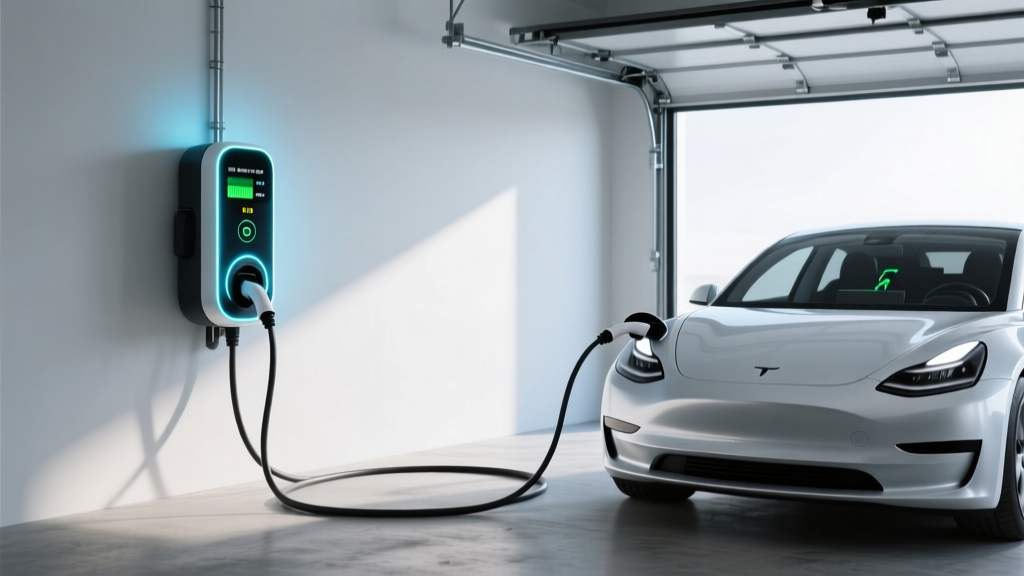
Ford Connected Charge Station
- Power: Up to 19.2 kW (80A, requires 100A circuit)
- Connector: NACS (2025+), CCS1 (earlier)
- Cable: 25 ft
- Smart features: FordPass integration, scheduled charging, energy monitoring
- Price: ~$600 (hardware)
- Best for: F-150 Lightning owners with 200A+ panels who want maximum overnight charge speed
ChargePoint Home Flex
- Power: Up to 12 kW (50A, configurable down to 16A)
- Connector: J1772 (NACS adapter included) or native NACS
- Cable: 23 ft
- Smart features: Wi-Fi, app scheduling, Alexa, flexible amperage
- Price: ~$550–$650
- Best for: Versatile install on 40A–60A circuits; works with any EV
Emporia Vue 2 Smart EV Charger
- Power: Up to 11.5 kW (48A)
- Connector: J1772 (NACS adapter available)
- Cable: 24 ft
- Smart features: Energy monitoring, solar integration, app control
- Price: ~$400–$450
- Best for: Budget-conscious buyers with solar panels; excellent energy tracking
Tesla Wall Connector (NACS)
- Power: Up to 11.5 kW (48A)
- Connector: NACS native
- Cable: 24 ft
- Smart features: Wi-Fi updates, load sharing (pair two units), power sharing
- Price: ~$475
- Best for: 2025+ NACS-equipped Ford EVs; clean install, proven reliability
Safety, Code, and Installation Best Practices
EV charging is a high-draw, continuous electrical load — the NEC classifies it as a continuous load, meaning the circuit must be rated at 125% of the charger's maximum draw. Key safety and code points:
- Dedicated circuit: Your Level 2 charger must have its own breaker — never share a circuit with other appliances.
- GFCI protection: The 2020 NEC requires GFCI protection for outdoor receptacles. Many modern EVSEs (chargers) include built-in ground fault protection, but confirm with your electrician that your installation meets local code.
- Outdoor rating: If mounting outside, ensure the charger carries a NEMA 4 or IP65 rating. All chargers recommended above are outdoor-rated.
- Hardwired vs. plug: Chargers above 40A (like the Ford Connected Charge Station at 80A) must be hardwired — there is no standard plug/receptacle rated for that amperage. For 32A–40A chargers, a NEMA 14-50 receptacle offers flexibility (you can unplug and take the charger if you move).
- Permit and inspection: Most jurisdictions require an electrical permit for new 240V circuits. Skipping this can void homeowner's insurance coverage for electrical fires and cause issues at home sale. Budget $50–$250 for the permit and schedule the inspection.
Blue Oval Network Tips for Ford EV Owners
A few practical insights from real-world use of the Blue Oval Charging Network through FordPass:
- Preconditioning matters: When navigating to a DC fast charger in Ford's SYNC system, the vehicle will precondition the battery — warming it to optimal temperature for faster charging. This can shave 5–10 minutes off a 10–80% session in cold weather. Always use built-in navigation to fast chargers rather than just driving there.
- Charging curve reality: The Mach-E Extended Range peaks at ~150 kW but sustains that rate only briefly (roughly 10–30% SoC). Above 50% SoC, the rate drops to ~80 kW, and above 80% it falls below 40 kW. This is why 10–80% times are the standard metric — charging from 80–100% can take as long as 10–80%.
- FordPass payment: You can set up payment in FordPass for seamless plug-and-charge at participating Electrify America and EVgo stations. Tesla Superchargers require either the Tesla app or Ford's integrated payment flow (available on 2025+ models with native NACS).
- Dealer chargers: Not all Ford dealers have public-access destination chargers. Use the FordPass map filter to confirm availability before relying on a dealer stop.
Frequently Asked Questions
How much does it cost to install a home EV charger for my Ford?
For a typical home with a 200-amp electrical panel, expect $900–$2,500 total (charger hardware + electrician labor + permit). If your home needs a panel upgrade from 100A to 200A service, add $1,500–$4,000. Always get a load calculation from a licensed electrician first.
How fast will each charging level add range to my Mach-E or F-150 Lightning?
Level 1 (120V) adds 3–5 miles per hour — essentially overnight trickle charging. Level 2 at 7.7 kW (32A) adds 20–25 miles per hour, sufficient for most daily driving. Level 2 at 19.2 kW (Ford Connected Charge Station) adds ~50 miles per hour for the Mach-E. DC fast charging at 150 kW adds 10–80% in ~38 minutes for the Mach-E and ~55 minutes for the Lightning Extended Range.
Which connector does my Ford EV use?
2021–2024 Mach-E and Lightning models have CCS1 ports and need a Ford-provided NACS adapter to use Tesla Superchargers. 2025 and newer Ford EVs have native NACS ports and plug directly into Superchargers but may need a NACS-to-CCS adapter for some Electrify America or EVgo stations still equipped with CCS-only cables.
How much does charging cost per mile vs. gas?
Home charging at $0.12/kWh (off-peak) costs roughly $0.044 per mile in a Mach-E — about one-third the cost of a 25 MPG gas SUV at $3.40/gallon ($0.136/mi). Public DC fast charging at $0.50/kWh costs $0.185/mile — actually more than the gas SUV. The savings depend on home charging access.
What electrical upgrades might I need for a Level 2 charger?
A standard 32A charger needs a 240V/40A dedicated circuit. If your panel is already 200A with spare capacity, no upgrade is needed. If you have a 100A panel or your existing loads are near capacity, you may need a 200A service upgrade ($1,500–$4,000). A licensed electrician can perform a load calculation to determine this before you buy equipment.
Sources: fueleconomy.gov for EPA efficiency ratings; Ford Motor Company for Blue Oval Charging Network and vehicle specifications; AFDC for state incentive data.