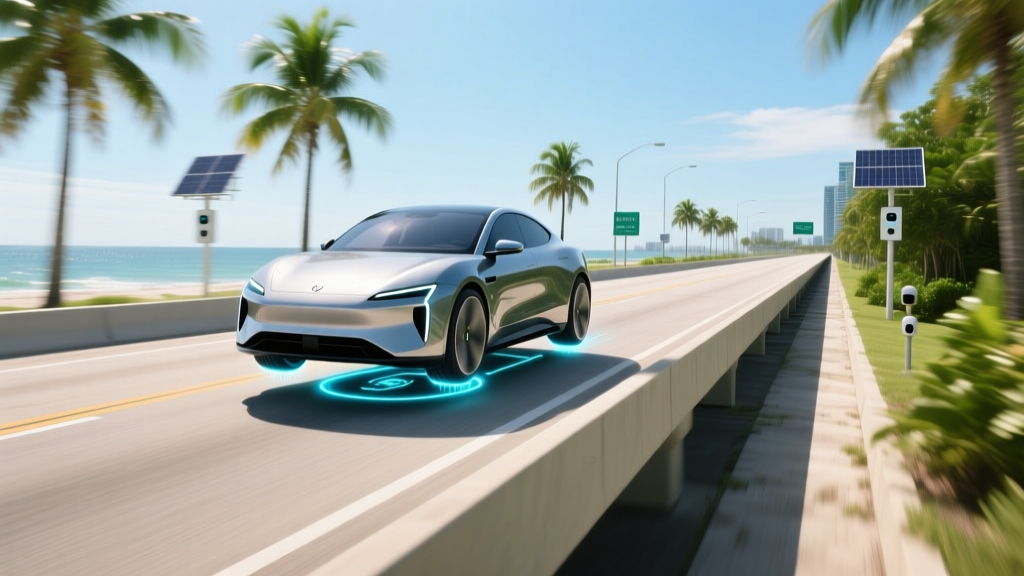
Florida's Department of Transportation is advancing plans for an inductive charging highway — embedding wireless charging coils directly into road surfaces so electric vehicles can top up while driving. If realized at scale, the technology could reshape how we think about EV range, battery sizing, and public charging infrastructure. But before you picture never plugging in again, it's worth understanding what this technology actually delivers today, where the Florida project stands, and how it fits alongside the Level 1, Level 2, and DC fast charging you rely on right now.
What Is Inductive Highway Charging and How Does It Work?
Inductive (wireless) charging uses electromagnetic fields to transfer energy between a transmitter coil embedded in the pavement and a receiver coil mounted on the underside of a vehicle. No physical plug is required. The concept has been tested in controlled environments for over a decade — companies like Qualcomm Halo (later acquired by WiTricity) demonstrated the physics as early as 2015, and pilot programs have run in Sweden, South Korea, and Germany.
Florida's project, part of a broader push to electrify its transportation corridors, aims to test dynamic wireless power transfer (DWPT) — charging vehicles in motion at highway speeds, not just while parked. The target power levels for highway applications are typically 50 to 200 kW per segment, though sustained delivery to a moving vehicle at 65+ mph introduces enormous engineering challenges in alignment, thermal management, and grid capacity.
Reality check: As of 2026, no public highway in the United States offers continuous inductive charging for consumer vehicles. Florida's project is in the pilot/testing phase. Even when operational, vehicles will need factory-installed or retrofitted receiver coils — standard EVs cannot use inductive roads today.
How Inductive Charging Fits Into the Broader EV Charging Landscape
Wireless highway charging is a long-term infrastructure play. For now — and for the foreseeable future — your daily charging will rely on three established levels. Understanding each level's speed in kilowatts (kW, the rate of power delivery) and the energy it adds in kilowatt-hours (kWh, the battery capacity) is essential.
| Level | Voltage | Max Power (kW) | Miles of Range per Hour | Typical Use Case |
|---|---|---|---|---|
| Level 1 | 120V AC | 1.4–1.9 kW | 3–5 mi/hr | Overnight trickle (PHEVs, low-mileage drivers) |
| Level 2 | 240V AC | 7.2–19.2 kW | 20–60 mi/hr | Home, workplace, retail destinations |
| DC Fast Charge | 400–900V DC | 50–350 kW | 150–800+ mi/hr (peak) | Highway corridors, road trips |
| Inductive (Dynamic) | N/A (wireless) | 50–200 kW (target) | Theoretical: continuous at speed | Future highway corridors (pilot phase) |
A key nuance: DC fast charging speeds are peak rates, not sustained averages. A vehicle that peaks at 250 kW may only sustain that rate between 10–30% state of charge (SoC), tapering significantly above 80% to protect the battery. Real-world 10–80% charging times for common battery sizes:
- 60 kWh battery (e.g., Nissan Ariya, base Tesla Model 3): ~18–25 minutes on a 150+ kW charger
- 80 kWh battery (e.g., Hyundai Ioniq 5, Ford Mustang Mach-E Extended Range): ~20–30 minutes on a 250+ kW charger
- 100+ kWh battery (e.g., Rivian R1S, GMC Sierra EV): ~25–40 minutes on a 350 kW charger, depending on architecture (800V systems charge faster)
How Much Does It Cost to Install a Home EV Charger?
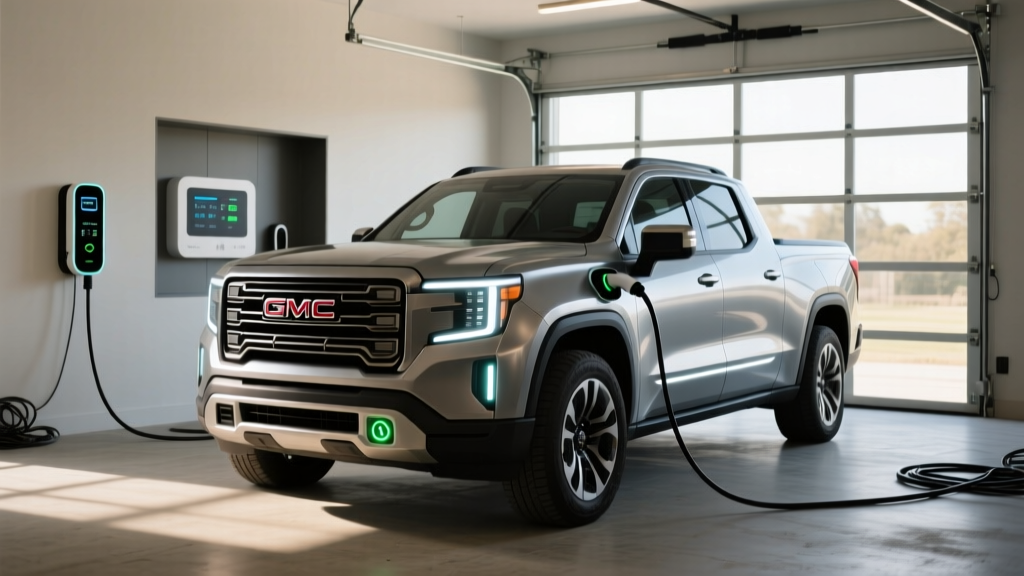
While Florida explores highway-scale wireless charging, most EV owners charge at home — and the economics strongly favor Level 2 home installation. The total cost depends on your electrical panel capacity, the distance from panel to charger location, and local permit requirements.
| Component | Low End | High End | Notes |
|---|---|---|---|
| Level 2 Charger (Equipment) | $350 | $750 | 32A–48A smart chargers; Wi-Fi enabled models cost more |
| Electrician Labor | $400 | $1,500 | Depends on run length, conduit, drywall repair |
| Permit & Inspection | $50 | $250 | Varies by municipality; some waive for EV installs |
| Panel Upgrade (if needed) | $1,500 | $4,000+ | Required if panel is 100A or near capacity; 200A service standard |
| Total (no panel upgrade) | $800 | $2,500 | Most homes with 200A service fall in this range |
| Total (with panel upgrade) | $2,300 | $6,500+ | Older homes (pre-1990s) often need this |
Panel upgrade gotcha: Many homes built before 2000 have 100-amp or 150-amp electrical service. A 48-amp Level 2 charger draws roughly 11.5 kW — that's a significant continuous load. A licensed electrician must perform a load calculation per NEC Article 220 to determine if your panel can handle the addition. If not, upgrading to 200A service adds $1,500–$4,000+ to the project, but also increases your home's resale value and supports future loads (heat pumps, solar inverters, second EV).
Electrical requirements for a typical 48A Level 2 install:
- 240V dedicated circuit with a 60-amp breaker (NEC requires continuous loads to use only 80% of breaker capacity, so 48A charger = 60A breaker)
- 6 AWG copper wire (THHN in conduit) or 4 AWG aluminum for longer runs
- NEMA 14-50 receptacle or hardwired connection (hardwired is preferred for 48A+ circuits and eliminates the GFCI breaker requirement that applies to receptacles)
- Outdoor-rated (NEMA 4) enclosure if installed outside
Connector Compatibility: NACS, CCS1, and CHAdeMO
One of the biggest shifts since 2024 is the industry-wide migration to the North American Charging Standard (NACS), originally developed by Tesla. As of the 2026 model year, nearly every major automaker — Ford, GM, Hyundai, Kia, Rivian, Volvo, BMW, and others — has adopted NACS as the native charging port on new vehicles. CCS1 (Combined Charging System) is being phased out on new models but remains on millions of EVs on the road, and CHAdeMO persists primarily on the Nissan Leaf.
| Connector | Brands Using It (New Vehicles) | DC Fast Charge Availability | Adapter Needed? |
|---|---|---|---|
| NACS (Tesla) | Tesla, Ford, GM, Hyundai, Kia, Rivian, Volvo, BMW, Mercedes, Nissan (Ariya), Subaru, Lucid | Tesla Supercharger network + growing third-party NACS stations | CCS-to-NACS adapters available (~$200–$250) for legacy CCS vehicles |
| CCS1 | Legacy models (2024 and earlier from most brands), some commercial EVs | Electrify America, EVgo, ChargePoint DC stations | NACS-to-CCS adapters for newer NACS vehicles at CCS stations |
| CHAdeMO | Nissan Leaf (discontinued), Mitsubishi Outlander PHEV (legacy) | Limited and shrinking network | No widely available adapter; CHAdeMO stations declining |
For home Level 2 charging, all vehicles use the J1772 connector (or NACS, which supports Level 2 AC via the same port on Tesla and newer NACS-equipped vehicles). Most Level 2 home chargers ship with J1772; if your EV uses NACS, you'll either buy a NACS-equipped charger or use the J1772-to-NACS adapter that ships with most new NACS vehicles.
How Much Does Charging Cost Per Mile vs. Gas?
One of the strongest arguments for EV ownership — whether you charge at home or eventually use inductive highway infrastructure — is cost per mile. The calculation depends on your electricity rate, charging scenario, and vehicle efficiency.
| Scenario | Electricity Cost ($/kWh) | Vehicle Efficiency | Cost Per Mile |
|---|---|---|---|
| Home (off-peak/utility rate) | $0.12–$0.16 | 3.5 mi/kWh (avg EV) | $0.034–$0.046 |
| Home (peak/utility rate) | $0.22–$0.30 | 3.5 mi/kWh | $0.063–$0.086 |
| Public Level 2 (network pricing) | $0.25–$0.49 | 3.5 mi/kWh | $0.071–$0.140 |
| DC Fast Charge (Electrify America, EVgo) | $0.40–$0.65 | 3.5 mi/kWh | $0.114–$0.186 |
| Gasoline vehicle (30 MPG combined) | $3.40/gal (2026 avg) | 30 MPG | $0.113 |
| Gasoline vehicle (22 MPG combined) | $3.40/gal | 22 MPG | $0.155 |
The takeaway: home off-peak charging is dramatically cheaper than gasoline — roughly 70–80% less per mile. Even DC fast charging at the highest public rates is competitive with or slightly cheaper than a 22-MPG gas vehicle. The inductive highway model, if implemented, would likely price similarly to DC fast charging — potentially $0.30–$0.55/kWh given the infrastructure costs of embedding coils in pavement and maintaining grid connections along highway corridors.
Recommended Home Level 2 Chargers for 2026
If you're installing a Level 2 charger at home, here are proven options across price and feature tiers. Each recommendation includes power output, connector, and smart features.
Emporia Vue Level 2 EV Charger
- Power: 48A (11.5 kW at 240V)
- Connector: J1772 (NACS adapter included with compatible EVs)
- Cable length: 24 ft
- Smart features: Wi-Fi, scheduling, energy monitoring via Emporia app, solar integration
- Price: ~$399
- Best for: Budget-conscious buyers who want smart scheduling and solar-aware charging
ChargePoint Home Flex
- Power: Configurable 16A–50A (up to 12 kW at 240V)
- Connector: J1772 (25 ft cable)
- Smart features: Wi-Fi, Alexa/Google Home, ChargePoint app with detailed session data, flexible amperage to match panel capacity
- Price: ~$649
- Best for: Homes with limited panel capacity (set to 32A on a 40A breaker) or those wanting the longest cable
Tesla Wall Connector
- Power: 48A (11.5 kW at 240V)
- Connector: NACS native (J1772 adapter available for non-Tesla EVs)
- Cable length: 24 ft
- Smart features: Wi-Fi, power sharing (daisy-chain up to 6 units on one circuit), OTA firmware updates
- Price: ~$475
- Best for: Tesla and NACS-equipped EV owners; multi-EV households using power sharing
Grizzl-E Smart
- Power: 40A (9.6 kW at 240V)
- Connector: J1772 (24 ft cable)
- Smart features: OCPP-compatible, works with multiple network apps, built-in overcurrent protection
- Price: ~$499
- Best for: Cold-climate durability (rated to -40°F), outdoor installs, Canadian-built quality
Safety, Electrical Code, and Installation Best Practices
EV charging is a high continuous electrical load — the National Electrical Code (NEC) treats it seriously, and so should you. Key safety and code requirements:
- Dedicated circuit: Your Level 2 charger must be on its own dedicated breaker — no sharing with other outlets or appliances.
- 80% rule: Continuous loads (defined as 3+ hours, which EV charging qualifies as) must not exceed 80% of the breaker rating. A 48A charger requires a 60A breaker. A 40A charger requires a 50A breaker.
- GFCI protection: If you install a NEMA 14-50 receptacle (rather than hardwiring), NEC 2023 and later require a GFCI breaker. Hardwired installations are exempt from this requirement, which is one reason many electricians recommend hardwiring for 48A+ circuits — GFCI breakers for 60A circuits are expensive ($150–$300) and can nuisance-trip.
- Outdoor rating: Any outdoor charger must be NEMA 4 rated (weatherproof). Most quality chargers meet this, but verify before purchasing for an exterior install.
- Permit and inspection: Most jurisdictions require an electrical permit for a new 240V circuit. The inspection ensures proper wire gauge, breaker sizing, grounding, and bonding. Do not skip this — it protects you and is required for insurance coverage of electrical fires.
- Utility notification: Some utilities require notification when adding a large load (11.5 kW qualifies). In Florida, FPL and Duke Energy both offer EV-specific time-of-use rates that can significantly reduce charging costs if you schedule charging during off-peak hours (typically 10 PM – 6 AM).
What Florida's Inductive Highway Means for the Future of EV Charging
The inductive charging highway concept addresses one of the last genuine limitations of EV ownership: long-distance travel in corridors with sparse DC fast charging. If dynamic wireless charging can deliver even 50 kW continuously at highway speeds, a vehicle consuming 25 kWh per 100 miles (a typical midsize EV) would be gaining 2 miles of range for every mile driven — effectively extending range indefinitely on equipped corridors.
But the practical hurdles are substantial:
- Vehicle compatibility: Cars need receiver coils, power electronics, and thermal management for inductive charging. No mainstream consumer EV sold in 2026 includes this hardware. The standard would need to be defined, likely by SAE International, before automakers integrate it.
- Infrastructure cost: Embedding charging coils in highway pavement requires lane closures, specialized construction, and grid connections every few miles. Cost estimates from European pilot projects suggest $1–2 million per lane-mile for installation alone.
- Efficiency losses: Wireless power transfer is typically 85–93% efficient, compared to 95–98% for a wired connection. At highway scale, those losses represent significant wasted energy and additional thermal load on pavement-embedded equipment.
- Maintenance: Road surfaces degrade, shift, and crack. Maintaining precise coil alignment under heavy truck traffic and Florida's heat and humidity is an unsolved durability challenge.
The more likely near-term outcome: Florida's pilot will validate the technology for specific applications — bus lanes, port drayage routes, and fixed commercial corridors — before expanding to general-purpose highway lanes. For consumer EV drivers, the practical charging strategy in 2026 remains home Level 2 + public DC fast charging, with the NACS connector and Tesla Supercharger network providing the most reliable road-trip experience.
Frequently Asked Questions
How much does it cost to install a home EV charger in Florida?
Expect $800–$2,500 for a standard Level 2 installation (48A, 240V) if your home has a 200-amp electrical panel with available capacity. If a panel upgrade is needed, total costs range from $2,300 to $6,500+. Florida utilities like FPL and Duke Energy may offer rebates or EV-specific time-of-use rates that offset operating costs.
How fast will each charging level add range to my EV?
Level 1 (120V) adds 3–5 miles per hour. Level 2 (240V, 48A) adds 30–45 miles per hour depending on vehicle efficiency. DC fast charging at 150–350 kW can add 150–800+ miles per hour at peak rates, but charging curves taper significantly above 80% SoC, so real-world 10–80% sessions take 18–40 minutes depending on battery size and vehicle architecture.
Which connector and charger is compatible with my EV?
For 2026 model-year vehicles, most new EVs use NACS (the Tesla connector standard). Legacy EVs (2024 and earlier) typically use CCS1, and the Nissan Leaf uses CHAdeMO. For home charging, most Level 2 chargers use J1772, and NACS-equipped vehicles include a J1772-to-NACS adapter. Check your vehicle's charge port before purchasing a home charger.
How much does charging cost per mile compared to gasoline?
Home off-peak charging costs approximately $0.03–$0.05 per mile for an average EV (3.5 mi/kWh efficiency). A comparable gasoline vehicle at 25–30 MPG costs $0.11–$0.14 per mile at $3.40/gallon. Even public DC fast charging at $0.50/kWh costs ~$0.14/mile — competitive with gasoline. Source: fueleconomy.gov efficiency data and EIA gasoline price averages.
What electrical upgrades might I need for a home EV charger?
If your home has a 100A or 150A electrical panel, you will likely need a panel upgrade to 200A service ($1,500–$4,000+). Even with a 200A panel, your electrician must perform a NEC Article 220 load calculation — if you're running electric heat, a dryer, an oven, and AC simultaneously, available capacity may be limited. Some utilities offer managed charging programs that reduce charger amperage during peak demand, which can avoid a panel upgrade.
Will Florida's inductive charging highway work with my current EV?
No. Current consumer EVs do not have the receiver coils or power electronics required for inductive charging. The Florida project is in the pilot phase, and even when operational, vehicles will need specialized hardware. For now, your charging options are Level 1, Level 2, and DC fast charging via NACS, CCS1, or CHAdeMO connectors.
Is wireless highway charging efficient compared to plugging in?
Current inductive charging systems achieve 85–93% transfer efficiency, compared to 95–98% for wired connections. At highway scale with hundreds of vehicles charging simultaneously, the 7–15% energy loss represents significant additional generation requirements. However, the convenience of charging while driving could offset the efficiency penalty if it enables smaller, lighter battery packs in future vehicles.
Sources: U.S. Department of Energy / fueleconomy.gov for vehicle efficiency data; IRS.gov for EV incentive rules; National Electrical Code (NEC) 2023 for installation requirements. Consult a licensed electrician for your specific installation and a tax professional for credit eligibility.