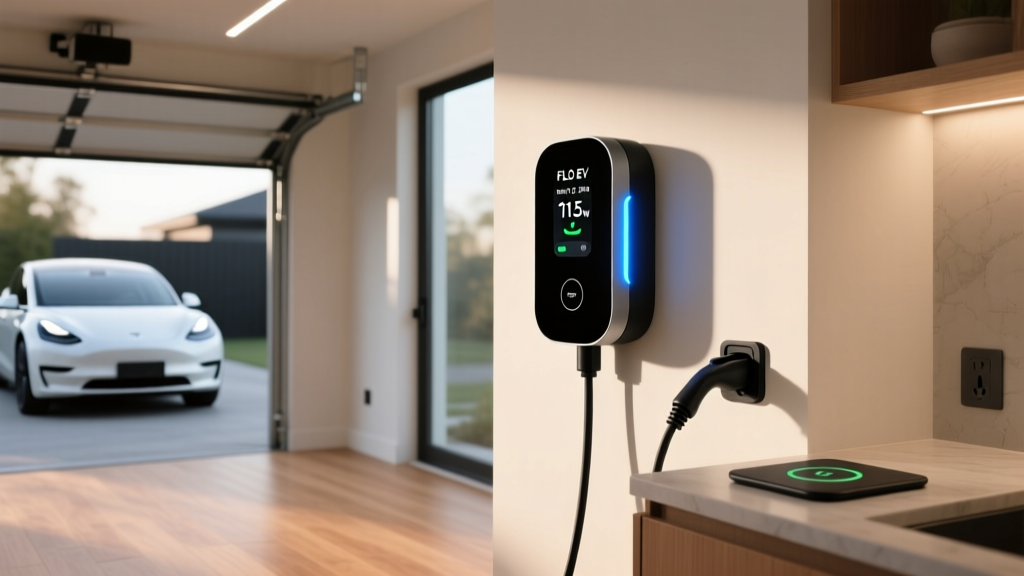
If you've searched for home Level 2 charging equipment, you've likely seen the distinctive FLO EV charging logo — green branding that has become ubiquitous across Canadian and U.S. public charging networks. FLO (owned by AddEnergie) is best known for its commercial and multi-family charging stations, but its residential lineup, anchored by the FLO CoQ D+, deserves a hard look for single-family homeowners planning a 240V garage or driveway install in 2026.
This guide covers the FLO CoQ D+ in detail — power output, connector compatibility, smart features, and pricing — while also serving as a complete home charging primer. We'll break down exactly what your electrician needs to know, what a panel upgrade might cost, and how FLO stacks up against competitors like the ChargePoint Home Flex, Tesla Wall Connector, and Emporia Vue.
FLO CoQ D+ at a Glance: Specs and Pricing
The FLO CoQ D+ is a hardwired, Wi-Fi-connected Level 2 home charger rated for up to 48 amps (11.5 kW on a 240V circuit). It ships with a 25-foot cable and is available in both J1772 (for CCS1 vehicles) and NACS (for Tesla and NACS-native vehicles like the Ford F-150 Lightning, Rivian, and 2025+ Hyundai/Kia models). Here's the spec breakdown:
| Specification | Value |
|---|---|
| Max Power Output | 11.5 kW (48A @ 240V) |
| Required Circuit | 60A dedicated breaker (NEC 80% rule) |
| Cable Length | 25 feet |
| Connector Options | J1772 or NACS |
| Wi-Fi / App | Yes — FLO app with scheduling & energy tracking |
| Indoor/Outdoor Rating | NEMA 4 (indoor and outdoor rated) |
| Energy Star Certified | Yes |
| Warranty | 3 years |
| MSRP (2026) | $599 (J1772) / $649 (NACS) |
At $599–$649, the CoQ D+ sits in the mid-range for premium smart chargers. The Tesla Wall Connector undercuts it at $420, while the ChargePoint Home Flex lands at a similar $549–$599 price point. The FLO's differentiator is build quality — the enclosure is aluminum with a polycarbonate face, and the cable management reel is integrated rather than an add-on hook.
Understanding Charging Levels: kW, Speeds, and Real-World Times
Before evaluating any home charger, you need clarity on the three EV charging levels. The critical distinction: kW (kilowatts) measures power — how fast energy flows into your battery. kWh (kilowatt-hours) measures energy — the total capacity of your battery. Think of kW as the width of a hose and kWh as the size of the bucket.
| Level | Voltage | Max kW | Miles of Range Added Per Hour | Typical Use Case |
|---|---|---|---|---|
| Level 1 | 120V AC | 1.4–1.9 kW | 3–5 miles/hr | Overnight top-up, PHEVs, low-mileage drivers |
| Level 2 | 240V AC | 3.3–19.2 kW | 12–75 miles/hr | Home daily charging, workplace, retail |
| DC Fast Charge | 400–900V DC | 50–350 kW | 150–1,000+ miles/hr (peak) | Road trips, highway corridors |
The FLO CoQ D+ at 11.5 kW delivers roughly 35–45 miles of range per hour of charging, depending on your vehicle's efficiency. For a typical EV with a 75–85 kWh battery (e.g., Tesla Model Y, Hyundai Ioniq 5, Ford Mustang Mach-E), here's what charging times look like:
- 10% to 80% SoC: approximately 5.5–6.5 hours at sustained 11.5 kW
- 20% to 80% SoC: approximately 4.5–5 hours
- Full 0% to 100%: approximately 7–9 hours (tapering above 90%)
Level 2 charging at home doesn't follow the same taper curve you see at DC fast chargers. Because AC charging is limited by the onboard charger (not the battery's thermal state), you get a relatively flat charge rate from 10% all the way to ~95% SoC. This makes overnight Level 2 charging highly predictable — plug in at 10 PM, wake up to a full battery at 6 AM.
Home Installation: Electrical Requirements, Panel Upgrades, and Costs
The FLO CoQ D+ is a hardwired unit — it does not use a plug. This means a licensed electrician must run a dedicated 60-amp, 240V circuit from your electrical panel to the charger location. The National Electrical Code (NEC) requires the circuit breaker to be rated at 125% of the continuous load, so a 48A charger needs a 60A breaker.
What Your Electrical Panel Needs
Your home's electrical panel must have two adjacent open slots (for a double-pole 60A breaker) and sufficient remaining capacity. Most modern 200A panels can accommodate a 60A EV circuit without issue. However, older homes with 100A service or panels already near capacity (electric range, dryer, HVAC, water heater all on 240V circuits) may require a panel upgrade to 200A — a significant added cost.
To determine your panel's headroom, an electrician will perform a load calculation per NEC Article 220. If your calculated load exceeds 80% of your panel's rating with the EV charger added, you'll need either a panel upgrade or a smart load-management device like the Emporia Smart Load Center, which dynamically throttles charger amperage when other heavy loads activate.
| Item | Low Estimate | High Estimate | Notes |
|---|---|---|---|
| FLO CoQ D+ charger unit | $599 | $649 | J1772 vs. NACS model |
| Electrician labor (run 60A circuit, mount unit) | $400 | $1,200 | Depends on run length, wall type, conduit |
| Electrical permit | $50 | $250 | Varies by municipality |
| Wire, conduit, breaker, misc. materials | $100 | $400 | Longer runs = more 6 AWG copper |
| Panel upgrade (if needed) | $1,500 | $4,000 | 100A → 200A; not always required |
| Total (no panel upgrade) | $1,149 | $2,499 | |
| Total (with panel upgrade) | $2,649 | $6,499 |
These ranges reflect national averages from HomeAdvisor's 2025–2026 EV charger installation data. Coastal metro areas (SF, LA, NYC) trend toward the high end; Midwest and Southern markets trend lower. Always get at least two quotes and confirm your electrician pulls a permit — unpermitted work can void homeowner's insurance claims.
Safety and Code Considerations
The FLO CoQ D+ is NEMA 4 rated, meaning it withstands rain, snow, and hose-directed water for outdoor installations. Key code requirements to verify with your electrician:
- Dedicated circuit: The 60A breaker must serve only the EV charger — no shared loads.
- GFCI protection: NEC 2023 and later require GFCI protection for all EV supply equipment. Hardwired units like the CoQ D+ typically use a GFCI breaker in the panel rather than a plug-in GFCI receptacle.
- Cable management: NEC 511.8 requires the charging cable not to cross a pedestrian walkway when not in use. The CoQ D+'s integrated cable reel helps meet this requirement.
- Disconnect: Some jurisdictions require a visible disconnect switch within sight of the charger for emergency shutoff.
Connector Compatibility: NACS, CCS1, CHAdeMO, and Adapters
The North American EV connector landscape has consolidated significantly since Tesla opened its Supercharger network and the NACS (North American Charging Standard, SAE J3400) was adopted by nearly every major automaker. As of 2026, here's where things stand:
| Connector | Brands Using It (2026) | Adapter Needed for FLO CoQ D+? |
|---|---|---|
| NACS (J3400) | Tesla, Ford, Rivian, GM, Hyundai, Kia, Volvo, Polestar, Nissan (Ariya+), Fisker | Buy the NACS model directly — no adapter |
| J1772 / CCS1 | VW, BMW, Mini, Toyota (bZ4X), Subaru (Solterra), some legacy models | Buy the J1772 model; CCS1 vehicles use J1772 for AC charging |
| CHAdeMO | Nissan Leaf (legacy), Mitsubishi Outlander PHEV | J1772 model; CHAdeMO is DC-only and irrelevant for home AC charging |
For AC Level 2 home charging, the relevant connectors are J1772 and NACS. CCS1 and CHAdeMO are DC fast-charging connectors and don't apply to your home setup. If you own a CCS1 vehicle (e.g., VW ID.4, BMW i4) and want to buy the NACS version of the CoQ D+ for future-proofing, FLO and third-party manufacturers sell NACS-to-J1772 adapters in the $100–$180 range. However, buying the correct connector natively is the cleaner solution.
Per the U.S. Department of Energy's AFDC, NACS is now the dominant AC connector for new EV sales in North America, representing over 70% of 2026 model-year EVs sold.
Cost to Charge: Home vs. Public vs. Gas per Mile
One of the strongest arguments for home Level 2 charging is economics. Let's compare the FLO CoQ D+ running on residential electricity against public charging networks and gasoline.
| Scenario | Rate | Cost per Mile (3.5 mi/kWh EV) | Annual Cost (12,000 mi) |
|---|---|---|---|
| Home Level 2 (national avg. $0.16/kWh) | $0.16/kWh | $0.046/mile | $549 |
| Home Level 2 (off-peak TOU rate $0.09/kWh) | $0.09/kWh | $0.026/mile | $309 |
| Public Level 2 (avg. $0.30/kWh) | $0.30/kWh | $0.086/mile | $1,029 |
| DC Fast Charge (avg. $0.48/kWh) | $0.48/kWh | $0.137/mile | $1,646 |
| Gasoline (25 MPG avg. @ $3.40/gal) | $3.40/gal | $0.136/mile | $1,632 |
Home charging on a time-of-use (TOU) plan is the cheapest option by a wide margin — often less than one-fifth the per-mile cost of gasoline. Even public DC fast charging is roughly cost-parity with gas at 2026 fuel prices. The FLO app supports TOU scheduling, so you can set charging to begin at 11 PM when off-peak rates kick in.
To maximize savings, contact your utility about EV-specific rate plans. Many utilities now offer dedicated EV metering or TOU rates that drop overnight electricity to $0.06–$0.10/kWh. Some utilities also offer rebates of $250–$500 for installing a smart Level 2 charger — check the AFDC state incentive database for programs in your area.
FLO CoQ D+ vs. Competitors: Equipment Comparison
The home Level 2 charger market in 2026 is competitive. Here's how the FLO CoQ D+ compares against the three most popular alternatives:
FLO CoQ D+
- Power: 11.5 kW (48A)
- Connector: J1772 or NACS
- Cable: 25 ft
- Smart features: Wi-Fi, app scheduling, energy monitoring, OTA updates
- Build: Aluminum enclosure, NEMA 4
- Warranty: 3 years
- Price: $599–$649
Tesla Wall Connector (Gen 3)
- Power: 11.5 kW (48A)
- Connector: NACS native; J1772 adapter included
- Cable: 24 ft
- Smart features: Wi-Fi, power sharing with 2nd unit, OTA updates
- Build: Polycarbonate, NEMA 3R (outdoor rated, less robust than NEMA 4)
- Warranty: 4 years
- Price: $420
ChargePoint Home Flex
- Power: Up to 12 kW (50A) — adjustable via DIP switches
- Connector: J1772 or NACS
- Cable: 23 ft
- Smart features: Wi-Fi, Alexa integration, detailed app analytics
- Build: Polycarbonate, NEMA 4
- Warranty: 3 years
- Price: $549–$599
Emporia Vue Level 2
- Power: 11.5 kW (48A)
- Connector: J1772 or NACS
- Cable: 24 ft
- Smart features: Wi-Fi, whole-home energy monitoring integration, solar-aware charging
- Build: Polycarbonate, NEMA 4
- Warranty: 3 years
- Price: $399–$449
Our take: The Tesla Wall Connector is the value leader at $420, especially for Tesla and NACS-native vehicle owners. The ChargePoint Home Flex offers the most granular app data. The Emporia Vue is the best pick if you already have an Emporia whole-home energy monitor. The FLO CoQ D+ wins on build quality and commercial-grade durability — if you want a charger that feels like it belongs in a parking garage rather than a garage wall, the aluminum enclosure and integrated cable management justify the $50–$200 premium.
Frequently Asked Questions
How much does it cost to install a home EV charger?
For a FLO CoQ D+ or equivalent 48A Level 2 charger, expect $1,149–$2,499 total (equipment + electrician + permit + materials) if your panel has sufficient capacity. If you need a panel upgrade from 100A to 200A, add $1,500–$4,000, bringing the total to $2,649–$6,499. Always get itemized quotes from licensed electricians.
How fast will each charging level add range?
Level 1 (120V) adds 3–5 miles per hour — fine for PHEVs or low-mileage BEV drivers. Level 2 (240V) at 11.5 kW adds roughly 35–45 miles per hour, fully recharging most EVs overnight. DC fast charging at 150–350 kW can add 150–1,000+ miles per hour at peak, but tapers significantly above 80% SoC.
Which connector/charger is compatible with my EV?
For 2026 models: Tesla, Ford, GM, Hyundai, Kia, Rivian, Volvo, and Nissan (new models) use NACS. VW, BMW, Toyota bZ4X, and Subaru Solterra still use J1772 for AC charging. Buy the FLO CoQ D+ in the connector your car uses natively. CHAdeMO is irrelevant for home charging — it's a DC-only connector used by older Nissan Leafs.
How much does charging cost per mile vs. gas?
Home Level 2 charging at the national average rate of $0.16/kWh costs about $0.046 per mile for a typical EV. On off-peak TOU rates, that drops to $0.026/mile. Gasoline at $3.40/gal and 25 MPG costs $0.136/mile. Home charging is 3–5× cheaper per mile than gasoline.
What electrical upgrades might I need?
The FLO CoQ D+ requires a dedicated 60A, 240V circuit. If your panel is 200A with available slots and headroom per a load calculation, no upgrade is needed. If your panel is 100A, fully loaded, or lacks two adjacent open slots, you may need a panel upgrade ($1,500–$4,000) or a smart load-management device that throttles the charger when other heavy appliances run.
Is the FLO CoQ D+ eligible for any tax credits or rebates?
The federal Alternative Fuel Vehicle Refueling Property Credit (IRS Form 8911) covers 30% of home charger equipment and installation costs, up to $1,000, but only for taxpayers in eligible census tracts (generally low-income or non-urban areas). Many state utilities and municipalities also offer $250–$500 rebates for smart Level 2 chargers — check your utility's website or the AFDC incentive database. Eligibility rules vary; consult a tax professional for your specific situation.
Can I install the FLO CoQ D+ outdoors?
Yes. The CoQ D+ carries a NEMA 4 rating, which protects against rain, snow, sleet, and hose-directed water. It's rated for outdoor wall mounting in all North American climates. Ensure your electrician uses outdoor-rated conduit and that the unit is mounted at least 18 inches above grade per NEC requirements.