Where to Charge: Mapping the EV Charging Landscape
Knowing how to find electric charging stations is the single most practical skill a new EV owner can develop. Whether you're planning a daily commute on home Level 2 power or mapping a cross-country road trip across DC fast-charging networks, the answer depends on three variables: your vehicle's connector type, your battery's acceptance rate (measured in kilowatts, or kW), and the energy you need to replenish (measured in kilowatt-hours, or kWh). Confusing kW with kWh is the most common EV literacy mistake — kW is the speed of charging (like water pressure from a hose), while kWh is the total energy stored in your battery (like the size of the tank).
As of 2026, the U.S. charging infrastructure includes over 70,000 public charging ports across networks like Tesla Supercharger, Electrify America, EVgo, and ChargePoint, according to the Alternative Fuels Data Center. But the fastest, cheapest, and most reliable "station" for most owners remains a Level 2 charger installed in their own garage.
Charging Levels Explained: Speed, Power, and Real-World Range Added
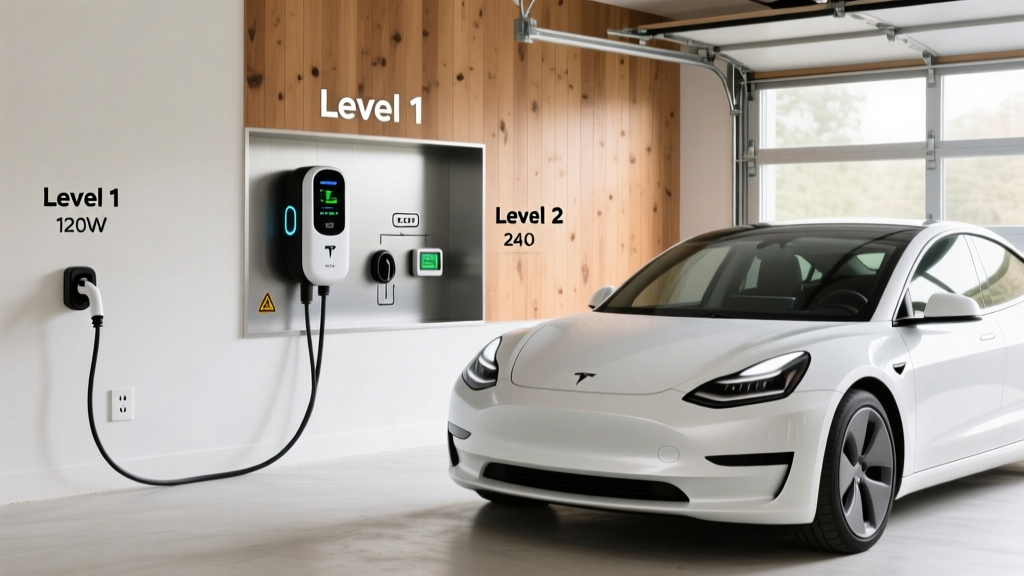
Every EV charging scenario falls into one of three levels. The table below shows typical power delivery, the approximate range added per hour of charging, and the real-world use case for each.
| Level | Voltage | Power (kW) | Miles of Range Added per Hour | Best Use Case |
|---|---|---|---|---|
| Level 1 | 120V AC | 1.0–1.9 kW | 3–5 mi/hr | Overnight top-up for PHEVs or low-mileage commuters |
| Level 2 | 240V AC | 7.2–19.2 kW | 25–70 mi/hr | Daily home charging; destination charging |
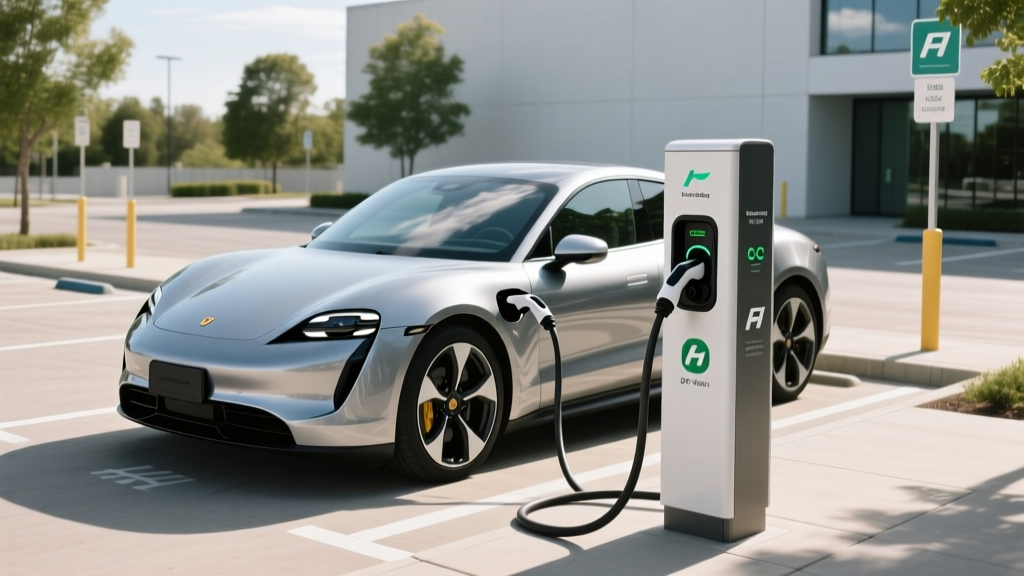
| DC Fast | 400–800V DC | 50–350 kW | 150–1,200+ mi/hr (peak) | Road trips; rapid top-ups on highways |
Real-world context: A Level 2 home charger delivering 11.5 kW (48A on a 60A circuit) will add roughly 40 miles of range per hour to a mid-size SUV like the Hyundai Ioniq 5. That means a 10–80% session on a 77.4 kWh battery takes about 5.5 hours — perfect for overnight replenishment. On a DC fast charger, that same Ioniq 5 (with 800V architecture) can peak at 240 kW and complete a 10–80% charge in approximately 18 minutes, though the charge curve tapers significantly above 80%, making the final 20% disproportionately slow.
Home Charger Installation: Electrical Requirements and Real Costs
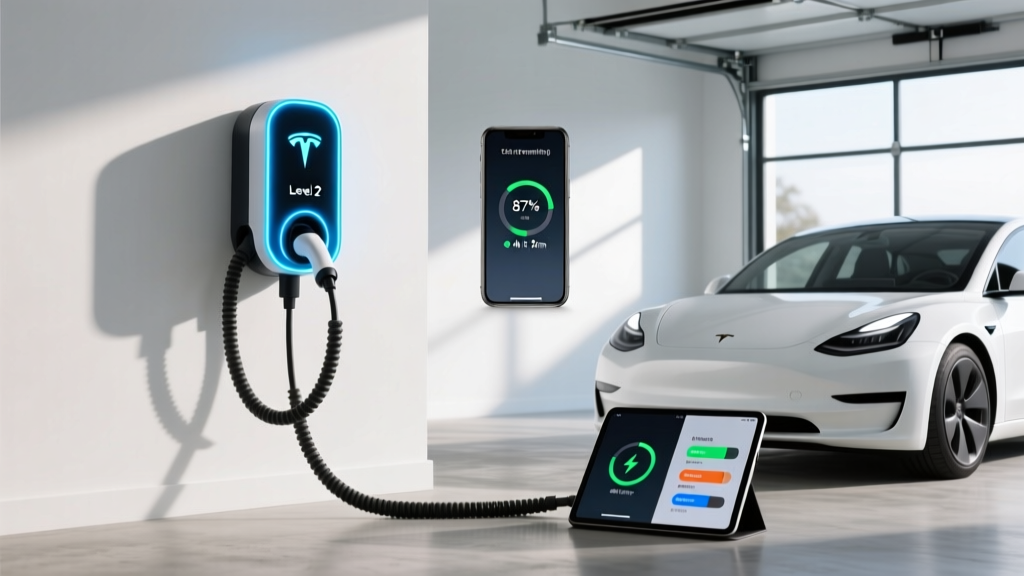
Before you can charge at home at Level 2 speeds, you need a dedicated 240-volt circuit — the same type of outlet your electric dryer uses. Most EV chargers draw between 32A and 48A continuously, which means the National Electrical Code requires a circuit rated for 125% of that continuous load. A 48A charger needs a 60A breaker; a 32A charger needs a 40A breaker.
What Electrical Upgrades Might You Need?
Many modern homes with 200-amp electrical panels can accommodate a new 60A circuit without issue. But older homes — particularly those built before 1990 with 100A or 150A service — may require a panel upgrade. A panel upgrade from 100A to 200A typically costs $1,500–$3,000 before permits, and the utility may need to upgrade the service drop as well. This is the single biggest variable in home charging costs and the one most online guides gloss over.
Every installation also requires:
- A dedicated circuit — no sharing with other appliances
- A GFCI breaker if the charger is installed outdoors (NEC 2020 and later)
- An outdoor-rated (NEMA 4) enclosure for exterior installations
- A local electrical permit — typically $50–$250 depending on your jurisdiction
| Component | Typical Cost Range | Notes |
|---|---|---|
| Level 2 charger (hardware) | $350–$750 | Smart WiFi-enabled units; basic units from $250 |
| Electrician labor (standard install) | $500–$1,500 | Varies by run length from panel to garage |
| Electrical permit | $50–$250 | Required in most jurisdictions; inspection included |
| Panel upgrade (if needed) | $1,500–$3,000 | Older homes with 100A service; not always required |
| Conduit and wiring materials | $100–$500 | Longer runs from panel increase cost |
| Total (no panel upgrade) | $900–$2,750 | Most homes with adequate panel capacity |
| Total (with panel upgrade) | $2,400–$5,750 | Homes needing 200A service upgrade |
Pro tip: The IRS §30D tax credit does not cover home charging equipment for most buyers as of 2026, but the Alternative Fuel Vehicle Refueling Property Credit (Form 8911) offers up to $1,000 (30% of cost) for qualifying home charger installations in eligible census tracts. Check your eligibility with a tax professional.
Connector Compatibility: NACS, CCS, and CHAdeMO in 2026
The North American charging connector landscape has consolidated significantly since Ford, GM, Rivian, Volvo, and others adopted the North American Charging Standard (NACS) — originally developed by Tesla. Here's where each major brand stands for 2026 model-year vehicles:
| Connector | Brands Using It | Adapter Needed for Tesla Superchargers? |
|---|---|---|
| NACS (native) | Tesla, Ford (2025+), GM (2025+), Rivian (2025+), Volvo/Polestar (2025+), Hyundai/Kia (2026 select models) | No — direct plug-in |
| CCS1 | Hyundai/Kia (2025 and earlier), VW ID.4, BMW iX/i4, most Stellantis EVs | Yes — CCS-to-NACS adapter ($200–$300) for Supercharger access |
| CHAdeMO | Nissan Leaf (discontinued), Mitsubishi Outlander PHEV (legacy) | Limited network; no Supercharger adapter available |
If you're buying a 2026 model, confirm the connector with the manufacturer. Hyundai's 2026 Ioniq lineup is transitioning to NACS, but some carryover 2025 models still ship with CCS1. The practical implication: CCS1 vehicles can use Electrify America and EVgo stations natively, but need an adapter for Tesla Superchargers — which, with over 30,000 stalls nationwide, represent the most reliable DC fast-charging network.
How to Find Electric Charging Stations on the Road
When you're away from home, locating a compatible, operational charger requires more than a simple map search. Here are the most reliable methods, ranked by practicality:
1. Your Vehicle's Built-In Navigation
Most modern EVs — Tesla, Hyundai, Ford, GM, Rivian — include native route planning that identifies compatible chargers along your route, preconditions the battery for optimal charging speed upon arrival, and displays real-time stall availability. Tesla's navigation is widely regarded as the most seamless, automatically routing through Superchargers and adjusting for elevation and temperature.
2. PlugShare and ChargeHub Apps
PlugShare remains the most comprehensive crowdsourced charging directory, with user reviews, photos, and reliability reports for virtually every public port in North America. Filter by connector type (NACS, CCS, CHAdeMO), network, power level, and whether the station is free or paid. ChargeHub offers similar functionality with a cleaner interface.
3. Network-Specific Apps
For the most accurate real-time status (operational/out-of-service/occupied), use the network's own app:
- Tesla app — Supercharger and Destination Charger status, stall count, pricing
- Electrify America app — CCS and NACS stations, session history, pricing tiers
- EVgo app — urban fast-charging network, subscription pricing available
- ChargePoint app — largest Level 2 destination network; some DC fast stations
4. A Better Routeplanner (ABRP)
For road-trip planning, A Better Routeplanner is the gold standard. Input your specific EV model, battery state of charge, and destination, and it calculates optimal charging stops, accounts for terrain and weather, and estimates arrival SoC at each stop. It supports all major connector types and networks.
Charging Cost Per Mile: EV vs. Gas in Real Dollars
The cost advantage of EV charging depends heavily on where and when you charge. Home charging on an off-peak utility rate is almost always cheaper than gasoline. Public DC fast charging can approach or exceed gas costs depending on the network and your state's electricity rates.
| Scenario | Rate | Cost per Mile (3.5 mi/kWh EV) | Equivalent Gas Vehicle (30 MPG at $3.50/gal) |
|---|---|---|---|
| Home Level 2 (off-peak utility rate) | $0.10/kWh | $0.029/mi | $0.117/mi |
| Home Level 2 (standard residential avg.) | $0.16/kWh | $0.046/mi | $0.117/mi |
| Public Level 2 (workplace/destination) | $0.25/kWh | $0.071/mi | $0.117/mi |
| DC Fast Charging (EA/EVgo average) | $0.40/kWh | $0.114/mi | $0.117/mi |
| DC Fast Charging (peak pricing) | $0.55/kWh | $0.157/mi | $0.117/mi |
The takeaway: If you charge primarily at home on a standard or off-peak rate, your fuel cost is roughly 40–75% less than a comparable 30 MPG gas vehicle. But if you rely exclusively on public DC fast charging at peak rates, you may actually pay more per mile than gas — which is why home charging access remains the single biggest factor in EV ownership economics.
Recommended Home EV Chargers: Power, Features, and Pricing
Not all Level 2 chargers are equal. The critical specs are maximum power output (kW), amperage, cable length, connector type, and smart features like WiFi scheduling and load management. Here are four top picks for 2026:
ChargePoint Home Flex
- Power: Up to 12 kW (50A) — adjustable down to 16A
- Connector: NACS or J1772 (configurable)
- Cable length: 23 feet
- Smart features: WiFi, app scheduling, Alexa integration, load sharing
- Price: ~$550
- Best for: Flexible amperage for older panels; NACS native option
WallConnector (Tesla, Gen 4)
- Power: Up to 11.5 kW (48A)
- Connector: NACS native
- Cable length: 24 feet
- Smart features: WiFi, OTA updates, power sharing with multiple units
- Price: ~$475
- Best for: Tesla and NACS-equipped Ford/GM/Rivian owners
Emporia Level 2 Smart Charger
- Power: Up to 11.5 kW (48A)
- Connector: J1772 (NACS adapter available)
- Cable length: 24 feet
- Smart features: Energy monitoring, solar integration, utility demand response
- Price: ~$400
- Best for: Solar-home owners wanting energy-tracking integration
Grizzl-E Smart
- Power: Up to 10 kW (40A)
- Connector: J1772 or NACS
- Cable length: 24 feet
- Smart features: OCPP-compatible, works with utility programs
- Price: ~$500
- Best for: Cold-climate durability (rated to -40°F); Canadian-built
Charging Time Examples: 10–80% for Common Battery Sizes
Charging time depends on your battery's usable capacity (kWh), the charger's power output (kW), and your vehicle's charge curve — the rate at which it accepts power as the battery fills. Most EVs charge fastest between 10% and 50% SoC, then taper progressively. Here are real-world estimates:
| Vehicle (Example) | Battery (Usable kWh) | DC Fast Peak kW | 10–80% Time (DC Fast) | 10–80% Time (Level 2 at 11.5 kW) |
|---|---|---|---|---|
| Tesla Model Y Long Range | 75 kWh | 250 kW | ~23 min | ~4.5 hours |
| Hyundai Ioniq 5 (800V) | 77.4 kWh | 240 kW | ~18 min | ~4.7 hours |
| Ford Mustang Mach-E ER | 91 kWh | 150 kW | ~38 min | ~5.6 hours |
| Chevrolet Equinox EV | 85 kWh | 150 kW | ~35 min | ~5.2 hours |
| Toyota bZ4X | 64 kWh | 150 kW | ~30 min | ~3.9 hours |
Charge curve reality check: That "250 kW peak" on the Tesla Model Y is sustained for only a few minutes at low SoC. The average power across a 10–80% session is closer to 130–150 kW. This is why published 10–80% times are more useful than peak kW numbers when comparing vehicles.
Safety, Code, and Installation Best Practices
EV charging draws sustained high current for hours — a duty cycle far more demanding than most household appliances. Cutting corners on installation invites fire risk, insurance denial, and failed inspections. Follow these non-negotiable guidelines:
- Always use a licensed electrician. DIY 240V work is dangerous and often violates code. Your electrician should pull a permit and schedule a final inspection.
- Never use an extension cord with a portable EV charger. If the outlet isn't close enough, have an electrician install a new one.
- Outdoor installations require a NEMA 4-rated (weatherproof) charger enclosure and a GFCI breaker per NEC Article 625.
- Hardwired vs. plug-in: Hardwired chargers (no plug, direct-wired to a junction box) are preferred for 48A+ units because NEMA 14-50 receptacles can overheat under continuous high-amperage loads if not installed with commercial-grade outlets (Hubbell or Bryant brand, not residential-grade).
- Load management: If your panel is near capacity, consider a smart charger with load-management features (like the ChargePoint Home Flex or Emporia) that dynamically adjusts charging amperage to avoid tripping the main breaker.
Frequently Asked Questions
How much does it cost to install a home EV charger?
For a standard installation with adequate panel capacity, expect $900–$2,750 total (charger hardware + electrician labor + permit). If your home needs a panel upgrade from 100A to 200A service, add $1,500–$3,000, bringing the total to $2,400–$5,750. Get at least two quotes from licensed electricians and confirm the quote includes permit and inspection fees.
How fast will each charging level add range?
Level 1 (120V standard outlet) adds 3–5 miles per hour — suitable for PHEVs with small batteries. Level 2 (240V, home or destination) adds 25–70 miles per hour depending on amperage and your vehicle's onboard charger. DC fast charging adds hundreds of miles per hour at peak rate, but the charge curve tapers significantly above 80% SoC, making the last 20% much slower than the first 50%.
Which connector and charger is compatible with my EV?
Check your vehicle's charge port. Tesla vehicles and 2025+ Ford, GM, Rivian, and Volvo EVs use NACS natively. Most 2024 and earlier non-Tesla EVs use CCS1. The aging CHAdeMO standard is limited to the Nissan Leaf and older Mitsubishi models. For home Level 2 charging, non-Tesla vehicles with CCS ports use a J1772 connector; NACS vehicles use the Tesla connector. Adapters exist in both directions but verify compatibility before purchasing.
How much does charging cost per mile compared to gas?
Home charging at the national average residential rate (~$0.16/kWh) costs roughly $0.04–$0.05 per mile for a typical EV achieving 3.5 miles per kWh. A 30 MPG gas vehicle at $3.50/gallon costs about $0.12 per mile. That's a 60% fuel savings. However, public DC fast charging at $0.40–$0.55/kWh can cost $0.11–$0.16 per mile — matching or exceeding gas costs. Home charging access is the key economic advantage.
What electrical upgrades might I need for a home charger?
The most common upgrade is a panel capacity increase. If your home has a 100A panel and you already run central AC, an electric oven, and a dryer, adding a 60A EV circuit may exceed your panel's capacity. An electrician will perform a load calculation per NEC Article 220 to determine if an upgrade is necessary. Other potential needs: running new conduit from the panel to your garage (especially if the panel is on the opposite side of the house), upgrading the meter socket, or installing a smart load-management system to avoid a panel upgrade altogether.