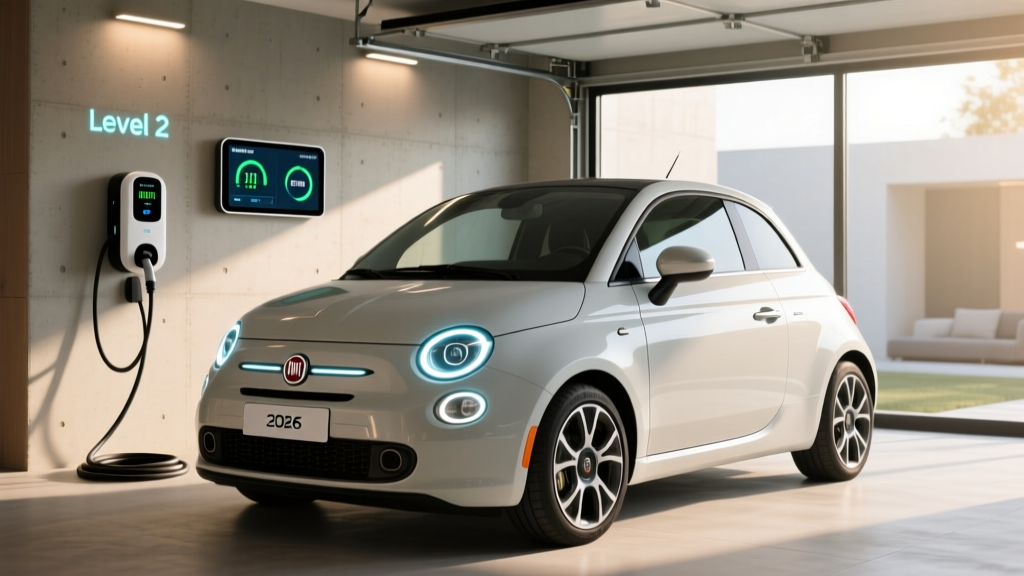
The Fiat 500e returns to the U.S. market with a compact footprint and a 42 kWh battery, but for most buyers the bigger question than its sticker price is how to keep it charged efficiently. With an EPA-estimated 149 miles of range on the RED trim, this city-focused EV rewards owners who plan their charging strategy around its modest battery and CCS1 port. Below, we break down the Fiat 500 electric range in real-world conditions, map out every charging level from a standard 120V outlet to an 85 kW DC fast charger, and give you a full home-installation cost breakdown so you can budget accurately before the car arrives in your driveway.
Fiat 500 Electric Range: EPA vs. Real World
The 2024–2026 Fiat 500e (42 kWh usable battery, NMC chemistry) carries an EPA-estimated range of 149 miles on the RED trim with 17-inch wheels. That figure assumes a mix of city and highway driving at moderate temperatures. In practice, several factors shift the number meaningfully:
Real-World Expectations:
• City / mild weather (65°F): ~140–155 miles (regen-heavy urban driving helps)
• Highway sustained (70 mph, 75°F): ~115–130 miles
• Cold weather (30°F, mixed driving): ~100–115 miles (no heat pump on U.S. trim)
• Cold + highway (worst case): ~85–100 miles
The 500e's relatively small battery amplifies cold-weather losses because the resistive heater draws from the same 42 kWh pack that propels the car. If you live above the 40th parallel, preconditioning while plugged in at home is essential — it warms the battery using grid power rather than pack energy, preserving range for your commute. Efficiency lands around 29–31 kWh/100 mi combined, or roughly 112 MPGe per fueleconomy.gov.
Charging Levels Explained: What Speeds to Expect
Understanding the difference between kW (power, the rate of energy flow) and kWh (energy, the battery's total capacity) is the single most important piece of EV literacy. The Fiat 500e's battery holds 42 kWh of usable energy; how quickly you refill it depends on the charger's kW output and the car's onboard acceptance rate.
| Level | Voltage | Max Power (kW) | Miles Added per Hour | 0–100% Time (42 kWh) | Best For |
|---|---|---|---|---|---|
| Level 1 (120V) | 120V / 12A | ~1.4 kW | ~4–5 mi/hr | ~30–35 hours | Overnight trickle, emergencies |
| Level 2 (240V) | 240V / 32–48A | 7.7–11.5 kW | ~25–38 mi/hr | ~4.5–6 hours | Daily home charging |
| DC Fast Charge | 400V DC | Up to 85 kW | ~170–210 mi/hr (peak) | 10–80% in ~30–35 min | Road trips, quick top-ups |
The 500e's onboard AC charger maxes out at 11 kW (48A), so a 48-amp Level 2 home unit will fill it at the car's maximum rate. On DC fast charging, the car peaks around 85 kW but tapers significantly above 60% state of charge — a typical 10–80% session takes roughly 30–35 minutes at a 150 kW+ station, though the car will only draw its peak rate in the lower SoC window.
Home Charger Installation: Costs, Electrical Requirements & Panel Upgrades
A Level 2 home charger is the backbone of practical 500e ownership. Here's what the installation actually involves.
Electrical Requirements
For a 48-amp continuous charger (the sweet spot for the 500e's 11 kW onboard charger), NEC code requires a dedicated circuit rated at 125% of the continuous load — that means a 60-amp breaker on a 240V circuit using 6 AWG copper wire (or 4 AWG aluminum). If you opt for a 32-amp charger, a 40-amp breaker with 8 AWG copper suffices.
Panel Upgrade Reality
Homes built before 2000 often have 100-amp or 150-amp main service panels. If your panel is already near capacity (running electric dryer, range, HVAC, water heater), adding a 60-amp EV circuit may require a panel upgrade to 200 amps — a $1,500–$3,500 job on its own. An electrician will perform a load calculation per NEC Article 220 to determine whether your panel can handle the added draw.
Installation Cost Breakdown
| Item | Low-End | High-End | Notes |
|---|---|---|---|
| Level 2 charger (hardware) | $350 | $750 | 32A–48A smart charger, NEMA 14-50 or hardwired |
| Electrician labor (basic run) | $500 | $1,200 | Short run from panel to garage, no panel upgrade |
| Electrical permit | $50 | $200 | Varies by municipality |
| Wire & conduit materials | $100 | $400 | Depends on run length (50–100 ft typical) |
| Panel upgrade (if needed) | $1,500 | $3,500 | 100A → 200A service upgrade |
| Total (no panel upgrade) | $1,000 | $2,550 | Most common scenario |
| Total (with panel upgrade) | $2,500 | $6,050 | Older homes with 100A service |
Get at least three quotes from licensed electricians. Some utilities offer rebates of $250–$750 for Level 2 installations — check your local provider before scheduling work.
Connector Compatibility: CCS1, NACS & Adapters
The U.S.-spec Fiat 500e uses a CCS1 (Combined Charging System) connector for both Level 2 AC and DC fast charging. As of 2026, the charging landscape has shifted heavily toward NACS (the Tesla connector, now standardized as SAE J3400), and this creates some adapter considerations for 500e owners.
| Network / Connector | Native 500e Support? | Adapter Needed? | Notes |
|---|---|---|---|
| CCS1 public chargers (Electrify America, EVgo) | Yes | No | Plug directly; declining but still widespread |
| Tesla Supercharger (NACS) | No | Yes — CCS1-to-NACS adapter (~$200–$250) | Tesla opened Superchargers to CCS vehicles via adapter |
| Home Level 2 (J1772 / NACS wall connector) | J1772: Yes; NACS: adapter | Possibly | Most home chargers still ship with J1772; Tesla Wall Connector includes J1772 adapter or use NACS-to-J1772 |
| CHAdeMO | No | No adapter available | CHAdeMO is effectively deprecated in the U.S. |
Practical recommendation: Buy a CCS1-to-NACS adapter ($200–$250 from Tesla or Lectron) to unlock the Supercharger network, which remains the most reliable DC fast-charging infrastructure in North America. For home charging, any J1772 Level 2 unit works natively with the 500e.
Charging Cost Per Mile: Home vs. Public vs. Gas
One of the strongest arguments for the 500e is running cost. At 30 kWh/100 mi (its combined efficiency), here's what charging actually costs across scenarios:
| Scenario | $/kWh | Cost for Full 42 kWh Charge | Cost per Mile (at 30 kWh/100 mi) |
|---|---|---|---|
| Home (off-peak TOU rate) | $0.09 | $3.78 | $0.027 |
| Home (standard residential avg) | $0.16 | $6.72 | $0.048 |
| Public Level 2 (ChargePoint, etc.) | $0.30 | $12.60 | $0.090 |
| DC Fast Charge (Electrify America) | $0.48 | $20.16 | $0.144 |
| Gas car comparison (30 MPG, $3.50/gal) | — | — | $0.117 |
At home off-peak rates, the 500e costs roughly 2.7 cents per mile — less than a quarter of the gas-car equivalent. Even at public DC fast-charging rates, it edges out a 30 MPG gas car. The savings are most dramatic when you charge at home, which is why a Level 2 installation pays for itself within the first year for most owners driving 10,000+ miles annually.
Recommended Home Chargers for the Fiat 500e
Since the 500e's onboard charger tops out at 11 kW (48A), you don't need an 80-amp unit. Here are three well-matched options:
Emporia Vue Level 2 Smart Charger
- Power: 48A / 11.5 kW (240V hardwired)
- Connector: J1772 (native to 500e)
- Cable length: 24 ft
- Smart features: Wi-Fi, scheduling, energy monitoring, solar integration
- Price: ~$399
- Verdict: Best value for the 500e — matches its max charge rate exactly, with robust app control and TOU scheduling.
ChargePoint Home Flex
- Power: Up to 50A / 12 kW (adjustable via DIP switch)
- Connector: J1772
- Cable length: 23 ft
- Smart features: Wi-Fi, Alexa, scheduling, ChargePoint network integration
- Price: ~$649
- Verdict: Premium build, adjustable amperage lets you match a 40A circuit if your panel is tight.
Tesla Wall Connector (J1772 version)
- Power: Up to 48A / 11.5 kW
- Connector: J1772 (2025+ models ship with J1772 connector option)
- Cable length: 24 ft
- Smart features: Wi-Fi, OTA updates, power sharing for multi-charger installs
- Price: ~$475
- Verdict: Clean design, competitive price, and if you later add a Tesla to the household you can power-share two units on one 60A circuit.
Safety, Code & Installation Best Practices
EV charging draws sustained high current for hours — this is not a DIY extension-cord situation. Key safety and code points:
- Dedicated circuit: NEC 625 requires a dedicated branch circuit for EV supply equipment — no sharing with outlets or appliances.
- GFCI protection: 2023 NEC (adopted in most states by 2026) requires GFCI protection for 240V receptacles used for EV charging. Hardwired units are exempt from this requirement, which is why many electricians prefer hardwiring.
- Outdoor rating: If your charger mounts outside, ensure it's rated NEMA 4 (weatherproof). All three units above carry outdoor ratings.
- Permit & inspection: Most jurisdictions require an electrical permit and a post-installation inspection. Skipping this can void homeowner's insurance coverage for electrical fires.
- Wire gauge: 6 AWG copper for 60A circuits; 8 AWG copper for 40A. Aluminum is cheaper but requires larger gauge — your electrician will specify.
Fiat 500e Quick Specs Reference
| Specification | Value |
|---|---|
| EPA Range | 149 miles (RED trim, 17" wheels) |
| Battery (usable) | 42 kWh, NMC chemistry |
| Onboard AC Charger | 11 kW (48A max) |
| DC Fast Charge Peak | 85 kW |
| 10–80% DC Time | ~30–35 minutes |
| Connector | CCS1 (AC: J1772) |
| Motor Output | 118 hp / 162 lb-ft torque |
| 0–60 mph | ~8.5 seconds |
| Efficiency | ~30 kWh/100 mi (112 MPGe combined) |
| Base MSRP (RED trim) | $36,500 (before incentives) |
| Federal §30D Credit | Up to $7,500 if eligible — subject to MSRP cap ($55,000 sedans), buyer income limits, and battery sourcing rules per IRS guidelines |
| Battery Warranty | 8 years / 100,000 miles (minimum 70% capacity retention) |
Frequently Asked Questions
How much does it cost to install a home EV charger for the Fiat 500e?
Expect $1,000–$2,550 for a standard installation (Level 2 charger + electrician + permit + materials) if your electrical panel has capacity. If a panel upgrade from 100A to 200A is required, total cost rises to $2,500–$6,050. Always get a load calculation from a licensed electrician before committing.
How fast will each charging level add range to the 500e?
Level 1 (120V) adds roughly 4–5 miles per hour — adequate only for overnight trickle charging of a partially depleted battery. Level 2 (240V, 48A) adds about 35–38 miles per hour, fully replenishing the 42 kWh pack in 5–6 hours. DC fast charging at 85 kW can add up to 100 miles in roughly 20 minutes at low state of charge, but the charge curve tapers sharply above 60%.
Which connector and charger is compatible with the Fiat 500e?
The 500e uses CCS1 for DC fast charging and J1772 for Level 2 AC charging — these are the same physical connector (CCS1 adds two DC pins below the J1772 port). Any J1772 home charger works. For Tesla Superchargers, you need a CCS1-to-NACS adapter (~$200–$250). CHAdeMO is not supported.
How much does charging the 500e cost per mile compared to gas?
At a national-average home electricity rate of $0.16/kWh, the 500e costs about 4.8 cents per mile. A comparable 30 MPG gas car at $3.50/gallon costs 11.7 cents per mile. Over 12,000 miles annually, that's roughly $828 in annual fuel savings with home charging — the Level 2 installation pays for itself within two years.
What electrical upgrades might I need for a Level 2 charger?
The most common upgrade is a panel capacity increase from 100A to 200A ($1,500–$3,500) if your existing panel is near its load limit. You may also need a new 240V circuit run from the panel to your garage or parking spot, which involves conduit, wire, and a 60-amp breaker. Homes with modern 200A panels and short wire runs typically need nothing beyond the dedicated circuit and permit.
Does the Fiat 500e qualify for the $7,500 federal tax credit?
Eligibility for the §30D clean vehicle credit depends on multiple factors: the vehicle's MSRP must not exceed $55,000 (sedan cap — the 500e qualifies), your modified adjusted gross income must fall below $150,000 (single) or $300,000 (joint), and the battery must meet critical-mineral and component sourcing thresholds that tighten annually. As of 2026, many non-North-American-built EVs face sourcing restrictions that reduce or eliminate the credit. The 500e is assembled in Toluca, Mexico — check current eligibility on fueleconomy.gov and consult a tax professional before relying on the credit.