The Federal Tax Credit for EV Charger: What §30C Covers in 2026
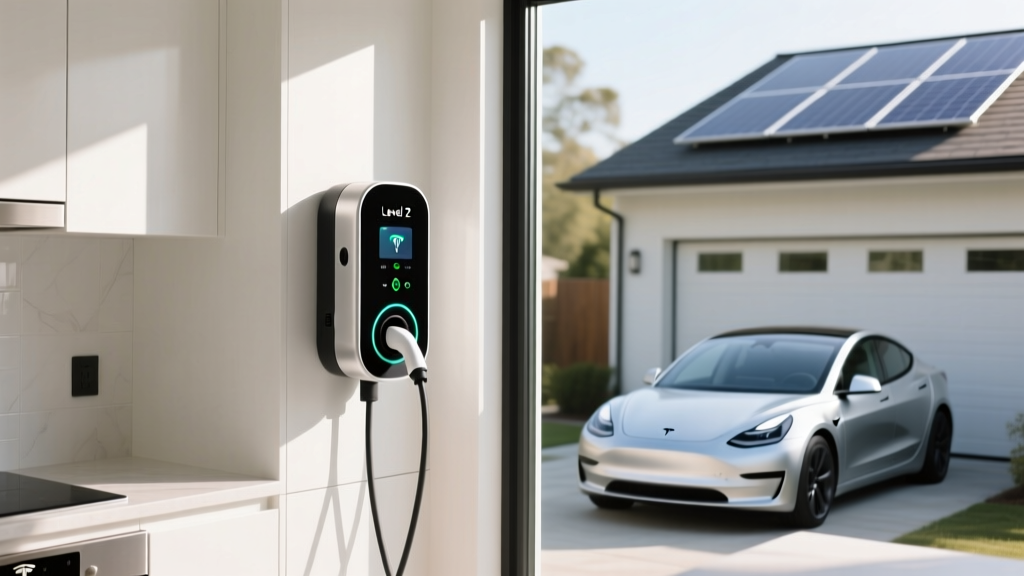
Home charging is where most EV owners do 85-95% of their replenishing, and the economics tilt heavily in your favor once a Level 2 station is wired up. The federal tax credit for EV charger — formally the Alternative Fuel Vehicle Refueling Property Credit under IRS §30C — was revived and expanded by the Inflation Reduction Act and remains available through 2032. For residential installations placed in service in 2026, it covers 30% of the combined hardware and installation cost, capped at $1,000.
There are strings attached that most buyers miss at the dealership. The credit applies only to property installed at your principal residence, located in an eligible census tract (generally low-income or non-urban areas — you can verify your address via the IRS eligibility tool or Argonne National Lab's mapping site). It is non-refundable, meaning it reduces your tax liability dollar-for-dollar but won't generate a refund if your liability is already zero. Unlike the §30D vehicle credit, there is no point-of-sale transfer option for §30C; you claim it on Form 8911 with your annual return.
- 30% of total equipment + labor cost, max $1,000 credit
- Residence must be in an eligible census tract (verify at irs.gov)
- Equipment must be new, UL-listed, and installed at your principal home
- Non-refundable — offsets tax owed, not a cash refund
- Claimed via IRS Form 8911; no point-of-sale transfer
- Combined with many state/utility rebates (stacking is allowed)
Charging Levels Explained: kW, Miles per Hour, and 10-80% Times
Before budgeting, understand what each level actually delivers. kW (kilowatts) is power — the rate electricity flows into the battery. kWh (kilowatt-hours) is energy — the capacity of the battery itself. A 240 kW DC fast charger pushes energy roughly 30x faster than a 7.7 kW Level 2 wallbox, but sustained speeds taper as the battery fills (the "charging curve").
| Level | Voltage / Amps | Peak Power (kW) | Miles Added per Hour | Typical Use Case |
|---|---|---|---|---|
| Level 1 | 120V / 12A | 1.4 kW | 3–5 mi/hr | Overnight top-up, PHEVs, low-mileage drivers |
| Level 2 (Home) | 240V / 32–48A | 7.7–11.5 kW | 25–44 mi/hr | Daily home charging, primary BEV solution |
| DC Fast (Public) | 400–800V DC | 50–350 kW | 150–1,000+ mi/hr (peak) | Road trips, highway corridors |
Realistic 10-80% charging times (accounting for curve taper, not just peak kW):
- 77 kWh battery (e.g., Hyundai Ioniq 5 Long Range): ~18 min on 250 kW DCFC; ~7.5 hr on 11.5 kW Level 2
- 82 kWh battery (e.g., Tesla Model Y Long Range): ~22 min on 250 kW DCFC; ~8 hr on 11.5 kW Level 2
- 112 kWh battery (e.g., Ford F-150 Lightning Extended): ~40 min on 150+ kW DCFC; ~11 hr on 11.5 kW Level 2
- 18 kWh PHEV battery (e.g., Toyota RAV4 Prime): ~2.5 hr on Level 2; not DCFC capable
Expect peak kW to be sustained only between roughly 10-50% state of charge; above 80%, most batteries throttle below 50 kW to protect cell health. Plan road-trip stops around the 10-80% window for the best time efficiency.
How Much Does It Cost to Install a Home EV Charger?
This is where the federal tax credit for EV charger installations earns its keep. A Level 2 home setup breaks down into three cost buckets: the charger hardware, the electrician's labor and materials, and any panel or service upgrades your home requires. Here's what we're seeing in 2026 for a typical single-family install:
| Component | Low End | Typical | High End |
|---|---|---|---|
| Level 2 charger (40-48A, hardwired) | $350 | $550 | $750 |
| Electrician labor + wire + conduit | $400 | $900 | $1,800 |
| Permit and inspection | $75 | $175 | $350 |
| Panel upgrade (100A → 200A service) | $0 | $0 (most homes) | $2,500 |
| Total (before incentives) | $825 | $1,625 | $5,400 |
| After 30% §30C credit (max $1,000) | $578 | $1,138 | $4,400 |
When a panel upgrade is likely needed: homes built before the 1980s often have 100A or even 60A service. A 48A continuous-load EV charger requires a 60A breaker (NEC 125% rule), which consumes a meaningful chunk of a 100A panel already running HVAC, dryer, and range. An electrician will perform a load calculation; if you're over 80% of panel capacity, a service upgrade to 200A is required. Modern homes with 200A service rarely need an upgrade for a single 48A charger.
Electrical requirements at a glance:
- 240V dedicated circuit on a double-pole breaker
- Breaker sized at 125% of continuous load: 48A charger → 60A breaker; 40A charger → 50A breaker
- 6 AWG copper THHN for 48A circuits; 8 AWG for 40A (copper, not aluminum)
- Hardwired preferred over NEMA 14-50 receptacle for daily-use reliability (fewer thermal failure points)
- GFCI protection required per NEC 2023 §625.54 for receptacle-based installs; hardwired units typically exempt
- Outdoor-rated (NEMA 4) enclosure if mounted outside
Which Connector Is Compatible with My EV?
The connector landscape has consolidated dramatically since 2024. NACS (North American Charging Standard), pioneered by Tesla, is now the dominant plug for new 2025-2026 BEVs from Ford, GM, Rivian, Volvo, Hyundai/Kia, and others. CCS1 remains on legacy models and the Electrify America network. CHAdeMO is effectively sunset in North America, retained only on older Nissan Leaf and Mitsubishi Outlander PHEV models.
| Connector | Adopted By (2026 Models) | Notes |
|---|---|---|
| NACS (Tesla plug) | Tesla, Ford, GM, Rivian, Volvo, Polestar, Hyundai, Kia, Honda, BMW, Mercedes, Lucid | De facto North American standard; works natively on Tesla Superchargers |
| CCS1 | VW ID.4 (through 2024), legacy Chevy Bolt, older Porsche Taycan, BMW i4 (pre-2025) | Still supported at EA, EVgo, ChargePoint; adapters to NACS widely available |
| CHAdeMO | Nissan Leaf (discontinued), older Mitsubishi Outlander PHEV | Network shrinking; no new models |
Adapter strategy: If you own a CCS1-equipped EV, a NACS-to-CCS1 adapter (~$150-200) unlocks the 20,000+ Tesla Supercharger stalls. Ford and Rivian ship these adapters with newer vehicles. For home chargers, most 2026 wallboxes now ship with a NACS connector; CCS1 models are still available but becoming less common. Always confirm the charger's connector matches your vehicle's inlet — or buy a third-party adapter rated for the charger's full amperage.
Cost per Mile: Home Charging vs Public DC vs Gas
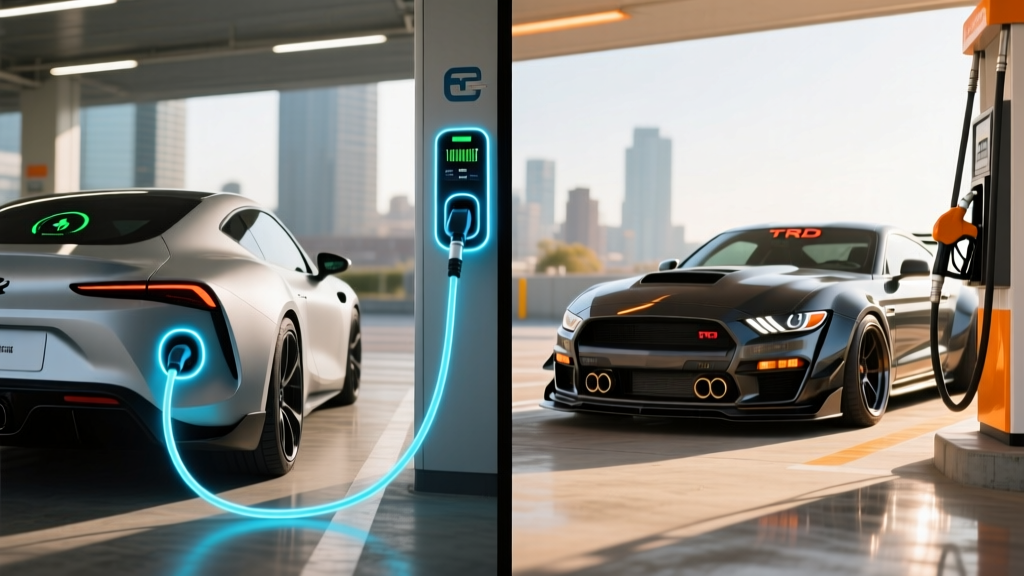
The per-mile math is where EV ownership separates itself from gas — but only if you charge smartly. Public DC fast charging has grown expensive enough that it occasionally rivals gasoline on a cost-per-mile basis.
| Scenario | Price per kWh | Efficiency (3 mi/kWh) | Cost per Mile |
|---|---|---|---|
| Home Level 2, off-peak utility rate | $0.09 | 3.0 mi/kWh | $0.030 |
| Home Level 2, average US rate | $0.16 | 3.0 mi/kWh | $0.053 |
| Public Level 2 (ChargePoint, Blink) | $0.35 | 3.0 mi/kWh | $0.117 |
| DC Fast (Tesla Supercharger avg) | $0.32 | 3.0 mi/kWh | $0.107 |
| DC Fast (Electrify America peak) | $0.52 | 3.0 mi/kWh | $0.173 |
| Gas vehicle, 27 MPG @ $3.40/gal | — | 27 MPG | $0.126 |
Annual savings example: A driver covering 12,000 miles/year at home off-peak spends roughly $360 on electricity. The same distance in a 27 MPG gas vehicle at $3.40/gallon costs $1,511 — a $1,150 annual gap. Over five years, that gap pays for the home charger installation several times over, even before the §30C credit.
Two caveats: DC fast charging is not free money — use it for road trips, not daily driving. And in states with high electricity rates (California, Hawaii, parts of the Northeast at $0.30+/kWh residential), the savings narrow, though they rarely disappear entirely.
2026 Equipment Picks: Home Level 2 Chargers
We evaluate wallboxes on sustained power output, connector flexibility, cable reach, smart features (scheduling, load sharing, solar integration), and real-world reliability. These are our current picks:
Emporia Vue Level 2 (Best Value)
- Output: 48A / 11.5 kW (240V hardwired)
- Connector: NACS (CCS1 adapter available)
- Cable: 24 ft
- Smart: WiFi, solar-aware scheduling, load management
- Price: ~$399
ChargePoint Home Flex (Best Flexibility)
- Output: up to 50A / 12 kW (adjustable 16-50A)
- Connector: NACS or CCS1 at order
- Cable: 23 ft
- Smart: app scheduling, Alexa, utility demand-response
- Price: ~$649
Grizzl-E Smart (Most Durable)
- Output: 40A / 9.6 kW
- Connector: NACS (J1772/CCS1 variants)
- Cable: 24 ft, cold-rated to -40°C
- Smart: OCPP, adjustable amperage
- Price: ~$499
Tesla Wall Connector (Best for NACS owners)
- Output: 48A / 11.5 kW
- Connector: NACS (Magic Dock adapter for CCS1)
- Cable: 24 ft
- Smart: Power Sharing, WiFi updates
- Price: ~$450
All four are UL-listed, NEMA 4 outdoor-rated (except Grizzl-E which is NEMA 4X), and support hardwired installation. For daily use, we prefer hardwired over NEMA 14-50 receptacles — thermal failures at the plug are a documented failure mode in high-use home charging. The ChargePoint Home Flex's adjustable amperage is valuable if your panel has limited headroom; you can dial it to 32A (40A breaker) rather than committing to a full 60A circuit.
Safety, Code, and the Electrician Conversation
EV charging is a continuous 8-12 hour load — a duty cycle most home circuits never experience. Treat the install like a permanent appliance, not a plug-in accessory.
- Dedicated circuit required: no sharing with dryers, HVAC, or workshop outlets.
- NEC Article 625 governs EVSE; your electrician should cite it on the permit application.
- Load calculation: a licensed electrician will sum existing loads per NEC 220 and confirm your panel can absorb the new circuit.
- Permit and inspection: required in virtually every US jurisdiction. Skipping inspection voids most charger warranties and may invalidate home insurance claims for electrical fires.
- Grounding and bonding: confirm a dedicated ground rod or equipment grounding conductor per local code.
- Outdoor mounting: use NEMA 4-rated enclosures; route conduit to prevent water ingress at the junction box.
A common mistake: buying a 48A charger and plugging it into an existing NEMA 14-50 outlet wired for a dryer on a 50A breaker. A 48A continuous load requires a 60A breaker and appropriately sized wire. Mismatched amperage is a fire risk. Have the electrician verify the circuit before the charger powers on.
Stacking Incentives: Federal, State, and Utility
The §30C federal tax credit for EV charger is stackable with state and utility rebates in most jurisdictions. For example:
- California: various utility rebates of $250-$1,500 (PG&E, SCE, SDG&E programs — confirm current availability)
- New York: NYSERDA and Con Edison rebates up to $1,000 in eligible areas
- Colorado: utility rebates of $300-$700 plus a 30% state credit (capped)
- Municipal utilities (SMUD, Austin Energy, Seattle City Light) often run $200-$500 rebates
Always check the DOE's Alternative Fuels Data Center and your utility's EV program page for current offers. State and utility incentives generally do not reduce your §30C basis unless they are explicitly designated as purchase-price reductions (most are rebates and do not).
Frequently Asked Questions
Can I claim the §30C credit if I rent my home?
No. The credit applies only to equipment installed at a principal residence you own. Renters may benefit from landlord-installed chargers, but the landlord claims the credit. Condo owners can claim it for garage installations they pay for.
Does the credit apply to Level 1 (120V) charging equipment?
Technically yes — §30C covers "property directly related to the delivery of alternative fuel into the vehicle." However, a $200 Level 1 cordset yields only a $60 credit and delivers 3-5 miles per hour. Most owners find Level 2 worth the slightly higher install cost.
What if my tax liability is less than $1,000?
The credit is non-refundable, so it cannot exceed your total tax liability for the year. Excess credit does not carry forward to future years under current §30C rules. Plan your installation timing with your tax situation in mind — or consult a tax professional.
Do I need a smart charger, or will a "dumb" one work?
A dumb charger works perfectly for charging. Smart features — scheduled off-peak charging, solar integration, load sharing with a second charger, remote diagnostics — justify the $50-$150 premium for most owners, especially in time-of-use rate areas where off-peak scheduling cuts costs 40-60%.
Can I install a charger in a condo or apartment garage?
Yes, with HOA or landlord approval. Many states (CA, CO, FL, HI, NJ, OR) have "right to charge" laws limiting an HOA's ability to deny reasonable EVSE installations. You'll still need a dedicated circuit from the building's panel, and metering arrangements vary.
Is NACS or CCS1 the better choice for a 2026 home charger?
NACS. With Ford, GM, Hyundai/Kia, Rivian, Volvo, and others adopting it for 2025-2026 models, NACS is the forward-looking choice. If you currently own a CCS1 vehicle, either buy a CCS1 charger or plan on using a NACS-to-CCS1 adapter (widely available from Ford, Tesla, and third parties).