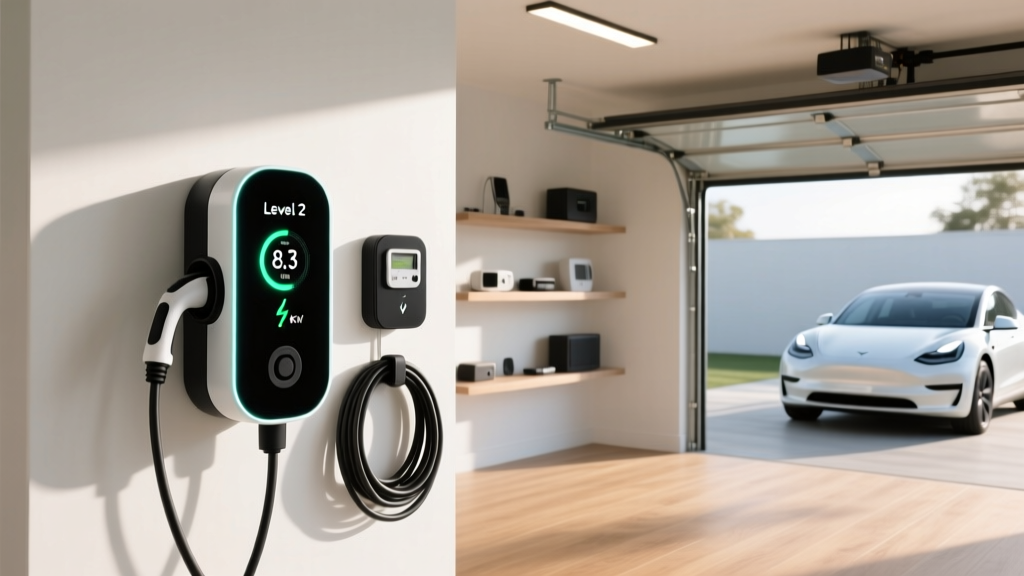
If you've been plugging into a standard 120V outlet and watching your EV gain 3 miles of range per hour, you already know the frustration. The search for the fastest home EV charger usually leads to one answer: a hardwired Level 2 station delivering 11.5 kW to 19.2 kW of power. But "fastest" only matters if your home's electrical panel can support it — and if your EV's onboard charger can actually accept that power.
This guide breaks down exactly what it takes to charge at home at maximum speed in 2026: the electrical requirements, real costs, equipment picks, and the critical distinction between kW (charging power, or how fast energy flows) and kWh (battery energy capacity, or how much your battery holds). Confusing the two is the single most common mistake new EV owners make.
Charging Levels Explained: How Fast Will Each Add Range?
Home charging falls into two categories — Level 1 and Level 2. DC fast charging is public-only infrastructure and not something you install at home. Here's what each level delivers in real-world terms:
| Level | Voltage | Max Power (kW) | Miles of Range Per Hour | Best For |
|---|---|---|---|---|
| Level 1 | 120V AC | 1.4 kW | 3–5 mi/hr | PHEVs, overnight top-ups, emergency backup |
| Level 2 (standard) | 240V AC | 7.2–11.5 kW | 20–45 mi/hr | Most BEVs, daily home charging |
| Level 2 (high-power) | 240V AC | 11.5–19.2 kW | 40–70 mi/hr | Large-battery EVs, fastest home charging |
| DC Fast (public) | 400–800V DC | 50–350 kW | 150–1,000+ mi/hr | Road trips, rapid top-ups away from home |
Your EV's Onboard Charger Is the Real Bottleneck
Here's the part most buying guides gloss over: the fastest home EV charger you can buy is irrelevant if your car's onboard charger can't accept its full output. The onboard charger is the component inside your EV that converts AC power from your home into DC power for the battery. Its maximum acceptance rate caps your home charging speed.
For example, the 2026 Tesla Model Y Long Range has an 11.5 kW onboard charger. Even if you install a 19.2 kW (80A) wall connector, the Model Y will only draw 11.5 kW. The Ford F-150 Lightning Extended Range, however, accepts up to 19.2 kW on its dual onboard chargers — making it one of the few vehicles that can actually exploit a high-amperage home station. The Hyundai Ioniq 5 and Kia EV6 both max out at 10.9 kW on Level 2.
Before spending extra on a 60A or 80A circuit, check your vehicle's onboard charger specification. If it's 11.5 kW or less, a 48A charger on a 60A circuit is your practical ceiling.
Electrical Requirements: What Your Panel Needs to Support
High-power Level 2 charging demands serious electrical infrastructure. Here's what each tier requires:
- 32A charger (7.7 kW): Requires a dedicated 40A, 240V circuit. Uses 10-gauge wire. This is the most common residential setup and fits most 100A or 150A electrical panels.
- 48A charger (11.5 kW): Requires a dedicated 60A, 240V circuit. Uses 6-gauge wire. The sweet spot for most modern BEVs with 11.5 kW onboard chargers.
- 64A charger (15.4 kW): Requires a dedicated 80A, 240V circuit. Uses 4-gauge or 3-gauge wire. Demands a 200A panel with available capacity.
- 80A charger (19.2 kW): Requires a dedicated 100A, 240V circuit. Uses 2-gauge or 1-gauge wire. Typically requires a 200A+ panel and often a load calculation by your electrician.
The National Electrical Code (NEC) requires that continuous loads — and EV charging qualifies — use no more than 80% of a circuit's rated capacity. That's why a 48A charger needs a 60A breaker (48 ÷ 0.8 = 60).
Will You Need a Panel Upgrade?
Homes built before 1990 often have 100A or 150A panels. If your panel is already near capacity — running electric heat, a dryer, an oven, and AC — adding a 60A EV circuit may push you over. Your electrician will perform a load calculation per NEC Article 220 to determine if your panel can handle the addition.
If it can't, you have three options:
- Panel upgrade to 200A: Costs $1,500–$3,500 depending on your utility and local labor rates.
- Install a lower-amperage charger: Drop to a 32A unit on a 40A circuit, which most panels can absorb.
- Smart load management: Devices like the Emporia Smart EV Charger or Span Drive can dynamically reduce charging power when other appliances cycle on, avoiding a panel upgrade entirely.
How Much Does It Cost to Install a Home EV Charger?
Installation costs vary enormously based on your panel's proximity to the charger location, wire gauge needed, and local permit fees. Here's a realistic 2026 breakdown:
| Component | 32A / 40A Circuit | 48A / 60A Circuit | 80A / 100A Circuit |
|---|---|---|---|
| Charger hardware | $350–$550 | $500–$750 | $700–$1,200 |
| Electrical permit | $50–$200 | $50–$250 | $75–$300 |
| Electrician labor (2–6 hrs) | $300–$900 | $500–$1,500 | $800–$2,500 |
| Wire and conduit materials | $50–$200 | $100–$400 | $200–$600 |
| Panel upgrade (if needed) | N/A usually | $0–$3,500 | $1,500–$3,500 |
| Total (no panel upgrade) | $750–$1,850 | $1,150–$2,900 | $1,775–$4,600 |
| Total (with panel upgrade) | $750–$1,850 | $2,650–$6,400 | $3,275–$8,100 |
The shortest wire run — a charger mounted on the garage wall directly behind the electrical panel — is the cheapest scenario. A detached garage or a charger on the far side of the house can double or triple labor and material costs. Always get at least three quotes from licensed electricians, and confirm they pull a permit. Unpermitted work can void your homeowner's insurance coverage for electrical fires.
Charging Time Examples: 10% to 80% at Different Speeds
Most EV owners charge between 10% and 80% State of Charge (SoC) at home, since charging above 80% slows dramatically to protect battery health. Here's how long that takes for common battery sizes:
| Battery Size | Example EV | 7.7 kW (32A) | 11.5 kW (48A) | 19.2 kW (80A) |
|---|---|---|---|---|
| 62 kWh (usable ~58 kWh) | 2026 Nissan Ariana / VW ID.4 | ~5.5 hours | ~3.5 hours | ~2.1 hours* |
| 77 kWh (usable ~74 kWh) | 2026 Ford Mustang Mach-E ER | ~7 hours | ~4.5 hours | ~2.7 hours* |
| 84 kWh (usable ~80 kWh) | 2026 Tesla Model Y LR | ~7.3 hours | ~4.8 hours | ~2.9 hours* |
| 131 kWh (usable ~125 kWh) | 2026 F-150 Lightning ER | ~11.4 hours | ~7.6 hours | ~4.5 hours |
*These times assume the vehicle's onboard charger can accept the full kW output. Most EVs cap at 11.5 kW on Level 2, so the 19.2 kW column only applies to vehicles with dual onboard chargers like the F-150 Lightning ER.
Connector Compatibility: Which Plug Fits Your EV?
The North American connector landscape shifted dramatically between 2023 and 2026. Tesla's North American Charging Standard (NACS) has been adopted by nearly every major automaker, but millions of CCS1-equipped EVs remain on the road. Here's where things stand:
| Connector | Brands Using It (Native) | Adapter Needed For |
|---|---|---|
| NACS (Tesla standard) | Tesla, Ford, GM, Rivian, Volvo, Polestar, Nissan (2026+), Hyundai/Kia (2026+) | CCS1 public chargers (adapter usually included with vehicle) |
| CCS1 | Volkswagen, BMW, Stellantis, remaining 2025-carryover models | Tesla Superchargers (requires Magic Dock or aftermarket adapter) |
| CHAdeMO | Legacy Nissan Leaf (discontinued), Mitsubishi Outlander PHEV (older) | Effectively obsolete for new purchases |
When buying a home charger, match the connector to your vehicle. If you drive a 2026 Ford or GM with a native NACS port, buy a NACS-terminated charger — don't rely on an adapter for daily home use, as adapters add a failure point and can reduce charging speed slightly. If you plan to swap brands in a few years, consider a charger with a swappable connector cable or keep your adapter handy.
Best Fastest Home EV Chargers: 2026 Equipment Picks
Based on power output, reliability, cable management, smart features, and real-world user feedback, these are the top high-power Level 2 chargers available in 2026:
Tesla Wall Connector (Gen 4)
- Max output: 48A (11.5 kW on 240V)
- Connector: NACS native
- Cable length: 24 feet
- Smart features: Wi-Fi, OTA updates, access control, power sharing between two units
- Price: ~$475
- Best for: Tesla owners and NACS-equipped Ford/GM/Rivian drivers who want a clean, reliable unit
ChargePoint Home Flex
- Max output: 50A (12 kW on 240V, configurable 16A–50A)
- Connector: NACS or CCS1 (select at purchase)
- Cable length: 23 feet
- Smart features: Wi-Fi, scheduling, energy tracking, Alexa integration
- Price: ~$550–$650
- Best for: Non-Tesla EV owners who want flexible amperage settings to match their panel
Grizzl-E Smart
- Max output: 40A (9.6 kW on 240V)
- Connector: NACS or J1772
- Cable length: 24 feet
- Smart features: Wi-Fi, OCPP protocol, usage logging
- Price: ~$450–$550
- Best for: Budget-conscious buyers in cold climates (rated to -40°F, built in Canada)
Emporia Level 2 Smart Charger
- Max output: 48A (11.5 kW on 240V)
- Connector: NACS or J1772
- Cable length: 24 feet
- Smart features: Wi-Fi, solar integration, load management with Emporia Vue panel monitor
- Price: ~$400–$500
- Best for: Homes with solar panels or tight electrical panels needing dynamic load management
If you need the absolute fastest home charging and drive an F-150 Lightning ER with a 19.2 kW onboard charger, the Ford Charge Station Pro delivers 80A (19.2 kW) and requires a 100A dedicated circuit. It's priced around $1,200 and is one of the only residential units that can deliver that power level. Expect installation to cost significantly more due to the heavy-gauge wiring and panel requirements.
Cost to Charge at Home vs. Gas: The Per-Mile Math
Home charging is where EVs deliver their biggest operating-cost advantage. Here's how the numbers work in 2026, using the national average electricity rate of $0.17/kWh and a gasoline price of $3.40/gallon:
| Scenario | Rate | Efficiency | Cost Per Mile |
|---|---|---|---|
| Home charging (off-peak TOU rate) | $0.10/kWh | 3.0 mi/kWh (average BEV) | $0.033/mile |
| Home charging (national avg rate) | $0.17/kWh | 3.0 mi/kWh | $0.057/mile |
| Public Level 2 (network pricing) | $0.30/kWh | 3.0 mi/kWh | $0.10/mile |
| DC Fast Charging (public) | $0.40/kWh | 3.0 mi/kWh | $0.133/mile |
| Gas car (30 MPG combined) | $3.40/gallon | 30 mi/gallon | $0.113/mile |
| Gas truck (18 MPG combined) | $3.40/gallon | 18 mi/gallon | $0.189/mile |
At off-peak residential rates, home-charged EVs cost roughly one-third to one-fifth per mile compared to a gasoline vehicle. Even at standard residential rates, you're saving 50% or more per mile. The savings are most dramatic for high-mileage drivers and those with access to time-of-use (TOU) utility plans that offer cheap overnight electricity.
According to fueleconomy.gov, the average 2026 EV achieves 3.0–4.0 miles per kWh, with efficient sedans like the Tesla Model 3 and Hyundai Ioniq 6 reaching 4.0+ mi/kWh and larger SUVs and trucks landing closer to 2.5 mi/kWh.
Safety, Permits, and Code Requirements
A home EV charger is a significant continuous electrical load. Cutting corners on installation is both dangerous and a liability risk. Here's what the NEC and best practices require:
- Dedicated circuit: Your EV charger must have its own breaker — it cannot share a circuit with outlets, lighting, or appliances.
- GFCI protection: NEC 2023 and later editions require Ground Fault Circuit Interrupter protection for all EV charging equipment. Most modern hardwired chargers include built-in GFCI. Plug-in units require a GFCI breaker.
- Outdoor rating: If your charger is installed outside, it must carry a NEMA 4 or NEMA 4X rating for weather resistance. All major chargers listed above meet this standard.
- Permit and inspection: Virtually all jurisdictions require an electrical permit for a new 240V circuit. The inspection ensures wire gauge, breaker sizing, and grounding meet code. Skip the permit, and you risk insurance denial if an electrical fire occurs.
- Hardwired vs. plug-in: Hardwired installations (no plug, direct wire connection) are preferred for chargers above 40A. They eliminate the NEMA 14-50 receptacle as a failure point and are required by code for continuous loads above 40A in many jurisdictions.
For detailed electrical code requirements, the National Fire Protection Association's NEC page provides the reference standard your electrician will follow.
Frequently Asked Questions
Can I install the fastest home EV charger myself?
No, unless you are a licensed electrician. A 240V circuit at 40–100 amps carries lethal current and must comply with NEC requirements. DIY installation also voids most charger warranties and can invalidate homeowner's insurance. Always hire a licensed electrician and pull a permit.
Is a 48A charger worth the extra cost over a 32A unit?
It depends on your vehicle and driving habits. If your EV has an 11.5 kW onboard charger and you regularly drive 150+ miles per day, the 48A unit cuts charging time by roughly 35%. If you drive 30–50 miles daily and charge overnight, a 32A charger is perfectly adequate and costs less to install.
Will a high-power home charger degrade my battery faster?
No. Level 2 charging — even at 19.2 kW — generates far less heat and stress than DC fast charging at 150–350 kW. Battery degradation is primarily driven by high SoC storage (sitting at 100%), extreme temperatures, and frequent DC fast charging. Level 2 home charging is the gentlest way to charge a lithium-ion battery.
What if my home only has a 100A electrical panel?
A 100A panel can typically support a 32A charger on a 40A circuit, provided you don't have heavy simultaneous loads (electric heat + dryer + oven + EV charger all running at once). Your electrician will perform a load calculation. If you're tight on capacity, consider a smart charger with load management that throttles charging when other appliances activate.
Do I qualify for any tax credits or rebates for installing a home charger?
The federal Alternative Fuel Vehicle Refueling Property Credit (IRC §30C) was available for home charger installations through 2032, covering up to 30% of equipment and installation costs (capped at $1,000). However, eligibility depends on census-tract qualifications and specific IRS rules. Check the IRS §30C page for current eligibility. Many utilities also offer $250–$500 rebates for Level 2 installations — check with your local provider.
Should I buy a charger with a NACS or CCS1 connector?
Buy the connector that matches your EV's native port. For 2026, most new EVs from Ford, GM, Rivian, Tesla, Volvo, and Polestar use NACS natively. Volkswagen and BMW still use CCS1. If you plan to switch EV brands within a few years, a NACS charger is the safer long-term bet given the industry's direction.