Understanding EV Charging Levels: Speed, Power, and Real-World Range
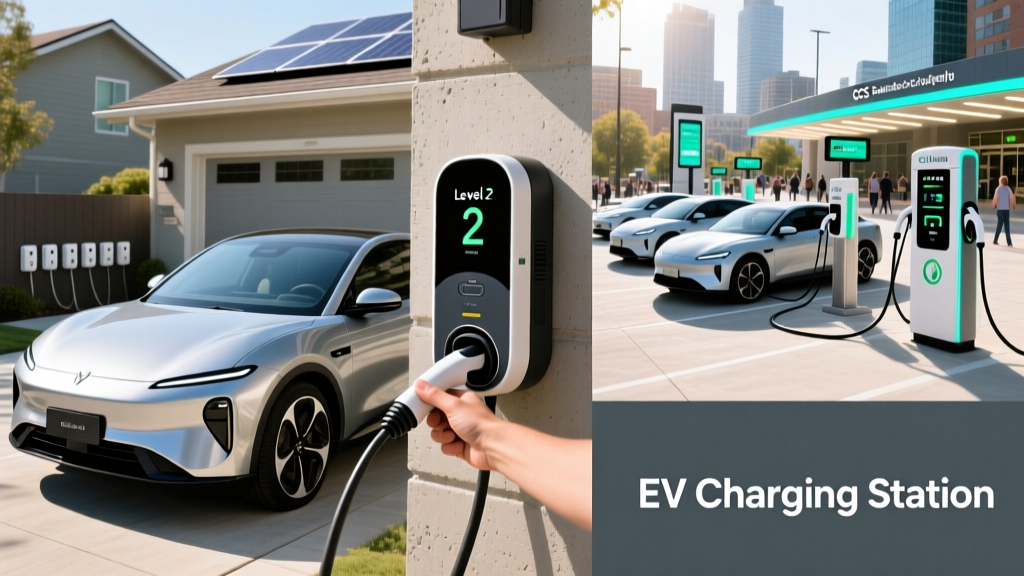
When EV buyers search for the fastest EV chargers, they're usually asking two different questions: How quickly can I charge at home overnight? And how fast can a DC fast charger replenish my battery on a road trip? The answer depends on the three charging levels, each with distinct power (kW) and energy-delivery characteristics.
A quick refresher on the single most important distinction in EV charging: kW (kilowatts) measures power—the rate at which energy flows into your battery. kWh (kilowatt-hours) measures energy—the total capacity of your battery. Think of kW as the flow rate of a hose and kWh as the size of the bucket. A 100 kWh battery charged at 50 kW takes roughly twice as long as one charged at 100 kW, all else being equal.
| Level | Voltage | Power (kW) | Miles of Range Added Per Hour | Typical Use Case |
|---|---|---|---|---|
| Level 1 | 120V AC | 1.0–1.9 kW | 3–5 mi/hr | Overnight trickle; PHEV-friendly |
| Level 2 | 240V AC | 3.3–19.2 kW | 12–75 mi/hr | Home daily charging; workplace; destination |
| DC Fast Charge (DCFC) | 400–800V DC | 50–350+ kW | 150–1,200+ mi/hr (peak) | Road trips; rapid top-ups on public networks |
For most BEV owners, Level 2 home charging is the daily workhorse. A 19.2 kW Level 2 charger (80A on a 240V circuit) can add roughly 60–75 miles of range per hour, fully replenishing a 75 kWh battery overnight. DC fast charging is reserved for road trips and situations where you need to recover 200+ miles in under 30 minutes.
The Fastest Home Level 2 Chargers: Equipment Picks and Power Output
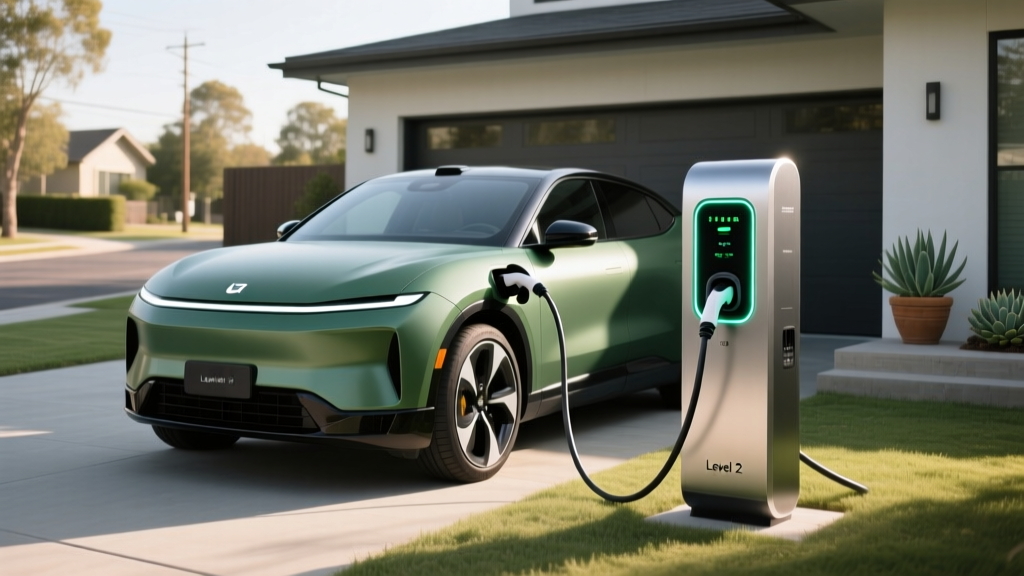
Not all Level 2 chargers are created equal. The fastest home chargers deliver 19.2 kW (80 amps) on a 240V circuit, but most homes are wired for 48-amp chargers (11.5 kW) or even 40-amp (9.6 kW) units. Here's how the top performers compare:
ChargePoint Home Flex (up to 50A / 12 kW)
- Max Power: 12 kW (50A) on a 60A dedicated circuit
- Connector: J1772 (NACS adapter required for Tesla vehicles)
- Cable Length: 23 feet
- Smart Features: Wi-Fi, scheduling, energy tracking, Alexa integration
- Price: ~$599
Ford Charge Station Pro (up to 80A / 19.2 kW)
- Max Power: 19.2 kW (80A) on a 100A dedicated circuit
- Connector: J1772 (NACS adapter for Tesla; native NACS version available)
- Cable Length: 25 feet
- Smart Features: FordPass app integration, bidirectional V2H capability with F-150 Lightning
- Price: ~$1,310
Tesla Wall Connector (up to 48A / 11.5 kW)
- Max Power: 11.5 kW (48A) on a 60A dedicated circuit
- Connector: NACS (native Tesla); CCS adapter available separately (~$250)
- Cable Length: 24 feet
- Smart Features: Wi-Fi, over-the-air updates, power sharing between units, Tesla app
- Price: ~$475
Emporia Vue Level 2 (up to 48A / 11.5 kW)
- Max Power: 11.5 kW (48A) on a 60A dedicated circuit
- Connector: J1772
- Cable Length: 24 feet
- Smart Features: Energy monitoring with whole-home panel integration, solar-aware scheduling
- Price: ~$399
Real-world note: While 80A/19.2 kW chargers like the Ford Charge Station Pro are the fastest Level 2 units available, they require a 100A dedicated circuit and most residential electrical panels cannot support this without an upgrade. For most homes, a 48A (11.5 kW) charger on a 60A circuit is the practical maximum—and it will still fully charge any current-production EV overnight.
Public DC Fast Charging: Peak Speeds, Charge Curves, and Network Reality
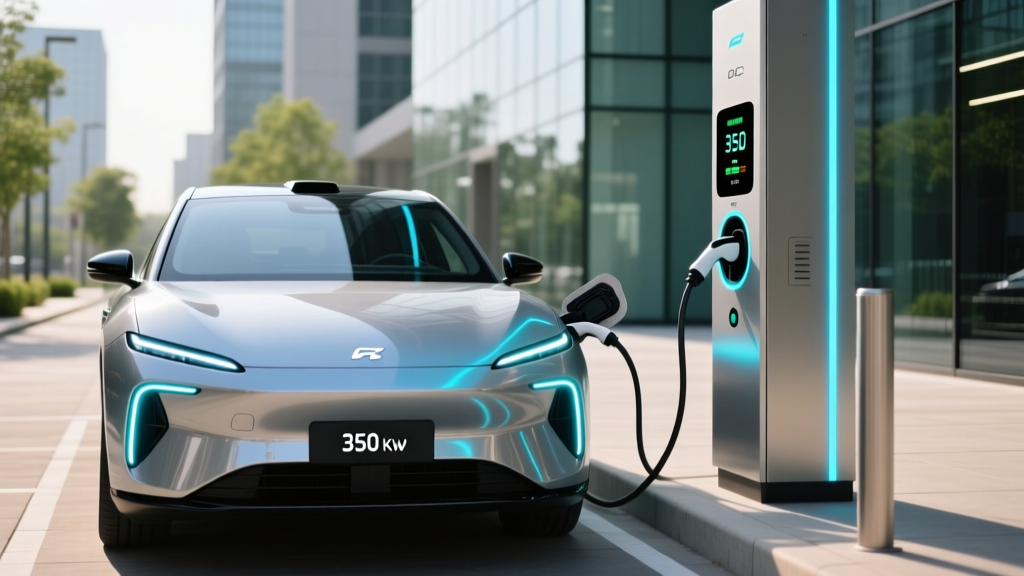
The fastest public EV chargers in the U.S. as of 2026 are 350 kW DCFC stations operated by Electrify America, EVgo, and Ionity-affiliated networks. Tesla's V4 Superchargers deliver up to 250–350 kW depending on the site. But peak kW tells only part of the story.
EV batteries follow a charge curve: charging is fastest between roughly 10% and 50% State of Charge (SoC), then progressively tapers as the battery approaches full. A vehicle that peaks at 250 kW at 20% SoC might be pulling only 80 kW by the time it reaches 75% SoC. This is why manufacturers and reviewers cite 10–80% charge times rather than peak kW alone.
| Vehicle Example | Battery (kWh usable) | Peak DC Charge Rate (kW) | 10–80% Time (min) | Notes |
|---|---|---|---|---|
| Hyundai Ioniq 5 (2026) | 77.4 kWh (NMC) | 240 kW (800V architecture) | ~18 min | Sustains high rate to ~65% SoC |
| Tesla Model 3 Long Range (2026) | 75 kWh (NMC/LFP variant) | 250 kW | ~25 min | Preconditioning essential for peak rate |
| Chevrolet Equinox EV (2026) | 85 kWh (NMC) | 150 kW | ~35 min | Moderate taper above 60% |
| Rivian R1S Dual-Motor (2026) | 128 kWh (NMC) | 220 kW | ~38 min | Large battery = longer absolute time |
| Kia EV6 GT-Line (2026) | 77.4 kWh (NMC) | 240 kW (800V) | ~18 min | Same platform as Ioniq 5 |
Vehicles with 800-volt architectures (Hyundai Ioniq 5/6, Kia EV6/EV9, Porsche Taycan, Lucid Air) can sustain higher charge rates for longer portions of the curve, making them the best real-world performers at public DCFC stations. If you road-trip frequently, an 800V vehicle paired with a 350 kW-capable station is the fastest practical charging experience available.
How Much Does It Cost to Install a Home EV Charger?
The total cost of a Level 2 home charger installation varies enormously based on your electrical panel's capacity, the distance from panel to charger location, and local permit fees. Here's a realistic breakdown:
| Component | Low-End Estimate | High-End Estimate | Details |
|---|---|---|---|
| Level 2 Charger Equipment | $399 | $1,310 | Depends on brand, power output, smart features |
| Electrician Labor | $400 | $2,000 | Simple panel-to-garage run vs. long conduit run or attic routing |
| Electrical Permit | $50 | $300 | Varies by municipality; some jurisdictions waive for EV installs |
| Panel Upgrade (if needed) | $1,500 | $4,500 | Upgrading from 100A to 200A service; older homes often need this |
| Materials (conduit, wire, breaker) | $100 | $600 | Longer runs = more copper and conduit |
| Total (no panel upgrade) | $950 | $4,200 | Most homes with 200A service fall in this range |
| Total (with panel upgrade) | $2,450 | $8,700 | Common for homes built before 2000 with 100A service |
What Electrical Upgrades Might I Need?
A Level 2 charger drawing 48 amps requires a dedicated 60-amp breaker (the National Electrical Code requires circuits to be rated at 125% of continuous load). If your home has a 100-amp main panel, adding a 60A EV circuit may exceed your panel's capacity—especially if you're also running electric range, dryer, and HVAC. An electrician will perform a load calculation to determine if your existing panel can handle the additional draw.
Homes with 200A service (standard for most construction after ~2000) can usually accommodate a 48A or even 60A Level 2 charger without a panel upgrade. But if you need a 100A circuit for an 80A/19.2 kW charger, even a 200A panel may be tight. Plan for this possibility during initial quotes.
Connector Compatibility: NACS, CCS1, and CHAdeMO
The North American EV charging connector landscape has consolidated significantly since Tesla opened its Supercharger network. As of 2026, most new EVs sold in the U.S. ship with the NACS (North American Charging Standard) port, while many 2023–2025 models still on the road use CCS1 (Combined Charging System). The legacy CHAdeMO connector (used by the Nissan Leaf and Mitsubishi Outlander PHEV) is being phased out at public stations.
| Connector | Brands Using It (Native) | Public Network Access | Adapter Needs |
|---|---|---|---|
| NACS (Tesla standard) | Tesla, Ford, GM, Rivian, Volvo, Polestar, Hyundai/Kia (2025+), Mercedes-Benz | Tesla Supercharger (native), Electrify America (NACS stations expanding), EVgo | CCS-to-NACS adapter for legacy CCS-only stations (~$200–$250) |
| CCS1 | BMW, Volkswagen/ID.4 (2024 and earlier), Stellantis, some Hyundai/Kia (pre-2025) | Electrify America, EVgo, ChargePoint (native) | NACS-to-CCS adapter to access Tesla Superchargers (Ford/GM provide free adapters to owners) |
| CHAdeMO | Nissan Leaf (discontinued 2025), Mitsubishi Outlander PHEV | Declining availability; some Electrify America and EVgo stations still equipped | No reliable adapter to NACS/CCS; plan routes around CHAdeMO availability |
Adapter reality check: If you drive a CCS-equipped vehicle and want to access Tesla Superchargers—the largest and most reliable DCFC network in the U.S.—you'll need a NACS adapter. Ford and GM have been shipping these adapters to registered owners. If you drive a 2026 NACS-equipped vehicle and encounter a legacy CCS-only station, you'll need the reverse adapter. Keep the appropriate adapter in your vehicle at all times.
Cost to Charge: Home vs. Public vs. Gas Per Mile
One of the strongest economic arguments for EVs is the per-mile energy cost. But the savings depend heavily on where and when you charge. Here's a realistic comparison using 2026 national averages:
| Scenario | Rate | Cost Per kWh | Cost Per Mile (at 3 mi/kWh) | Annual Cost (12,000 mi) |
|---|---|---|---|---|
| Home Level 2 (off-peak utility rate) | $0.08–$0.14/kWh | $0.11 avg | $0.037 | $444 |
| Home Level 2 (standard residential rate) | $0.14–$0.22/kWh | $0.18 avg | $0.060 | $720 |
| Public Level 2 (ChargePoint, workplace) | $0.20–$0.40/kWh | $0.30 avg | $0.100 | $1,200 |
| Public DC Fast Charge (Electrify America, EVgo) | $0.35–$0.55/kWh | $0.45 avg | $0.150 | $1,800 |
| Tesla Supercharger (varies by location/time) | $0.25–$0.40/kWh | $0.32 avg | $0.107 | $1,284 |
| Gasoline vehicle (27 MPG avg, $3.40/gal) | $3.40/gal | — | $0.126 | $1,512 |
The data is clear: home charging at off-peak rates is the cheapest way to drive, at roughly one-quarter the cost of gasoline per mile. Even exclusive DC fast charging is competitive with gas in most markets. But if you rely solely on public DCFC at $0.45–$0.55/kWh, your per-mile cost can exceed a fuel-efficient gas car. This is why home Level 2 access is the single most important factor in EV ownership economics.
According to the U.S. Department of Energy's fueleconomy.gov, the average EV achieves 3–4 miles per kWh, while efficient models like the Tesla Model 3 and Hyundai Ioniq 6 can reach 4.5+ mi/kWh. Use your vehicle's actual efficiency (kWh/100mi as listed on the EPA Monroney label) to calculate your personal cost per mile.
Safety, Electrical Code, and Installation Best Practices
EV charging involves sustained high-current draw—unlike most household appliances that cycle on and off. This makes proper installation critical for fire safety and equipment longevity.
Key Safety and Code Requirements
- Dedicated circuit: Your Level 2 charger must be on its own dedicated circuit—never shared with other appliances. A 48A charger requires a 60A breaker; a 40A charger requires a 50A breaker.
- GFCI protection: The 2020 and 2023 NEC require GFCI (Ground Fault Circuit Interrupter) protection for outdoor EV charging outlets. Hardwired chargers with built-in ground-fault protection may satisfy this without a separate GFCI breaker.
- Outdoor rating: If your charger is installed outdoors (driveway, carport), ensure the unit carries a NEMA 4 or NEMA 4X rating for weather resistance. Most major chargers (ChargePoint Home Flex, Tesla Wall Connector) meet this standard.
- Wire gauge: A 60A circuit typically requires 6 AWG copper wire (THHN in conduit) or 4 AWG aluminum. Longer runs may require upsizing to reduce voltage drop. Your electrician will specify this.
- Permit and inspection: Virtually all jurisdictions require a permit and post-installation inspection for EV charger circuits. Skipping this step risks insurance denial in the event of an electrical fire.
Always hire a licensed electrician familiar with EV charger installations. According to the National Fire Protection Association (NFPA), improper EV charging installations have been linked to residential electrical fires—almost always traced to undersized wiring, missing permits, or shared circuits.
Frequently Asked Questions
How much does it cost to install a home EV charger?
For a typical 48A Level 2 charger on a 60A dedicated circuit, expect $950–$4,200 all-in (equipment + electrician + permit) if your panel can handle the load. If your home needs a panel upgrade from 100A to 200A service, add $1,500–$4,500. Always get at least two quotes from licensed electricians.
How fast will each charging level add range?
Level 1 (120V) adds roughly 3–5 miles per hour—adequate for PHEVs with small batteries but impractical for BEVs. Level 2 (240V) at 48A adds approximately 30–35 miles per hour for an average EV. At 80A (19.2 kW), that increases to 55–75 miles per hour. DC fast charging adds 150–1,200+ miles per hour at peak, but only for the first 10–30 minutes of a session before the charge curve tapers.
Which connector/charger is compatible with my EV?
If your EV is a 2025 or newer model from Ford, GM, Rivian, Tesla, Hyundai, Kia, Volvo, or Polestar, it almost certainly has a NACS port. Earlier models from Volkswagen, BMW, and Stellantis typically use CCS1. Check your owner's manual or the port on the vehicle itself. For home Level 2 charging, a J1772 connector works with all non-Tesla EVs, and a NACS connector works with Tesla and NACS-equipped vehicles. Many chargers now offer swappable connector options.
How much does charging cost per mile vs. gas?
Home charging at off-peak rates averages $0.037/mile—roughly 70% cheaper than gasoline at $0.126/mile (27 MPG, $3.40/gallon). Standard residential home charging costs about $0.06/mile. Public DC fast charging at $0.45/kWh averages $0.15/mile, which is slightly more than gas. The economic case for EVs is strongest when you can charge at home.
What electrical upgrades might I need?
If your home has 200A electrical service (common in homes built after 2000), you can usually add a 48A Level 2 charger without a panel upgrade. Homes with 100A service—common in older construction—often need a panel upgrade to 200A, which costs $1,500–$4,500. An electrician's load calculation will determine your specific needs. Some utilities offer rebates for panel upgrades when paired with EV charger installation.
Can I use a NACS-to-CCS adapter at any Supercharger?
Tesla has been opening Supercharger stalls to non-Tesla EVs equipped with NACS adapters, but not all stalls are enabled for non-Tesla vehicles. Use the Tesla app to locate compatible stalls. Ford and GM owners with complimentary NACS adapters generally have the broadest access. Always verify stall compatibility before planning a route around Superchargers.
For the most current federal tax credit rules that may apply to home charger equipment and installation, consult the IRS Alternative Fuel Vehicle Refueling Property Credit (Form 8911)—this separate credit (up to $1,000 for residential charging equipment) is distinct from the §30D new EV purchase credit and has its own income and location-based eligibility requirements.