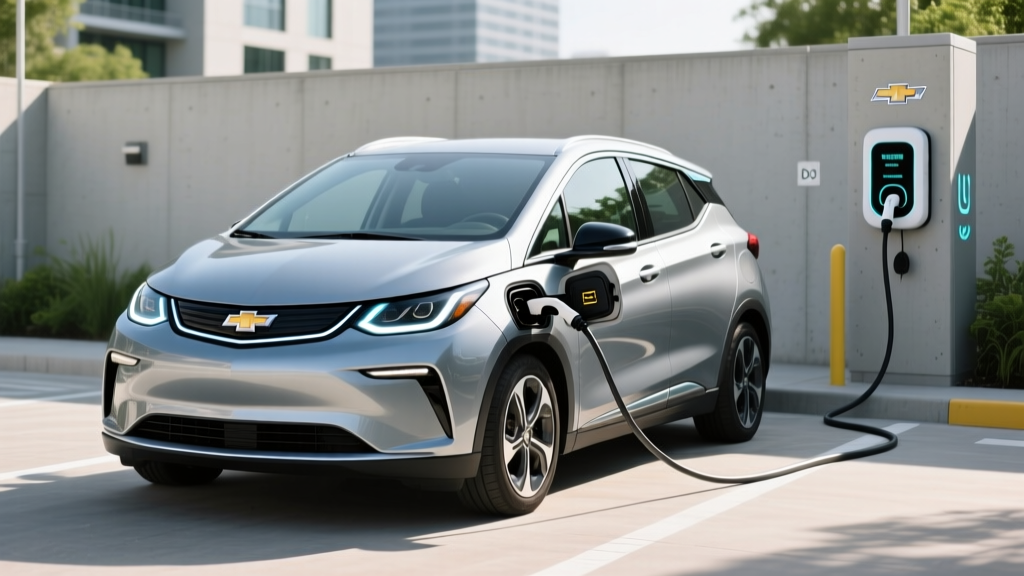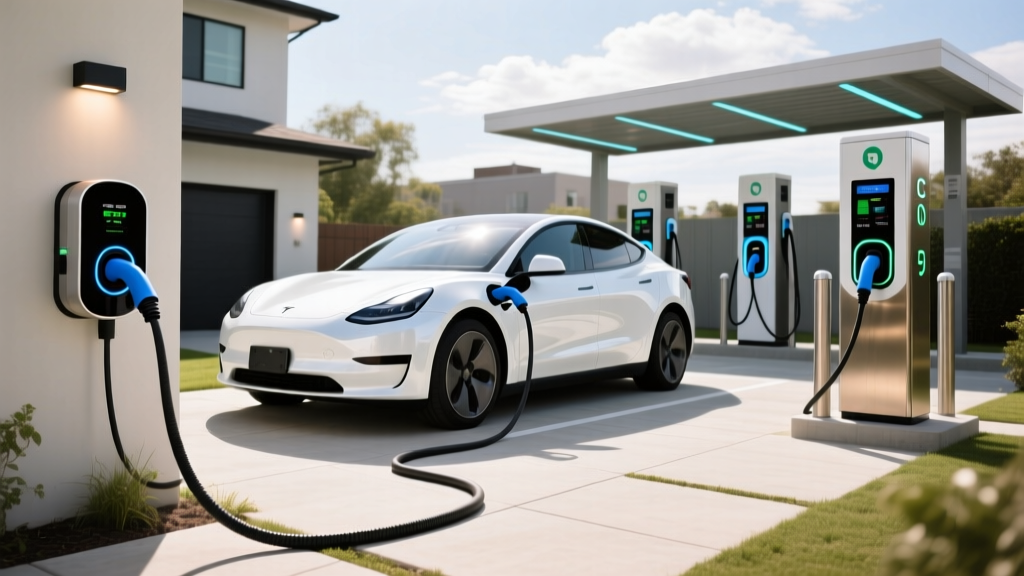
If you have ever pulled up to a public DC fast charger, plugged in, and watched the stall struggle to push past 30 kW when the sticker promised 350 kW, you know the frustration. The "fast and the furious charger" experience is real — but it is not random. Charging speed depends on your vehicle's onboard acceptance rate, the station's actual output, battery temperature, and state of charge. This guide breaks down exactly what each charging level delivers, what home installation costs, and which equipment actually performs in 2026.
kW (kilowatts) measures power — how fast energy flows into your battery, like water pressure from a hose.
kWh (kilowatt-hours) measures energy — the total capacity stored in your battery, like gallons in a tank.
A 150 kW charger delivers energy quickly; a 75 kWh battery stores 75 kWh of energy. Never use these interchangeably.
Charging Levels Explained: How Fast Will Each Level Add Range?
Every EV sold in the US charges at one of three levels. The miles-per-hour figures below assume a vehicle averaging 3.0 to 3.5 miles per kWh (typical for midsize crossovers like the Hyundai Ioniq 5, Tesla Model Y, or Ford Mustang Mach-E). Larger trucks like the Rivian R1T or Ford F-150 Lightning will see lower miles-per-hour at the same kW because they consume more energy per mile.
| Level | Voltage / Amps | Power (kW) | Miles of Range Added per Hour | Typical Use Case |
|---|---|---|---|---|
| Level 1 | 120V / 12A | 1.4 kW | 3–5 mi/hr | Overnight trickle; PHEV top-ups |
| Level 2 | 240V / 32–48A | 7.7–11.5 kW | 25–44 mi/hr | Home daily charging; workplace |
| DC Fast (Level 3) | 400–900V DC | 50–350 kW | 150–1,200+ mi/hr (peak) | Road trips; rapid top-ups |
Real-world DC fast charging reality check: Peak kW is a marketing headline, not a sustained rate. A vehicle advertising 250 kW peak charging will typically sustain that rate only between roughly 10% and 40% state of charge. Above 80%, the charge curve tapers sharply to protect battery health. A "10–80% in 18 minutes" claim assumes optimal battery temperature (preconditioning active) and a station that can actually deliver the rated power. On a 350 kW Electrify America stall, a Hyundai Ioniq 5 (84 kWh battery, 800V architecture) can genuinely achieve 10–80% in about 18 minutes. A 400V vehicle on the same stall might take 28–35 minutes for the same session because it cannot accept as much power simultaneously.
Home EV Charger Installation: Cost, Electrical Requirements, and Panel Upgrades
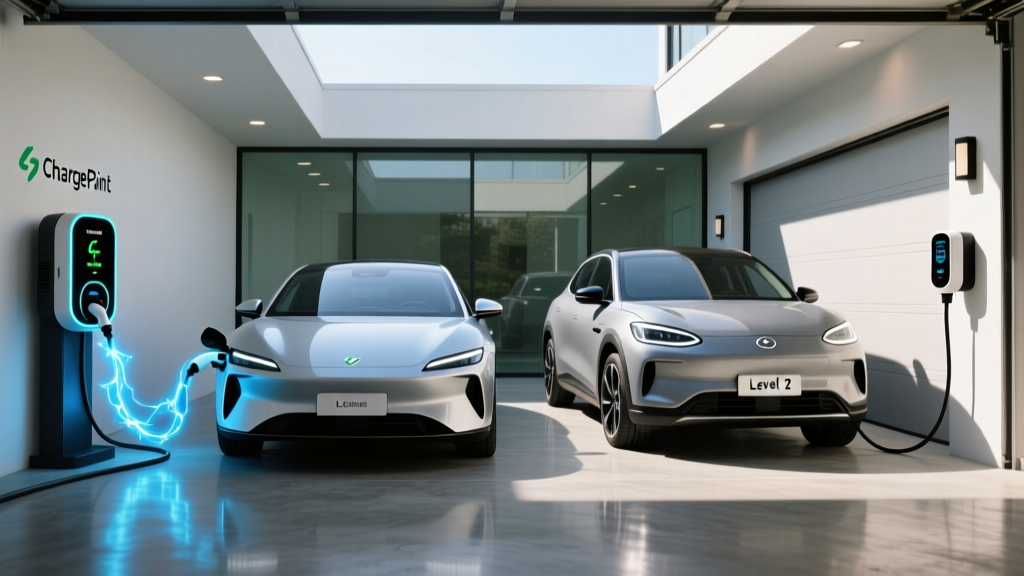
Installing a dedicated Level 2 home charger is the single most impactful upgrade for daily EV ownership. You wake up every morning with a full battery, and your cost per mile drops to a fraction of gasoline. But the installation cost varies enormously based on your home's electrical panel, the distance from panel to charger location, and local permitting requirements.
Electrical Requirements for Level 2 Charging
A Level 2 charger requires a 240-volt dedicated circuit, identical in concept to what your electric dryer or oven uses. The most common configurations:
- 40-amp circuit / 32A continuous charge: Delivers 7.7 kW. Adequate for most EVs and the most common residential install. Requires 6 AWG copper wire.
- 50-amp circuit / 40A continuous charge: Delivers 9.6 kW. Recommended if you own a large-battery vehicle (100+ kWh) or want faster top-ups. Requires 6 AWG copper wire.
- 60-amp circuit / 48A continuous charge: Delivers 11.5 kW. Maximum for most residential chargers. Requires 4 AWG copper wire. Best for high-use households with two EVs.
Panel upgrade reality: The National Electrical Code (NEC) requires that your total electrical load not exceed 80% of your panel's rated capacity. If you have a 100-amp panel (common in homes built before 1990), adding a 40-amp EV circuit may push you over the limit, requiring a panel upgrade to 200 amps. This is the single biggest cost variable in EV charger installation and the one most online guides gloss over.
Installation Cost Breakdown
| Component | Low Estimate | High Estimate | Notes |
|---|---|---|---|
| Level 2 Charger Unit | $350 | $750 | Smart Wi-Fi chargers (ChargePoint, Emporia, Wallbox) |
| Electrician Labor | $400 | $1,500 | Depends on run length, conduit, wall material |
| Permit & Inspection | $50 | $300 | Varies by municipality; some waive for EV installs |
| Electrical Panel Upgrade (if needed) | $1,500 | $4,000 | 100A to 200A service upgrade; not always required |
| Additional Materials | $100 | $500 | Conduit, wire, junction boxes, NEMA 14-50 outlet or hardwire |
| TOTAL (no panel upgrade) | $900 | $3,050 | Most installations fall in the $1,200–$2,000 range |
| TOTAL (with panel upgrade) | $2,400 | $7,050 | Older homes with 100A service |
According to data aggregated by the U.S. Department of Energy, the national average for a straightforward Level 2 install (no panel upgrade, short wire run) is approximately $1,200 to $2,000. The federal Alternative Fuel Vehicle Refueling Property Credit (§30C) offers up to $1,000 (30% of equipment and installation costs) for home charger installs, though it is subject to census-tract eligibility requirements — check the IRS §30C page for current qualification maps.
Connector Compatibility: NACS, CCS1, and CHAdeMO in 2026
The connector landscape has shifted dramatically since 2024, when Ford and General Motors adopted the North American Charging Standard (NACS), originally developed by Tesla. By 2026, NACS is the dominant light-duty EV connector in the United States, but legacy CCS1 vehicles and chargers remain widespread.
| Connector | Native Vehicle Brands | Adapter Needed For | Public Charger Availability |
|---|---|---|---|
| NACS (Tesla) | Tesla, Ford, GM, Rivian, Volvo, Polestar, Mercedes, Fisker | CCS1 stations (adapter often included with vehicle) | Tesla Supercharger network (20,000+ stalls); growing NACS on other networks |
| CCS1 | Hyundai, Kia, BMW, VW, Audi, Porsche (Taycan), Subaru, Honda | Tesla Superchargers (Magic Dock or adapter required) | Electrify America, EVgo, ChargePoint — widely available |
| CHAdeMO | Nissan Leaf (legacy) | N/A — declining network | Limited; most new DC stations prioritize CCS1/NACS |
Adapter guidance: If you own a CCS1-native vehicle (like a Hyundai Ioniq 5 or Kia EV6) and want to access Tesla Superchargers, Tesla sells a CCS-to-NACS adapter for approximately $200–$250. Ford and GM vehicles shipping with NACS ports since 2025 include adapters for legacy CCS stations. Always verify your adapter is rated for the full DC fast charging power your vehicle can accept — some cheaper third-party adapters cap at 50 kW.
Cost to Charge: Per-Mile Economics vs. Gasoline
The economic case for EV charging hinges on where and when you charge. Home charging on a time-of-use (TOU) plan delivers the lowest cost per mile, while public DC fast charging can approach or occasionally exceed gasoline costs per mile.
| Scenario | Rate ($/kWh) | Vehicle Efficiency | Cost Per Mile | Annual Cost (12,000 mi) |
|---|---|---|---|---|
| Home Level 2 — Off-Peak TOU | $0.08–$0.12 | 3.2 mi/kWh | $0.025–$0.038 | $300–$450 |
| Home Level 2 — Standard Rate | $0.13–$0.18 | 3.2 mi/kWh | $0.041–$0.056 | $490–$675 |
| Public Level 2 (ChargePoint, etc.) | $0.20–$0.35 | 3.2 mi/kWh | $0.063–$0.109 | $750–$1,310 |
| DC Fast Charging (EA, EVgo) | $0.35–$0.55 | 3.2 mi/kWh | $0.109–$0.172 | $1,310–$2,060 |
| Gasoline Car (28 MPG combined, $3.40/gal) | — | 28 MPG | $0.121 | $1,457 |
The takeaway: Home off-peak charging costs roughly 25–30% of what gasoline costs per mile. Even public DC fast charging, the most expensive EV scenario, is often competitive with gasoline. But if you rely exclusively on DC fast charging, your annual fuel cost can exceed that of an efficient hybrid. According to fueleconomy.gov, the average EV achieves 100–130 MPGe combined, translating to the per-mile costs above.
Equipment Picks: Best Home Level 2 Chargers in 2026
Not all Level 2 chargers are equal. Smart chargers with Wi-Fi connectivity enable scheduled off-peak charging (critical for TOU rate savings), firmware updates, and energy monitoring. Below are three field-tested recommendations across price tiers.
Emporia Vue Level 2 Smart Charger
- Power: 48A / 11.5 kW (on 60A circuit)
- Connector: NACS or J1772 (select at purchase)
- Cable Length: 24 ft
- Smart Features: Wi-Fi, load management (pairs with Emporia Vue energy monitor to avoid panel overload), scheduled charging, energy tracking
- Price: ~$399
- Best For: Budget-conscious buyers who want full smart features and load management without a panel upgrade
ChargePoint Home Flex
- Power: Up to 50A / 12 kW (adjustable via DIP switch: 16A–50A)
- Connector: NACS or J1772
- Cable Length: 23 ft
- Smart Features: Wi-Fi, Alexa/Google integration, ChargePoint app scheduling, detailed session history
- Price: ~$549
- Best For: Reliable mid-range option with strong app ecosystem and flexible amperage
Tesla Wall Connector
- Power: 48A / 11.5 kW (on 60A circuit)
- Connector: NACS native (J1772 adapter included)
- Cable Length: 24 ft
- Smart Features: Wi-Fi, power sharing (link two units on one circuit for dual-EV garages), OTA updates, sleek design
- Price: ~$475
- Best For: Tesla owners and NACS-native vehicles; best-in-class power-sharing for two-EV homes
10–80% Charging Times: What to Expect by Battery Size
Charging time depends on three factors: your battery's usable capacity (kWh), the peak charge rate your vehicle accepts (kW), and the station's actual output. Below are representative times for common battery sizes at different charger types, assuming optimal battery preconditioning.
| Battery Size (Usable kWh) | Example Vehicles | Level 2 at 11.5 kW | DC Fast (150 kW peak) | DC Fast (250–350 kW peak) |
|---|---|---|---|---|
| 60–65 kWh | Tesla Model 3 RWD, Chevy Equinox EV | ~4.0 hrs | ~30 min | ~22 min |
| 75–84 kWh | Hyundai Ioniq 5, Tesla Model Y LR, Ford Mach-E ER | ~5.0 hrs | ~32 min | ~18 min (800V) |
| 100–110 kWh | Ford F-150 Lightning ER, Rivian R1S, BMW iX | ~7.0 hrs | ~45 min | ~30 min |
| 130+ kWh | GMC Hummer EV, Chevy Silverado EV | ~9.5 hrs | ~60 min | ~40 min |
Cold-weather caveat: In sub-freezing temperatures, expect 10–80% DC fast charging times to increase by 20–40% unless your vehicle has active battery preconditioning (most modern EVs do, but it must be activated via navigation to the charger or a preconditioning button). Lithium-ion chemistry resists accepting charge at low temperatures, and the battery management system will throttle power to protect the cells.
Safety, Code Compliance, and Installation Best Practices
EV charger installation is electrical work that must comply with the National Electrical Code (NEC Article 625) and local amendments. Key requirements that protect you and your home:
- Dedicated circuit: Your Level 2 charger must be on its own dedicated breaker — not shared with other appliances. This prevents overloading and tripped breakers during charging sessions.
- GFCI protection: NEC 2020 and later require GFCI (ground-fault circuit interrupter) protection for outdoor receptacles used for EV charging. Hardwired installations may have different requirements depending on jurisdiction.
- Outdoor rating: If your charger is mounted outside (garage exterior, carport, driveway), it must carry a NEMA 3R or NEMA 4 weather-resistance rating. All chargers recommended above are outdoor-rated.
- NEMA 14-50 vs. hardwire: A NEMA 14-50 outlet offers portability (take the charger when you move) but requires a GFCI breaker (adds $80–$150). Hardwired installations eliminate the outlet, reduce failure points, and may not require GFCI in some jurisdictions — consult your electrician.
- Permit and inspection: Most municipalities require an electrical permit for EV charger installation. The inspection verifies correct wire gauge, breaker sizing, grounding, and GFCI compliance. Skipping the permit risks voiding homeowner insurance coverage for electrical fires.
Frequently Asked Questions
How much does it cost to install a home EV charger?
A straightforward Level 2 installation (no panel upgrade, short wire run) costs $900 to $3,050 total, including the charger unit ($350–$750), electrician labor ($400–$1,500), and permits ($50–$300). If your home has a 100-amp panel and needs a 200-amp upgrade, add $1,500 to $4,000, bringing the total to $2,400–$7,050. The federal §30C tax credit can offset up to $1,000 of this cost for eligible installations.
How fast will each charging level add range?
Level 1 (120V) adds 3–5 miles per hour. Level 2 (240V) adds 25–44 miles per hour depending on amperage. DC fast charging adds 150–1,200+ miles per hour at peak, though sustained rates taper significantly above 80% state of charge. Actual miles per hour depend on your vehicle's efficiency (mi/kWh).
Which connector and charger is compatible with my EV?
Check your vehicle's charge port. Tesla, Ford, GM, Rivian, and Volvo/Polestar use NACS in 2026. Hyundai, Kia, BMW, VW, and most legacy EVs use CCS1. The Nissan Leaf uses CHAdeMO. For home Level 2 charging, NACS vehicles use a NACS Wall Connector; CCS1 vehicles use a J1772 charger (J1772 is the Level 2 standard that pairs with the CCS1 DC port). Adapters bridge the gap between standards.
How much does charging cost per mile compared to gas?
Home off-peak charging costs $0.025–$0.038 per mile, roughly 25–30% of the $0.121 per mile for a 28 MPG gasoline car at $3.40/gallon. Public DC fast charging costs $0.109–$0.172 per mile — competitive with or slightly above gasoline. The more you charge at home, the greater your savings.
What electrical upgrades might I need for a home charger?
The most common upgrade is a panel increase from 100A to 200A service, required when your existing panel lacks capacity for a dedicated 40–60A EV circuit. Other potential upgrades include replacing a Federal Pacific or Zinsco panel (known fire hazards that fail modern inspection), adding a sub-panel if the charger is far from the main panel, or upgrading the service drop wire from the utility. A licensed electrician will perform a load calculation per NEC Article 220 to determine your exact needs.