Search for EV charging equipment and you'll eventually encounter the term fast 5 charger — a phrase that mixes marketing shorthand with genuine technical meaning. In practice, it usually refers to a Level 2 home wallbox delivering up to 11.5 kW (48 amps on a 240V/60A circuit) or a compact DC fast unit in the 5–20 kW range designed for residential or light-commercial use. Neither is a formal industry standard, but the concept maps to a real buyer question: how do I get the fastest practical charge at home without rewiring my entire house?
This guide dissects what "fast" actually means across Level 1, Level 2, and DC fast charging, translates kilowatts into real miles-per-hour of range, and gives you the exact electrical requirements, installation costs, and equipment picks to make a confident decision in 2026.
The kW vs. kWh Distinction You Cannot Skip
Before comparing chargers, lock in the single most important EV literacy point: kW (kilowatts) measures power — the rate of energy flow, like water pressure in a hose. kWh (kilowatt-hours) measures energy — the total amount stored or delivered, like gallons in a bucket.
A charger rated at 11.5 kW delivers energy at that rate. A 75 kWh battery charged from empty at a sustained 11.5 kW would theoretically fill in about 6.5 hours. Real-world charging is never perfectly linear — thermal management, state of charge (SoC), and taper curves all affect actual time — but this mental model keeps you honest when manufacturers advertise "up to" figures.
Charging Levels Decoded: Speeds in kW and Miles Per Hour
Every EV sold in the US charges at one of three levels. The table below translates each into the numbers that matter: power draw in kW and approximate miles of range added per hour of charging.
| Level | Voltage / Circuit | Power (kW) | Miles of Range / Hour | Typical Use |
|---|---|---|---|---|
| Level 1 | 120V / 15–20A | 1.2–1.9 kW | 3–5 mi/hr | Overnight trickle; PHEVs; emergency backup |
| Level 2 | 240V / 20–60A | 3.8–11.5 kW | 12–44 mi/hr | Primary home charging; workplace; public destinations |
| DC Fast (Level 3) | 400–800V DC | 50–350 kW | 150–1,000+ mi/hr | Highway travel; rapid top-ups; commercial fleets |
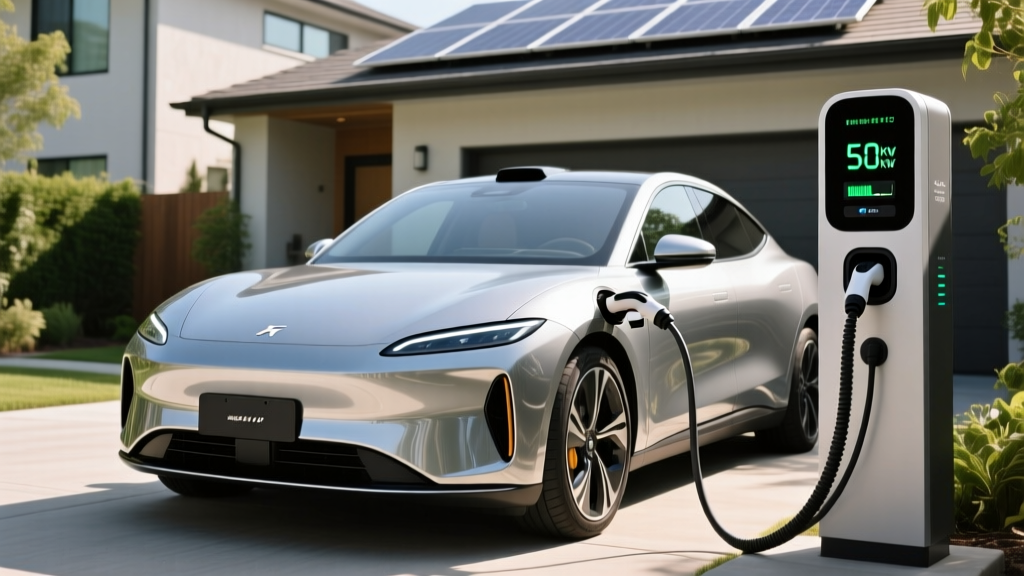
The "fast 5" concept slots into two places: the upper end of Level 2 (roughly 11.5 kW, which some brands market as "5x faster than Level 1") and low-power DC fast units in the 5–20 kW bracket that some homeowners install when they have solar surplus or want faster turnaround than Level 2 allows.
Charging Time Examples: What to Expect With Common Battery Sizes
Here's how long it takes to charge from 10% to 80% SoC — the practical window most EV owners use — across three common battery capacities:
| Battery (kWh usable) | Example Vehicles | Level 1 (1.4 kW) | Level 2 (7.7 kW / 32A) | Level 2 (11.5 kW / 48A) | DC Fast (150 kW peak) |
|---|---|---|---|---|---|
| 60 kWh | Chevy Equinox EV, base Tesla Model 3 | ~30 hrs | ~5.5 hrs | ~3.7 hrs | ~22 min |
| 82 kWh | Tesla Model Y LR, Hyundai Ioniq 5 | ~41 hrs | ~7.5 hrs | ~5 hrs | ~25 min |
| 100 kWh | Ford F-150 Lightning Ext., Rivian R1S | ~50 hrs | ~9 hrs | ~6 hrs | ~30 min |
For most EV owners driving 30–40 miles daily, a Level 2 charger at 7.7 kW or higher replenishes a full day's driving in under 2 hours. The "fast 5" upgrade to 11.5 kW matters most for drivers covering 60+ miles daily, towing, or those who want the battery fully topped up by morning after arriving home nearly empty.
Home Installation: Electrical Requirements, Costs, and Panel Gotchas
A Level 2 charger is only as good as the circuit feeding it. Here's what the electrical side actually requires.
Voltage, Amperage, and Circuit Sizing
Level 2 chargers run on 240V — the same voltage as an electric dryer or oven. The National Electrical Code (NEC) requires that continuous loads (anything running 3+ hours, which includes EV charging) use only 80% of a circuit's rated capacity. So a 48A charger needs a 60A circuit; a 32A charger needs a 40A circuit.
- 32A charger (7.7 kW): Requires a 240V/40A dedicated circuit with 8 AWG copper wire
- 40A charger (9.6 kW): Requires a 240V/50A dedicated circuit with 6 AWG copper wire
- 48A charger (11.5 kW): Requires a 240V/60A dedicated circuit with 4 AWG copper wire
Do You Need a Panel Upgrade?
This is the cost variable that catches buyers off guard. Most modern homes have 200A electrical service panels. If your panel is already near capacity — running electric heat, a tankless water heater, and a dryer simultaneously — adding a 60A EV circuit may exceed your panel's safe load. A licensed electrician will perform a load calculation to determine if you need a panel upgrade to 200A or even 400A service.
Homes with 100A panels (common in pre-1980 construction) almost always need an upgrade for a 48A charger. Options include:
- Panel upgrade to 200A ($2,500–$5,000+ depending on utility requirements)
- Installing a smaller 32A charger that fits within existing capacity
- A smart load-management device (e.g., Emporia or Span panel integration) that dynamically reduces charger draw when other appliances cycle on
Installation Cost Breakdown
| Component | Simple Install (panel nearby, no upgrade) | Complex Install (long wire run or panel upgrade) |
|---|---|---|
| Level 2 Charger Unit | $350–$700 | $350–$700 |
| Electrical Permit | $50–$200 | $50–$300 |
| Electrician Labor + Materials | $300–$800 | $800–$2,500 |
| Panel Upgrade (if needed) | $0 | $2,500–$5,000+ |
| Total Estimated Cost | $700–$1,700 | $3,700–$8,500+ |
Always get at least two quotes from licensed electricians. Ask specifically about the load calculation, wire gauge, conduit requirements, and whether the quote includes the permit and final inspection. According to Energy.gov's home charging guide, permitted installations protect your warranty and insurance coverage.
Connector Compatibility: NACS, CCS1, and CHAdeMO in 2026
The connector landscape has consolidated significantly since Tesla opened its Supercharger network and the North American Charging Standard (NACS) was adopted by nearly every major automaker. Here's where things stand for 2026 model-year vehicles:
| Connector | Brands Using It (Factory) | Notes |
|---|---|---|
| NACS (Tesla-style) | Tesla, Ford, GM, Rivian, Volvo, Polestar, Mercedes, Nissan (new models) | Native access to Tesla Superchargers; becoming the dominant US standard |
| CCS1 | Hyundai, Kia, BMW, VW, Audi, Stellantis brands | Widely supported at Electrify America, EVgo, ChargePoint DC stations |
| CHAdeMO | Nissan Leaf (legacy), Mitsubishi Outlander PHEV | Being phased out; fewer new stations adding CHAdeMO connectors |
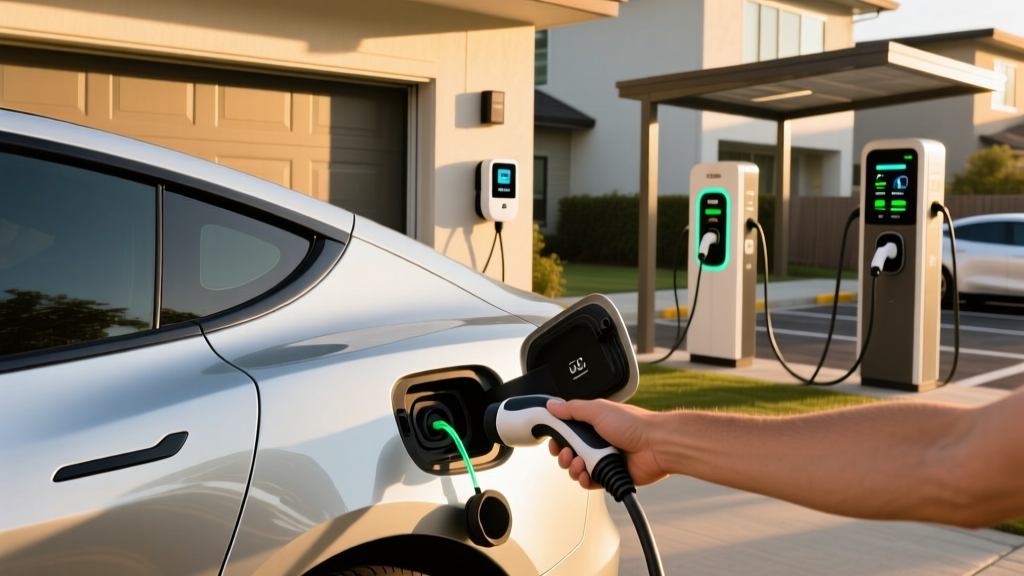
If you're buying a home Level 2 charger, note that all Level 2 chargers use the J1772 connector (or a NACS connector with J1772 signaling). Tesla vehicles include a J1772 adapter in the glovebox. New NACS-equipped non-Tesla EVs may ship with a J1772-to-NACS adapter, or you can buy a universal home charger with a NACS plug directly (e.g., the Tesla Wall Connector, which now supports non-Tesla NACS vehicles).
Cost to Charge: Per-Mile Economics vs. Gasoline
Charging cost depends entirely on where and when you plug in. The table below uses a national average EV efficiency of 3.0 miles/kWh (roughly 112 MPGe) and a gas vehicle at 28 MPG combined on $3.40/gallon regular.
| Charging Scenario | Avg. $/kWh | Cost per Mile | Annual Cost (12,000 mi) |
|---|---|---|---|
| Home, off-peak utility rate | $0.09–$0.13 | $0.030–$0.043 | $360–$520 |
| Home, standard residential rate | $0.14–$0.18 | $0.047–$0.060 | $560–$720 |
| Public Level 2 (ChargePoint, etc.) | $0.25–$0.49 | $0.083–$0.163 | $1,000–$1,960 |
| DC Fast (Electrify America, EVgo) | $0.35–$0.55 | $0.117–$0.183 | $1,400–$2,200 |
| Gas vehicle (28 MPG, $3.40/gal) | — | $0.121 | $1,457 |
The takeaway: home charging on an off-peak or time-of-use plan delivers per-mile costs roughly one-quarter to one-third of gasoline. Public DC fast charging, while convenient for road trips, can equal or exceed gas costs per mile. This is why a reliable home Level 2 setup — even a "fast 5" 11.5 kW unit — pays for itself within 1–2 years for most drivers.
Equipment Picks: Top Home Chargers for 2026
These are the Level 2 wallboxes we recommend based on power output, build quality, smart features, cable management, and real-world reliability across multiple EV platforms.
Tesla Wall Connector (Gen 4)
- Power: Up to 11.5 kW (48A)
- Connector: NACS (native); J1772 adapter available
- Cable: 24 ft
- Smart Features: Wi-Fi, OTA updates, load sharing between units, access control
- Price: ~$475
- Best For: Tesla owners and NACS-equipped EVs; multi-charger households
ChargePoint Home Flex
- Power: Up to 12 kW (50A) on a 60A circuit; configurable down to 16A
- Connector: J1772 (NACS adapter included in latest revision)
- Cable: 23 ft
- Smart Features: Wi-Fi, app scheduling, Alexa integration, detailed energy reports
- Price: ~$550–$650
- Best For: Mixed-brand households; users who want granular energy data
Emporia Level 2 EV Charger
- Power: Up to 11.5 kW (48A)
- Connector: J1772
- Cable: 24 ft
- Smart Features: Wi-Fi, integration with Emporia Vue energy monitor, solar-aware charging
- Price: ~$400
- Best For: Solar owners; budget-conscious buyers who still want 48A output
All three units are NEMA 4 rated for indoor/outdoor use, UL-listed, and qualify for the IRS Residential Clean Energy Credit — which covers 30% of charger equipment and installation costs up to $1,000 (through 2032, subject to census-tract eligibility). Check irs.gov for current qualification maps before purchasing.
Safety, Code, and Best Practices
EV charging draws sustained high current for hours — more like a furnace than a phone charger. Safety isn't optional:
- Dedicated circuit: Your EV charger must have its own breaker. Never share a circuit with other appliances.
- GFCI protection: NEC 2023 and later require GFCI protection for all EV charging outlets (not hardwired units, which have internal ground-fault protection). Hardwiring your charger avoids nuisance GFCI trips that plague some outlet installations.
- Outdoor rating: If mounting outside, ensure the unit is NEMA 4 (weather-resistant) and the connector holster protects the plug from rain and debris.
- Hardwire vs. plug: Hardwired installations (no plug) are preferred for 48A+ chargers. A NEMA 14-50 outlet is acceptable up to 40A continuous (50A breaker), but many electricians report outlet loosening and thermal issues at sustained high draw. Hardwiring also eliminates the GFCI breaker requirement.
- Permit and inspection: Always pull an electrical permit. The inspection ensures wire gauge, breaker sizing, and bonding are correct — and it protects your homeowner's insurance coverage in the event of a fault.
Frequently Asked Questions
How much does it cost to install a home EV charger?
A straightforward Level 2 installation (short wire run, no panel upgrade, hardwired) typically costs $700–$1,700 including equipment, electrician labor, and permit. Complex installations with long conduit runs or a panel upgrade can reach $3,700–$8,500+. The 30% federal clean-energy credit (up to $1,000) can offset a portion of this cost if you're in an eligible census tract.
How fast will each charging level add range?
Level 1 (120V) adds roughly 3–5 miles of range per hour. Level 2 (240V) adds 12–44 miles per hour depending on amperage — a 48A/11.5 kW charger adds about 37–44 miles per hour for an efficient sedan. DC fast charging adds 150–1,000+ miles per hour at peak, but sessions are measured in minutes (typically 18–35 minutes for a 10–80% charge), not hours.
Which connector/charger is compatible with my EV?
For Level 2 home charging, all EVs accept either a J1772 plug or a NACS plug. Tesla vehicles use NACS natively and include a J1772 adapter. New 2025–2026 Ford, GM, Rivian, and Volvo models also use NACS. Hyundai, Kia, BMW, and VW still use CCS1 for DC fast charging but accept J1772 for Level 2. Check your vehicle's charge port — if it's a smaller, round 5-pin port, it's NACS. If it's a larger, oval port with two extra DC pins below, it's CCS1.
How much does charging cost per mile vs. gas?
Home charging on an off-peak utility rate costs roughly $0.03–$0.04 per mile — about one-quarter the cost of a 28 MPG gas vehicle at $3.40/gallon ($0.12/mile). Even standard residential rates ($0.14–$0.18/kWh) deliver $0.05–$0.06/mile. Public DC fast charging at $0.35–$0.55/kWh costs $0.12–$0.18/mile, which equals or exceeds gasoline. Home charging is where the economics overwhelmingly favor EVs.
What electrical upgrades might I need?
The most common upgrade is adding a 240V circuit from your panel to your garage or driveway — this requires wire, conduit, and a breaker. The expensive scenario is a panel upgrade: if your home has a 100A service panel, or a 200A panel that's already heavily loaded, you may need to upgrade to 200A or 400A service ($2,500–$5,000+). A load calculation by a licensed electrician is the definitive answer. Alternatives include choosing a lower-amperage charger (32A instead of 48A) or installing a smart load-management device that throttles the charger when other appliances are drawing heavily.