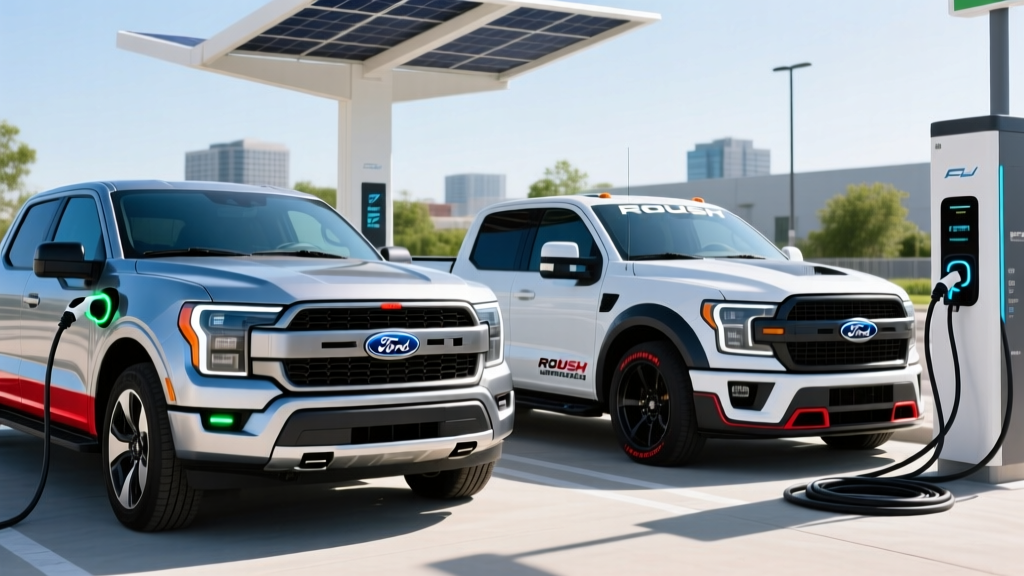
If you're cross-shopping a Ford F-150 Lightning against a F150 Roush supercharged build, the headline horsepower numbers tell only half the story. A Roush-supercharged 5.0L Coyote V8 puts down 650–700 hp and sounds like thunder, but it also drinks premium fuel at 12–15 mpg combined. The Lightning counters with 563 hp (Standard Range) or 580 hp (Extended Range), instant torque, and a fuel cost measured in cents per mile rather than dollars per gallon. This guide breaks down exactly what it takes to charge a Lightning at home and on the road — and how those costs stack up against feeding a supercharged F-150.
Why the F-150 Lightning Changes the Fueling Math
The Lightning's usable battery capacity is 98 kWh (Standard Range, LFP chemistry) or 131 kWh (Extended Range, NMC chemistry). EPA range sits at 240 miles for Standard Range and 320 miles for Extended Range, though expect 10–15% less on sustained highway runs at 75 mph and up to 30% less in sub-freezing weather. Efficiency hovers around 2.0–2.2 kWh/mile depending on trim, tires, and payload. That efficiency figure is the linchpin for every cost comparison that follows.
Charging Levels Explained: kW, Miles per Hour, and What They Mean
Before shopping for hardware, you need the kW vs kWh distinction locked in. kW (kilowatts) measures power — the rate of energy flow, like water pressure from a hose. kWh (kilowatt-hours) measures energy — the total amount stored or delivered, like gallons in a bucket. A 131 kWh battery charged at 11.5 kW takes roughly 11.4 hours from empty; the same battery at 150 kW DC fast charging refills much faster but tapers as it approaches full.
| Level | Voltage / Amps | Power (kW) | Miles of Range Added per Hour | Best Use Case |
|---|---|---|---|---|
| Level 1 | 120V / 12A | ~1.4 kW | ~3–4 mi/hr | Overnight top-off, emergencies |
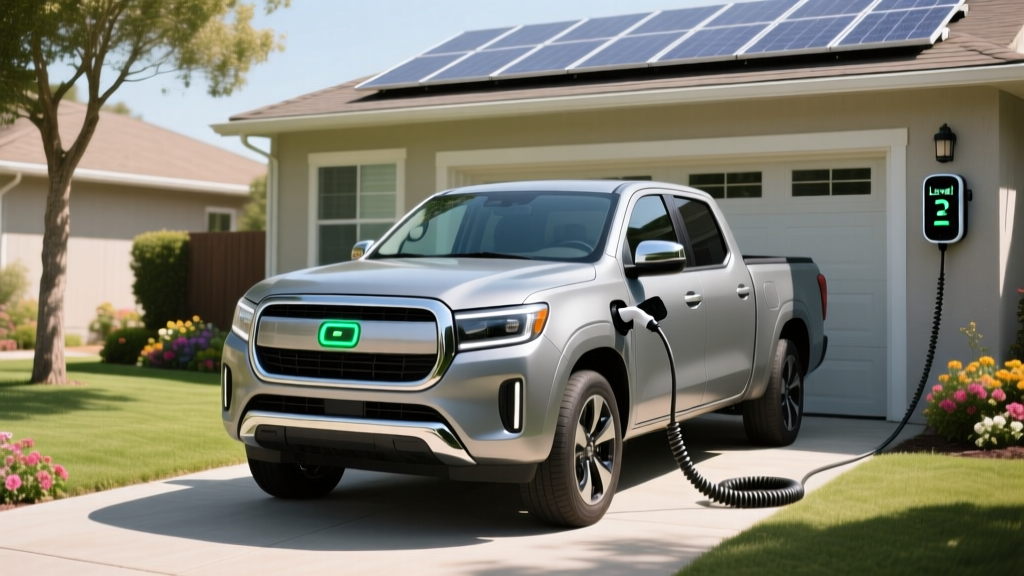
| Level 2 | 240V / 40–48A | 9.6–11.5 kW | ~20–26 mi/hr | Daily home charging |
| Level 2 (Lightning Mobile Charger) | 240V / 30A | 7.2 kW | ~15 mi/hr | Included portable option |
| DC Fast Charging | 400V+ / up to 375A | up to 150 kW peak | ~180–220 mi/hr (to 80%) | Road trips, quick top-ups |
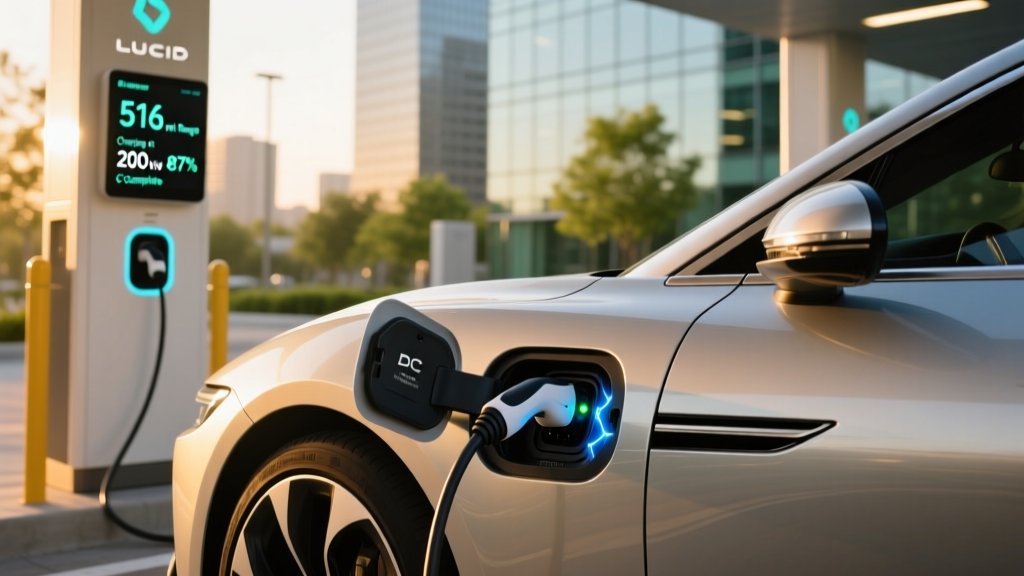
The Lightning's onboard charger maxes out at 11.5 kW on Level 2 (Extended Range) or 10.5 kW on some Standard Range trims. DC fast charging peaks at 150 kW for Extended Range and 120 kW for Standard Range. Expect a 10–80% DC fast charge in approximately 41 minutes (Extended Range) and 36 minutes (Standard Range), with the charge curve tapering significantly above 80%.
How Much Does It Cost to Install a Home EV Charger?
Home Level 2 installation cost varies enormously based on your electrical panel's capacity and the distance from panel to charger location. The Lightning's Pro Power Onboard and large battery make a robust 48A circuit ideal so you can fully replenish overnight.
| Component | Typical Cost Range | Notes |
|---|---|---|
| Level 2 Charger Hardware | $400–$750 | 48A smart charger, 25-ft cable |
| Electrician Labor (standard install) | $500–$1,500 | Panel within 20 ft of install location |
| Permit & Inspection | $50–$200 | Varies by municipality |
| 60A Circuit Breaker + Wiring | $100–$300 | 6 AWG copper for 48A continuous |
| Electrical Panel Upgrade (if needed) | $1,500–$3,500 | 100A → 200A service for older homes |
| Total (no panel upgrade) | $1,050–$2,750 | Most homes with 200A service |
| Total (with panel upgrade) | $2,550–$6,250 | Older homes or maxed-out panels |
The NEC requires a dedicated circuit rated at 125% of the charger's continuous draw. A 48A charger needs a 60A breaker with appropriately gauged wire. A licensed electrician should pull permits and verify your panel has headroom — adding a 60A circuit to an already-loaded 100A panel is a fire risk and code violation. Always get a load calculation before installation.
Which Connector and Charger Are Compatible with the Lightning?
For the 2025–2026 model years, Ford delivers the F-150 Lightning with a CCS1 (Combined Charging System) port. However, Ford has secured access to the Tesla Supercharger network using a Ford-supplied NACS adapter, and 2025+ models may ship with a native NACS port depending on production date. Here's how connectors break down across the EV market:
| Connector | Brands Using It | Lightning Compatible? |
|---|---|---|
| CCS1 | Ford, GM (pre-2025), VW, Hyundai/Kia, BMW | Yes — native port |
| NACS (Tesla) | Tesla, Ford (2025+), GM (2025+), Rivian | Yes — via adapter or native on newer builds |
| CHAdeMO | Nissan Leaf, Mitsubishi (legacy) | No — network fading |
For home Level 2 charging, the Lightning uses the standard J1772 connector, which is universal across all non-Tesla Level 2 chargers and included with Tesla Wall Connectors via adapter. Any quality J1772 Level 2 charger will work.
Level 2 Home Charger Recommendations for the Lightning
With a 131 kWh Extended Range battery, you want a charger that can deliver close to the Lightning's 11.5 kW onboard maximum. Here are three proven units:
ChargePoint Home Flex
- Power: Up to 11.5 kW (48A), configurable down to 16A
- Connector: J1772, 25-ft cable
- Smart Features: Wi-Fi, app scheduling, Alexa, energy tracking
- Price: ~$550
- Best For: Flexible amperage if panel headroom is tight
Tesla Wall Connector (J1772 version)
- Power: Up to 11.5 kW (48A)
- Connector: J1772 (newer version), 24-ft cable
- Smart Features: Wi-Fi, OTA updates, load sharing for multi-unit installs
- Price: ~$475
- Best For: Clean design, reliable firmware, multi-charger garages
Emporia Vue + Level 2 Charger
- Power: Up to 11.5 kW (48A)
- Connector: J1772, 24-ft cable
- Smart Features: Whole-home energy monitoring integration, solar-aware scheduling
- Price: ~$400 (charger only)
- Best For: Solar owners wanting integrated energy management
Charging Cost Per Mile: Lightning vs Roush Supercharged F-150
This is where the comparison gets stark. Let's model real scenarios using national averages and the Lightning's ~2.1 kWh/mile efficiency versus the Roush supercharged F-150's ~14 mpg combined on premium unleaded.
| Scenario | Cost per kWh / Gallon | Lightning $/Mile | Roush SC $/Mile |
|---|---|---|---|
| Home Charging (off-peak utility rate) | $0.13/kWh | $0.027 | — |
| Home Charging (peak / high-cost state) | $0.28/kWh | $0.059 | — |
| Public Level 2 (network pricing) | $0.35/kWh | $0.074 | — |
| DC Fast Charging (Electrify America, etc.) | $0.48/kWh | $0.101 | — |
| Gas (premium 93 octane, national avg) | $4.60/gal | — | $0.329 |
| Gas (premium, high-cost state like CA) | $5.80/gal | — | $0.414 |
At 15,000 miles per year, the math becomes dramatic. Home-charging the Lightning at $0.13/kWh costs roughly $405/year. Fueling the Roush supercharged F-150 at $4.60/gallon premium costs approximately $4,929/year. Even exclusive DC fast charging of the Lightning ($0.48/kWh) yields ~$1,515/year — still less than one-third the Roush fuel bill. Over five years, the Lightning saves $15,000–$22,000 in energy costs alone, depending on your charging mix. Data from fueleconomy.gov confirms that EVs typically cost less than half per mile to "fuel" compared to comparable ICE vehicles.
Charging Time Examples: What to Expect With the Lightning
Here are real-world time estimates for common scenarios using the Extended Range 131 kWh battery:
- Level 1 (120V, 1.4 kW): Adding 50 miles overnight takes ~14 hours. Impractical for daily use on a battery this large.
- Level 2 (240V, 48A, 11.5 kW): 10–80% in approximately 8 hours — perfect for overnight replenishment.
- Level 2 (240V, 32A, 7.7 kW): 10–80% in approximately 12 hours — adequate if you drive under 200 miles daily.
- DC Fast Charge (150 kW peak): 10–80% in ~41 minutes. Note that charging speed tapers significantly above 80%; a 10–100% session takes closer to 75 minutes.
- DC Fast Charge (50 kW station): 10–80% in ~2.5 hours — avoid these for road trips if faster options exist.
The charge curve matters: the Lightning pulls peak 150 kW only between roughly 15–45% SoC, then steps down to ~100 kW through 65%, and further to ~50 kW above 80%. Plan your road-trip stops to charge from 10–80% and move on rather than waiting for a full battery.
Safety, Code, and Electrical Upgrade Considerations
A 48A continuous-draw Level 2 charger is a significant electrical load. Key safety and code requirements per the National Electrical Code (NEC Article 625):
- Dedicated circuit: The charger must have its own breaker — no sharing with other outlets or appliances.
- GFCI protection: NEC 2020+ requires GFCI protection for EV receptacles. Hardwired chargers avoid this requirement and are generally recommended for 48A+ installations.
- Outdoor rating: If installing outside, the charger must carry a NEMA 4 or IP65 rating. All three chargers recommended above meet this standard.
- Wire gauge: 6 AWG copper THHN for a 60A breaker feeding a 48A charger. Long runs (over 50 ft) may require 4 AWG to limit voltage drop.
- Panel capacity: Your electrician will perform a load calculation per NEC 220. If your existing loads plus the new 60A circuit exceed 80% of panel rating, a panel upgrade is mandatory — not optional.
Homes built before 1990 often have 100A service, which is rarely sufficient for a 48A EV charger plus electric range, dryer, and HVAC. Budget for a panel upgrade if your home falls in this category. The IRS §30D credit does not cover home charger installation, but the separate §30C Alternative Fuel Vehicle Refueling Property Credit may cover up to 30% of charger hardware and installation costs (capped at $1,000 for residential), subject to income and census-tract eligibility. Consult a tax professional.
Frequently Asked Questions
How much does it cost to install a home EV charger for the F-150 Lightning?
Expect $1,050–$2,750 for a standard installation with a 200A panel and short wire run. If your home needs a panel upgrade from 100A to 200A service, total cost rises to $2,550–$6,250. Get quotes from at least two licensed electricians and insist on a load calculation before committing.
How fast will each charging level add range to the Lightning?
Level 1 (120V) adds ~3–4 miles per hour. Level 2 (240V, 48A) adds ~22–26 miles per hour. DC fast charging at 150 kW adds roughly 180–220 miles per hour equivalent during peak charge rate, though this tapers as the battery fills past 80%.
Which connector is compatible with the F-150 Lightning?
The Lightning uses CCS1 for DC fast charging and J1772 for Level 2 AC charging. Ford provides a NACS adapter for Tesla Supercharger access on CCS-equipped models, and 2025+ production may feature a native NACS port. For home Level 2, any J1772 charger works.
How much does charging cost per mile vs gas for a Roush supercharged F-150?
Home charging the Lightning at average US rates costs $0.03–$0.06 per mile. A Roush supercharged F-150 on premium fuel at $4.60/gal and 14 mpg combined costs ~$0.33 per mile — roughly 6–10× more per mile. Over 15,000 annual miles, that's a $4,000+ yearly fuel savings with the Lightning.
What electrical upgrades might I need for a 48A Level 2 charger?
You need a 200A electrical panel with available capacity, a dedicated 60A breaker, and 6 AWG copper wiring. Older homes with 100A service will likely need a full panel upgrade ($1,500–$3,500). Homes with existing 200A panels that are already heavily loaded may also need an upgrade or a lower-amperage charger configuration (e.g., 32A instead of 48A).
Can I use the Lightning's Pro Power Onboard to offset home energy costs?
Pro Power Onboard provides up to 9.6 kW of 240V output from the truck bed, useful for job-site tools or emergency backup. However, the Lightning does not currently support full vehicle-to-home (V2H) bidirectional charging as of the 2026 model year. Ford has announced future V2H capability, but it requires specific hardware and utility compatibility.
The bottom line for anyone weighing a Lightning against a F150 Roush supercharged truck: the Roush wins on exhaust note and aftermarket swagger, but the Lightning's charging infrastructure — once installed — delivers dramatically lower per-mile costs, instant torque that matches or beats the supercharger's grunt, and the convenience of a "full tank" every morning without visiting a gas station. Budget $1,500–$3,000 for a quality home Level 2 install, choose a 48A smart charger, and your Lightning's energy cost drops to a few cents per mile for the life of the truck.