F-150 Lightning Range: EPA Numbers vs Real-World Reality
The Ford F-150 Lightning anchors the electric truck segment with two battery options and a usable pack size that directly dictates how far you can drive between plugs. For 2025–2026 models, Ford offers the Standard Range pack (98 kWh usable, LFP chemistry on newer builds) and the Extended Range pack (131 kWh usable, NMC chemistry). EPA estimates sit at 240 miles for Standard Range and 320 miles for Extended Range on the XLT and Lariat trims, per fueleconomy.gov.
EPA 320 miles (Extended Range) assumes a mixed city/highway cycle at moderate temperatures. Expect ~250–275 miles at sustained 70–75 mph highway speeds, and ~200–230 miles in sub-freezing weather without preconditioning. Towing a 5,000-lb trailer can cut range to 150–180 miles depending on aerodynamics and grade.
The discrepancy between the sticker and reality comes down to physics: the Lightning's boxy profile creates substantial aerodynamic drag above 65 mph, and the 6,500+ lb curb weight demands more energy per mile than a sedan. Cold weather increases battery internal resistance and cabin heating load — the heat pump on higher trims helps but doesn't eliminate the loss.
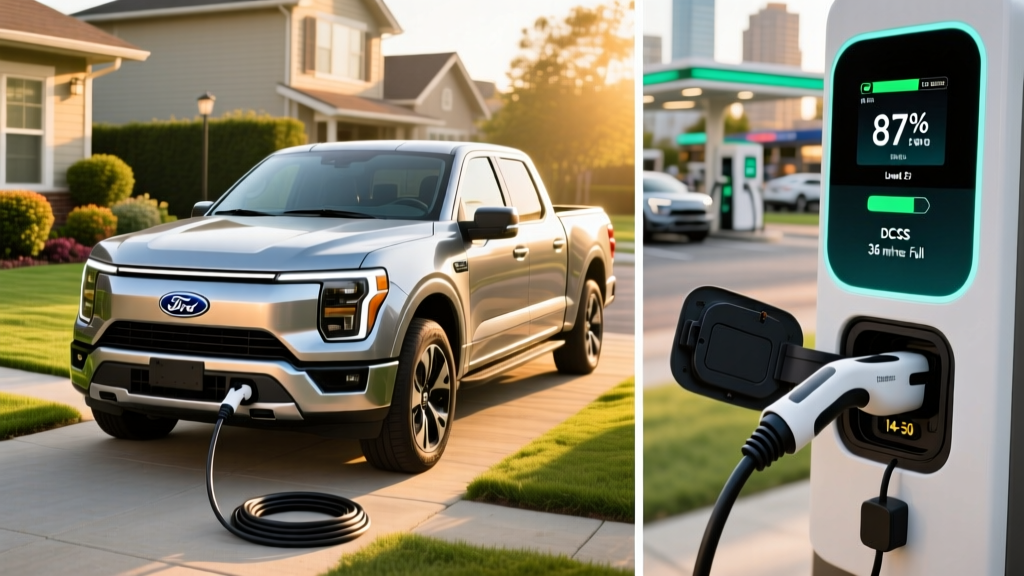
How Fast Will Each Charging Level Add Range to the Lightning?
Understanding charging speed requires distinguishing kW (kilowatts) — the rate of power delivery — from kWh (kilowatt-hours) — the total energy stored in the battery. A 131 kWh battery charged at 150 kW for one hour would theoretically receive 150 kWh, but real charging involves a taper curve that slows delivery as the battery fills.
| Level | Power (kW) | Miles Added/Hour | Typical Use |
|---|---|---|---|
| Level 1 (120V) | 1.4 kW | ~2–3 mi/hr | Emergency top-up |
| Level 2 (240V, 40A) | 9.6 kW | ~18–22 mi/hr | Home overnight |
| Level 2 (240V, 80A) | 19.2 kW | ~36–42 mi/hr | Ford Charge Station Pro |
| DC Fast (150 kW) | 150 kW peak | ~180 mi in 30 min | Road trips |
| DC Fast (250+ kW) | 150 kW sustained* | ~200 mi in 30 min | 350-kW stations |
*The F-150 Lightning Extended Range peaks at ~150 kW on DC fast charging. Even at a 350 kW Electrify America or Tesla Supercharger stall, the truck's onboard charge acceptance caps at 150 kW, tapering to ~100 kW above 60% SoC and ~50 kW above 80% SoC.
Charging time examples for the 131 kWh Extended Range pack:
- Level 1 (120V, 12A): 0–100% in ~93 hours — impractical for full recharges
- Level 2 (240V, 40A/9.6 kW): 0–100% in ~14 hours; 10–80% in ~9.5 hours
- Level 2 (240V, 80A/19.2 kW): 0–100% in ~7 hours; 10–80% in ~4.8 hours
- DC Fast (150 kW peak): 10–80% in ~41 minutes; 15–80% in ~36 minutes
Home Charger Installation: Electrical Requirements and Real Costs
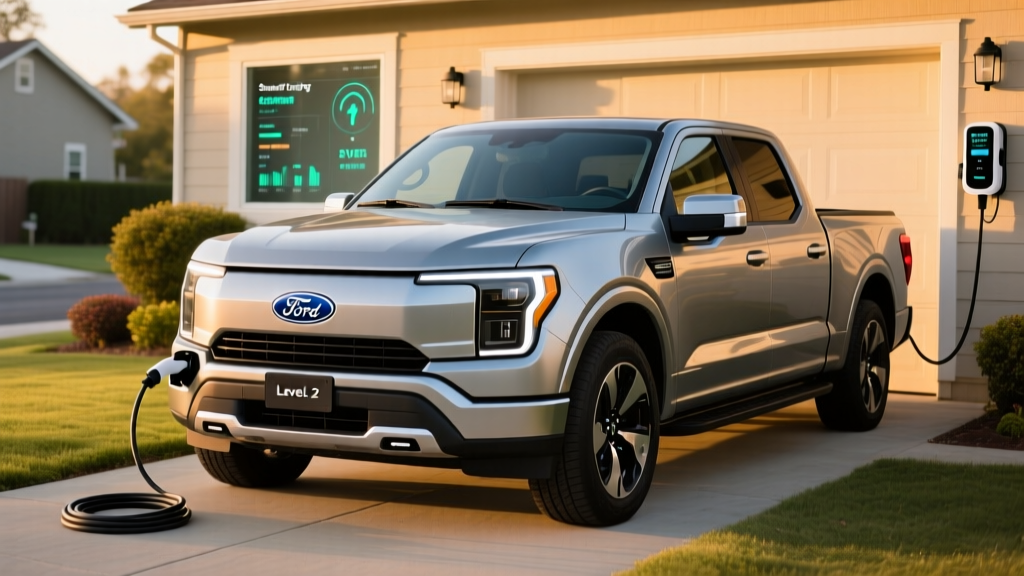
Most F-150 Lightning owners will install a Level 2 home charger to gain 20–40 miles of range per hour of charging. The electrical requirements depend on the charger's amperage and your home's existing panel capacity.
Standard Level 2 setup (40A charger): Requires a 240V dedicated circuit with a 50A breaker (NEC code mandates circuits rated at 125% of continuous load, so 40A × 1.25 = 50A breaker). This delivers 9.6 kW.
High-power Level 2 setup (80A charger, like Ford's Charge Station Pro): Requires a 240V dedicated circuit with a 100A breaker. This delivers 19.2 kW — but only if your home's electrical panel has the capacity.
Homes built before 2000 often have 100A or 150A main service panels. Adding a 50A or 100A EV circuit may exceed available capacity, requiring a panel upgrade to 200A service ($2,000–$4,500). Always have a licensed electrician perform a load calculation before committing to an 80A charger.
| Component | 40A Setup Cost | 80A Setup Cost |
|---|---|---|
| Level 2 Charger (hardware) | $400–$700 | $700–$1,300 |
| Electrician labor (wire run, breaker, outlet/hardwire) | $500–$1,500 | $800–$2,500 |
| Permit and inspection | $50–$250 | $75–$350 |
| Panel upgrade (if needed) | $0–$4,500 | $0–$4,500 |
| Total (no panel upgrade) | $950–$2,450 | $1,575–$4,150 |
| Total (with panel upgrade) | $2,950–$6,950 | $3,575–$8,650 |
The federal Residential Clean Energy Credit does not cover EV charger installation after 2022. However, the Alternative Fuel Vehicle Refueling Property Credit (IRS Form 8911) may cover up to 30% of hardware and installation costs, capped at $1,000, if you live in an eligible census tract. Check with a tax professional for your specific eligibility.
Connector Compatibility: NACS, CCS1, and Adapter Needs
The F-150 Lightning's charge port connector depends on model year and the evolving industry standard:
| Model Year | Built-In Connector | DC Fast Network Access | Adapter Needed? |
|---|---|---|---|
| 2022–2024 | CCS1 | Electrify America, EVgo, ChargePoint | NACS-to-CCS adapter for Tesla Superchargers |
| 2025–2026 | NACS (native) | Tesla Supercharger, all NACS networks | CCS1 adapter for legacy stations |
Ford began equipping 2025+ Lightnings with the NACS (North American Charging Standard) port natively, granting direct access to Tesla's Supercharger network — currently the largest and most reliable DC fast-charging network in the US. Owners of 2022–2024 CCS1-equipped Lightnings received a complimentary NACS adapter from Ford, but verify yours arrived and is firmware-updated before relying on it for road trips.
For home Level 2 charging, both NACS and CCS1 vehicles use the J1772 protocol for AC charging. Most Level 2 home chargers ship with a J1772 connector; NACS-equipped Lightnings use the Tesla Mobile Connector or a J1772-to-NACS adapter for home charging.
Level 2 Charger Equipment Picks for the F-150 Lightning
The right home charger depends on your electrical panel capacity, budget, and whether you want smart scheduling features. Here are three proven options:
- Power: 40A / 9.6 kW (48A variant available)
- Connector: J1772 (NACS adapter included on newer models)
- Cable: 24 ft
- Smart features: Wi-Fi, energy monitoring, solar integration, scheduling
- Price: ~$400–$450
Best for: Budget-conscious owners wanting energy tracking.
- Power: Up to 50A / 12 kW (adjustable 16–50A via DIP switch)
- Connector: J1772 (NACS version available)
- Cable: 23 ft
- Smart features: Wi-Fi, Alexa, scheduling, charge history
- Price: ~$550–$650
Best for: Flexible amperage to match panel capacity.
- Power: 80A / 19.2 kW (requires 100A circuit)
- Connector: NACS (2025+ models) / J1772 (older)
- Cable: 25 ft
- Smart features: FordPass integration, bi-directional V2H capability (Pro Power Onboard)
- Price: ~$1,100–$1,300
Best for: Maximum charge speed + home backup power.
For the 131 kWh Extended Range pack, the Ford Charge Station Pro's 19.2 kW output adds roughly 38 miles of range per hour — meaning a full overnight charge from 20% to 100% takes about 7 hours. The 40A/48A options work perfectly fine for most owners who plug in nightly and rarely deplete below 30%.
Cost to Charge the F-150 Lightning vs Gasoline F-150
Electricity pricing varies dramatically by location, time of day, and charging method. Here's what it actually costs to "fill" a Lightning compared to a gas F-150:
| Scenario | Rate ($/kWh) | Cost for 131 kWh (0–100%) | Cost/Mile (320 mi range) |
|---|---|---|---|
| Home off-peak (utility TOU rate) | $0.08–$0.12 | $10.50–$15.70 | $0.033–$0.049 |
| Home standard rate (no TOU) | $0.14–$0.18 | $18.35–$23.60 | $0.057–$0.074 |
| Public Level 2 (ChargePoint, etc.) | $0.25–$0.40 | $32.75–$52.40 | $0.102–$0.164 |
| DC Fast (Electrify America, EVgo) | $0.35–$0.55 | $45.85–$72.05 | $0.143–$0.225 |
| Gas F-150 (18 MPG, $3.40/gal) | — | ~$60.40 (320 mi) | $0.189 |
At home off-peak rates, the Lightning costs roughly one-quarter per mile compared to a gasoline F-150. Even at public DC fast-charging rates, the Lightning breaks even or beats gas on a per-mile basis in most states. The economics strongly favor home charging — public fast charging should be treated as a road-trip convenience, not a daily strategy.
The Lightning's efficiency averages ~2.0–2.3 kWh/mile (combined), or roughly 48–53 MPGe per the EPA. Highway-only driving drops this to ~1.8 MPGe equivalent, and towing can push consumption above 3.5 kWh/mile.
Safety, Electrical Code, and Installation Best Practices
EV charging involves sustained high-current draw over many hours — far more demanding on wiring than intermittent appliance use. Key safety and code requirements include:
- Dedicated circuit: NEC requires a dedicated circuit for EV charging — no sharing with other outlets or appliances.
- GFCI protection: 2020 NEC and later require GFCI protection for outdoor receptacles used for EV charging. Hardwired chargers (no plug) may bypass this requirement in some jurisdictions, and hardwiring eliminates a common failure point.
- Outdoor rating: If your charger mounts outside, ensure it carries a NEMA 4 or NEMA 4X rating for weather resistance. Indoor-rated units (NEMA 1) will fail prematurely in rain or snow.
- Wire gauge: A 50A circuit requires 6 AWG copper wire; a 100A circuit requires 3 AWG copper or 1 AWG aluminum. Your electrician will size this based on run length and local code.
- Permit and inspection: Most jurisdictions require an electrical permit for new 240V circuits. The inspection ensures proper grounding, breaker sizing, and wire routing. Skipping the permit risks insurance claim denial in the event of an electrical fire.
- Surge protection: Consider a whole-panel surge protective device (SPD), especially in areas with frequent lightning or grid instability. The Lightning's onboard charger is expensive to replace if a surge reaches it.
F-150 Lightning Charging FAQ
How much does it cost to install a home EV charger for the F-150 Lightning?
Expect $950–$2,450 for a 40A Level 2 installation without a panel upgrade, or $1,575–$4,150 for an 80A setup. If your home needs a 200A panel upgrade, add $2,000–$4,500. Get 2–3 quotes from licensed electricians — prices vary significantly by region and wire-run length.
How fast will each charging level add range to the Lightning?
Level 1 (120V) adds ~2–3 miles per hour. Level 2 at 40A adds ~18–22 miles per hour. Level 2 at 80A adds ~36–42 miles per hour. DC fast charging at 150 kW can add ~130 miles in 20 minutes, though the charge curve tapers significantly above 80% SoC.
Which connector does the F-150 Lightning use?
2022–2024 models use CCS1 natively and need a Ford-provided NACS adapter for Tesla Superchargers. 2025–2026 models ship with NACS natively and may need a CCS1 adapter for older Electrify America or EVgo stations still transitioning to NACS.
How much does charging the Lightning cost per mile vs gas?
Home charging at off-peak rates costs ~$0.03–$0.05 per mile. A comparable gas F-150 at 18 MPG and $3.40/gallon costs ~$0.19 per mile. Public DC fast charging at $0.45/kWh costs ~$0.16–$0.20 per mile — roughly breaking even with gas.
What electrical upgrades might I need for a home charger?
If your home has a 100A or 150A main panel, adding a 50A or 100A EV circuit may require a panel upgrade to 200A service ($2,000–$4,500). Older homes may also need aluminum-to-copper wiring updates or a new meter base. A licensed electrician's load calculation is the definitive answer.
Does the F-150 Lightning support vehicle-to-home (V2H) backup power?
Yes — when equipped with the 80A Ford Charge Station Pro and the Home Integration System, the Extended Range Lightning can supply up to 9.6 kW of continuous power to your home during an outage, enough to run essential circuits for several days on a full 131 kWh charge.
Should I precondition the battery before DC fast charging?
Yes. The Lightning's navigation system will automatically precondition the battery when you route to a DC fast charger. This warms the pack to optimal temperature, enabling the full 150 kW peak charge rate. Arriving at a fast charger without preconditioning — especially in cold weather — can reduce peak charge speed by 30–50%.