If you've been searching for f150 5.0 supercharger, you're likely conflating two very different automotive worlds — and you're not alone. The "5.0" refers to Ford's legendary 5.0-liter Coyote V8 engine, while "supercharger" in the EV context means a Tesla Supercharger DC fast-charging station. The gas-powered F-150 5.0 doesn't plug into any charger; it drinks gasoline. But Ford's electrified F-150 lineup — the all-electric F-150 Lightning and the F-150 PowerBoost Hybrid — absolutely can leverage Tesla's Supercharger network (with the right adapter) and offers a compelling case for electrified truck ownership.
This guide untangles the confusion and gives you everything you need to know about charging Ford's electrified F-150s at home, on the road, and at Tesla Superchargers — with exact speeds, costs, and equipment picks for 2026.
The F-150 Lineup: Which Ones Actually Charge?
Before we talk chargers, let's clarify which F-150s have a charge port:
- F-150 Lightning (BEV): All-electric, 98 kWh (Standard Range) or 131 kWh (Extended Range) usable battery. EPA range 230–320 miles depending on trim. This is the truck that can use Tesla Superchargers with a NACS adapter.
- F-150 PowerBoost Hybrid (HEV): A 3.5L V6 paired with a 1.5 kWh battery and 47-hp electric motor. It's a conventional hybrid — it charges itself via regenerative braking and the engine. No plug. No Supercharger access. EPA combined MPG: ~25.
- F-150 5.0 V8 (ICE): Pure gasoline. No electrification. No charge port. A supercharger in this context would be an aftermarket forced-induction blower (like a Roush or Whipple supercharger kit) that adds horsepower — not electrons.
For the rest of this guide, we're focusing on the F-150 Lightning, since that's the truck that actually interfaces with charging infrastructure including Tesla Superchargers.
Charging Levels Explained: Speeds in kW and Miles Per Hour
EV charging comes in three tiers. The critical distinction: kW (kilowatts) measures power — how fast energy flows into the battery. kWh (kilowatt-hours) measures energy — the battery's total capacity. Think of kW as the hose diameter and kWh as the bucket size.
| Level | Power (kW) | Voltage/Amps | Miles of Range Per Hour | Use Case |
|---|---|---|---|---|
| Level 1 (120V) | ~1.4 kW | 120V / 12A | ~2–3 mi/hr | Emergency / trickle only |
| Level 2 (240V) | 11.5–19.2 kW | 240V / 48–80A | ~18–34 mi/hr | Daily home charging |
| DC Fast (CCS/NACS) | Up to 150 kW peak | 400V+ DC | ~170+ mi/hr (peak) | Road trips, quick top-ups |
The F-150 Lightning Extended Range with its 131 kWh battery will take roughly 10+ hours on a standard 11.5 kW Level 2 home charger from 10–80%, or about 35–40 minutes from 10–80% on a 150 kW DC fast charger (with taper above 80% — the charge curve slows to protect battery chemistry).
Tesla Supercharger Access for the F-150 Lightning
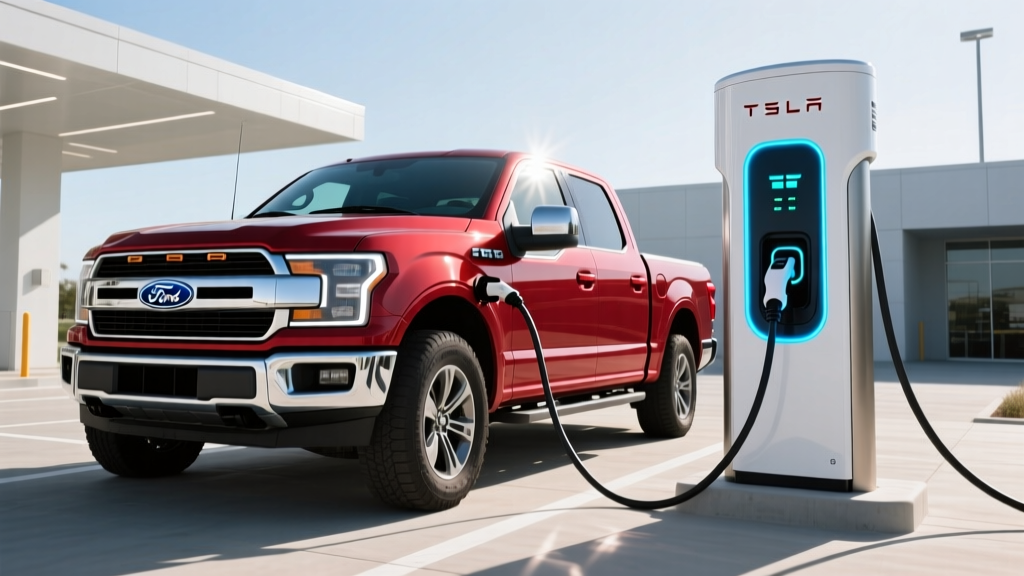
As of 2024, Ford was the first legacy automaker to gain access to Tesla's Supercharger network using a Tesla-provided NACS (North American Charging Standard) adapter. By 2026, the F-150 Lightning ships with a native NACS charge port on newer model years, eliminating the adapter requirement entirely. Older 2022–2024 Lightnings still use the included Ford NACS adapter.
| Model Year | Native Port | Tesla Supercharger Access | Adapter Needed? |
|---|---|---|---|
| 2022–2024 | CCS1 | Yes, via Ford-supplied NACS adapter | Yes (included by Ford) |
| 2025–2026 | NACS (native) | Yes, direct plug-in | No |
At a Tesla V3 Supercharger (250 kW max), the Lightning will peak around 150 kW due to its 400V architecture — it cannot fully utilize the 250 kW the stall can deliver. Expect a 10–80% charge in roughly 35–40 minutes at a V3 or V4 Supercharger. At Electrify America or other CCS networks, speeds are similar since the bottleneck is the truck's onboard charge acceptance, not the station.
Home Charging Installation: Costs, Electrical Requirements, and Gotchas
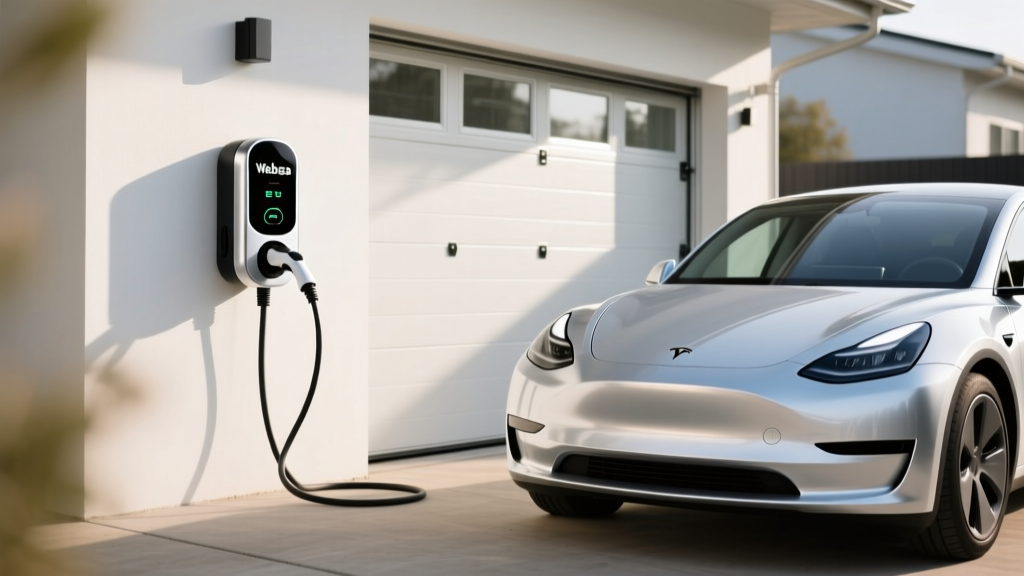
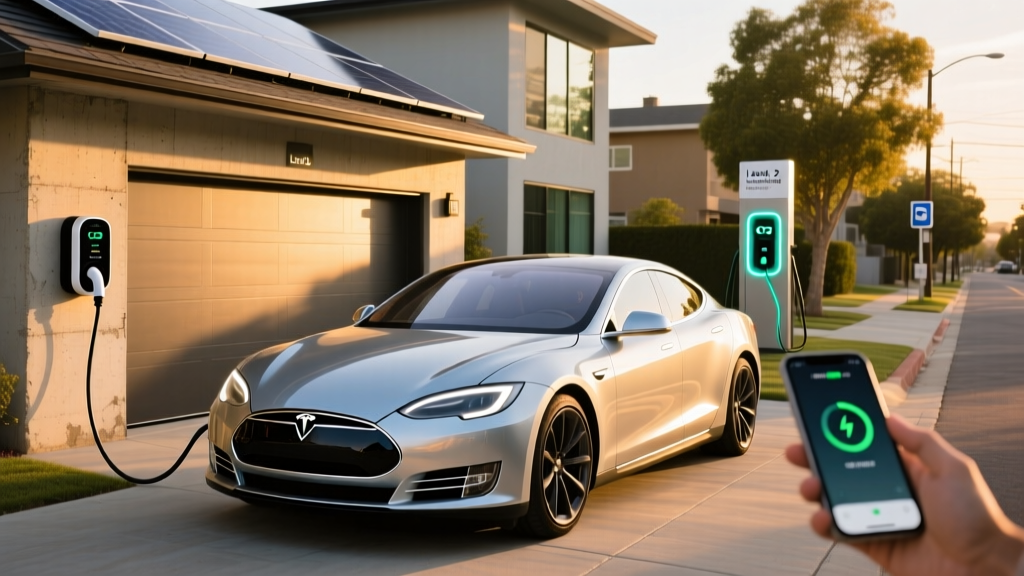
Home Level 2 charging is where 80%+ of F-150 Lightning owners do their charging. Here's what you need to know about the electrical side.
Electrical Requirements
- Circuit: Dedicated 60-amp breaker for a 48A continuous-draw charger (NEC requires 125% overhead: 48A × 1.25 = 60A breaker).
- For max 80A charging (19.2 kW): You need a 100-amp dedicated circuit — this is a significant electrical upgrade most homes don't have capacity for without a panel upgrade.
- Wire: 6 AWG copper for 48A; 3 AWG for 80A runs.
- GFCI protection: Required by NEC 2020+ for EV outlets in garages.
- Outdoor rating: If mounting outside, the charger must carry a NEMA 4 or IP65 rating.
Panel Upgrade: The Hidden Cost
Many homes built before 2010 have 100-amp or 150-amp main panels. Adding a 60-amp EV circuit may exceed your panel's spare capacity. A licensed electrician will perform a load calculation to determine if you need a panel upgrade to 200 amps. This is the single biggest variable in installation cost.
| Component | Low End | High End | Notes |
|---|---|---|---|
| Level 2 Charger (hardware) | $400 | $750 | 48A smart charger |
| Electrician labor (basic install) | $500 | $1,500 | Short wire run, nearby panel |
| Permit & inspection | $50 | $300 | Varies by municipality |
| Panel upgrade (if needed) | $1,500 | $4,000 | 100A → 200A service upgrade |
| Total (no panel upgrade) | $950 | $2,550 | Typical scenario |
| Total (with panel upgrade) | $2,450 | $6,550 | Older homes |
Level 2 Charger Equipment Picks for the F-150 Lightning
Here are three chargers we recommend based on power output, connector, cable length, smart features, and build quality:
ChargePoint Home Flex
- Power: Up to 12 kW (50A) on a 60A circuit
- Connector: NACS or J1772 (configurable)
- Cable: 23 ft
- Smart: Wi-Fi, app scheduling, Alexa
- Price: ~$599
Best for: Most Lightning owners on a standard 60A circuit. Solid app, UL-listed.
Tesla Wall Connector (NACS)
- Power: Up to 11.5 kW (48A) on 60A circuit
- Connector: NACS native
- Cable: 24 ft
- Smart: Wi-Fi, OTA updates, load sharing
- Price: ~$450
Best for: 2025+ Lightning owners with native NACS port. Best value, seamless Supercharger ecosystem integration.
Emporia Level 2 EV Charger
- Power: Up to 11.5 kW (48A) on 60A circuit
- Connector: J1772 (NACS adapter available)
- Cable: 24 ft
- Smart: Wi-Fi, energy monitoring, solar integration
- Price: ~$399
Best for: Budget-conscious buyers who want detailed energy tracking and solar pairing.
For the F-150 Lightning's 19.2 kW onboard charger capability, you'd need an 80A-capable charger on a 100A circuit — few residential setups support this. Most owners are well-served by a 48A/11.5 kW unit, which adds ~20 miles of range per hour — plenty to fully recharge overnight.
Cost to Charge: Per-Mile Economics vs. the Gas 5.0 V8
Here's where the electrified F-150 makes its case against the 5.0L Coyote V8. The gas F-150 5.0 returns roughly 17 MPG combined. At $3.50/gallon, that's ~$0.21 per mile in fuel alone.
| Scenario | Cost/kWh or Gallon | Cost Per Mile (Lightning) | Cost Per Mile (5.0 V8 Gas) |
|---|---|---|---|
| Home charging (off-peak) | $0.12/kWh | $0.04 | — |
| Home charging (peak rate) | $0.22/kWh | $0.07 | — |
| Public Level 2 (ChargePoint, etc.) | $0.30/kWh | $0.10 | — |
| DC Fast (Tesla Supercharger avg) | $0.35/kWh | $0.12 | — |
| DC Fast (Electrify America peak) | $0.48/kWh | $0.16 | — |
| Gasoline (17 MPG combined) | $3.50/gal | — | $0.21 |
The Lightning's efficiency averages about 2.0–2.2 kWh/mile (roughly 48–50 MPGe combined per fueleconomy.gov). Even on the most expensive DC fast chargers, you're saving money per mile versus the 5.0 V8. Charge at home on off-peak rates and you're spending ~80% less per mile on energy.
For a driver covering 15,000 miles/year, home charging the Lightning costs roughly $600–$1,050/year vs. $3,088/year for the gas 5.0 V8. That's $2,000+ in annual fuel savings before accounting for the EV's reduced maintenance (no oil changes, no spark plugs, fewer brake replacements thanks to regenerative braking).
Safety and Electrical Code Considerations
EV charging installation is not a DIY project. Key safety and code requirements:
- Dedicated circuit: Your EV charger must have its own breaker — no sharing with other appliances.
- GFCI protection: NEC 2020 and later requires ground-fault circuit interrupter protection for EVSE in garages and outdoor locations. Many modern chargers have built-in GFCI; if using a NEMA 14-50 outlet, the breaker itself may need GFCI.
- Outdoor-rated equipment: If your charge point is outside, the unit must be rated NEMA 4 (splash-resistant) or IP65. The Tesla Wall Connector and ChargePoint Home Flex both carry outdoor ratings.
- Permit and inspection: Most jurisdictions require an electrical permit for a new 240V circuit. The inspection ensures wire gauge, breaker sizing, and grounding meet NEC standards. Skipping this can void home insurance coverage.
- Wire gauge: Undersized wire on a long run causes voltage drop and fire risk. Your electrician will calculate the correct gauge based on circuit amperage and run length.
Always hire a licensed electrician familiar with EVSE installation. Ask for a load calculation before committing to a circuit size.
Frequently Asked Questions
Can a gas F-150 5.0 use a Tesla Supercharger?
No. The F-150 with the 5.0L V8 is a pure gasoline vehicle with no charge port. "Supercharger" in the context of a gas 5.0 refers to an aftermarket forced-induction kit (Roush, Whipple, etc.) that increases horsepower — it has nothing to do with EV charging. Only the all-electric F-150 Lightning can use Tesla Superchargers.
How much does it cost to install a home EV charger for the F-150 Lightning?
Expect $950–$2,550 for a typical installation (48A Level 2 charger + electrician + permit) if your electrical panel has sufficient capacity. If a panel upgrade from 100A to 200A is needed, add $1,500–$4,000, bringing the total to $2,450–$6,550.
How fast will each charging level add range to the Lightning?
Level 1 (120V): ~2–3 miles per hour. Level 2 (240V, 48A): ~18–20 miles per hour. DC Fast Charging (150 kW peak): up to ~170+ miles per hour at peak, but the charge curve tapers significantly above 80% SoC.
Which connector does the F-150 Lightning use?
2022–2024 models have a CCS1 port and use a Ford-supplied NACS adapter for Tesla Superchargers. 2025–2026 models feature a native NACS port and plug directly into Tesla Superchargers without an adapter.
How much does charging cost per mile vs. the gas F-150 5.0?
Home charging at $0.12/kWh costs ~$0.04/mile. The gas 5.0 V8 at 17 MPG and $3.50/gallon costs ~$0.21/mile. That's roughly an 80% per-mile savings when charging at home on off-peak rates.
What electrical upgrades might I need?
If your home has a 100A or 150A main panel, you may need a 200A service upgrade ($1,500–$4,000) to add a 60A dedicated EV circuit. A licensed electrician will perform a load calculation to determine this. Homes built after 2015 with 200A panels typically have sufficient spare capacity.