The EVSE Tax Credit Explained: What It Covers in 2026
Federal incentives for electric vehicles get most of the attention, but the Alternative Fuel Vehicle Refueling Property Credit — commonly called the EVSE tax credit — can knock up to $1,000 off your home charging setup. Codified under IRS §30C, this credit applies to both the charger hardware and the electrical work needed to install it, making it one of the most practical incentives for new EV owners.
Here is exactly what qualifies, what it costs out of pocket, and which Level 2 chargers deliver the best value once you factor the credit in.
Charging Levels: Speed, Power, and What Each Adds Per Hour
Before sizing a charger or claiming a credit, understand the three charging tiers available to EV owners. Each level delivers different power (kW) and adds different miles of range per hour of charging.
| Level | Voltage | Max Power (kW) | Miles of Range Added/Hour | Typical Use Case |
|---|---|---|---|---|
| Level 1 | 120V AC | 1.4–1.9 kW | 3–5 mi/hr | Overnight trickle; PHEVs; low-mileage drivers |
| Level 2 | 240V AC | 3.3–19.2 kW | 12–75 mi/hr | Home daily charging; workplace; destination |
| DC Fast | 400–800V DC | 50–350 kW | 150–1,200+ mi/hr (peak) | Road trips; highway corridors |
Most EV owners install a Level 2 charger at home — it is the sweet spot for overnight replenishment and qualifies for the EVSE tax credit. DC fast chargers are public infrastructure only; you will not install one at home.
Real-world charging time depends on your vehicle's onboard charger capacity. A Tesla Model Y (75 kWh usable battery, 11.5 kW max AC acceptance) charges from 10–80% at home in roughly 4.5 hours on an 11.5 kW (48A) Level 2 unit. A Hyundai Ioniq 5 (77.4 kWh battery, 10.9 kW AC acceptance) takes about 5 hours for the same 10–80% session. A Ford F-150 Lightning Extended Range (131 kWh battery) can take 10+ hours on the same circuit, so larger batteries may warrant a 60A/14.4 kW circuit if your panel supports it.
How Much Does Home EV Charger Installation Cost?
Installation costs vary enormously depending on your home's electrical panel, the distance from panel to charger location, and local permit fees. Below is a realistic 2026 breakdown based on typical US residential installations.
| Component | Low-End | Typical | High-End |
|---|---|---|---|
| Level 2 EVSE hardware (40A–48A smart charger) | $350 | $550 | $750 |
| Electrician labor (240V/50A circuit, hardwired) | $400 | $900 | $2,000 |
| Electrical panel upgrade (100A → 200A, if needed) | $1,500 | $2,500 | $4,000 |
| Permit and inspection fees | $50 | $150 | $350 |
| Total (no panel upgrade) | $800 | $1,600 | $3,100 |
| Total (with panel upgrade) | $2,300 | $4,100 | $7,100 |
When Will You Need a Panel Upgrade?
Homes built before 1990 often have 100-amp electrical panels. A 48A Level 2 charger on a 60A dedicated circuit draws roughly 11.5 kW — adding that load to a 100A panel already serving an electric dryer, range, and HVAC can exceed the panel's safe capacity. A licensed electrician will perform a load calculation per NEC Article 220 to determine whether an upgrade to 200A is required.
Some homeowners avoid panel upgrades by installing a lower-amperage charger (e.g., 32A on a 40A circuit, delivering 7.7 kW). This still adds ~25–30 miles of range per hour — adequate for most daily commutes — and may fit within existing panel capacity. Load-management devices like the Emporia Load Management or Enel X JuiceBox smart splitting can also dynamically throttle charger draw when other appliances cycle on, avoiding a panel upgrade entirely.
EVSE Tax Credit Eligibility: §30C Rules for 2026
The federal EVSE tax credit under IRS §30C covers 30% of qualified installation costs, up to a maximum of $1,000 per year. Here is what qualifies and what does not.
- Eligible: The charger (EVSE) hardware itself, wiring, conduit, dedicated circuit breaker, labor by a licensed electrician, and permit fees directly tied to the installation.
- Not eligible: Electrical panel upgrades (the panel serves the whole house, not just the EVSE), general electrical repairs, or portable chargers not permanently installed.
- Location requirement: The charger must be installed at your primary residence in the United States. Rental properties and second homes do not qualify under the current residential provision.
- Census tract requirement: Under Inflation Reduction Act modifications, the installation must be in a qualifying census tract — generally non-urban or low-income communities. The IRS provides a locator tool to verify eligibility.
- Nonrefundable credit: The credit reduces your federal tax liability dollar-for-dollar but cannot create a refund. If you owe $0 in federal tax, you cannot benefit from this credit in the current year.
Practical example: You spend $1,600 total ($550 charger + $900 electrician + $150 permit) on a qualifying installation. The 30% credit equals $480, reducing your federal tax bill by that amount. If your install costs $3,100, the 30% calculation yields $930 — still under the $1,000 cap, so you claim the full $930. Only if your qualified costs exceed $3,334 do you hit the $1,000 maximum.
Note: The EVSE credit (§30C) is separate from the new-vehicle tax credit (§30D, up to $7,500) and the used-EV credit (§25E, up to $4,000). You can claim all three in the same tax year if you qualify for each. Consult a tax professional for your specific situation.
Connector Compatibility: NACS, CCS1, and CHAdeMO
The connector landscape has consolidated significantly by 2026, but knowing what your vehicle accepts is critical before buying a charger.
| Connector Standard | Brands Using It (2026) | Notes |
|---|---|---|
| NACS (J3400) | Tesla, Ford, GM, Rivian, Volvo, Polestar, Mercedes, Nissan, Fisker, Honda (2026+) | Industry standard by 2026; native on most new EVs |
| CCS1 | Hyundai, Kia, BMW, VW, Audi, Porsche, Stellantis | Legacy standard; adapters to NACS widely available |
| CHAdeMO | Nissan Leaf (older), Mitsubishi Outlander PHEV | Being phased out; limited new DCFC support |
For home Level 2 charging, all connectors use the same J1772 signaling protocol. Most NACS-equipped vehicles ship with a J1772-to-NACS adapter, so you can buy any J1772-output Level 2 charger and use it with a Tesla, Ford, or GM vehicle. However, if you drive a NACS-native vehicle and want a cleaner setup without an adapter, several manufacturers now offer NACS-connector Level 2 chargers (listed below).
For DC fast charging in public, NACS vehicles can use Tesla Superchargers natively and CCS stations via adapter. CCS vehicles can access Electrify America, EVgo, and ChargePoint networks natively, and Tesla Superchargers via a Magic Dock or CCS-to-NACS adapter where supported.
Best Level 2 Home Chargers for 2026
The chargers below are selected based on reliability, smart features, power output, and value after the EVSE tax credit. All are hardwire-capable (required for circuits above 40A per NEC) and UL-listed.
ChargePoint Home Flex (NACS)
- Power: Up to 12 kW (50A) on a 60A circuit
- Connector: Native NACS (J3400)
- Cable length: 23 ft
- Smart features: Wi-Fi, app scheduling, Alexa, load sharing
- Price: ~$599
- After §30C credit (30%): ~$419 effective cost
Best for: NACS-native EV owners wanting a future-proof, feature-rich charger.
Emporia Vue Level 2 EV Charger
- Power: Up to 11.5 kW (48A) on a 60A circuit
- Connector: J1772 (NACS adapter included)
- Cable length: 24 ft
- Smart features: Wi-Fi, solar integration, energy dashboard, load management
- Price: ~$399
- After §30C credit (30%): ~$279 effective cost
Best for: Budget-conscious buyers; solar-panel households wanting integrated energy monitoring.
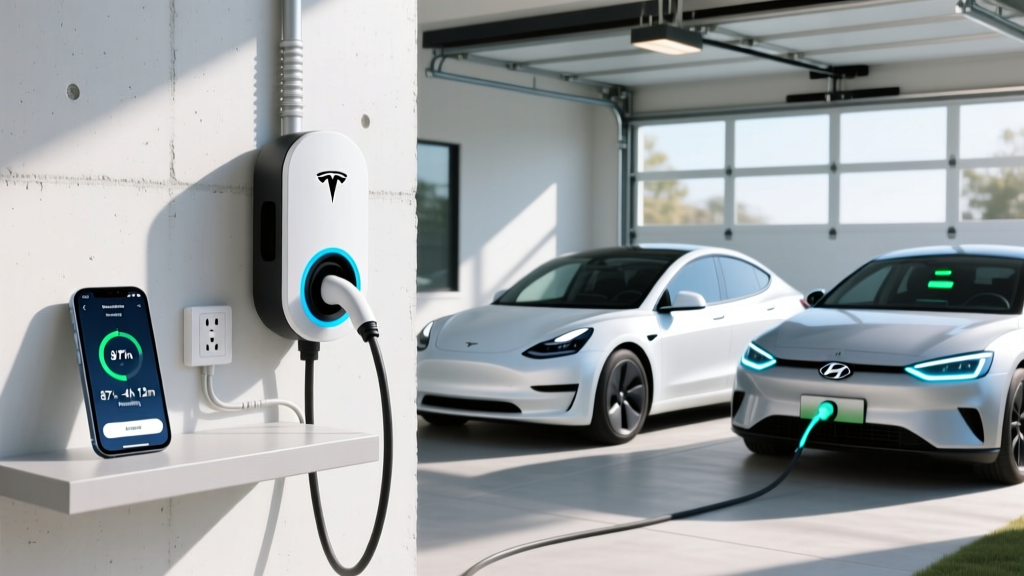
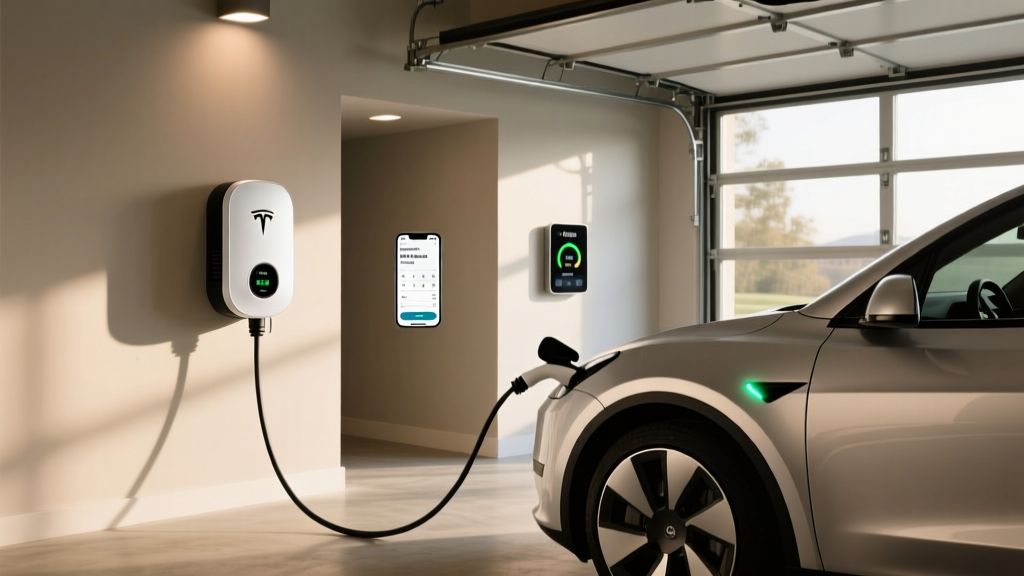
Tesla Wall Connector (Gen 3)
- Power: Up to 11.5 kW (48A) on a 60A circuit
- Connector: Native NACS
- Cable length: 24 ft
- Smart features: Wi-Fi, OTA updates, power sharing with second unit
- Price: ~$420
- After §30C credit (30%): ~$294 effective cost
Best for: Tesla owners wanting a simple, reliable, NACS-native charger at the lowest effective price.
Enel X JuiceBox Pro 48
- Power: Up to 11.5 kW (48A) on a 60A circuit
- Connector: J1772 (NACS adapter available)
- Cable length: 25 ft
- Smart features: Wi-Fi, app, energy tracking, smart-grid ready
- Price: ~$549
- After §30C credit (30%): ~$384 effective cost
Best for: CCS-vehicle owners (Hyundai, Kia, VW) who want a robust J1772 charger.
Cost to Charge: Home vs. Public vs. Gas per Mile
Charging at home on a Level 2 circuit is almost always cheaper than public DC fast charging — and dramatically cheaper than gasoline on a per-mile basis. The table below uses a 2026 national average electricity rate of $0.16/kWh (residential) and $3.30/gallon (regular unleaded), with an average EV efficiency of 3.0 mi/kWh and an average gas car at 28 MPG combined.
| Charging Scenario | Rate ($/kWh) | Cost per Mile (EV at 3 mi/kWh) | vs. Gas Car (28 MPG) |
|---|---|---|---|
| Home Level 2 (off-peak TOU rate) | $0.09 | $0.030 | 75% cheaper |
| Home Level 2 (standard rate) | $0.16 | $0.053 | 55% cheaper |
| Public Level 2 (ChargePoint, etc.) | $0.25 | $0.083 | 30% cheaper |
| DC Fast Charging (Electrify America, EVgo) | $0.40–$0.55 | $0.133–$0.183 | Comparable to gas |
| Gasoline (28 MPG, $3.30/gal) | — | $0.118 | Baseline |
The takeaway is clear: home charging is where the savings live. At off-peak time-of-use rates, you pay roughly $0.03 per mile — less than a quarter of the gasoline cost. Even at standard residential rates, EVs save 50%+ per mile. DC fast charging is best reserved for road trips, not daily use, both for cost and battery longevity reasons.
For a driver covering 12,000 miles per year, home charging at $0.12/kWh costs roughly $480/year in electricity. The equivalent gasoline cost at 28 MPG and $3.30/gal is $1,414/year — a savings of nearly $930 annually, which pays for the charger installation in the first two years.
Safety, Electrical Code, and Installation Best Practices
A Level 2 charger installation is a permanent, high-draw electrical circuit. Cutting corners creates fire risk and may void your home insurance. Here are the non-negotiable requirements:
- Dedicated circuit: NEC requires a dedicated breaker for the EVSE — it cannot share a circuit with any other appliance. A 48A charger requires a 60A breaker (NEC 125% rule: continuous loads cannot exceed 80% of breaker rating).
- GFCI protection: NEC 2020 and later require GFCI protection for all EVSE outlets. Hardwired installations are exempt from the GFCI breaker requirement if the EVSE has internal ground-fault protection (most UL-listed units do). If you use a NEMA 14-50 receptacle, a GFCI breaker (~$120–$180 extra) is mandatory.
- Outdoor rating: If the charger is mounted outside, it must carry a NEMA 4 (weatherproof) or NEMA 4X rating. All chargers listed above meet this standard.
- Wire gauge: A 60A circuit requires 6 AWG copper wire (THHN in conduit) or 4 AWG if the run exceeds 100 feet to compensate for voltage drop. Your electrician will size wire per NEC Table 310.15.
- Permit and inspection: A licensed electrician must pull a permit and schedule a municipal inspection after installation. The inspector verifies wire gauge, breaker sizing, grounding, and GFCI compliance. Keep the inspection certificate — you may need it for the §30C tax credit documentation and for home resale.
Frequently Asked Questions
Can I claim the EVSE tax credit if I rent my home?
No. The §30C credit applies only to equipment installed at your primary residence that you own. Renters cannot claim it, though some states and utilities offer separate rebates for portable Level 2 chargers — check your local utility's EV programs.
Does a portable Level 2 charger qualify for the tax credit?
Generally, no. The IRS interprets §30C as applying to permanently installed property. A portable charger you plug into an existing NEMA 14-50 outlet is unlikely to qualify unless the outlet was newly installed specifically for EV charging by a licensed electrician — in which case the outlet installation labor may qualify, but the portable charger itself is a gray area. Hardwired, wall-mounted EVSEs are the safest path to credit eligibility.
Can I install a NEMA 14-50 outlet instead of hardwiring?
Yes, and this is a common approach. A NEMA 14-50 receptacle on a 50A circuit supports up to 40A continuous draw (9.6 kW), which covers most EVs adequately. The advantage is portability — you can unplug the charger when moving. The disadvantage is that NEC 2020+ requires a GFCI breaker for receptacles, adding $120–$180 to the panel cost. Hardwired installations avoid the GFCI breaker requirement if the EVSE has built-in ground-fault protection.
How long does a full home installation take?
The physical installation typically takes 2–4 hours for a straightforward run (panel in garage, charger on adjacent wall). Installations requiring long conduit runs through attics or crawl spaces, or those needing a panel upgrade, can take a full day. Permit approval and inspection scheduling add 1–3 weeks depending on your municipality.
Will a Level 2 charger degrade my EV battery faster than Level 1?
No. Level 2 AC charging is gentle on batteries — the AC-to-DC conversion happens inside the vehicle's onboard charger, which manages current and temperature carefully. Battery degradation is primarily driven by DC fast charging frequency, sustained high state-of-charge (above 90%), and extreme heat. For daily use, Level 2 charging at 80% state-of-charge is considered optimal for long-term battery health. Refer to fueleconomy.gov for EV battery longevity data.
What if my state offers additional EVSE rebates?
Many states and utilities stack rebates on top of the federal §30C credit. For example, some utilities offer $250–$500 rebates for smart Level 2 chargers, and states like California, Colorado, and Massachusetts have additional incentive programs. These can be combined with the federal credit — check afdc.energy.gov for a state-by-state incentive database. Always verify current-year availability, as programs change annually.