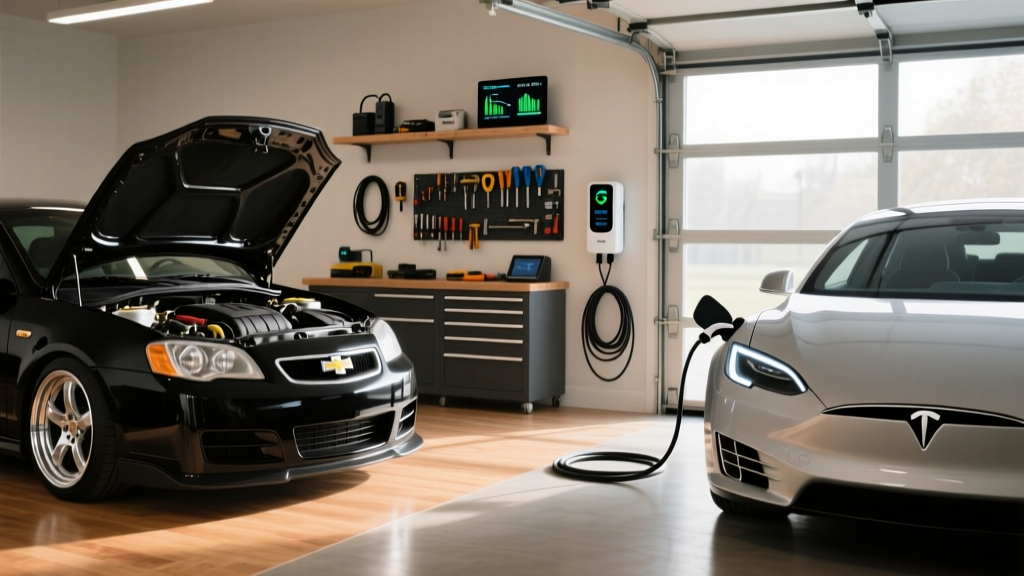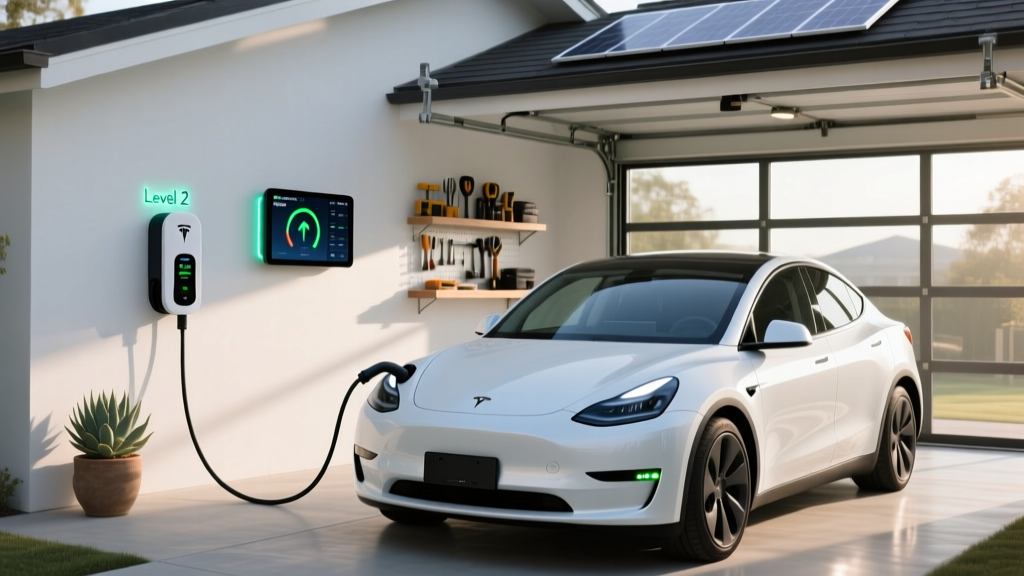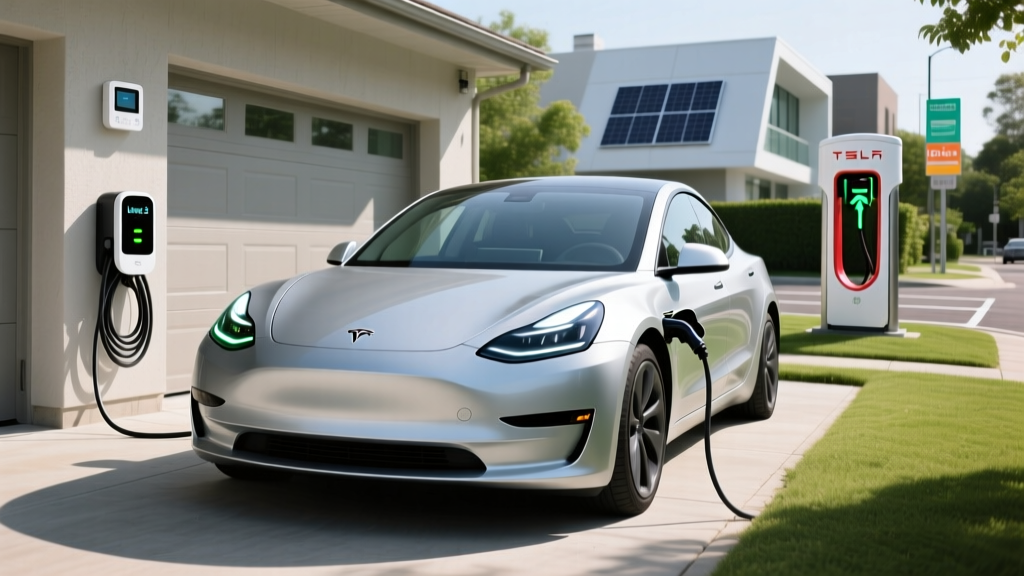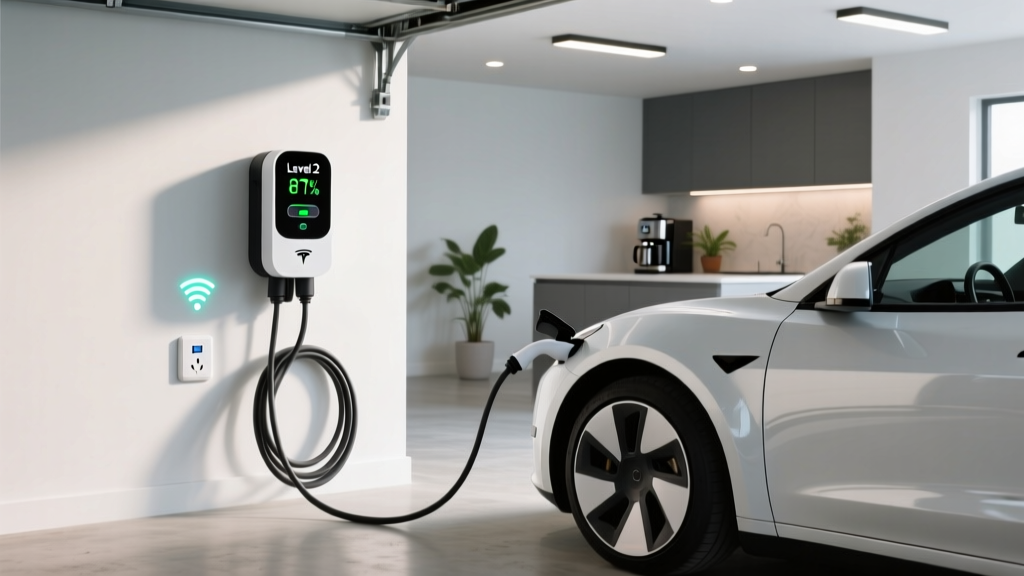
If you own or are shopping for an electric vehicle, a Level 2 EVSE (Electric Vehicle Supply Equipment) is the single most impactful upgrade you can make to your ownership experience. While Level 1 charging from a standard 120V outlet technically works, it adds roughly 3–5 miles of range per hour — barely enough to replenish a daily commute on larger-battery EVs. A properly installed Level 2 home charger operating at 240V delivers 5 to 10 times that speed, turning overnight charging into a non-issue and eliminating routine visits to public stations.
This guide covers the electrical requirements, real installation costs (including the panel-upgrade scenario nobody warns you about), connector compatibility across every major brand, cost-per-mile math versus gasoline, and specific EVSE recommendations with exact power outputs and pricing.
Charging Levels Explained: Speeds in kW and Miles Per Hour
The three EV charging tiers differ fundamentally in power delivery, infrastructure requirements, and use cases. Understanding the distinction between kW (kilowatts — the rate of power delivery) and kWh (kilowatt-hours — the total energy stored in your battery) is essential. Think of kW as the flow rate of a hose and kWh as the size of the bucket you're filling.
| Level | Voltage | Power (kW) | Miles of Range Added Per Hour | Typical Use Case |
|---|---|---|---|---|
| Level 1 | 120V AC | 1.0–1.9 kW | 3–5 mi/hr | Overnight top-off, PHEVs, low-mileage drivers |
| Level 2 (EVSE) | 240V AC | 3.3–19.2 kW | 12–75 mi/hr | Daily home/workplace charging, primary EV fueling |
| DC Fast Charge | 400–900V DC | 50–350+ kW | 150–1,200+ mi/hr (peak) | Road trips, highway corridors, rapid top-ups |
Most home Level 2 EVSE units deliver between 7.7 kW (32A on a 40A circuit) and 11.5 kW (48A on a 60A circuit). At 11.5 kW, a typical EV consuming around 300 Wh/mile gains roughly 38 miles of range per hour. A 75 kWh battery charging from 10% to 80% (roughly 52.5 kWh) takes approximately 5–6 hours at 11.5 kW — perfectly suited to overnight replenishment.
- Tesla Model Y (75 kWh usable, NMC): ~5.5 hours at 11.5 kW | ~8.5 hours at 7.7 kW
- Hyundai Ioniq 5 (77.4 kWh usable, NMC): ~5.5 hours at 11.5 kW | ~8 hours at 7.7 kW
- Ford F-150 Lightning Extended Range (131 kWh usable, NMC): ~9.5 hours at 11.5 kW | ~14 hours at 7.7 kW
- Chevrolet Equinox EV (85 kWh usable, NMC): ~6 hours at 11.5 kW | ~9 hours at 7.7 kW
Note: Level 2 charging maintains a relatively flat power curve from 10–90%+ SoC, unlike DC fast charging which tapers significantly above 80%.
Home EVSE Level 2 Installation: Electrical Requirements and Costs
A Level 2 EVSE requires a dedicated 240V circuit — the same voltage your electric dryer or oven uses. The specific amperage depends on the charger's maximum draw. By National Electrical Code (NEC) continuous-load rules, the circuit breaker must be rated at 125% of the charger's maximum amperage: a 48A charger requires a 60A breaker, and a 40A charger requires a 50A breaker.
Core Electrical Specifications
- Voltage: 240V (split-phase, standard US residential)
- Amperage: 40A, 50A, or 60A dedicated circuit (most common)
- Wire gauge: 6 AWG copper for 50A; 4 AWG copper for 60A (varies by run length)
- Circuit: Must be dedicated — no shared loads on the same breaker
- GFCI protection: Required by NEC 2020+ for EV receptacles (240V/50A GFCI breakers add $100–$180 to material cost)
- Permit: Required in virtually all US jurisdictions; typically $50–$200 depending on municipality
Installation Cost Breakdown
The honest answer to "how much does it cost to install a home EV charger?" is: it depends entirely on your electrical panel's capacity and the distance from your panel to the charging location. Here are the three real-world scenarios:
| Cost Component | Simple Install (Panel has capacity, short run) | Moderate Install (Longer run, conduit needed) | Complex Install (Panel upgrade required) |
|---|---|---|---|
| EVSE unit (hardwired, 48A) | $400–$700 | $400–$700 | $400–$700 |
| Electrician labor | $300–$600 | $600–$1,500 | $800–$2,000 |
| Materials (wire, conduit, breaker) | $100–$250 | $250–$600 | $300–$800 |
| Permit & inspection | $50–$150 | $50–$200 | $50–$200 |
| Electrical panel upgrade (if needed) | $0 | $0 | $1,500–$4,000 |
| Total Estimated Cost | $850–$1,700 | $1,300–$3,000 | $3,050–$7,700 |
Connector Compatibility: NACS, CCS, and CHAdeMO
As of the 2025–2026 model years, the North American EV connector landscape has consolidated significantly around the NACS (North American Charging Standard), originally developed by Tesla and now adopted by nearly every major automaker. However, millions of CCS-equipped EVs remain on the road, and adapter compatibility matters when selecting your home EVSE.
| Connector | Brands Using It (New Vehicles) | Home EVSE Availability |
|---|---|---|
| NACS (J3400) | Tesla, Ford, GM, Rivian, Hyundai, Kia, Volvo, Polestar, BMW, Mercedes, Lucid, Toyota, Subaru (new models from 2025+) | Widely available — NACS-connector EVSEs from ChargePoint, Tesla, Emporia, Wallbox |
| CCS1 (Combo) | VW ID.4 (2024 and earlier), older Ford/GM/Hyundai/Kia models, BMW i4/iX (pre-2025), most 2019–2024 EVs | Widely available — CCS-connector EVSEs from JuiceBox, ChargePoint, Grizzl-E |
| CHAdeMO | Nissan Leaf (discontinued 2025), Mitsubishi Outlander PHEV (older) | Limited — primarily for legacy owners; adapters available |
Adapter options: Tesla sells a CCS-to-NACS adapter (~$250) for Supercharger access on CCS vehicles. Ford and GM provide NACS adapters for their CCS-equipped 2024 models. Lectron and A2Z make third-party adapters for both directions. When buying a home EVSE, matching the connector to your vehicle's native port avoids daily adapter hassle.
Level 2 EVSE Equipment Recommendations
The EVSE market has matured considerably. Here are five well-regarded units spanning different price points and feature sets, all hardwired or plug-in (NEMA 14-50) capable:
ChargePoint Home Flex (NACS or CCS)
- Power: Up to 11.5 kW (50A) / configurable down to 16A
- Connector: Available in NACS or CCS1
- Cable: 23 ft
- Smart features: Wi-Fi, app scheduling, utility demand-response, energy tracking
- Price: ~$599–$699
- Best for: Most buyers — proven reliability, flexible amperage
Emporia Vue Level 2 (NACS)
- Power: Up to 11.5 kW (48A)
- Connector: NACS native
- Cable: 24 ft
- Smart features: Wi-Fi, solar integration, whole-home energy monitoring, load management
- Price: ~$449–$549
- Best for: Solar owners and budget-conscious buyers
Grizzl-E Smart (CCS or NACS)
- Power: Up to 10 kW (40A)
- Connector: Available in CCS1 or NACS
- Cable: 24 ft
- Smart features: Wi-Fi, OCPP support, adjustable amperage
- Price: ~$449–$499
- Best for: Cold-climate durability (rated to -40°F), Canadian-built
Tesla Wall Connector (NACS)
- Power: Up to 11.5 kW (48A)
- Connector: NACS native
- Cable: 24 ft
- Smart features: Wi-Fi, OTA updates, Power-Share (load management between two units)
- Price: ~$475
- Best for: Tesla owners, multi-Tesla households
Wallbox Pulsar Plus (NACS or CCS)
- Power: Up to 11.5 kW (48A)
- Connector: Available in NACS or CCS1
- Cable: 25 ft
- Smart features: Wi-Fi + Bluetooth, app scheduling, Eco-Smart solar mode, compact form factor
- Price: ~$549–$649
- Best for: Compact garages, solar integration, premium app experience
Cost to Charge: EVSE Level 2 vs. Gasoline Per Mile
Home Level 2 charging is where EV ownership economics shine. Your cost per mile depends on local electricity rates and your vehicle's efficiency (measured in kWh/100 miles or Wh/mile, per fueleconomy.gov).
| Scenario | Energy Cost | Vehicle Efficiency | Cost Per Mile |
|---|---|---|---|
| Home Level 2 (off-peak rate) | $0.09/kWh | 3.0 mi/kWh (333 Wh/mi) | $0.03/mi |
| Home Level 2 (average US rate) | $0.16/kWh | 3.0 mi/kWh (333 Wh/mi) | $0.053/mi |
| Home Level 2 (high-cost state, e.g. CA) | $0.30/kWh | 3.0 mi/kWh (333 Wh/mi) | $0.10/mi |
| Public Level 2 (network pricing) | $0.25–$0.49/kWh | 3.0 mi/kWh | $0.08–$0.16/mi |
| DC Fast Charging ( Electrify America, EVgo) | $0.35–$0.55/kWh | 3.0 mi/kWh | $0.12–$0.18/mi |
| Gasoline (25 MPG combined) | $3.40/gal | 25 mi/gal | $0.136/mi |
| Gasoline (35 MPG highway sedan) | $3.40/gal | 35 mi/gal | $0.097/mi |
At the US average residential rate of ~$0.16/kWh (EIA data), home Level 2 charging costs roughly $0.04–$0.06 per mile for most EVs — about one-third the per-mile cost of a 25 MPG gasoline vehicle. Over 15,000 miles annually, that translates to $750–$900 in electricity versus $2,040 in gasoline, a savings of $1,100–$1,300 per year.
Even at California's higher rates (~$0.30/kWh peak), home charging remains competitive with a 35 MPG sedan. Time-of-use (TOU) rate plans from your utility can dramatically reduce costs — scheduling your EVSE to charge between midnight and 6 AM often cuts rates by 40–60%.
Safety, Code Compliance, and Installation Best Practices
EVSE installation is electrical work that carries real safety and insurance implications. Key considerations:
- Always use a licensed electrician. DIY 240V work voids home insurance in most states if unpermitted, and improper EV charging installations have been linked to residential fires.
- Dedicated circuit is mandatory. Never share the EVSE circuit with other appliances. Continuous EV loads (running 4+ hours) trigger NEC Article 220 continuous-load calculations.
- GFCI protection. NEC 2020 and later requires ground-fault circuit interrupter protection on 240V EV receptacles. Hardwired EVSEs may not require a GFCI breaker (the EVSE has internal ground-fault protection), which saves $100–$180 on the breaker itself.
- Outdoor-rated equipment. If your EVSE is installed outside (driveway, carport), the unit must carry a NEMA 4 or NEMA 4X weather rating. All units listed above meet this standard.
- NEMA 14-50 receptacle vs. hardwired. A plug-in 14-50 receptacle offers portability (take the EVSE when you move) but requires a GFCI breaker under current code. Hardwired installations eliminate the receptacle, simplify the circuit, and are often $100–$200 cheaper in materials. Most EV owners who plan to stay in their home 3+ years should hardwire.
- Load management. If your panel is near capacity but you want to avoid a full upgrade, devices like the Emporia Smart Load Manager or Tesla Power-Share can dynamically reduce EVSE amperage when other household loads spike, keeping total draw within your panel's rating.
Federal Tax Credit for Home Charging Equipment
The IRS §30C Alternative Fuel Vehicle Refueling Property Credit covers 30% of the cost of home EVSE equipment and installation, up to a maximum of $1,000. This is separate from the §30D new EV purchase credit.
Key eligibility rules for 2025–2026:
- The credit is 30% of combined equipment + installation costs, capped at $1,000
- Your home must be located in an eligible census tract (low-income or non-urban area — the IRS provides a census tract lookup tool)
- Applies to both primary and secondary residences
- Must be placed in service during the tax year — keep your electrician invoice and equipment receipt
- This is a non-refundable credit (reduces tax liability but does not generate a refund beyond zero)
Consult a tax professional to confirm your eligibility, as census-tract rules and IRS guidance may be updated.
Frequently Asked Questions
How much does it cost to install a home Level 2 EV charger?
A straightforward install on an existing 200A panel with a short wire run costs $850–$1,700 all-in (equipment, labor, materials, permit). Longer conduit runs or sub-panel additions push costs to $1,300–$3,000. If your home needs a full electrical panel upgrade from 100A to 200A service, expect $3,050–$7,700 total. Always get a load calculation from a licensed electrician before committing.
How fast will a Level 2 EVSE add range compared to Level 1?
A 48A Level 2 EVSE at 11.5 kW adds roughly 30–44 miles of range per hour depending on vehicle efficiency, versus 3–5 miles per hour on Level 1. For a 75 kWh battery, Level 2 charges 10–80% in about 5–6 hours; Level 1 would take 30–40 hours for the same charge.
Which connector does my EV use, and which EVSE should I buy?
For 2025–2026 model-year vehicles, most new EVs use NACS (Tesla, Ford, GM, Hyundai, Kia, Rivian, and others). Older 2019–2024 models from VW, BMW, and others use CCS1. Check your vehicle's charge port or owner's manual, then buy an EVSE with the matching native connector to avoid daily adapter use.
Is a Level 2 home charger cheaper per mile than gasoline?
Yes, significantly. At the US average residential electricity rate ($0.16/kWh), a typical EV costs $0.04–$0.06 per mile to fuel at home. A 25 MPG gasoline vehicle at $3.40/gallon costs $0.14 per mile. Over 15,000 miles/year, home charging saves roughly $1,100–$1,300 annually.
What electrical upgrades might I need for a Level 2 EVSE?
The most common upgrade is a panel capacity increase (100A to 200A) for older homes, costing $1,500–$4,000. You may also need a new 240V circuit with appropriate wire gauge (6 AWG or 4 AWG copper), a GFCI breaker for receptacle installs, and conduit if wiring runs outside walls. A load-management device ($200–$400) can sometimes avoid a panel upgrade entirely by throttling EVSE power when household demand peaks.