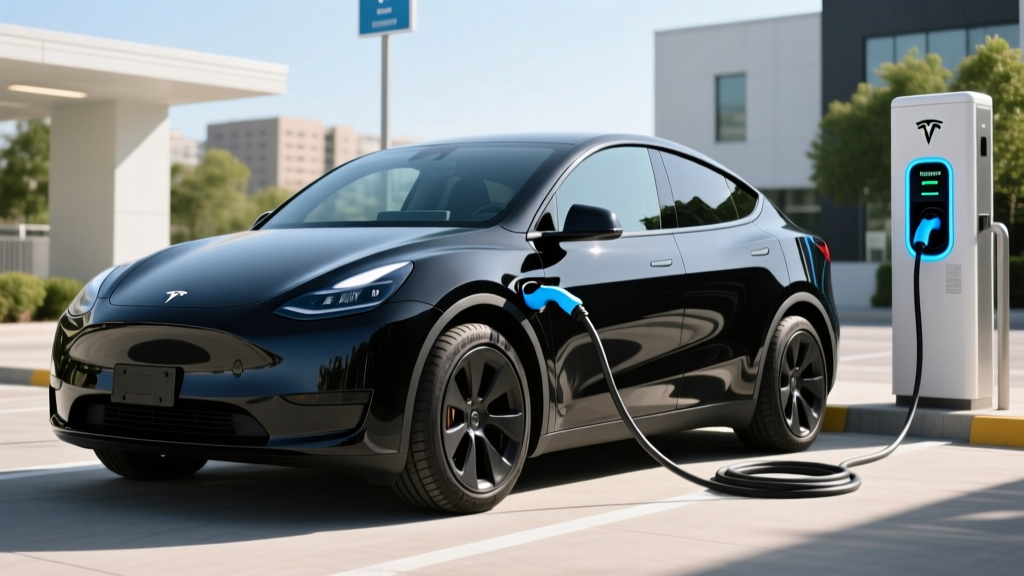
If you drive a Tesla and rely on public DC fast charging beyond the Supercharger network, you've likely encountered a common problem: most non-Tesla fast chargers use CCS1 connectors, while your car has a NACS (North American Charging Standard) port. The EVgo Tesla adapter bridges that gap, letting you access EVgo's growing network of 350 kW-capable stations. This guide covers everything you need to know about the adapter, how fast you'll actually charge, what it costs, and how to set up reliable charging at home.
Why Tesla Owners Need an EVgo Adapter in 2026
Tesla's Supercharger network remains the gold standard for reliability, but it doesn't cover every route. EVgo operates over 1,100 public fast-charging stations across the U.S., many positioned in urban centers, shopping districts, and highway corridors where Superchargers are sparse. The catch: EVgo's DC fast chargers primarily deploy CCS1 connectors, with NACS connectors still rolling out across their network through 2026.
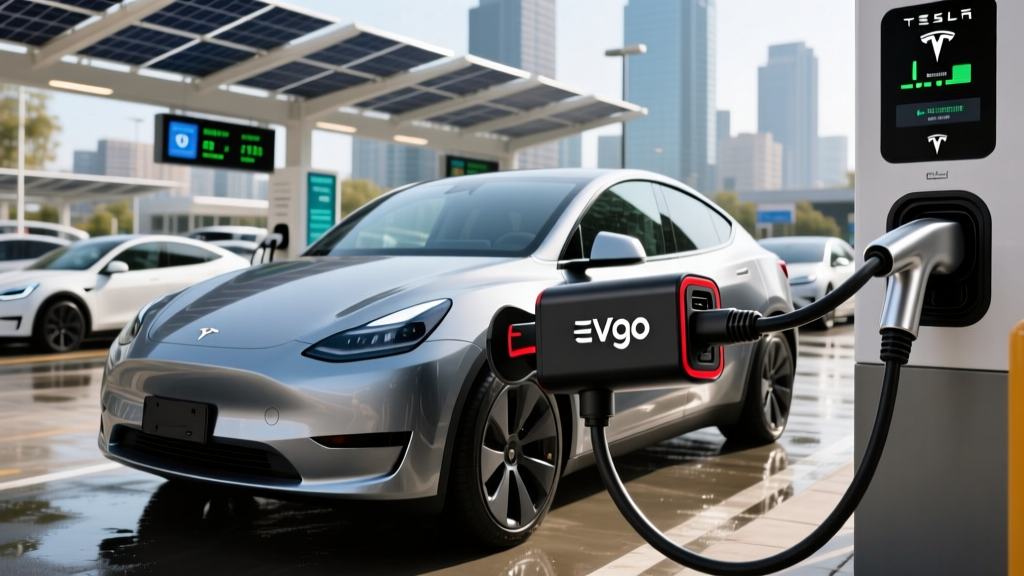
The EVgo Tesla adapter (officially called the EVgo eXtend adapter for Tesla vehicles) solves this by converting CCS1 plugs to fit your Tesla's NACS charge port. EVgo provides these adapters at select stations as tethered units, and you can also purchase your own aftermarket CCS1-to-NACS adapter from approved suppliers. The key distinction: Tesla's official CCS Adapter (part number 1848778-00-A) is rated for up to 250 kW DC fast charging and is the safest, most compatible option for Tesla vehicles.
Charging Levels Explained: Speed, Power, and What to Expect
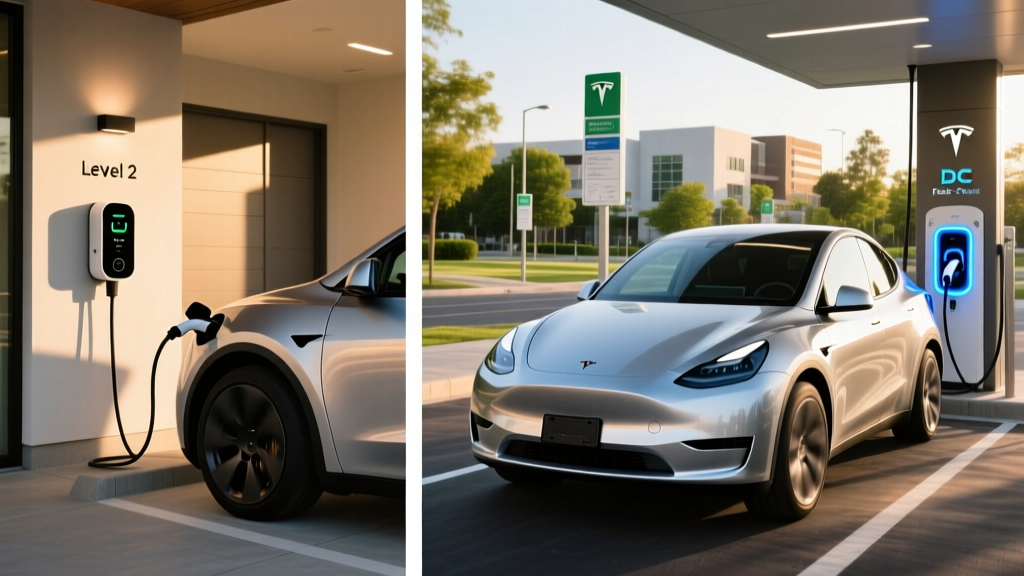
Before evaluating any adapter or charger, you need to understand the three charging tiers and how power (kW) translates to range added per hour. Remember: kW measures power (how fast energy flows), while kWh measures energy (how much your battery holds). A 75 kWh battery charged at 7 kW takes roughly 10+ hours; at 150 kW, the same battery can go from 10–80% in under 30 minutes.
| Level | Voltage / Amps | Max Power (kW) | Miles of Range Added per Hour | Typical Use |
|---|---|---|---|---|
| Level 1 | 120V / 12A | ~1.4 kW | 3–5 mi/hr | Emergency / overnight trickle |
| Level 2 | 240V / 32–48A | 7.7–11.5 kW | 25–44 mi/hr | Home daily charging, workplace |
| DC Fast | 400–800V DC | 50–350 kW | 150–1,000+ mi/hr (peak) | Road trips, rapid top-ups |
Real-world charging times for a Tesla Model Y Long Range (75 kWh usable battery, ~310 miles EPA range):
- Level 1 (1.4 kW): 10% to 80% takes approximately 50+ hours — impractical for daily use.
- Level 2 (11.5 kW / 48A): 10% to 80% in roughly 5 hours — ideal for overnight home charging.
- DC Fast at EVgo (150 kW peak, CCS1 via adapter): 10% to 80% in approximately 25–30 minutes. Note that the Tesla CCS adapter caps at 250 kW, and the Model Y's charge curve tapers significantly above 60% state of charge.
- DC Fast at Tesla Supercharger V3 (250 kW): 10% to 80% in approximately 18–22 minutes with battery preconditioning active.
Connector Compatibility: Which Adapter Do You Actually Need?
The EVgo network in 2026 is in transition. Most existing EVgo stations still feature CCS1 connectors, while new installations and retrofits increasingly include native NACS cables. Here's how connector compatibility breaks down by vehicle brand:
| Connector | Vehicles That Use It Natively | Adapter Needed for EVgo CCS1 Stations? |
|---|---|---|
| NACS (Tesla) | Tesla (all models), Ford F-150 Lightning (2025+), Rivian (2025+), GM Ultium vehicles (2025+) | Yes — CCS1-to-NACS adapter required at CCS1-only EVgo stalls |
| CCS1 | Hyundai, Kia, BMW, VW, most legacy non-Tesla EVs | No — native fit |
| CHAdeMO | Nissan Leaf (older), Mitsubishi Outlander PHEV | Yes — CHAdeMO stations are separate; adapter to CCS1/NACS is rare and not recommended for DC fast charging |
The Tesla CCS Adapter (Tesla's official unit) is your best option for charging a Tesla at EVgo's CCS1 stalls. It weighs under 1 lb, fits in your glovebox, and supports up to 250 kW. Third-party CCS1-to-NACS adapters from brands like Lectron and A2Z are available for $100–$180, but Tesla's official adapter (~$175 from Tesla's shop) is the only one guaranteed to work with your car's firmware and thermal management. Some EVgo stations in high-Tesla-traffic areas now provide tethered EVgo eXtend adapters — you simply grab the attached adapter, plug the CCS1 cable into it, and connect to your car.
How Much Does It Cost to Install a Home EV Charger?
Public DC fast charging is essential for road trips, but 80%+ of EV charging happens at home. A Level 2 home charger (240V) is the single biggest quality-of-life upgrade for any EV owner. Here's what installation actually costs in 2026:
| Component | Typical Cost Range | Notes |
|---|---|---|
| Level 2 charger (hardware) | $250–$700 | Smart Wi-Fi chargers cost more; basic units start ~$250 |
| Electrician labor (240V outlet or hardwire) | $400–$1,500 | Depends on run length from panel, wall material, local rates |
| Electrical permit | $50–$200 | Required in most jurisdictions; inspected after install |
| Panel upgrade (if needed) | $1,500–$4,000 | Homes with 100A service may need 200A upgrade for a 48A charger |
| TOTAL (no panel upgrade) | $700–$2,400 | Most homes with 200A service fall in this range |
| TOTAL (with panel upgrade) | $2,200–$6,400 | Older homes with 100A or 150A panels |
Electrical requirements for a typical 48-amp Level 2 charger: You need a dedicated 240V / 60A circuit (NEC code requires circuits to be rated at 125% of continuous load, so a 48A charger requires a 60A breaker). A NEMA 14-60 outlet is the most common receptacle, though many electricians recommend hardwiring for reliability and to avoid outlet wear. If your electrical panel is already near capacity — common in homes with electric ranges, dryers, and HVAC — a licensed electrician may recommend a panel upgrade or a smart load-management device like the Emporia Smart Load Center.
Charging Cost: EVgo vs. Home vs. Gas
The economics of EV charging depend heavily on where and when you plug in. Here's a realistic cost comparison for 2026:
| Scenario | Rate | Cost per Mile (Tesla Model Y, 3.5 mi/kWh) |
|---|---|---|
| Home (off-peak utility rate) | $0.09–$0.14/kWh | $0.026–$0.040 |
| Home (standard rate, no TOU plan) | $0.15–$0.22/kWh | $0.043–$0.063 |
| EVgo DC fast (member rate) | $0.33–$0.48/kWh | $0.094–$0.137 |
| EVgo DC fast (non-member / guest) | $0.43–$0.58/kWh | $0.123–$0.166 |
| Tesla Supercharger (avg. 2026) | $0.28–$0.36/kWh | $0.080–$0.103 |
| Gasoline (28 MPG avg, $3.40/gal) | $3.40/gallon | $0.121 |
The takeaway: home charging on a time-of-use (TOU) plan is dramatically cheaper than gas — roughly $0.03–$0.04 per mile versus $0.12 per mile for a 28 MPG gas car. EVgo DC fast charging at member rates is competitive with gas, while non-member rates can exceed gasoline costs per mile. If you use EVgo regularly, the EVgo Plus membership ($4.99/month) pays for itself within one or two charging sessions.
Practical example: A Tesla Model Y owner driving 12,000 miles per year who charges 85% at home (off-peak) and 15% on EVgo DC fast chargers would spend approximately $480–$620 annually on electricity. The equivalent gas car at 28 MPG and $3.40/gallon would cost $1,457 per year. That's $837–$977 in annual fuel savings — before factoring in EV maintenance reductions (no oil changes, fewer brake replacements due to regenerative braking).
Recommended Home Level 2 Chargers for Tesla and NACS Vehicles
Whether you drive a Tesla or a newer NACS-equipped Ford, GM, or Rivian, these Level 2 chargers deliver reliable daily charging. All recommendations below include exact specs — power output, connector type, cable length, and current pricing.
Tesla Wall Connector (Gen 3)
- Power output: 11.5 kW (48A) on a 60A circuit
- Connector: Native NACS — no adapter needed for Tesla or NACS vehicles
- Cable length: 24 feet
- Smart features: Wi-Fi, OTA updates, power sharing (link up to 6 units on one circuit), access control
- Price: ~$450
- Best for: Tesla owners who want the simplest, most integrated home charging solution
ChargePoint Home Flex
- Power output: Up to 12 kW (50A) on a 60A circuit; adjustable down to 16A
- Connector: J1772 (NACS adapter included for Tesla vehicles)
- Cable length: 23 feet
- Smart features: Wi-Fi, app scheduling, Alexa integration, energy tracking, flexible amperage
- Price: ~$550–$650
- Best for: Multi-EV households (charges any EV natively); adjustable amperage is ideal for older panels
Emporia Vue Level 2 Charger
- Power output: 11.5 kW (48A) on a 60A circuit
- Connector: J1772 (NACS version available for 2025+ models)
- Cable length: 24 feet
- Smart features: Wi-Fi, integration with Emporia whole-home energy monitor, solar-aware charging, TOU scheduling
- Price: ~$400–$500
- Best for: Budget-conscious buyers who want smart features and solar integration
Grizzl-E Smart
- Power output: 10 kW (40A) on a 50A circuit
- Connector: J1772 (NACS adapter available separately)
- Cable length: 24 feet
- Smart features: Wi-Fi, OCPP protocol, adjustable amperage, extreme cold rated (-40°F)
- Price: ~$450–$550
- Best for: Cold-climate owners and outdoor installations; built in Canada with a rugged aluminum case
Safety, Electrical Code, and Installation Best Practices
EV charging draws sustained high current for hours — this is fundamentally different from plugging in a dryer for 45 minutes. The National Electrical Code (NEC) treats EV charging as a continuous load, which means the circuit must be rated at 125% of the charger's maximum draw. A 48-amp charger requires a 60-amp breaker and 6 AWG copper wire (or 4 AWG aluminum).
Key safety and code requirements:
- Dedicated circuit: Your EV charger must have its own dedicated breaker — never share a circuit with other appliances.
- GFCI protection: NEC 2020 and later require GFCI (Ground Fault Circuit Interrupter) protection for all 240V EV charging outlets. Hardwired installations may be exempt depending on local code. Many smart chargers have built-in GFCI detection.
- Outdoor rating: If your charger is installed outside (garage-exterior wall, carport, or driveway pedestal), it must carry a NEMA 4 or NEMA 4X rating for weather resistance. All four chargers recommended above are outdoor-rated.
- Permit and inspection: Most municipalities require an electrical permit for a new 240V circuit. The inspection ensures proper wire gauge, breaker sizing, grounding, and GFCI compliance. Skipping the permit risks insurance claim denials if an electrical fire occurs.
- Load calculation: A licensed electrician will perform a load calculation on your panel to confirm it can handle the additional 48–50 amps. If your home already has electric heat, an electric range, and a dryer on a 100A or 150A panel, a 200A upgrade may be necessary.
Using the EVgo Network with a Tesla: Step-by-Step
Here's exactly how a charging session works when you pull up to an EVgo station with your Tesla and a CCS1-to-NACS adapter:
- Open the EVgo app and locate a station with CCS1 connectors (marked as "CCS" on the map). Confirm the stall's power rating — EVgo offers 50 kW, 100 kW, 150 kW, and 350 kW stalls.
- Initiate the session via the EVgo app, RFID card, or the station's screen. Select the CCS connector.
- Connect your adapter: Plug the station's CCS1 cable into your CCS1-to-NACS adapter, then plug the adapter into your Tesla's charge port.
- Verify charging has started: Your Tesla's screen will show charge rate in kW and estimated time to your target SoC. The EVgo app will display real-time cost.
- Monitor the charge curve: Expect peak charge rates only between 10–40% SoC. Above 60%, the rate tapers significantly. Above 80%, charging slows dramatically to protect battery health — don't wait for 100% at a DC fast charger unless absolutely necessary.
- Disconnect: Stop the session in the app, unplug the adapter from your car, then separate the CCS1 cable from your adapter. Return any tethered station adapter to its holster.
Pro tip: Enable battery preconditioning in your Tesla by navigating to a Supercharger (or any fast charger) in the navigation system. The car will warm the battery to optimal temperature for faster charging, even if you're actually heading to an EVgo station. This can shave 5–8 minutes off your 10–80% charge time in cold weather.
Frequently Asked Questions
Does EVgo provide Tesla adapters at their stations?
Some EVgo stations in high-Tesla-traffic areas have tethered CCS1-to-NACS adapters (called the EVgo eXtend adapter) permanently attached to the charging cable. However, this is not universal. Carry your own Tesla CCS Adapter to guarantee compatibility at any EVgo CCS1 station. EVgo is progressively adding native NACS cables to new and retrofitted stations through 2026.
How fast will my Tesla charge on EVgo with an adapter?
A Tesla Model 3 or Model Y can peak at approximately 170–250 kW on a compatible EVgo DC fast charger via CCS1 adapter, depending on battery temperature and state of charge. Expect a 10–80% session to take 25–35 minutes on a 150+ kW stall. On a 50 kW EVgo stall, the same 10–80% session will take roughly 60–75 minutes. The adapter itself does not reduce charge speed — your car's onboard charge architecture and the station's power output are the limiting factors.
Can I use the Tesla CCS Adapter for Level 2 AC charging at public stations?
No. The Tesla CCS Adapter is designed exclusively for DC fast charging. For AC Level 2 public chargers (which use the J1772 connector), use the J1772-to-NACS adapter that came with your Tesla. That adapter handles up to 19.2 kW AC and is included with every Tesla vehicle.
What electrical upgrades might my home need for a Level 2 charger?
Homes with a 200-amp electrical panel typically have sufficient capacity for a 48-amp Level 2 charger without upgrades. Homes with 100-amp or 150-amp service — common in houses built before 2000 — may require a panel upgrade ($1,500–$4,000) or a reduced-amperage charger (32A / 7.7 kW) that fits within existing capacity. A licensed electrician will perform a load calculation to determine your exact needs. Smart load-management devices like the Emporia Smart Load Center can sometimes avoid a panel upgrade by dynamically reducing charger draw when other appliances are running.
Is EVgo cheaper than Tesla Supercharging?
It depends on your membership status and location. EVgo Plus members typically pay $0.33–$0.48/kWh, while Tesla Superchargers average $0.28–$0.36/kWh nationally in 2026. In some markets, EVgo member rates are competitive with or slightly below Supercharger pricing; in others, Supercharging remains cheaper. Both networks charge idle fees if you remain plugged in after reaching your charge limit. For the lowest per-mile cost, nothing beats home charging on an off-peak utility rate.
How much does charging cost per mile compared to gasoline?
Based on 2026 national averages: home-charging a Tesla Model Y on an off-peak rate costs approximately $0.03–$0.04 per mile. EVgo DC fast charging at member rates costs $0.09–$0.14 per mile. A comparable gasoline car getting 28 MPG at $3.40/gallon costs $0.12 per mile. Home charging delivers the largest savings — roughly 65–75% less per mile than gasoline. Even public DC fast charging at member rates is cost-competitive with gas, with the added benefit of zero tailpipe emissions.
Sources: EPA Fuel Economy for efficiency data; IRS.gov for home charging tax credit rules; EVgo.com for network pricing and adapter availability. Pricing and rates reflect 2026 estimates and may vary by region.