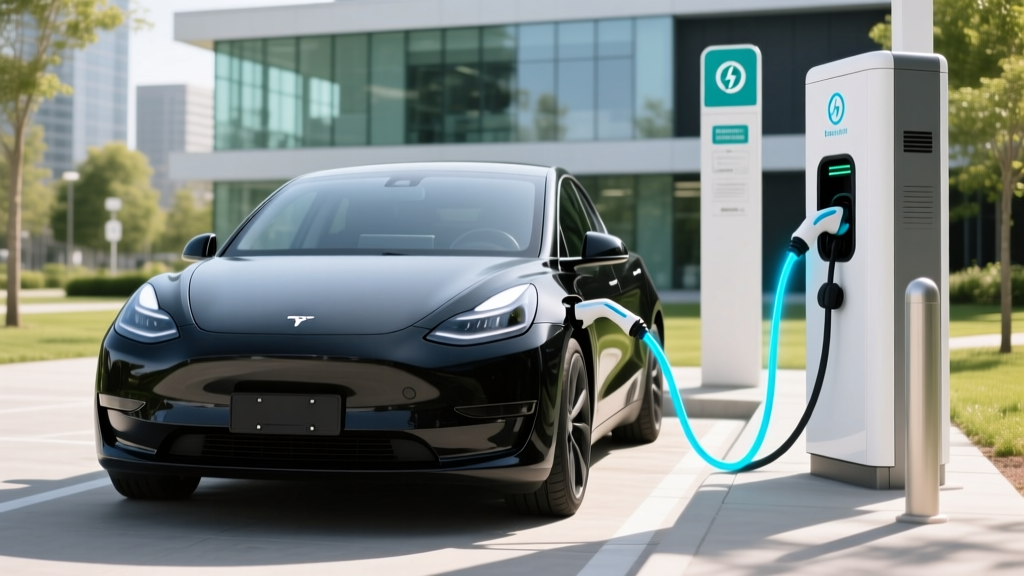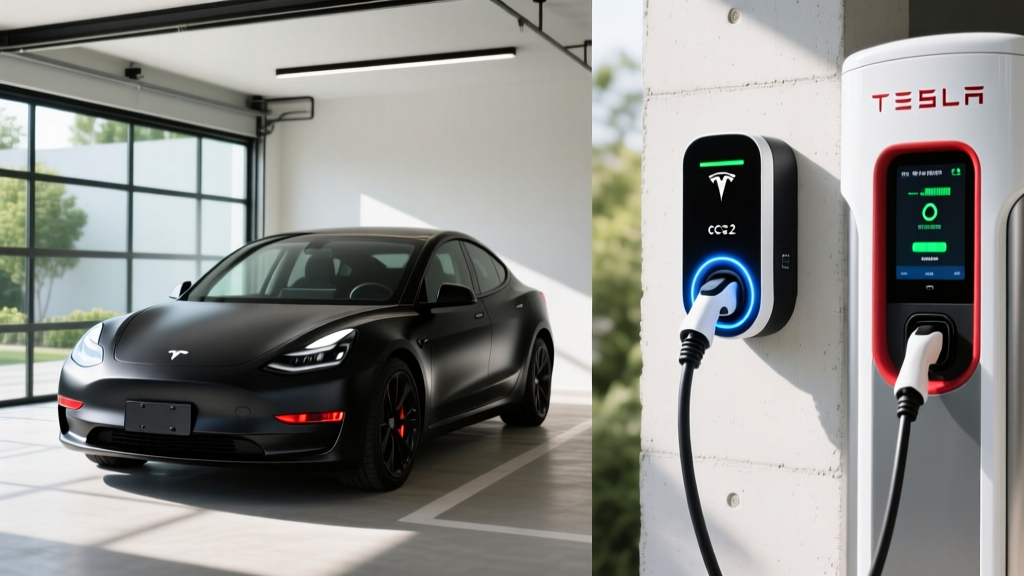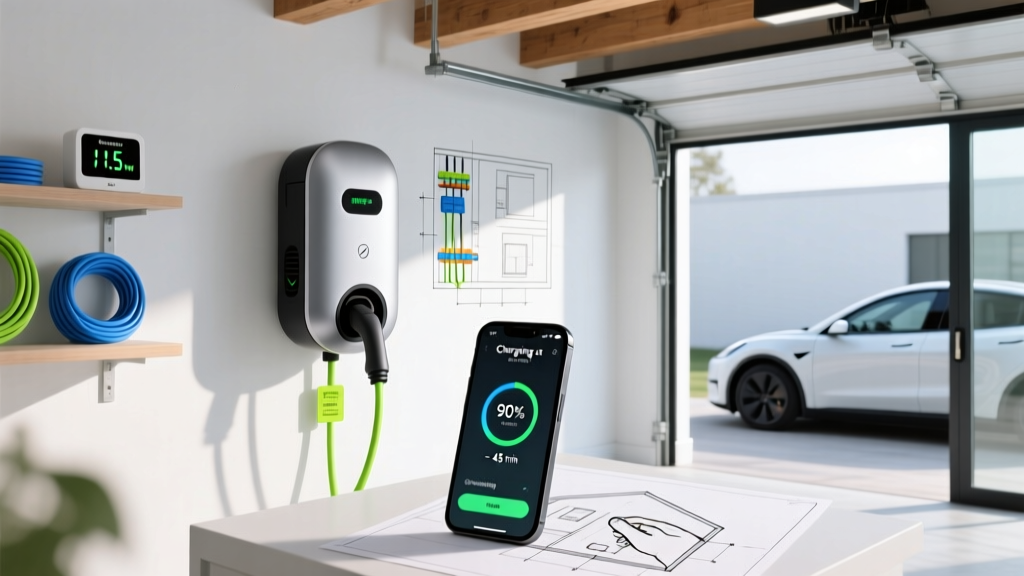
If you've recently purchased an electric vehicle or are planning to, charging at home is where the ownership experience is won or lost. Public DC fast chargers are essential for road trips, but 80–90% of all EV charging happens at home, according to the U.S. Department of Energy. The centerpiece of that setup is an EV smart charger — a Wi-Fi-connected Level 2 wall unit that lets you schedule sessions, monitor energy use, and take advantage of off-peak utility rates.
This guide breaks down everything you need to spec, buy, and install a home smart charger in 2026: charging speeds at every level, real installation costs including panel upgrades, connector compatibility across every major brand, and concrete equipment picks with pricing.
Charging Levels Explained: Speeds in kW and Miles Per Hour
Before choosing equipment, you need to understand the three charging tiers and what they actually deliver to your battery. The critical distinction: kW (kilowatts) measures power — how fast energy flows into the car. kWh (kilowatt-hours) measures energy — the total capacity of the battery. A 75 kWh battery charged at 11.5 kW takes roughly 6.5 hours from empty to full.
| Level | Voltage | Power (kW) | Miles of Range Added Per Hour | Typical Use Case |
|---|---|---|---|---|
| Level 1 | 120V AC | 1.0–1.4 kW | 3–5 mi/hr | Overnight trickle; PHEVs or low-mileage drivers |
| Level 2 (Home) | 240V AC | 3.3–19.2 kW | 12–75 mi/hr | Daily home and workplace charging |
| DC Fast Charging | 200–900V DC | 50–350+ kW | 150–1,000+ mi/hr (peak) | Road trips; 10–80% in 15–40 min |
For most EV owners, a Level 2 home charger delivering 7.7 kW to 11.5 kW is the practical sweet spot. That's enough to fully replenish a 75–100 kWh battery overnight (8–12 hours), which covers virtually all daily driving needs. A Level 1 cord plugged into a standard 120V outlet adds only 3–5 miles of range per hour — adequate for a plug-in hybrid with a 30-mile electric range, but insufficient for a full-size BEV with a 300+ mile battery.
- Tesla Model Y (75 kWh usable): 10–80% in ~4.5 hours
- Hyundai Ioniq 5 (77.4 kWh usable): 10–80% in ~4.7 hours
- Ford F-150 Lightning Extended Range (131 kWh usable): 10–80% in ~8 hours
- Chevrolet Equinox EV (85 kWh usable): 10–80% in ~5.2 hours
Home EV Charger Installation: Electrical Requirements and Costs
This is where most EV buyers encounter surprise expenses. Installing a hardwired Level 2 EV smart charger isn't just about mounting a box on the garage wall — it's an electrical project that may require service panel upgrades, a dedicated circuit, and local permits.
Electrical Specifications
A typical home Level 2 charger requires a 240V dedicated circuit, similar to what an electric dryer or oven uses. The most common configurations:
- 40-amp circuit / 32A continuous draw: Delivers 7.7 kW — sufficient for most EVs and compatible with older 100A or 150A electrical panels.
- 50-amp circuit / 40A continuous draw: Delivers 9.6 kW — the most popular home setup; requires adequate panel capacity.
- 60-amp circuit / 48A continuous draw: Delivers 11.5 kW — maximum practical home speed; requires a modern 200A panel with available headroom.
The National Electrical Code (NEC) requires that continuous loads (anything running 3+ hours, which includes EV charging) use only 80% of a circuit's rated capacity. So a 48A charger needs a 60A breaker. A licensed electrician will verify your panel's available amperage before recommending a circuit size.
Installation Cost Breakdown
| Component | Simple Install (Near Panel) | Complex Install (Long Run / Panel Upgrade) |
|---|---|---|
| EV Smart Charger (Equipment) | $350–$700 | $350–$700 |
| Electrician Labor (2–4 hrs simple / 6–10 hrs complex) | $300–$700 | $900–$2,000 |
| Electrical Permit | $50–$150 | $50–$200 |
| Conduit, Wiring, Junction Box | $50–$150 | $200–$600 |
| Panel Upgrade (100A → 200A, if needed) | $0 (not needed) | $1,500–$3,500 |
| Total Estimated Cost | $750–$1,700 | $3,000–$7,000 |
The single biggest cost variable is whether your electrical panel can handle the additional load. Homes built after 2000 typically have 200A service with enough spare capacity. Older homes with 100A or 150A panels may need a service panel upgrade before adding a 50A or 60A EV circuit. Some utilities offer rebates of $250–$1,000 for panel upgrades tied to EV adoption — check with your local provider.
An alternative to hardwiring is a NEMA 14-50 outlet (240V/50A), which lets you plug in a charger with a matching plug and take it with you if you move. This adds flexibility but costs slightly more in outlet hardware and requires a GFCI breaker under current NEC code.
Connector Compatibility: Which Plug Fits Your EV?
The connector landscape has shifted dramatically since 2023, when Ford, GM, Rivian, and most other automakers committed to adopting Tesla's North American Charging Standard (NACS). As of the 2026 model year, NACS is the dominant connector for new EVs sold in North America, though thousands of CCS1-equipped vehicles remain on the road.
| Connector | Brands Using It (New Vehicles) | Adapter Needed? |
|---|---|---|
| NACS (Tesla / J3400) | Tesla, Ford, GM, Rivian, Hyundai, Kia, BMW, Volvo, Polestar, Mercedes-Benz, Subaru | CCS1 → NACS adapter for older CCS vehicles at NACS stalls |
| CCS1 (Combined Charging System) | Remaining Stellantis models, some VW ID.4 (transitioning to NACS) | NACS → CCS1 adapter for charging at Tesla Superchargers |
| CHAdeMO | Discontinued — no new 2026 models (legacy Nissan Leaf, Mitsubishi) | No reliable adapter to NACS/CCS for DC fast charging |
Practical advice: If you're buying a new EV in 2026, it almost certainly uses NACS. Buy a NACS-connector smart charger for your home. If you own a 2023–2025 CCS1 vehicle (e.g., Hyundai Ioniq 5, VW ID.4, Ford Mustang Mach-E pre-2025), you can either purchase a CCS1-connector charger or use a NACS-to-CCS1 adapter ($150–$250) with a NACS charger. Adapters add a point of failure and slight resistance, so a native connector is always preferred.
CHAdeMO is effectively dead for new vehicles. If you own a legacy Nissan Leaf, CHAdeMO home chargers (e.g., used ClipperCreek units) still work but are no longer manufactured by major brands. Plan for a future adapter or vehicle swap.
Cost to Charge: Home vs. Public vs. Gas
One of the strongest financial arguments for home charging is cost. Electricity prices vary widely by region and utility, but home charging is nearly always cheaper per mile than gasoline — and dramatically cheaper than public DC fast charging.
| Scenario | Rate ($/kWh) | Efficiency (kWh/100 mi) | Cost Per Mile |
|---|---|---|---|
| Home (national avg. residential) | $0.17/kWh | 30 kWh/100 mi | $0.051/mi |
| Home (off-peak TOU rate) | $0.08/kWh | 30 kWh/100 mi | $0.024/mi |
| Public Level 2 (ChargePoint, EVgo) | $0.30–$0.49/kWh | 30 kWh/100 mi | $0.09–$0.15/mi |
| DC Fast Charging (Electrify America, Tesla Supercharger) | $0.35–$0.58/kWh | 30 kWh/100 mi | $0.11–$0.17/mi |
| Gasoline vehicle (28 MPG combined, $3.40/gal) | — | — | $0.12/mi |
At the national residential average of roughly $0.17/kWh, a typical EV consuming 30 kWh per 100 miles costs about 5 cents per mile to charge at home. A comparable gasoline vehicle at 28 MPG and $3.40/gallon costs roughly 12 cents per mile. That's a per-mile savings of nearly 60%.
The savings compound with a time-of-use (TOU) utility plan. Many utilities offer off-peak rates between 10 PM and 6 AM as low as $0.06–$0.10/kWh. An EV smart charger's scheduling feature is what unlocks this: you plug in when you get home at 6 PM, but the charger delays the session until 11 PM when rates drop. Over a year of 12,000 miles, that's roughly $300–$500 in annual electricity savings compared to charging during peak hours.
Top EV Smart Charger Picks for 2026
We evaluated chargers on power output, connector options, cable length, smart features (Wi-Fi, scheduling, energy monitoring, load sharing), build quality, and price. Here are four standout units across different budgets and use cases.
ChargePoint Home Flex (2nd Gen)
- Power: Up to 12 kW (50A) — adjustable 16A–50A
- Connector: NACS or J1772 (CCS via adapter)
- Cable Length: 23 ft
- Smart Features: Wi-Fi, Alexa/Google Home, scheduling, energy dashboard, load sharing for 2-unit installs
- Price: ~$549 (NACS), ~$499 (J1772)
- Best For: Flexible amperage matching to your panel; strong app ecosystem
Tesla Wall Connector
- Power: Up to 11.5 kW (48A)
- Connector: NACS (native Tesla); J1772 adapter included
- Cable Length: 24 ft
- Smart Features: Wi-Fi, OTA updates, power sharing (up to 6 units on one circuit), Tesla app integration
- Price: ~$475
- Best For: Tesla owners wanting seamless integration; excellent value at 48A
Emporia Level 2 EV Charger
- Power: Up to 11.5 kW (48A)
- Connector: NACS or J1772
- Cable Length: 24 ft
- Smart Features: Wi-Fi, real-time energy monitoring (pairs with Emporia Vue panel monitor), TOU scheduling, solar integration
- Price: ~$399
- Best For: Budget-conscious buyers who want granular energy data and solar-aware charging
Grizzl-E Smart (United Chargers)
- Power: Up to 10 kW (40A)
- Connector: NACS or J1772
- Cable Length: 24 ft
- Smart Features: Wi-Fi, OCPP protocol support, scheduling, energy tracking
- Price: ~$499
- Best For: Extreme cold climates (rated to -40°F); rugged outdoor installation
All four chargers support hardwired installation (recommended for maximum amperage) or NEMA 14-50 plug configurations. For outdoor installation, verify the unit carries a NEMA 4 rating (weatherproof against rain, snow, and hose-directed water). The Grizzl-E and Tesla Wall Connector are particularly robust for exposed outdoor mounting.
Safety, Code, and Permitting Requirements
EV charging draws significant sustained current — often for 6–10 hours straight. This makes proper installation non-negotiable. Key requirements under the National Electrical Code (NEC) and most local jurisdictions:
- Dedicated circuit: Your EV charger must be on its own breaker — it cannot share a circuit with other appliances.
- GFCI protection: Required for all receptacle-based (plug-in) installations. Hardwired units may not require GFCI under all local codes, but many jurisdictions now mandate it regardless.
- Outdoor rating: Any outdoor charger must be NEMA 4 rated. Indoor garage units need only NEMA 1 (basic enclosure).
- Permit and inspection: Nearly all jurisdictions require an electrical permit for a new 240V circuit. The permit fee typically runs $50–$200, and an inspector will verify the installation meets code before you energize the circuit. Skipping the permit risks insurance claim denials and code violations at resale.
- Wire gauge: A 50A circuit requires 6 AWG copper wire; a 60A circuit requires 4 AWG. Your electrician will size wire based on run length and amperage.
Federal Tax Credit: §30D Alternative Fuel Vehicle Refueling Property Credit
Home EV charger installations may qualify for the Alternative Fuel Vehicle Refueling Property Credit under IRS §30C (distinct from the §30D new-vehicle credit). This credit covers up to 30% of the cost of the charger and installation, capped at $1,000 for residential property.
Key eligibility requirements per IRS guidelines:
- The charger must be installed at your primary residence in the United States.
- The property must be placed in service during the current tax year.
- The credit applies to both equipment and installation labor.
- Income and geographic restrictions may apply — the credit is subject to phase-outs and census-tract eligibility for certain installations.
Consult a tax professional to confirm your eligibility. Many state and utility incentive programs stack on top of the federal credit — states like California, Colorado, and New York offer additional rebates of $250–$750 for smart charger installations.
Frequently Asked Questions
How much does it cost to install a home EV charger?
A straightforward installation (panel near the garage, no upgrade needed) typically costs $750–$1,700 total including the charger, electrician labor, wiring, and permit. Complex installations requiring long wire runs, trenching, or a panel upgrade can reach $3,000–$7,000. The panel upgrade alone accounts for $1,500–$3,500 of that range.
How fast will each charging level add range?
Level 1 (120V) adds roughly 3–5 miles per hour. Level 2 (240V at 48A / 11.5 kW) adds roughly 35–45 miles per hour depending on vehicle efficiency. DC fast charging at 150+ kW can add 150–300+ miles in 20 minutes, though charge speed tapers significantly above 80% state of charge.
Which connector/charger is compatible with my EV?
For 2026 model-year vehicles, most new EVs use the NACS connector. Check your vehicle's charge port — if it's a single, compact port (not the wider CCS1 with two pins below), it's NACS. Buy a NACS-connector charger. If you own a 2023–2025 CCS1 vehicle, you can use a NACS-to-CCS1 adapter or purchase a J1772/CCS1 charger.
How much does charging cost per mile vs. gas?
Home charging at the national average rate of $0.17/kWh costs roughly $0.05 per mile for a typical EV. Off-peak rates can drop this to $0.02–$0.03/mi. A comparable gasoline vehicle at 28 MPG and $3.40/gal costs about $0.12/mi. Public DC fast charging at $0.40–$0.55/kWh costs $0.12–$0.17/mi — comparable to or slightly more than gas.
What electrical upgrades might I need?
If your home has a 100A or 150A electrical panel, you may need a panel upgrade to 200A to safely add a 50A or 60A EV circuit. An electrician will perform a NEC Article 220 load calculation to determine available capacity. Alternatives include installing a lower-amperage charger (32A/7.7 kW on a 40A circuit) or adding an automatic load-management device that throttles charging when other appliances draw heavy current.
Do I really need a smart charger, or will a basic unit work?
A basic (non-smart) Level 2 charger will charge your car just fine. However, a smart charger's scheduling feature lets you exploit off-peak utility rates (saving $300–$500/year), its energy monitoring helps you track charging costs, and its firmware updates can add features over time. The price premium for smart functionality is typically only $50–$150 over a dumb charger — a fast payback.