Why Charging an EV With Range Extender Is Different
An EV with range extender (often called an EREV or extended-range electric vehicle) pairs a smaller battery with a gasoline generator that recharges the pack on the fly. The driver experience is still electric — you plug in at home and drive on battery power daily — but the smaller pack means charging is faster, less expensive, and less demanding on your home electrical system than a full-size BEV.
For the 2025–2026 model years, the primary EREVs available to US buyers include the BMW i3 REx (used market), the Ram 1500 Ramcharger (announced, preliminary specs), and several Chinese-market models. Whether you own a current EREV or are evaluating an upcoming one, understanding your charging options — and the real costs — is essential.
Charging Levels Explained: Speeds, Power, and Miles Added
Before selecting equipment, understand the three charging tiers. Power is measured in kilowatts (kW), which is the rate of energy delivery. The battery capacity is measured in kilowatt-hours (kWh), which is the total energy stored. Think of kW as the speed of water flowing through a hose, and kWh as the size of the bucket.
| Level | Voltage | Typical Power (kW) | Miles of Range Added per Hour | Best Use Case |
|---|---|---|---|---|
| Level 1 | 120V AC | 1.0–1.4 kW | 3–5 mi/hr | Overnight top-up, small EREV batteries |
| Level 2 | 240V AC | 3.3–19.2 kW | 12–75 mi/hr | Daily home charging, workplace |
| DC Fast | 400–800V DC | 50–350 kW | 150–1,200+ mi/hr (peak) | Road trips, rapid replenishment |
For a typical EREV with a 30–40 kWh battery and roughly 30–50 miles of electric range, Level 1 charging at 1.4 kW can fully recharge the pack overnight (7–10 hours). That makes Level 1 viable for EREV owners who drive less than 40 miles daily — something that's impractical for most full BEVs.
However, Level 2 at 7.2 kW (the most common home setup) will refill that same 30–40 kWh pack in roughly 4–6 hours, giving you flexibility to charge during shorter parking windows or to take advantage of time-of-use electricity rates.
How Much Does It Cost to Install a Home EV Charger?
Home charger installation costs vary enormously depending on your electrical panel's capacity, the distance from the panel to the charger location, and local permitting requirements. Here's a realistic breakdown for a 240V/48A Level 2 charger installation in 2026:
| Component | Typical Cost Range | Notes |
|---|---|---|
| Level 2 Charger (Equipment) | $350–$700 | Smart Wi-Fi-enabled, 40–48A, 24ft cable |
| Electrician Labor | $500–$2,000 | Depends on run length, conduit, drywall work |
| Electrical Permit | $50–$250 | Varies by municipality |
| Panel Upgrade (if needed) | $1,500–$4,000 | Required if panel is at capacity or below 200A |
| Total (No Panel Upgrade) | $900–$2,950 | Most homes with 200A service |
| Total (With Panel Upgrade) | $2,400–$6,950 | Older homes with 100A or maxed-out panels |
What Electrical Upgrades Might I Need?
A 48A Level 2 charger requires a dedicated 60A circuit on a 240V line (the National Electrical Code requires circuits to be rated at 125% of continuous load). If your electrical panel is a 200A service with available breaker slots and sufficient load headroom, you're likely fine.
However, many homes built before 2000 have 100A or 150A panels that may already be near capacity with HVAC, electric ranges, and dryers. An electrician will perform a load calculation per NEC Article 220 to determine whether a panel upgrade is necessary. For EREV owners, there's a silver lining: because the battery is smaller, you can often get by with a 32A charger on a 40A circuit, which places less demand on the panel.
Safety requirements include a GFCI breaker (required by NEC 2020 and later for EV charging outlets), a NEMA 14-50 receptacle or hardwired connection, and an outdoor-rated (NEMA 4) enclosure if the charger is installed outside.
Which Connector and Charger Is Compatible With My EREV?
The connector landscape has shifted dramatically. As of 2025–2026, nearly all new EVs sold in North America use the NACS (North American Charging Standard, also called the Tesla connector). Legacy CCS1 and CHAdeMO connectors persist on older models and some public chargers.
| Connector | Used By | Public Charger Availability | Adapter Needed? |
|---|---|---|---|
| NACS (Tesla) | Tesla, Ford, GM, Rivian, Volvo, BMW (2025+), most new EREVs | Excellent — Tesla Supercharger network + growing third-party | CCS-to-NACS adapters available ~$200–$300 for legacy CCS vehicles |
| CCS1 | Hyundai, Kia, VW, older BMW, Stellantis (pre-2025) | Good — Electrify America, EVgo, ChargePoint | NACS-to-CCS adapters available for Tesla Supercharger access |
| CHAdeMO | Nissan Leaf (legacy) | Declining — limited new installations | No practical adapter to NACS/CCS |
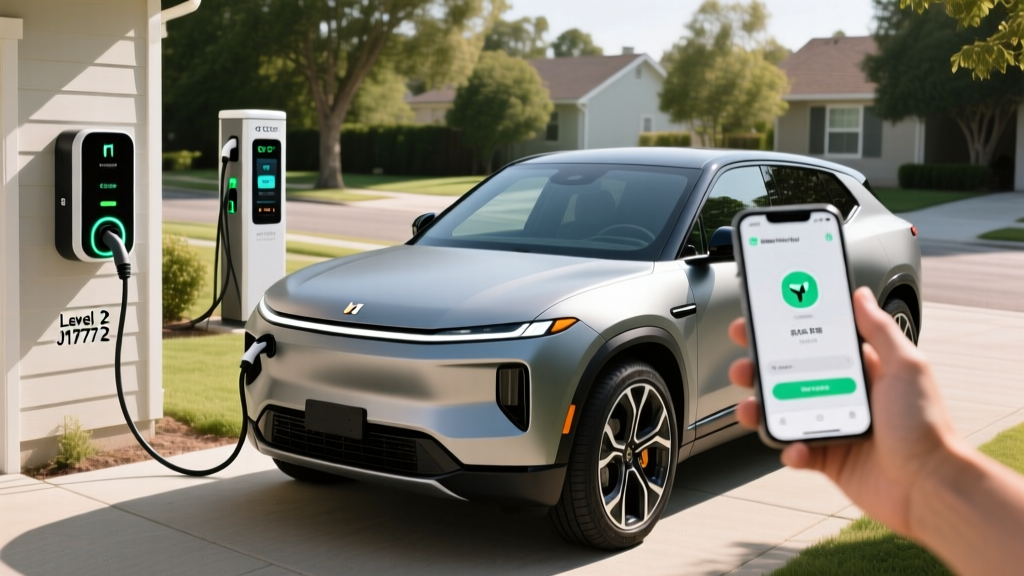
| J1772 (Level 1/2) | All EVs (AC charging standard) | Universal | Tesla vehicles include J1772 adapter; NACS vehicles need J1772-to-NACS adapter |
Most upcoming EREVs entering the US market in 2025–2026, including the Ramcharger, are expected to ship with NACS ports. If you're buying a used BMW i3 REx, it has a CCS1 port and will need a CCS-to-NACS adapter (such as the Lectron or A2Z adapter, ~$200–$250) for Tesla Supercharger access.
Cost to Charge: Per-Mile Economics vs Gasoline
The financial case for plugging in your EREV rather than running the gasoline generator hinges on your electricity rate and driving patterns. Here's a realistic comparison:
| Scenario | Rate | Cost to Fill 35 kWh Battery | Cost per Mile (EV mode) | Equivalent Gas Cost per Mile |
|---|---|---|---|---|
| Home Off-Peak (utility TOU rate) | $0.09/kWh | $3.15 | $0.08/mi | — |
| Home Standard Rate | $0.16/kWh | $5.60 | $0.14/mi | — |
| Public Level 2 (ChargePoint, etc.) | $0.25–$0.40/kWh | $8.75–$14.00 | $0.22–$0.35/mi | — |
| DC Fast Charging (Electrify America) | $0.35–$0.55/kWh | $12.25–$19.25 | $0.31–$0.48/mi | — |
| EREV Gas Generator Mode | $3.40/gal @ 30 MPG | — | — | $0.11/mi |
| Gasoline ICE Vehicle Baseline | $3.40/gal @ 25 MPG | — | — | $0.14/mi |
At home off-peak rates, charging an EREV costs roughly $0.08 per mile — undercutting even the EREV's own gas generator at ~$0.11/mile. At standard residential rates ($0.16/kWh), the costs are nearly identical to running the generator. The takeaway: home charging on a time-of-use plan is where EREV owners save the most. Public DC fast charging is the most expensive option and can actually exceed the cost of gasoline per mile.
For a more detailed look at the EPA's EV efficiency ratings, check the kWh/100mi figure on the window sticker — lower numbers mean better efficiency and lower per-mile costs.
Charging Times for Common EREV Battery Sizes
EREV batteries are smaller than full BEV packs, which translates to shorter charge sessions. Here are representative 10–80% charging times:
- 20 kWh pack (e.g., early BMW i3 REx): ~5–6 hours on Level 1 (1.4 kW); ~2.5–3 hours on Level 2 (7.2 kW); ~25–30 minutes on 50 kW DC fast charger (note: many older EREVs have limited DC charge rates of 50 kW or less)
- 35 kWh pack (e.g., mid-size EREV crossover): ~9–10 hours on Level 1; ~4.5–5 hours on Level 2 (7.2 kW); ~30–40 minutes on 50 kW DC; ~20–25 minutes on 150 kW DC (if vehicle supports peak rate)
- 92 kWh pack (e.g., Ramcharger, large EREV pickup): ~27+ hours on Level 1 (impractical); ~10–12 hours on Level 2 (7.2 kW) or ~5 hours on 19.2 kW Level 2; ~30–40 minutes on 150+ kW DC fast charger
A critical note on DC fast charging: peak kW ratings are not sustained. A vehicle rated for 150 kW peak may only hold that rate between 10–40% SoC, then taper to 80–100 kW through 60%, and drop to 30–40 kW above 80%. This is called the charge curve taper, and it's why manufacturers quote 10–80% times rather than 0–100%. Charging past 80% on DC fast is slow and expensive — set your charge limit to 80% at public stations.
Recommended Level 2 Chargers for EREV Owners
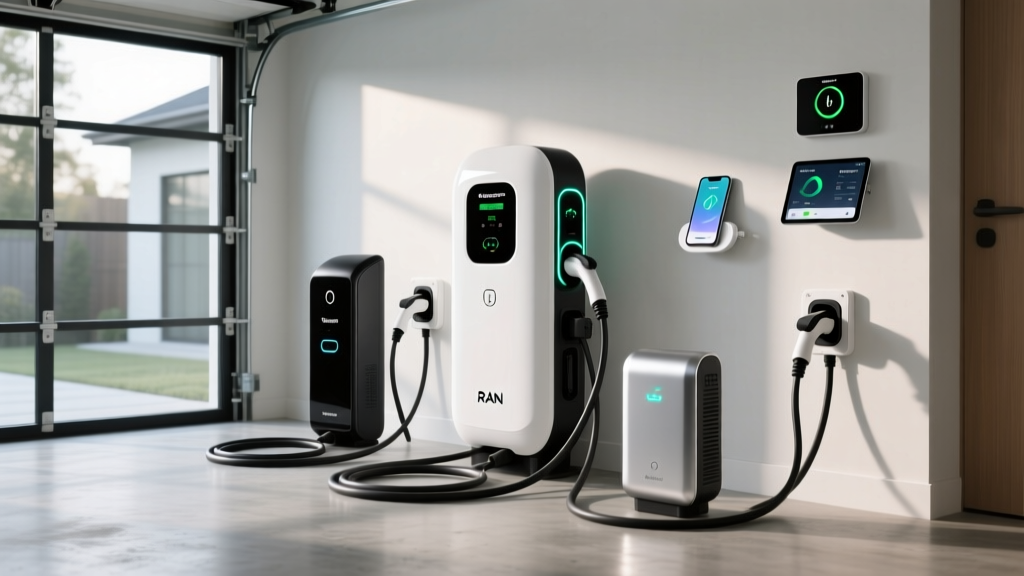
Because EREV batteries are smaller, you don't always need the highest-power charger. A 32A (7.7 kW) unit is sufficient for most EREVs, but a 48A (11.5 kW) charger provides future-proofing if you add a full BEV later.
ChargePoint Home Flex (NACS or J1772)
- Power: Up to 12 kW (50A), adjustable down to 16A for smaller circuits
- Connector: Available in NACS or J1772 (J1772-to-NACS adapter included with some bundles)
- Cable Length: 23 feet
- Smart Features: Wi-Fi, app scheduling, Alexa integration, energy tracking, utility TOU optimization
- Price: ~$550–$650
- Best For: EREV owners who want flexible amperage adjustment and utility rate scheduling
Wallbox Pulsar Plus (J1772, NACS adapter available)
- Power: Up to 11.5 kW (48A)
- Connector: J1772 standard; NACS adapter sold separately (~$100)
- Cable Length: 25 feet
- Smart Features: Wi-Fi + Bluetooth, app control, load balancing (pairs with Power Meter for panel-constrained homes), ECO-Solar mode
- Price: ~$450–$550
- Best For: Homes with limited panel capacity — load-balancing feature avoids a panel upgrade
Tesla Wall Connector (NACS)
- Power: Up to 11.5 kW (48A)
- Connector: NACS native; includes J1772 adapter in box
- Cable Length: 24 feet
- Smart Features: Wi-Fi, OTA firmware updates, power sharing (link multiple units on one circuit), vehicle access control
- Price: ~$425–$475
- Best For: EREV owners with NACS-port vehicles who want the simplest, most affordable smart charger
Emporia Level 2 EV Charger
- Power: Up to 11.5 kW (48A), configurable in 1A increments
- Connector: J1772 (NACS adapter available)
- Cable Length: 24 feet
- Smart Features: Wi-Fi, detailed energy monitoring (integrates with Emporia Vue home energy monitor), solar-aware scheduling
- Price: ~$350–$400
- Best For: Budget-conscious EREV owners who want granular energy data
Safety, Code, and Installation Best Practices
EV charging is a continuous high-draw load — similar to running your dryer for hours. Proper installation is non-negotiable for safety and insurance compliance:
- Dedicated circuit: Your charger must be on its own breaker — never share a circuit with other appliances. A 48A charger needs a 60A breaker; a 32A charger needs a 40A breaker.
- GFCI protection: NEC 2020 and later require GFCI protection for all EV charging receptacles. Hardwired installations may exempt you from the GFCI breaker requirement in some jurisdictions, which saves $50–$100 on the breaker itself.
- Outdoor rating: If installing outside, the charger must carry a NEMA 4 (weatherproof) rating. All units listed above meet this standard.
- Permit and inspection: Most jurisdictions require an electrical permit for EV charger installation. The inspection ensures the wiring gauge, breaker size, and grounding meet code. Skipping the permit can void your homeowner's insurance coverage for electrical fires.
- Wire gauge: A 60A circuit requires 6 AWG copper wire (or 4 AWG aluminum). Your electrician will size this correctly, but be aware that long wire runs (over 50 feet from panel to charger) may require upsizing to prevent voltage drop.
For EREV owners in older homes, the Wallbox Pulsar Plus with its load-balancing Power Meter is worth serious consideration. It monitors your panel's total real-time draw and automatically reduces charger amperage when other appliances are running — potentially eliminating the need for a $2,000–$4,000 panel upgrade.
Frequently Asked Questions
Can I just use a standard 120V outlet to charge my EREV?
Yes — and for many EREV owners, Level 1 charging is sufficient. With a 30–40 kWh battery, a 120V/12A outlet delivers roughly 1.4 kW, adding about 4–5 miles of range per hour. Over a 10-hour overnight session, that's 40–50 miles — enough to cover most daily commutes on electric power alone. However, use a dedicated 120V outlet on its own 15A or 20A circuit. Avoid extension cords, and inspect the outlet for warmth after the first few sessions. Continuous 12A draw for hours can overheat aging residential wiring.
Do I need a DC fast charger at home?
No. DC fast chargers cost $15,000–$50,000+ for the equipment alone and require 480V three-phase power, which is unavailable in virtually all residential settings. Level 2 at 7.2–11.5 kW is the practical home standard and fully replenishes any EREV battery overnight.
Will charging my EREV on a time-of-use plan really save money?
It depends on your utility, but typically yes. Off-peak rates can be 40–60% lower than standard rates. If your utility offers $0.08–$0.10/kWh overnight versus $0.16–$0.20/kWh during peak hours, scheduling your EREV to charge between 11 PM and 6 AM can cut your per-mile electric cost in half — making it significantly cheaper than the gasoline generator.
My EREV has a CCS port. Can I use Tesla Superchargers?
Yes, with an adapter. CCS-to-NACS adapters from Lectron, A2Z EV, and other manufacturers ($200–$300) allow CCS-equipped vehicles to charge at Tesla Superchargers. Verify compatibility with your specific vehicle model before purchasing, as some adapters have firmware requirements. The Tesla Supercharger network has progressively opened to non-Tesla vehicles via the NACS standard.
How does the range extender generator affect charging behavior?
The gasoline generator in an EREV is not a charger you control directly — it activates automatically when the battery drops to a preset threshold (typically 10–20% SoC) to maintain charge and extend range. You cannot use the generator to "fast charge" the battery while parked; it's designed to sustain, not rapidly replenish. For daily driving, plugging in at home remains the most cost-effective strategy. The generator is your safety net for longer trips where charging infrastructure is sparse.
Are there any federal incentives for installing a home charger?
The federal Alternative Fuel Vehicle Refueling Property Credit (IRS Form 8911) covers 30% of home EV charger equipment and installation costs, up to $1,000, for installations in eligible census tracts (typically low-income or non-urban areas). Eligibility depends on your address — check the IRS census tract tool. Many states and utilities also offer additional rebates of $250–$1,000 for Level 2 charger purchases. Consult a tax professional for your specific situation.