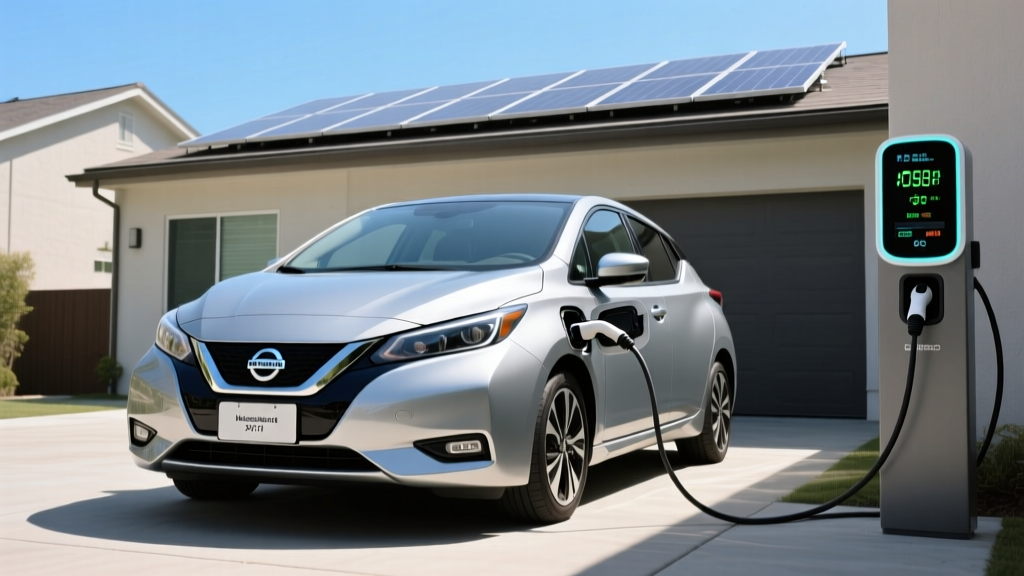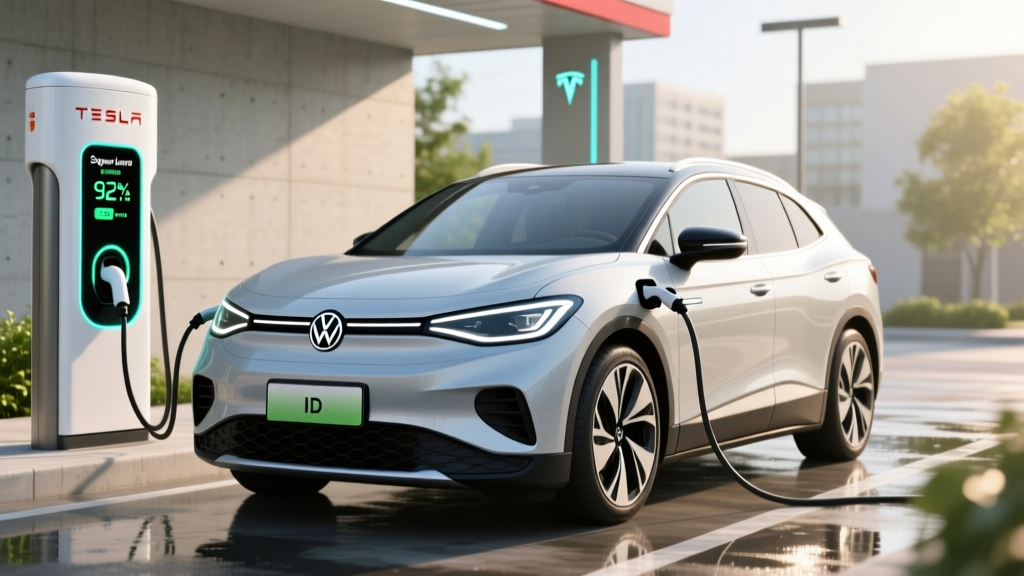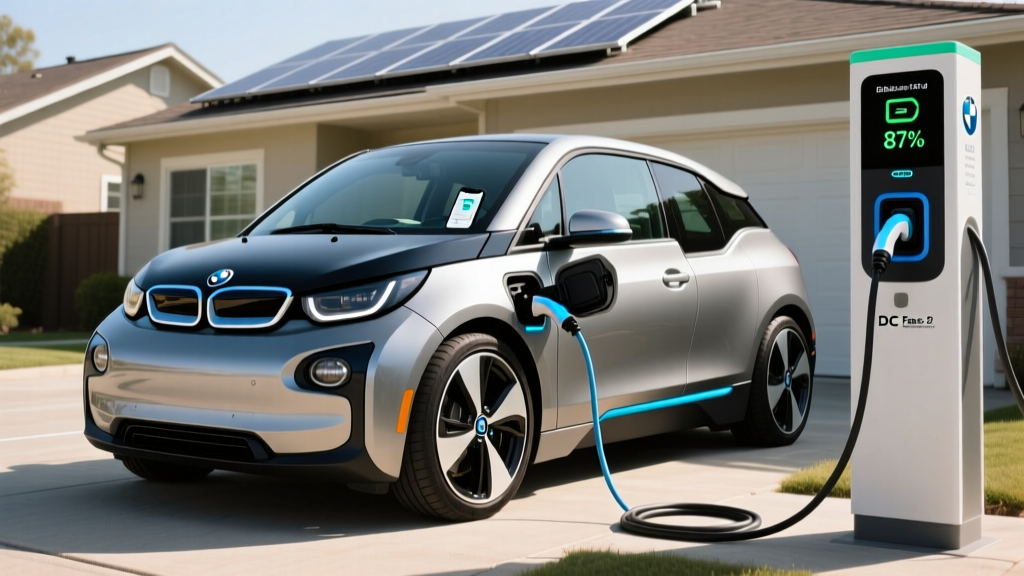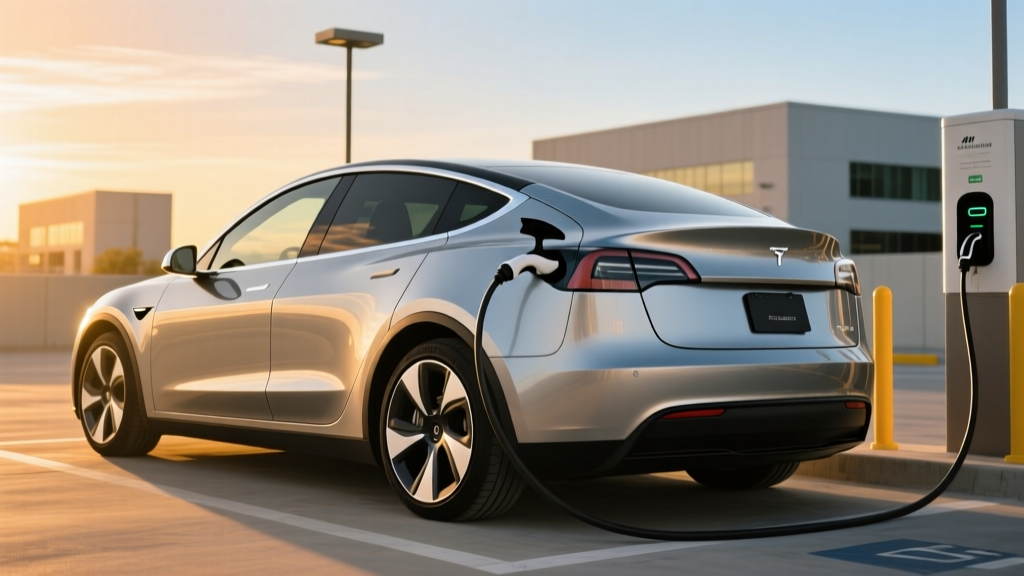
If you're shopping for an electric vehicle or trying to optimize the one you own, EV miles per kWh is the single most important efficiency metric to understand. It's the electric equivalent of miles per gallon — and it directly determines your real-world range, your charging cost, and how long you'll sit at a DC fast charger on a road trip.
Yet most buyers fixate on battery size (kWh) or EPA range stickers without asking: how efficiently does this vehicle actually use electricity? A 100 kWh battery in a heavy, boxy SUV might deliver 300 miles. That same battery in a sleek sedan could push 400+. The difference is miles per kWh.
This guide breaks down exactly what miles per kWh means, how it translates to range and charging cost, what equipment you need at home, and how to compare EVs on efficiency — not just battery size.
What Is EV Miles per kWh (and Why It Matters More Than Battery Size)
Miles per kWh tells you how far an electric vehicle travels on one kilowatt-hour of energy. It's calculated simply:
Miles per kWh = EPA Range ÷ Usable Battery Capacity (kWh)
For example, the 2026 Tesla Model 3 Long Range RWD carries a ~75 kWh usable battery and an EPA range of 363 miles. That's roughly 4.8 miles per kWh — one of the most efficient EVs on the market. Compare that to the 2026 GMC Hummer EV Pickup with its ~212 kWh battery and 314-mile EPA range: just 1.5 miles per kWh.
This distinction between kW (power) and kWh (energy) is critical and frequently confused:
- kW (kilowatt) = the rate of energy flow. Think of it like water pressure from a hose. A 150 kW DC fast charger delivers energy at that rate.
- kWh (kilowatt-hour) = the total energy delivered over time. Think of it like gallons of water in a bucket. A 75 kWh battery holds 75 kilowatt-hours of energy.
Your vehicle's miles per kWh efficiency is what connects the two: it determines how many miles of range you gain from each kWh of energy — whether that kWh comes from your home Level 2 charger or a 350 kW DC fast station.
2026 EV Efficiency Rankings: Miles per kWh by Model
Efficiency varies dramatically across the EV market. Aerodynamics, weight, tire choice, drivetrain design, and thermal management all play a role. Here's how popular 2026 models stack up, using EPA data from fueleconomy.gov:
| Vehicle | Battery (kWh usable) | EPA Range (mi) | Miles per kWh | MPGe (combined) |
|---|---|---|---|---|
| Tesla Model 3 LR RWD | 75 | 363 | 4.8 | 132 |
| Lucid Air Pure RWD | 88 | 419 | 4.8 | 146 |
| Hyundai Ioniq 6 SEL RWD | 77.4 | 361 | 4.7 | 140 |
| Chevrolet Equinox EV RS | 85 | 319 | 3.8 | 109 |
| Ford Mustang Mach-E Premium RWD | 91 | 320 | 3.5 | 105 |
| Kia EV9 GT-Line AWD | 99.8 | 270 | 2.7 | 83 |
| GMC Hummer EV Pickup | 212 | 314 | 1.5 | 47 |
Charging Levels Explained: Speeds in kW and Miles Added per Hour
How fast you add range depends on two things: the charger's power output (kW) and your vehicle's efficiency (miles per kWh). Here's the breakdown across all three charging levels:
| Level | Voltage | Power (kW) | Miles Added per Hour* | Typical Use |
|---|---|---|---|---|
| Level 1 (120V outlet) | 120V / 12A | ~1.4 kW | 3–7 mi/hr | Overnight trickle, PHEVs, emergencies |
| Level 2 (240V home/public) | 240V / 32–48A | 7.7–11.5 kW | 20–55 mi/hr | Daily home charging, workplace, hotels |
| DC Fast Charge | 400–800V DC | 50–350 kW | 150–1,200+ mi/hr (peak) | Road trips, highway corridors |
*Miles per hour ranges assume vehicles from 2.5 to 4.8 mi/kWh efficiency. A highly efficient sedan (4.5+ mi/kWh) on an 11.5 kW Level 2 charger gains ~50 miles per hour. A heavy SUV (2.5 mi/kWh) on the same charger gains ~28 miles per hour.
This is why efficiency matters for charging speed just as much as range: at a 150 kW DC fast charger, a Lucid Air (4.8 mi/kWh) gains roughly 12 miles of range per minute, while a Hummer EV (1.5 mi/kWh) gains only about 3.75 miles per minute — even though both are pulling the same power.
DC Fast Charging: The 10-80% Reality
Peak kW ratings are misleading. No EV sustains its maximum charge rate for the full session. The charge curve tapers significantly above ~60% state of charge to protect battery health. Here's realistic 10-80% timing for common battery sizes:
- ~60 kWh battery (Chevy Equinox EV): ~22-28 min at a 150+ kW charger (peak ~150 kW, tapering to ~60 kW above 60%)
- ~75-80 kWh battery (Tesla Model 3, Hyundai Ioniq 5): ~18-25 min at a 250 kW charger (peak 200-250 kW)
- ~100 kWh battery (Kia EV9, Ford F-150 Lightning Extended): ~25-35 min at a 350 kW charger
- ~130+ kWh battery (GMC Sierra EV, Hummer EV): ~32-45 min at a 350 kW charger (800V architecture helps sustain higher rates)
Preconditioning — warming the battery to optimal temperature before arriving at a charger — can shave 5-10 minutes off these times, especially in cold weather. Most modern EVs automatically precondition when you navigate to a DC fast charger.
Home Charger Installation: Electrical Requirements and Real Costs
A Level 2 home charger is the backbone of practical EV ownership. Most owners do 80-90% of their charging at home, waking up to a full battery every morning. But installation costs vary widely based on your electrical panel, distance from panel to charger location, and local permit requirements.
Electrical Requirements
A typical Level 2 home charger requires:
- 240V circuit (same voltage as an electric dryer or oven)
- 40A to 60A dedicated breaker (for 32A to 48A continuous charging)
- NEMA 14-50 outlet (for plug-in chargers) or hardwired connection (for higher-amperage units)
- A circuit rated at 125% of the continuous load per NEC code — so a 48A charger needs a 60A breaker
Do You Need a Panel Upgrade?
This is the biggest wildcard. If your home has a 100A electrical service panel (common in homes built before the 1990s), adding a 40-60A EV circuit may exceed your panel's capacity — especially if you already have electric appliances (dryer, oven, HVAC). A licensed electrician will perform a load calculation to determine whether an upgrade to 200A service is needed.
Panel upgrades typically cost $1,500–$3,500 depending on your utility's requirements, meter location, and local code. Some homeowners avoid this by installing a lower-amperage charger (e.g., 24A on a 30A circuit) or using a smart load-management system that throttles the charger when other appliances are running.
| Item | Low End | Typical | High End |
|---|---|---|---|
| Level 2 charger unit (smart, 40-48A) | $350 | $550 | $800 |
| Electrician labor (standard install, <50 ft run) | $500 | $900 | $1,500 |
| Electrical permit | $50 | $125 | $300 |
| Panel upgrade (if needed — 100A → 200A) | $1,500 | $2,500 | $3,500 |
| Total (no panel upgrade) | $900 | $1,575 | $2,600 |
| Total (with panel upgrade) | $2,400 | $4,075 | $6,100 |
The federal Residential Clean Energy Credit covers 30% of home EV charger equipment and installation costs (up to $1,000) through 2032, per IRS guidelines. Check irs.gov for current eligibility, and consult a tax professional for your specific situation. Many utilities and states offer additional rebates — check your local provider.
Connector Compatibility: NACS, CCS1, and CHAdeMO in 2026
The connector landscape has consolidated significantly. As of 2026, the North American Charging Standard (NACS) — originally Tesla's proprietary connector — has been adopted by nearly every major automaker. Here's where things stand:
| Connector | Brands Using It | Notes |
|---|---|---|
| NACS (native) | Tesla, Ford, GM, Rivian, Volvo, Polestar, Mercedes-Benz, Nissan (new models) | Direct access to Tesla Supercharger network (17,000+ stalls) |
| NACS (via adapter) | Hyundai/Kia (2024+ CCS models), Stellantis, VW (existing CCS vehicles) | OEM adapters provided or available for ~$200; Supercharger access enabled |
| CCS1 | Legacy models: pre-2025 Hyundai Ioniq 5/6, Kia EV6/EV9, VW ID.4, BMW i4/iX | Works on Electrify America, EVgo, ChargePoint DC networks |
| CHAdeMO | Nissan Leaf (2011-2025 model years), Mitsubishi Outlander PHEV (older) | Declining infrastructure; most new DC stations omit CHAdeMO |
If you're buying a new EV in 2026, NACS is the clear standard going forward. If you own a CCS-equipped vehicle, a NACS adapter unlocks the Supercharger network — a significant advantage for road trips given Tesla's reliability and coverage.
Cost to Charge: Home vs. Public vs. DC Fast Charging
Charging cost depends on your electricity rate, the charger type, and your vehicle's miles per kWh efficiency. Here's a realistic cost-per-mile breakdown:
| Charging Scenario | Rate ($/kWh) | Cost per Mile (3.5 mi/kWh EV) | Cost per Mile (4.5 mi/kWh EV) |
|---|---|---|---|
| Home — off-peak utility rate | $0.10 | $0.029 | $0.022 |
| Home — average US rate | $0.17 | $0.049 | $0.038 |
| Public Level 2 (ChargePoint, etc.) | $0.25–$0.40 | $0.071–$0.114 | $0.056–$0.089 |
| DC Fast Charge (Electrify America, EVgo) | $0.35–$0.55 | $0.100–$0.157 | $0.078–$0.122 |
| Tesla Supercharger (average) | $0.28–$0.36 | $0.080–$0.103 | $0.062–$0.080 |
| Gasoline comparison (28 MPG avg, $3.40/gal): | |||
| Gas vehicle | $3.40/gal | $0.121 per mile | |
The takeaway: home charging is 2-5x cheaper per mile than gasoline, even at average electricity rates. Public DC fast charging narrows the gap but still undercuts gas for most efficient EVs. The least efficient EVs (Hummer EV at 1.5 mi/kWh) can approach gas costs at premium DC fast-charger rates.
Time-of-use (TOU) utility plans are the single biggest cost lever. Setting your charger to run between 11 PM and 6 AM on a TOU plan can cut home charging costs to $0.06–$0.10/kWh in many markets.
Best Home EV Chargers for 2026: Equipment Picks
Based on power output, reliability, connector support, smart features, and value, here are our top Level 2 home charger recommendations:
ChargePoint Home Flex
- Power: Up to 11.5 kW (48A) on 60A circuit; configurable down to 16A
- Connector: NACS or J1772 (select at purchase)
- Cable length: 18 ft or 23 ft
- Smart features: Wi-Fi, app scheduling, energy tracking, Alexa
- Price: $599–$699
- Best for: Flexibility across amperages; strong app ecosystem
Tesla Wall Connector
- Power: Up to 11.5 kW (48A) on 60A circuit
- Connector: NACS (native Tesla); J1772 adapter available for ~$200
- Cable length: 24 ft
- Smart features: Wi-Fi, OTA updates, power sharing (link multiple units), access control
- Price: $425
- Best for: Tesla owners; best value at 48A; cleanest design
Emporia Level 2 EV Charger
- Power: Up to 11.5 kW (48A) on 60A circuit
- Connector: J1772 (NACS adapter available)
- Cable length: 24 ft
- Smart features: Wi-Fi, energy monitoring, solar integration, TOU scheduling
- Price: $399
- Best for: Budget-conscious buyers; solar-panel homes
Safety and Electrical Code Considerations
EV charging involves sustained high-current draw — often 8-10 hours continuously. This is fundamentally different from intermittent loads like a microwave. Key safety requirements include:
- Dedicated circuit: Your Level 2 charger must have its own breaker — never shared with other appliances.
- GFCI protection: The 2020 NEC (and later) requires GFCI protection for EV charging outlets in garages. Hardwired chargers may be exempt depending on local interpretation — your electrician will know your jurisdiction's stance.
- Outdoor rating: If installing outside, the charger must carry a NEMA 4 (weatherproof) rating. All three picks above qualify.
- Wire gauge: A 48A charger on a 60A breaker typically requires 6 AWG copper wire for runs under 50 feet. Longer runs may need 4 AWG to prevent voltage drop.
- Permit and inspection: Most jurisdictions require an electrical permit and final inspection for EV charger installations. Skipping this can void homeowner's insurance coverage for related incidents.
Always use a licensed electrician for installation. DIY electrical work at 240V/48A carries serious arc-flash and fire risk, and unpermitted work can cause insurance claim denials.
Frequently Asked Questions
How much does it cost to install a home EV charger?
A typical Level 2 home charger installation costs $900–$2,600 if your electrical panel has sufficient capacity. If a panel upgrade from 100A to 200A is needed, add $1,500–$3,500, bringing the total to $2,400–$6,100. The federal Residential Clean Energy Credit covers 30% of equipment and installation (up to $1,000) through 2032.
How fast will each charging level add range?
Level 1 (120V) adds 3–7 miles per hour — adequate for PHEVs with small batteries but impractical for full BEVs. Level 2 (240V) adds 20–55 miles per hour depending on your vehicle's efficiency and the charger's amperage. DC fast charging adds 150–1,200+ miles per hour at peak power, though sessions are typically limited to 10-80% and take 18-45 minutes depending on battery size.
Which connector/charger is compatible with my EV?
For 2026 models: Tesla, Ford, GM, Rivian, Volvo, and most new models use NACS natively. Older Hyundai/Kia, VW, and BMW EVs use CCS1 but can access Tesla Superchargers via adapter. The Nissan Leaf uses CHAdeMO, which has declining public infrastructure support. For home Level 2 charging, all EVs use either NACS or J1772 — and J1772-to-NACS adapters are widely available.
How much does charging cost per mile vs. gas?
Home charging at the US average rate ($0.17/kWh) costs $0.038–$0.049 per mile for most EVs — roughly one-third the cost of a 28 MPG gas car at $3.40/gallon ($0.121/mile). DC fast charging costs $0.08–$0.16 per mile depending on the network and your vehicle's efficiency. The most efficient EVs (4.5+ mi/kWh) are cheapest to fuel; heavy trucks and SUVs (under 2.5 mi/kWh) narrow the gap.
What electrical upgrades might I need?
The most common upgrade is a panel capacity increase from 100A to 200A service, required when your existing panel lacks headroom for a 40-60A EV circuit. Alternatives include installing a lower-amperage charger (24A–32A), using a smart load-management device that shares capacity between the charger and other circuits, or upgrading only the specific sub-panel serving the garage. A licensed electrician's load calculation is the definitive answer.