If you've shopped for the EV with the longest range, you've likely landed on models packing massive battery packs — the Lucid Air Grand Touring with its 118 kWh usable pack, the Chevrolet Silverado EV 4WT with over 200 kWh, or the Tesla Model S Long Range at 100 kWh. These vehicles deliver 400 to 500+ miles of EPA-rated range, eliminating most daily charging needs. But when you do need to recharge a battery that large, the logistics shift dramatically compared to a 60 kWh commuter EV.
This guide breaks down exactly how to charge long-range, large-battery EVs at home and in public — covering charging speeds in kW, real installation costs, connector compatibility for 2026 models, and the per-mile economics versus gasoline. Whether you own a 400-mile Lucid or are considering a 350-mile Rivian, the physics and economics below apply directly to your situation.
Understanding Charging Levels: kW Speeds and Miles Added Per Hour
The single most important distinction in EV charging is between kW (kilowatts), which measures power — the rate at which energy flows into your battery — and kWh (kilowatt-hours), which measures energy capacity — the total amount your battery stores. Think of kW as the width of the hose and kWh as the size of the bucket. A long-range EV has a very large bucket (100+ kWh), so hose width matters enormously.
| Level | Voltage / Amps | Power (kW) | Miles of Range Added Per Hour | 10–80% Time (100 kWh pack) |
|---|---|---|---|---|
| Level 1 (Standard Outlet) | 120V / 12A | 1.4 kW | 3–5 mi/hr | ~70+ hours (impractical) |
| Level 2 (Home / Workplace) | 240V / 40–48A | 9.6–11.5 kW | 28–44 mi/hr | 7–9 hours (overnight) |
| DC Fast Charging | 400V–900V DC | 150–350 kW peak | 500–1,200+ mi/hr (peak) | 15–30 minutes (varies) |
For a long-range EV, Level 1 charging is essentially useless as a primary strategy. Plugging a 118 kWh Lucid Air into a standard 120V outlet adds roughly 4 miles of range per hour — meaning a full recharge from 10% to 80% would take nearly three full days. Level 2 at home is the practical baseline, while DC fast charging handles road trips.
How Much Does It Cost to Install a Home EV Charger?
Home Level 2 charging is where long-range EV ownership makes the most sense. You wake up every morning with a full 400+ mile battery without visiting a gas station. But installation costs vary widely depending on your home's electrical infrastructure.
A hardwired Level 2 charger on a dedicated 240V/60A circuit (delivering up to 11.5 kW / 48A continuous) is the gold standard for large-battery EVs. Here's what that actually costs:
| Component | Low Estimate | High Estimate | Notes |
|---|---|---|---|
| Level 2 Charger Unit (40A–48A) | $400 | $750 | Smart Wi-Fi-enabled units from ChargePoint, Emporia, Wallbox |
| Electrician Labor | $500 | $2,000 | Depends on run length from panel to garage/driveway |
| Electrical Permit | $50 | $250 | Varies by municipality; some jurisdictions waive for EV installs |
| Panel Upgrade (if needed) | $1,500 | $4,000 | Required if existing panel is 100A or has no spare capacity |
| Conduit, Wiring, Breaker | $100 | $500 | 6 AWG copper for 60A circuit; longer runs cost more |
| Total (No Panel Upgrade) | $1,050 | $3,500 | Typical for newer homes with 200A panels |
| Total (With Panel Upgrade) | $2,550 | $7,500 | Older homes or those with high existing electrical load |
The panel upgrade is the hidden cost that catches many buyers off guard. If your home has a 100-amp main panel — common in homes built before 1990 — adding a 60A EV circuit may exceed your panel's capacity. An electrician will perform a load calculation per NEC Article 220 to determine whether an upgrade to 200A service is required. According to the National Electrical Contractors Association, panel upgrades average $2,500–$3,500 nationally.
Which Connector and Charger Is Compatible with My Long-Range EV?
The connector landscape in 2026 has largely consolidated around the North American Charging Standard (NACS), originally developed by Tesla and now adopted by most major automakers. However, many long-range EVs from 2023–2025 model years were built with CCS1 ports, and adapters bridge the gap.
| EV Model | Native Connector | Tesla Supercharger Access | CCS Network Access | Adapter Needed? |
|---|---|---|---|---|
| Tesla Model S Long Range | NACS | Native | Via NACS-to-CCS adapter (~$250) | For Electrify America, etc. |
| Lucid Air Grand Touring | CCS1 | Via CCS-to-NACS adapter | Native | Yes, for Superchargers |
| Rivian R1T / R1S (Dual-Motor Max) | NACS (2025+) | Native | Via adapter | Older models: CCS1 |
| Chevrolet Silverado EV 4WT | NACS | Native | Via adapter | For non-Tesla DC networks |
| Hyundai Ioniq 6 Long Range | CCS1 | Via adapter (2025+) | Native | Yes, for Superchargers |
| BMW i7 xDrive60 | CCS1 | Via adapter | Native | Yes, for Superchargers |
Key takeaway: If you're buying a 2026 model-year long-range EV, it almost certainly ships with NACS. If you own a 2023–2025 model, check whether the manufacturer offers an official CCS-to-NACS adapter — Tesla sells one for ~$250, and several third-party options exist. Always buy adapters certified to SAE J3400 standards to ensure safe high-power DC charging.
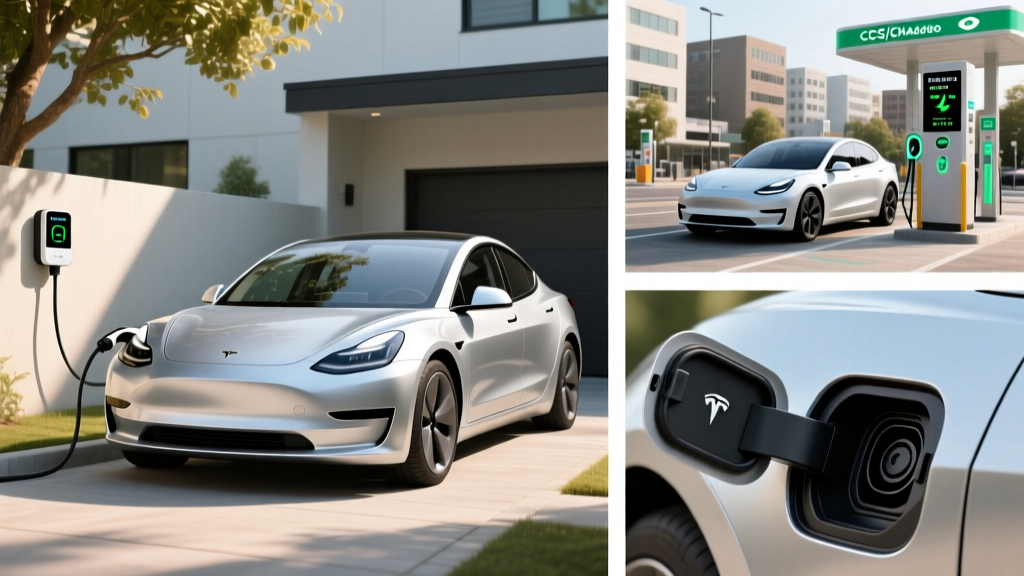
For home Level 2 charging, the connector situation is simpler. All Level 2 chargers sold in North America now ship with either a NACS plug or a J1772 plug (the legacy standard). A J1772-to-NACS adapter (often included with the vehicle) allows any J1772 home charger to work with a NACS-equipped car. Most 2026-model EVs include this adapter in the trunk.
Charging Time Examples: How Long to Recharge a 100+ kWh Battery
Long-range EVs have large batteries, which means longer charging sessions at every level. Here are real-world estimates for popular long-range models:
| Vehicle | Battery (kWh Usable) | Level 2 at 11.5 kW | DC Fast (Peak kW) | DC Fast 10–80% (Real-World) |
|---|---|---|---|---|
| Lucid Air Grand Touring | 118 kWh | ~8.5 hours | 300 kW peak | ~22–28 minutes |
| Tesla Model S LR | 100 kWh | ~7.5 hours | 250 kW peak | ~25–32 minutes |
| Rivian R1T Max Pack | 141 kWh | ~10.5 hours | 220 kW peak | ~35–45 minutes |
| Chevy Silverado EV 4WT | 200+ kWh | ~15+ hours | 350 kW peak | ~30–40 minutes (to 80%) |
| Hyundai Ioniq 6 LR | 77.4 kWh | ~5.5 hours | 240 kW peak | ~18–22 minutes |
| BMW i7 xDrive60 | 101.7 kWh | ~7.5 hours | 195 kW peak | ~30–35 minutes |
The Lucid Air's combination of a large 118 kWh pack and 900V architecture enables it to accept up to 300 kW at compatible chargers, adding roughly 200 miles of EPA range in about 12 minutes under ideal conditions. The Rivian R1T Max Pack's 141 kWh battery is the largest in any consumer EV, meaning even at 220 kW peak, a 10–80% session takes noticeably longer. Plan road trips accordingly — the EPA-rated range of 400+ miles means you'll typically charge only once on a 500-mile trip.
How Much Does Charging Cost Per Mile vs. Gasoline?
One of the strongest arguments for long-range EVs is the per-mile fuel cost. Even with large batteries, electricity is substantially cheaper than gasoline on a per-mile basis — but the savings depend heavily on where and when you charge.
| Scenario | Rate ($/kWh) | Efficiency (kWh/100 mi) | Cost Per Mile | Annual Fuel Cost (12,000 mi) |
|---|---|---|---|---|
| Home Level 2 (Off-Peak Utility Rate) | $0.08–$0.13 | 28–35 | $0.025–$0.045 | $300–$540 |
| Home Level 2 (Standard Residential Avg.) | $0.16 | 30 | $0.048 | $576 |
| Public Level 2 (Workplace / Mall) | $0.20–$0.35 | 30 | $0.06–$0.105 | $720–$1,260 |
| DC Fast Charging (Electrify America / Tesla) | $0.35–$0.55 | 30 | $0.105–$0.165 | $1,260–$1,980 |
| Gasoline Vehicle (27 MPG avg., $3.50/gal) | — | 3.7 gal/100 mi | $0.130 | $1,560 |
| Gasoline Vehicle (18 MPG truck, $3.50/gal) | — | 5.6 gal/100 mi | $0.194 | $2,333 |
The numbers are clear: home charging at off-peak rates delivers 3–5× lower per-mile costs than gasoline. Even exclusive DC fast charging is often cheaper per mile than a mid-efficiency gas car. For long-range EV owners who charge primarily at home — which the 400+ mile range makes easy — annual "fuel" costs typically land between $300 and $600, compared to $1,500–$2,300 for an equivalent gas vehicle.
Long-range EVs also tend to be more efficient per mile than shorter-range models with the same battery chemistry, because regenerative braking recaptures more energy over longer drives and the larger pack operates in a more optimal state-of-charge window. The Lucid Air Grand Touring achieves an EPA-rated 146 MPGe combined (approximately 23 kWh/100 mi), making it one of the most efficient large sedans on the road, per fueleconomy.gov.
Best Level 2 Home Chargers for Long-Range EVs in 2026
When charging a 100+ kWh battery overnight, you want a reliable, high-amperage Level 2 unit that can deliver a full recharge in 7–10 hours. Here are top picks based on power output, smart features, build quality, and connector compatibility:
ChargePoint Home Flex (NACS)
- Power: Up to 11.5 kW (48A) on a 60A circuit
- Connector: NACS native (J1772 version also available)
- Cable Length: 23 feet
- Smart Features: Wi-Fi, app scheduling, utility demand-response, Alexa integration
- Price: ~$599
- Best For: Tesla and NACS-native EVs; excellent app and scheduling
Emporia Vue Level 2 Charger
- Power: Up to 11.5 kW (48A)
- Connector: J1772 (use included adapter for NACS vehicles)
- Cable Length: 24 feet
- Smart Features: Energy monitoring, solar integration, load management with Emporia panel monitor
- Price: ~$399
- Best For: Budget-conscious buyers; solar homes; panel-load management without upgrade
Wallbox Pulsar Plus (48A)
- Power: Up to 11.5 kW (48A)
- Connector: J1772 (NACS adapter included with 2026 units)
- Cable Length: 25 feet
- Smart Features: Wi-Fi + Bluetooth, Power Sharing (two chargers on one circuit), Eco-Smart solar mode
- Price: ~$549
- Best For: Two-EV households; compact unit; excellent Power Sharing feature
Tesla Wall Connector (Gen 4)
- Power: Up to 11.5 kW (48A)
- Connector: NACS native
- Cable Length: 24 feet
- Smart Features: Wi-Fi updates, Power Sharing, vehicle-specific access control, integrated cable management
- Price: ~$475
- Best For: Tesla owners; cleanest integration; best cable management design
All four chargers above are hardwired units rated for indoor and outdoor installation (NEMA 4 or equivalent). Hardwired is preferred over plug-in (NEMA 14-50) for 48A chargers because the NEC requires that continuous loads not exceed 80% of a circuit breaker's rating — a 60A breaker supports 48A continuous, but a plug-in 14-50 outlet is only rated for 50A (40A continuous), limiting you to 9.6 kW.
Safety, Code Compliance, and Installation Best Practices
EV charging draws sustained high current for hours — unlike any other household appliance. This makes proper installation critical. Here are the key safety and code requirements per the National Electrical Code (NEC) and best practices:
- Dedicated Circuit: Your Level 2 charger must be on its own dedicated circuit — it cannot share with other outlets or appliances. For 48A continuous charging, this means a 60A breaker with 6 AWG copper wire (or 4 AWG aluminum).
- GFCI Protection: NEC 2023 and later require GFCI protection for all EV charging outlets (receptacle-type). Hardwired installations are exempt from GFCI requirements, which is another reason hardwired is preferred — fewer nuisance trips.
- Outdoor Rating: If your charger is installed outside (driveway, carport), the unit must carry a NEMA 4 or IP65 rating for weather resistance. All chargers listed above meet this standard.
- Permit and Inspection: Most jurisdictions require an electrical permit for EV charger installation. The work must pass a final inspection to verify correct wire gauge, breaker sizing, grounding, and bonding. Never skip the permit — it protects you and is required for insurance coverage of any electrical fire.
- Utility Notification: Some utilities require you to notify them before installing a Level 2 charger, especially if it draws 40A or more. They may offer a time-of-use (TOU) rate plan that dramatically reduces your charging cost during off-peak hours (typically 10 PM – 6 AM).
- Load Management: If your panel is near capacity but you want to avoid a costly upgrade, consider a smart load-management system like the Emporia Vue or a utility-managed charger. These systems monitor your home's total electrical load in real time and reduce charger amperage when other large loads (dryer, oven, AC) are running.
Public DC Fast Charging: Maximizing Speed on Long-Range EV Road Trips
With 400+ miles of EPA range, long-range EV owners typically need only one DC fast-charging stop on a 500–600 mile road trip. Here's how to make that stop as fast and affordable as possible:
- Precondition the battery. Always navigate to the charger using your EV's built-in navigation. This activates battery thermal preconditioning, warming or cooling the pack to optimal temperature for maximum charge acceptance. Skipping this step can add 10–15 minutes to your session in cold weather.
- Arrive at 10–15% SoC. Charge curves are fastest at low states of charge. Arriving at 5% wastes time searching for the station; arriving at 30% means you've missed the fastest portion of the curve.
- Choose 350 kW chargers when available. Electrify America, EVgo, and Tesla all operate high-power stations. A Lucid Air or Hyundai Ioniq 6 can leverage 250–300+ kW chargers; a BMW i7 is capped at ~195 kW and won't benefit from 350 kW posts.
- Stop at 80% and go. Charging from 80% to 100% on DC fast charging can take as long as 10% to 80%. With a 400-mile-range EV, 80% still gives you 320+ miles — more than enough to reach your destination or the next charger.
- Check pricing before you plug in. DC fast charging rates vary from $0.25/kWh (some utility-owned stations) to $0.69/kWh (peak-rate Electrify America). Networks like Tesla Superchargers typically range $0.28–$0.45/kWh depending on location and time of day.
Frequently Asked Questions
Do I really need a 48A home charger for a long-range EV?
It depends on your daily driving. If you drive under 80 miles per day and charge overnight, even a 32A (7.7 kW) charger will replenish your battery fully. However, 48A is recommended for long-range EVs because it provides headroom for days when you arrive home nearly empty — a 100 kWh battery recharges from 10% to 100% in about 10 hours at 11.5 kW versus 14 hours at 7.7 kW.
Can I use a NACS-to-CCS adapter at home on Level 2?
Yes. Adapters work identically on Level 2 AC charging and DC fast charging, provided the adapter is properly rated. Most manufacturer-supplied adapters handle both. Third-party adapters should be UL-listed or certified to SAE J3400 for safety.
Is it cheaper to charge a long-range EV at home or at public DC fast chargers?
Home charging is dramatically cheaper. At $0.13/kWh (off-peak utility rate), fully charging a 100 kWh battery costs about $13. The same charge at a $0.45/kWh DC fast charger costs $45. Long-range EV owners who charge 80%+ of their energy at home typically spend $300–$500 per year on electricity for driving.
Will frequent DC fast charging degrade my long-range EV battery?
Moderate DC fast charging has a measurable but manageable impact on battery health. Studies show that exclusive DC fast charging can accelerate degradation by 2–5% over 100,000 miles compared to Level 2 charging. Most long-range EVs use NMC chemistry with liquid thermal management, which mitigates heat-related degradation. LFP batteries (used in some Tesla Model 3/Y variants) tolerate fast charging better but are less common in 400+ mile vehicles. All major manufacturers warrant their batteries for 8 years / 100,000 miles with a minimum 70% capacity retention threshold.
What if my home only has a 100-amp electrical panel?
You have three options: (1) upgrade to a 200A panel ($1,500–$4,000), (2) install a lower-amperage charger (24A or 32A) that fits within your existing panel capacity, or (3) use a smart load-management system that dynamically reduces charger draw when other appliances are running. Option 3 can let you install a 48A charger on a 100A panel in many cases — ask your electrician about products like the Emporia Smart Load Management or Tesla Wall Connector Power Sharing.
How does the federal §30D tax credit apply to home charger installation?
The IRS §30D credit covers the vehicle, not the charger. However, a separate credit — the Alternative Fuel Vehicle Refueling Property Credit (IRC §30C) — covers up to 30% of home charger equipment and installation costs, capped at $1,000. This credit is available for chargers installed at your primary residence in a non-urban census tract. Consult a tax professional and review current IRS guidance on §30C for eligibility details, as census-tract requirements and credit amounts can change.