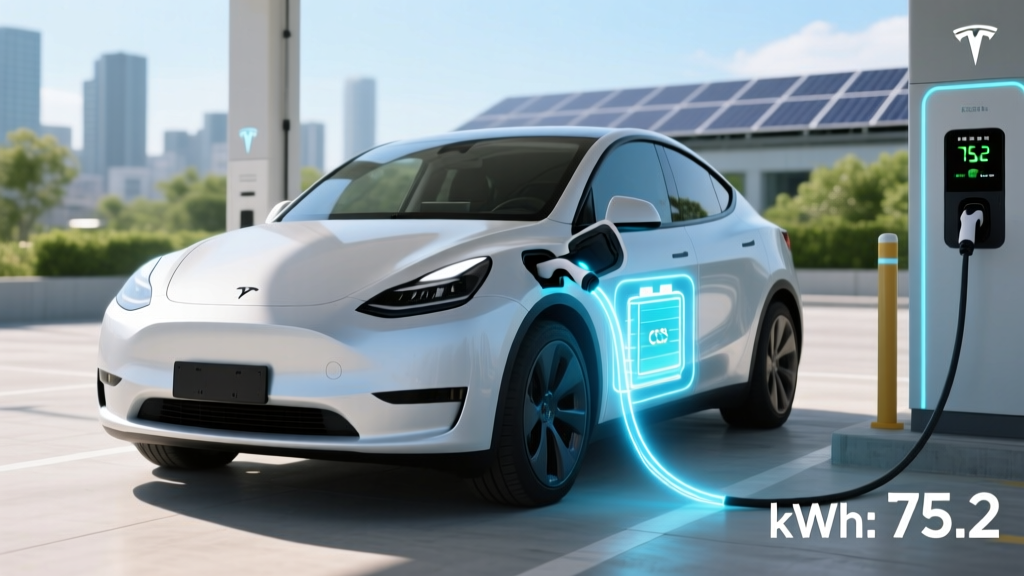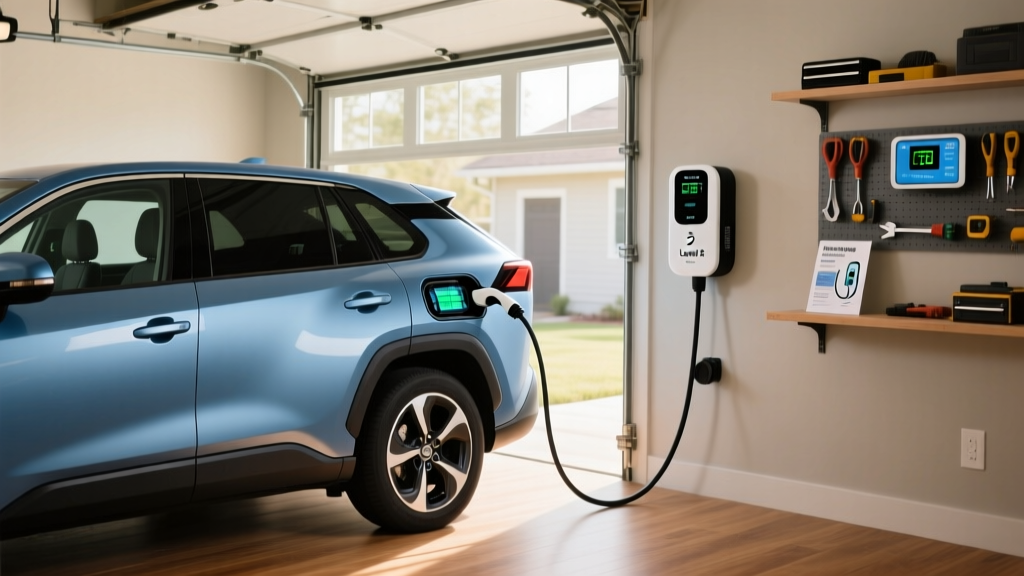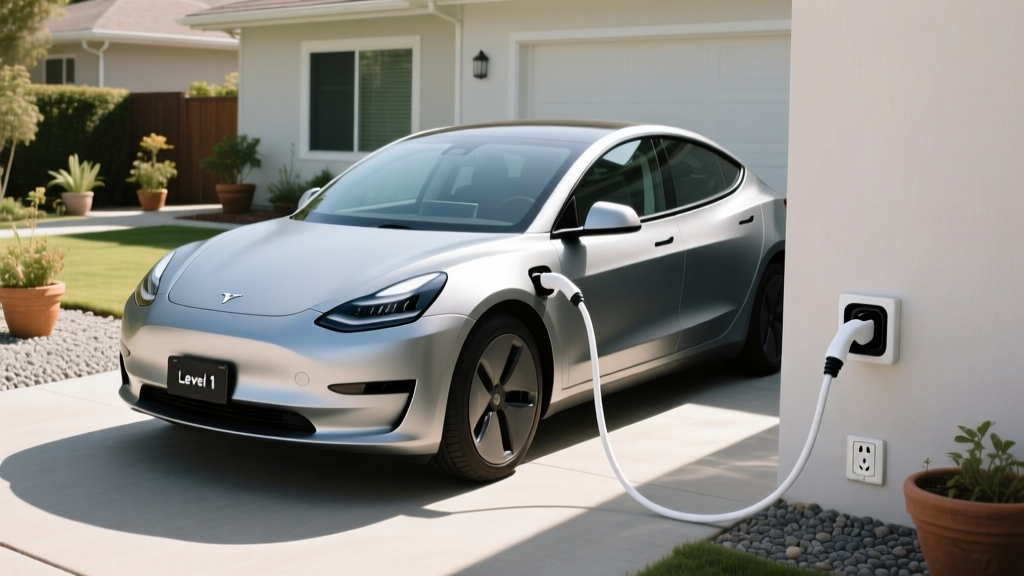
The Reality of Level 1 EV Charging at Home
Plug into a standard 120-volt household outlet, and you're Level 1 charging. No electrician. No permit. No $500 wall unit. For plug-in hybrid owners and some battery-electric drivers with short commutes and predictable routines, an EV Level 1 charger is genuinely sufficient. But "sufficient" has a strict mathematical ceiling — and if your daily driving exceeds it, Level 1 becomes a daily frustration rather than a convenience.
This guide breaks down exactly what Level 1 delivers in miles per hour, what Level 2 and DC fast charging add, what a home installation actually costs, and which specific equipment we recommend in 2026. We'll also clarify the single most important distinction in EV ownership: kW (power — how fast energy flows) versus kWh (energy — how much the battery holds). Confusing these two is the most common mistake new EV buyers make.
- kW (kilowatts) = the rate of charging, like water pressure from a hose.
- kWh (kilowatt-hours) = the battery's total capacity, like the size of the bucket.
- A 1.4 kW Level 1 charger filling a 75 kWh battery is a slow fill — plan accordingly.
Charging Levels Explained: Speed, Power, and Real-World Range Added
EV charging is categorized into three levels. Each level is defined by voltage, amperage, and resulting power output (kW). Here's what each actually delivers to your driveway or parking spot:
| Level | Voltage / Amps | Power Output | Miles of Range Added per Hour | Typical Use Case |
|---|---|---|---|---|
| Level 1 | 120V / 12A | ~1.4 kW | 3–5 miles | Overnight top-off, PHEVs, short commutes |
| Level 2 | 240V / 32–48A | 7.7–11.5 kW | 25–44 miles | Primary home charging, daily full replenishment |
| DC Fast Charge | 400–800V DC | 50–350 kW | 150–1,000+ miles (peak rate) | Road trips, rapid top-ups, 10–80% in 18–45 min |
A few nuances matter here. Level 1 at 12 amps (the safe continuous draw on a standard 15-amp circuit) delivers roughly 1.4 kW. That means 14 hours of charging adds about 42–50 miles of range in a typical EV like the Hyundai Ioniq 5 (which averages around 3.5 miles per kWh). For a PHEV like the Toyota RAV4 Prime with its 18.1 kWh battery (~42 miles electric range), Level 1 fully replenishes the battery in roughly 10–12 hours — perfectly viable for overnight.
Level 2 at 48 amps on a 60-amp dedicated circuit delivers up to 11.5 kW. That same Ioniq 5 gains roughly 40 miles per hour — a full overnight charge from near-empty. DC fast charging operates on a charge curve: peak power (say, 240 kW) is only sustained at low state-of-charge and tapers significantly above 80%. A "10–80% in 18 minutes" claim assumes battery preconditioning and ideal ambient temperatures.
Is an EV Level 1 Charger Enough? The Daily-Mileage Test
Whether Level 1 works for you comes down to one calculation: your average daily miles driven versus overnight charging recovery.
Assume you plug in for 12 hours each night (say, 7 PM to 7 AM). At 1.4 kW, you recover approximately 42 miles of range per night in a typical mid-efficiency EV. If your round-trip commute plus errands averages 30–35 miles, Level 1 keeps you net-positive most days. If you regularly drive 50+ miles daily, Level 1 falls behind — you'll slowly drain the battery over the week and eventually need public DC fast charging to catch up.
Level 1 is a strong fit for:
- PHEV owners: Small batteries (15–25 kWh) recharge fully overnight on Level 1.
- Low-mileage commuters: Under 35 miles round-trip with consistent overnight parking.
- Apartment dwellers with access to a standard outlet but no Level 2 option.
- Secondary vehicle households: The EV handles local trips; a second car covers long drives.
Level 1 is a poor fit for:
- Large-battery BEVs (100+ kWh) where a full Level 1 charge would take 70+ hours.
- Daily drivers exceeding 40–50 miles.
- Cold-climate owners: winter range loss of 20–30% shrinks your already tight Level 1 margin.
- Anyone without reliable overnight parking near an outlet.
How Much Does It Cost to Install a Home EV Charger?
Level 1 requires zero installation — just a standard 120V outlet on a dedicated 15-amp or 20-amp circuit. The mobile charging cord included with most EVs handles Level 1 out of the box. If you need a new outdoor-rated outlet near your parking spot, budget $150–$400 for an electrician to install one.
Level 2 is where installation costs become a real factor. Here's a realistic 2026 breakdown:
| Cost Component | Typical Range | Notes |
|---|---|---|
| Level 2 charger unit (hardwired or plug-in) | $350–$700 | Smart Wi-Fi units cost more; basic units start around $250 |
| Electrician labor (240V/50A circuit run) | $600–$2,000 | Depends on panel proximity, wall/ceiling routing, conduit length |
| Electrical panel upgrade (if needed) | $1,500–$4,000 | Required if your panel is 100A or lacks spare breaker slots |
| Permit and inspection | $50–$300 | Varies by municipality; some jurisdictions waive for EV installs |
| Total (no panel upgrade) | $1,000–$3,000 | Most homes with 200A service and nearby garage panel |
| Total (with panel upgrade) | $2,500–$6,000+ | Older homes with 100A service or distant parking |
Which Connector Is Compatible With My EV?
The connector landscape has shifted dramatically. As of 2026, the North American Charging Standard (NACS) — originally Tesla's proprietary connector — has been adopted by Ford, GM, Rivian, Hyundai, Kia, BMW, and most major automakers for new models. The legacy CCS1 connector remains on vehicles produced before the transition (roughly 2024 and earlier for most brands). CHAdeMO is effectively discontinued for new vehicles but persists on older Nissan Leafs and Mitsubishi Outlander PHEVs.
| Connector | Vehicles Using It (2026) | Adapter Availability |
|---|---|---|
| NACS (J3400) | Tesla (all), Ford F-150 Lightning & Mustang Mach-E (2025+), GM Ultium vehicles, Hyundai Ioniq 5/6 (2025+), Kia EV6/EV9 (2025+), Rivian (2025+) | CCS-to-NACS adapters widely available ($150–$250) |
| CCS1 | VW ID.4 (pre-2025), older BMW i4/iX, older Hyundai/Kia, Chevrolet Bolt EUV | NACS-to-CCS adapters available for Supercharger access |
| CHAdeMO | Nissan Leaf (all years), Mitsubishi Outlander PHEV (older) | Limited adapter options; network declining |
When buying a home Level 2 charger, match the connector to your vehicle's inlet. If you drive a CCS1 vehicle but plan to upgrade to NACS later, some chargers (like the Tesla Universal Wall Connector) include an integrated adapter. For Level 1, the mobile cord included with your EV typically has a J1772 connector that works universally — NACS vehicles include a J1772-to-NACS adapter in the trunk.
Cost to Charge: Home Electricity vs. Public vs. Gas
The economic case for home charging rests on a simple comparison: the cost per mile on electricity versus gasoline. But public DC fast charging is a different story — pricing there can rival or exceed gasoline costs depending on your local rates.
| Charging Scenario | Rate ($/kWh) | Cost per Mile (EV at 3.5 mi/kWh) | Equivalent Gas Price at 30 MPG |
|---|---|---|---|
| Home, off-peak utility rate | $0.08–$0.14 | $0.02–$0.04 | $0.60–$1.20/gal |
| Home, standard residential rate | $0.14–$0.20 | $0.04–$0.06 | $1.20–$1.80/gal |
| Public Level 2 (ChargePoint, EVgo L2) | $0.25–$0.49 | $0.07–$0.14 | $2.10–$4.20/gal |
| DC Fast Charge (Electrify America, EA Pass) | $0.35–$0.56 | $0.10–$0.16 | $3.00–$4.80/gal |
| Tesla Supercharger (varies by location/time) | $0.25–$0.45 | $0.07–$0.13 | $2.10–$3.90/gal |
| Gasoline (US avg, early 2026) | — | $0.10–$0.13 (at $3.10/gal, 30 MPG) | — |
The takeaway: home charging on off-peak rates is roughly 70–80% cheaper per mile than gasoline. Public DC fast charging, at $0.40–$0.56/kWh, can approach or exceed gasoline costs per mile. This is why home Level 2 installation pays for itself — frequent reliance on DC fast charging erases most of the fuel-cost advantage of going electric.
For Level 1 specifically, the cost equation is identical to Level 2 at home — you're paying the same $/kWh, just accumulating kWh more slowly. There is no efficiency penalty for slower charging; in fact, Level 1's gentle charge rate produces marginally less heat in the battery, which is theoretically beneficial for long-term cell health.
Charging Time Examples: 10–80% by Battery Size and Level
How long does a charge actually take? Here are real-world estimates for common battery sizes, assuming you're charging from 10% to 80% state of charge (the practical daily range most EV owners use):
| Vehicle (Battery Size) | Level 1 (1.4 kW) | Level 2 (11.5 kW, 48A) | DC Fast (Peak Rate) |
|---|---|---|---|
| Chevrolet Equinox EV (85 kWh) | ~42 hours | ~5.2 hours | ~22 min (150 kW peak) |
| Hyundai Ioniq 5 (84 kWh) | ~41 hours | ~5.1 hours | ~18 min (240 kW peak, 800V) |
| Tesla Model Y Long Range (75 kWh) | ~37 hours | ~4.6 hours | ~25 min (250 kW peak) |
| Ford F-150 Lightning Ext. Range (131 kWh) | ~64 hours | ~8 hours | ~42 min (150 kW peak) |
| Toyota RAV4 Prime PHEV (18.1 kWh) | ~9 hours | ~1.5 hours (3.3 kW onboard limit) | N/A (no DC fast capability) |
Level 1 times make one thing clear: for large-battery BEVs, Level 1 is not a primary charging strategy — it's an emergency trickle or a supplementary top-off. A 64-hour 10–80% charge on the F-150 Lightning means you'd need nearly three full days to recover from a road trip. For the RAV4 Prime PHEV, however, 9 hours overnight is perfectly practical.
Equipment Recommendations: Level 1 Cords and Level 2 Upgrades
Most EVs ship with a dual-voltage mobile charging cord that handles both Level 1 (120V) and Level 2 (240V with the appropriate adapter pigtail). If yours didn't, or you want a dedicated home unit, here are specific recommendations:
Best for Level 1 Only: OEM Mobile Cord
- Power output: 1.4 kW (120V/12A)
- Connector: J1772 (NACS vehicles include adapter)
- Cable length: 20–25 feet typical
- Smart features: None (basic LED status indicators)
- Price: Included with most EVs; replacement $200–$350
- Best for: PHEV owners and BEV drivers under 30 daily miles
Best Dual-Voltage Upgrade: Tesla Mobile Connector
- Power output: 1.4 kW (Level 1) / up to 7.7 kW (Level 2, 240V/32A with NEMA 14-50 adapter)
- Connector: NACS (J1772 adapter included)
- Cable length: 20 feet
- Smart features: Basic; works with Tesla app for scheduling
- Price: ~$300 (cord only; adapters sold separately)
- Best for: Tesla owners who want flexibility between 120V and 240V outlets
Best Level 2 Home Unit: ChargePoint Home Flex
- Power output: Up to 11.5 kW (240V/48A, hardwired) or 9.6 kW (NEMA 14-50 plug)
- Connector: J1772 (NACS version available, or use adapter)
- Cable length: 23 feet
- Smart features: Wi-Fi, app-based scheduling, Alexa integration, energy tracking, flexible amperage settings
- Price: ~$550–$650
- Best for: BEV owners wanting a reliable, configurable smart charger
Best Premium Level 2: Emporia Vue EV Charger
- Power output: Up to 11.5 kW (240V/48A, hardwired)
- Connector: J1772
- Cable length: 24 feet
- Smart features: Whole-home energy monitoring integration, solar-aware charging, time-of-use scheduling, load management
- Price: ~$400–$500
- Best for: Solar-panel owners and energy-conscious households
Safety, Electrical Code, and Installation Essentials
EV charging draws sustained high current for hours — this is fundamentally different from briefly running a microwave or hair dryer. The National Electrical Code (NEC) treats EV charging as a continuous load, which means the circuit must be rated for 125% of the charger's maximum draw. A 48-amp Level 2 charger requires a 60-amp breaker and appropriately gauged wire (typically 6 AWG copper for runs under 50 feet).
Critical safety and code requirements for any home EV charger installation:
- Dedicated circuit: Your EV charger must have its own breaker — no sharing with other outlets or appliances. Level 1 on a shared 15A circuit risks tripping the breaker if another device draws power simultaneously.
- GFCI protection: NEC 2020 and later requires GFCI (ground-fault circuit interrupter) protection for all EV charging outlets. Hardwired units often have built-in ground-fault protection, but plug-in 240V outlets (NEMA 14-50) need a GFCI breaker, which adds $50–$100 to the installation.
- Outdoor rating: If your charger is installed outdoors or in an unenclosed carport, the unit must carry a NEMA 4 or NEMA 4X weather rating. All units recommended above meet this standard.
- Proper wire gauge: Undersized wire for the circuit amperage is a fire hazard. Your licensed electrician will calculate the correct gauge based on run length and amperage — do not attempt DIY sizing.
- Permit and inspection: Most jurisdictions require an electrical permit for a new 240V circuit. The inspection ensures the work meets code. Skipping the permit risks insurance claim denial if an electrical fire occurs.
Frequently Asked Questions
Can I charge my EV with just a regular household outlet?
Yes — that's Level 1 charging, and it works with every EV sold in the US using the included mobile charging cord. At roughly 1.4 kW, you'll gain 3–5 miles of range per hour. It's adequate for PHEVs and BEV drivers with short commutes, but insufficient as a primary strategy for large-battery EVs driven 40+ miles daily.
How much does a Level 2 home charger cost to install?
Expect $1,000–$3,000 total if your home has a 200-amp electrical panel with spare capacity and the parking spot is near the panel. If you need a panel upgrade from 100A to 200A, add $1,500–$4,000. The charger unit itself runs $350–$700, with electrician labor and materials making up the rest. Always get at least two quotes from licensed electricians.
Will Level 1 charging damage my EV battery?
No. Level 1's low charge rate (1.4 kW) generates minimal heat in the battery cells, which is actually gentler on long-term battery health than repeated DC fast charging. The main risk with Level 1 isn't battery damage — it's running out of range because you couldn't recover enough overnight.
Do I need a smart charger, or is a basic unit fine?
A basic (non-smart) Level 2 charger works perfectly well — it delivers full power whenever plugged in. Smart chargers add utility-bill savings through time-of-use scheduling (charge during off-peak hours automatically), energy tracking, and remote start/stop via app. If your utility offers significant off-peak rate discounts (common in California, Texas, and the Northeast), a smart charger pays for its price premium within a year.
What's the difference between a NEMA 14-50 outlet and hardwired installation?
A NEMA 14-50 is a 240V/50-amp plug-in outlet (similar to what an electric range uses). It lets you unplug the charger and take it with you if you move, but NEC code limits it to 40 amps continuous draw — so your charger maxes out at 9.6 kW. Hardwired installations connect directly to the breaker panel and can support up to 48 amps (11.5 kW). Hardwired is the better choice if you're staying in your home long-term and want maximum charging speed.
Can I use a Tesla Supercharger with a non-Tesla EV?
As of 2026, Tesla has opened many Supercharger locations to non-Tesla EVs equipped with CCS1 or NACS connectors, depending on the station. CCS1 vehicles typically need a built-in Magic Dock adapter at the station or a personal CCS-to-NACS adapter. Check the Tesla app for station-by-station availability, as not all Superchargers are equipped with Magic Dock hardware. According to Tesla's support page, pricing for non-Tesla vehicles is typically higher than Tesla member rates.
What electrical upgrades might my older home need?
Homes built before 1990 often have 100-amp electrical service, which may lack capacity for a 50-amp EV circuit. Signs you'll need a panel upgrade: your panel is already near capacity (few or no open breaker slots), you have multiple high-draw appliances (electric range, electric dryer, central AC), or your panel is 100A. A licensed electrician can perform a load calculation to determine whether a panel upgrade is required. Per the U.S. Department of Energy, some utilities offer rebates of $500–$1,500 for panel upgrades paired with EV charger installations.
Level 1 charging is a legitimate entry point into EV ownership — particularly for PHEV drivers and low-mileage commuters. But understand its ceiling: 42 miles of overnight recovery is a hard limit. If your daily driving regularly approaches or exceeds that number, budget for a Level 2 installation from the start. The $1,000–$3,000 investment pays for itself within 12–24 months through fuel savings and eliminates the daily math of "did I plug in long enough?" that makes Level 1 ownership a low-grade stress for heavy drivers.