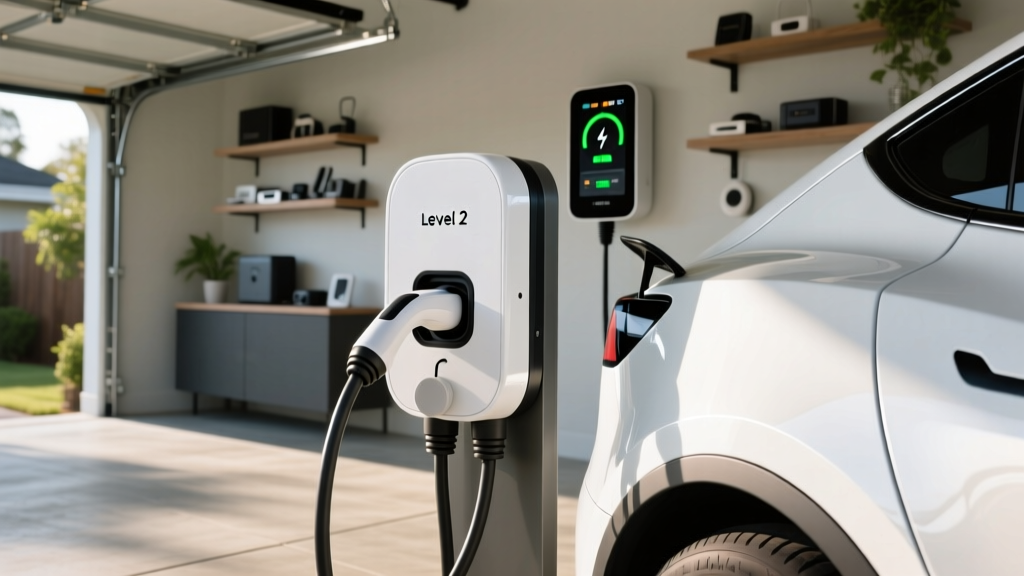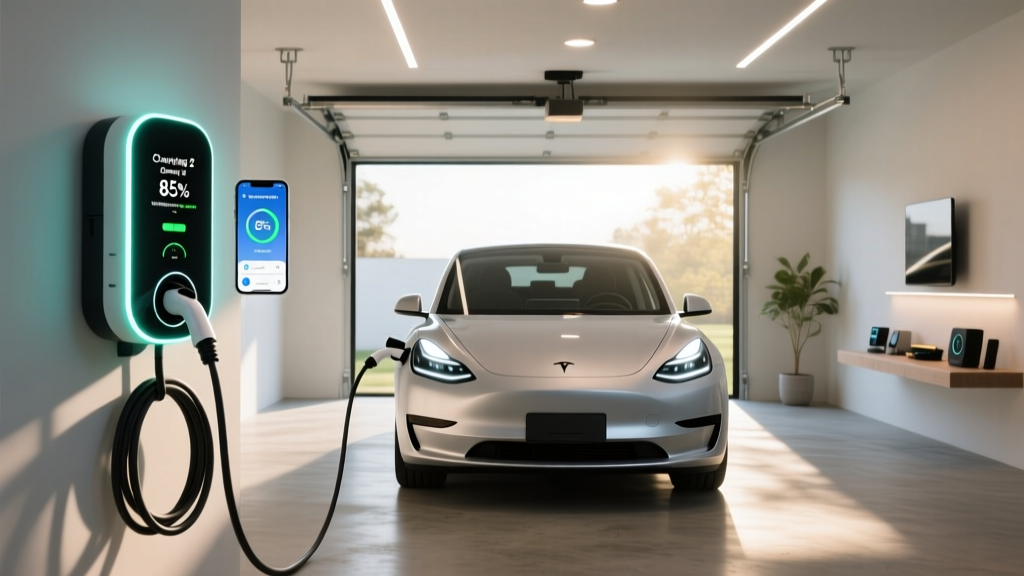
Ask any experienced EV owner what single factor most defines daily ownership happiness, and the answer is almost universal: reliable, fast home charging. Public DC fast-charger networks are improving, but the foundation of EV home charging satisfaction is a properly sized Level 2 setup that refills your battery overnight at a fraction of gas-station costs. This guide breaks down the exact electrical requirements, real installation costs, equipment recommendations, and per-mile economics you need to plan a home charging system in 2026 — with no marketing fluff, just the numbers that matter.
Charging Levels Explained: kW, Miles Per Hour, and Real Charge Times
The first step toward home charging satisfaction is understanding what each charging level actually delivers. A common mistake is confusing kW (kilowatts), which measures power or charge rate, with kWh (kilowatt-hours), which measures energy capacity — your battery size. Think of kW as the width of the pipe and kWh as the size of the tank you're filling.
| Level | Voltage | Max Power (kW) | Miles of Range Added/Hour | Typical Use Case |
|---|---|---|---|---|
| Level 1 | 120V AC | 1.4–1.9 kW | 3–5 mi/hr | Overnight top-up for PHEVs or low-mileage drivers |
| Level 2 (Home) | 240V AC | 7.2–19.2 kW | 20–60 mi/hr | Primary daily home charging for BEVs |
| DC Fast Charge | 400–800V DC | 50–350 kW | 150–800+ mi/hr (peak) | Road trips and quick top-ups |
For a typical 2026 BEV with a 75–85 kWh usable battery (think Tesla Model Y, Hyundai Ioniq 5, or Ford Mustang Mach-E), here are realistic charge times:
- Level 1 (120V, ~1.4 kW): 10% to 80% SoC in roughly 50–60 hours — impractical for full BEVs but adequate for a PHEV with a 15–20 kWh pack.
- Level 2 (240V, 48A / 11.5 kW): 10% to 80% SoC in approximately 5–6 hours — the sweet spot for overnight charging.
- DC Fast Charge (150–250 kW peak): 10% to 80% SoC in 18–28 minutes on vehicles with modern charge curves. Note that charge speed tapers significantly above 80% SoC to protect battery health, which is why most EV route planners target 80% stops.
How Much Does It Cost to Install a Home EV Charger?
Installation cost is the single biggest variable in home charging satisfaction — and it depends almost entirely on your home's existing electrical infrastructure. Here is a realistic breakdown for a hardwired Level 2 charger installation in 2026:
| Component | Simple Install (Panel Adjacent) | Complex Install (Long Run / Panel Upgrade) |
|---|---|---|
| Level 2 Charger Equipment (11.5–19.2 kW) | $400–$700 | $400–$700 |
| Electrician Labor (2–8 hours) | $300–$600 | $1,200–$3,000 |
| Materials (Conduit, Wire, Breaker) | $100–$250 | $300–$800 |
| Electrical Permit | $50–$150 | $50–$200 |
| Panel Upgrade (if needed: 100A → 200A) | N/A | $1,500–$3,500 |
| Total Estimated Cost | $850–$1,700 | $3,450–$8,200 |
The wide range exists because homes built before 2000 often have 100-amp electrical panels with limited spare capacity. Adding a 60-amp dedicated circuit for a 48-amp charger may require a panel upgrade to 200 amps — a $1,500–$3,500 job on its own. Newer homes with 200-amp panels and garage-adjacent panels can often accommodate a charger install for under $1,500.
Cost-reduction tip: The federal Alternative Fuel Vehicle Refueling Property Credit (IRC §30C) offers up to $1,000 (30% of equipment and installation costs) for home charger installs in eligible census tracts. Check the IRS site and your utility for additional local rebates, which in some areas cover $250–$500 of equipment cost.
Electrical Requirements: What Your Home Needs for Level 2 Charging
A Level 2 home charger requires a 240-volt dedicated circuit, similar to what powers an electric dryer or oven. Here are the key specifications your electrician will evaluate:
- Circuit amperage: A 48-amp continuous-draw charger requires a 60-amp breaker (NEC code mandates that continuous loads not exceed 80% of breaker rating). For a 32-amp charger, you need a 40-amp breaker.
- Wire gauge: 6 AWG copper for 48A/60A circuits; 8 AWG for 32A/40A circuits (varies by run length and local code).
- Hardwired vs. plug: Hardwired installations are preferred for 48A+ chargers (more reliable, no plug overheating risk). NEMA 14-50 receptacles are common for 40A/32A setups and offer portability.
- Panel capacity: Your electrician will perform a load calculation to confirm your panel can handle the additional draw. A 200-amp panel with gas appliances typically has ample room. An all-electric home on a 100-amp panel may not.
- GFCI protection: The 2023 NEC (widely adopted by 2026) requires GFCI protection for EV charging receptacles in garages. Hardwired chargers with built-in ground-fault protection may satisfy this without a separate GFCI breaker, which can cost $50–$120 more.
- Outdoor rating: If your charger mounts outside, ensure the unit carries a NEMA 4 (weatherproof) rating and that the installation uses outdoor-rated conduit and fittings.
Connector Compatibility: NACS, CCS1, CHAdeMO, and Adapter Needs
As of 2026, the North American connector landscape has largely consolidated around NACS (North American Charging Standard), originally developed by Tesla. Nearly every major automaker — Ford, GM, Hyundai/Kia, Rivian, Volvo, BMW, and others — has adopted NACS for new vehicles starting with 2025–2026 model years. However, millions of CCS1-equipped EVs remain on the road, and CHAdeMO persists on older Nissan Leafs and Mitsubishi Outlander PHEVs.
| Connector | Brands / Models | Home Charger Availability |
|---|---|---|
| NACS (Tesla standard) | Tesla (all), Ford (2025+), GM (2025+), Hyundai/Kia (2026+), Rivian (2025+), Volvo, BMW | Tesla Wall Connector, ChargePoint Home Flex (NACS), Emporia Vue (NACS) |
| CCS1 | Hyundai/Kia (2024 and earlier), VW ID.4 (2024 and earlier), Ford (2024 and earlier), GM (2024 and earlier) | ChargePoint Home Flex, Emporia Vue, Enel X JuiceBox (CCS1 models) |
| CHAdeMO | Nissan Leaf (all years), Mitsubishi Outlander PHEV | Limited — CHAdeMO home chargers are rare; most owners use Level 1 or adapter solutions |
Adapter considerations: If you own a CCS1-equipped EV but want to use Tesla Superchargers or a NACS home charger, a CCS-to-NACS adapter (approximately $150–$250 from manufacturers like Lectron or A2Z) enables compatibility. Tesla owners charging non-Tesla EVs at home can use a NACS-to-J1772 adapter for older vehicles. Buy a charger with the native connector matching your current EV to avoid daily adapter hassle.
Best Home EV Chargers for 2026: Equipment Recommendations
We evaluated home chargers on power output, cable length, smart features, connector options, build quality, and value. These are our top picks for maximizing daily charging satisfaction:
Tesla Wall Connector (Gen 4)
- Power: Up to 11.5 kW (48A on 60A circuit)
- Connector: Native NACS
- Cable: 24 ft
- Smart features: Wi-Fi, OTA updates, power sharing between multiple units, Tesla app integration
- Price: ~$475
- Best for: Tesla owners and NACS-equipped EVs seeking a clean, reliable unit
ChargePoint Home Flex
- Power: Up to 12 kW (50A on 60A circuit) — configurable from 16A to 50A
- Connector: Available in NACS or J1772 (CCS1-compatible)
- Cable: 23 ft
- Smart features: Wi-Fi, app scheduling, energy tracking, Alexa integration
- Price: ~$550–$650
- Best for: Multi-EV households needing connector flexibility and amperage adjustment
Emporia Level 2 EV Charger
- Power: Up to 11.5 kW (48A) or 19.2 kW (80A) model available
- Connector: NACS or J1772
- Cable: 24 ft
- Smart features: Wi-Fi, energy monitoring with Emporia Vue panel integration, solar-aware scheduling
- Price: ~$400–$500 (48A model)
- Best for: Budget-conscious buyers and solar-panel owners wanting detailed energy tracking
Enel X JuiceBox Pro 48
- Power: 11.5 kW (48A on 60A circuit)
- Connector: J1772 (CCS1-compatible); NACS via adapter
- Cable: 25 ft
- Smart features: Wi-Fi, app scheduling, load balancing, utility demand-response compatible
- Price: ~$500–$600
- Best for: Utility program participants and homes needing load management
Cost to Charge: Home vs. Public vs. Gas — The Per-Mile Economics
Charging cost is where home EV ownership delivers its biggest financial advantage. Here's how per-mile fuel costs compare across scenarios, based on a representative 2026 BEV averaging 3.0 miles per kWh (roughly 112 MPGe combined):
| Scenario | Rate | Cost per kWh | Cost per Mile (at 3 mi/kWh) |
|---|---|---|---|
| Home — Off-Peak TOU Rate | $0.08–$0.14/kWh | $0.11 avg | $0.037 |
| Home — Standard Residential Rate | $0.14–$0.22/kWh | $0.18 avg | $0.060 |
| Public Level 2 (ChargePoint, EVgo) | $0.25–$0.49/kWh | $0.37 avg | $0.123 |
| DC Fast Charging (EA, Tesla, EVgo) | $0.32–$0.58/kWh | $0.45 avg | $0.150 |
| Gasoline Vehicle (30 MPG, $3.40/gal) | $3.40/gallon | — | $0.113 |
The numbers tell a clear story: home off-peak charging costs roughly one-third of gasoline per mile, while exclusive reliance on DC fast charging can actually exceed gas costs. This is why home charging access is the single biggest predictor of EV ownership satisfaction. Drivers who charge at home 80%+ of the time typically spend $400–$700 annually on electricity for 12,000 miles of driving, compared to $1,300–$1,500 on gasoline.
Maximize savings with time-of-use (TOU) rates: Most utilities offer TOU plans where overnight electricity (typically 12 AM–6 AM) costs 30–50% less than peak afternoon rates. Program your charger or vehicle to start charging at midnight and you'll consistently hit the $0.03–$0.05 per mile range. According to fueleconomy.gov, the average 2026 EV costs $0.04–$0.06 per mile to fuel on residential rates — roughly half the cost of a 30 MPG gas car.
Safety, Code Compliance, and Installation Best Practices
EV home charging satisfaction depends on an installation that's not just functional but safe and code-compliant for years of daily use. Key requirements and recommendations:
- Dedicated circuit: Your EV charger must be on its own dedicated breaker — never shared with other appliances. This prevents overloads and nuisance tripping.
- Permit and inspection: Most jurisdictions require an electrical permit for a new 240V circuit. The inspection ensures proper wire gauge, breaker sizing, grounding, and conduit. Skipping the permit risks insurance claim denials if an electrical fire occurs.
- Hardwired preference for high-amperage: For 48A+ chargers, hardwired connections eliminate the plug as a failure point. NEMA 14-50 receptacles rated for continuous EV use (such as the Hubbell 9450A or Bryant 9450FR) are far more robust than standard dryer outlets and cost $60–$90.
- Cable management: A 24-foot cable drags on garage floors and collects dirt. Install a cable organizer or holster ($15–$30) to keep the connector clean and accessible.
- Surge protection: While not universally required by code, a whole-home surge protector ($150–$300 installed) protects your charger and vehicle electronics from voltage spikes, especially in areas with frequent lightning or grid instability.
- Ventilation: Level 2 chargers generate minimal heat, but if your charger is in an enclosed space, ensure basic airflow. Most modern chargers have thermal management that throttles power if internal temperatures rise.
Frequently Asked Questions
How fast will each charging level add range to my EV?
Level 1 (120V) adds 3–5 miles of range per hour — adequate only for PHEVs or BEVs driven under 30 miles daily. Level 2 (240V, 48A) adds approximately 35–45 miles per hour for a typical midsize BEV, meaning a full overnight charge (8–10 hours) replenishes 280–450 miles of range. DC fast charging at 150+ kW can add 150–250 miles in 15–20 minutes, though speed tapers above 80% SoC.
Which connector and charger is compatible with my EV?
Check your vehicle's charge port. For 2025–2026 model-year EVs from Tesla, Ford, GM, Hyundai/Kia, Rivian, Volvo, and BMW, the connector is NACS. For 2024 and earlier models from most non-Tesla brands, it's CCS1 (J1772 for AC charging, CCS Combo for DC). Purchase a home charger with the native connector that matches your vehicle, or plan to use a CCS-to-NACS adapter. Refer to your owner's manual or the Alternative Fuels Data Center for brand-specific details.
What electrical upgrades might I need for a home charger?
The most common upgrade is a panel capacity increase from 100 amps to 200 amps, costing $1,500–$3,500. You may also need a new dedicated 60-amp breaker, 6 AWG wire run (up to 50–100 feet depending on garage location), conduit, and possibly a GFCI breaker. Homes with 200-amp panels and gas appliances usually have sufficient capacity without a panel upgrade. Always get a professional load calculation before assuming your panel can handle the load.
How much does charging cost per mile compared to gasoline?
Home charging on off-peak TOU rates costs approximately $0.03–$0.05 per mile for a typical 2026 EV. Standard residential rates push this to $0.05–$0.08 per mile. A comparable 30 MPG gasoline vehicle at $3.40 per gallon costs about $0.11 per mile. Exclusive DC fast charging, however, can cost $0.13–$0.18 per mile — sometimes exceeding gasoline. Home charging is where the economics work decisively in the EV's favor.
How much does it cost to install a home EV charger?
A straightforward installation with a nearby 200-amp panel typically costs $850–$1,700 including equipment, labor, materials, and permits. A complex installation requiring a long wire run or a panel upgrade from 100A to 200A ranges from $3,500–$8,000+. The federal §30C tax credit can offset up to $1,000 of the total if your home is in an eligible census tract, and many utilities offer additional rebates of $250–$500.
Is a smart charger worth the extra cost?
Yes, for most owners. Smart chargers ($400–$650) offer Wi-Fi connectivity, scheduled charging to hit off-peak TOU rates, energy tracking, and remote diagnostics. The scheduling feature alone can save $200–$400 per year by ensuring you charge during the cheapest rate window. Budget "dumb" chargers ($250–$350) work fine electrically but require manual plug/unplug timing to optimize costs.