Understanding EV Charging Levels: Speeds That Actually Matter
When shopping for EV charging equipment, the single most important distinction is between power (kW) and energy (kWh). A charger's power rating in kilowatts (kW) determines how fast energy flows into your battery. Your battery's capacity in kilowatt-hours (kWh) determines how much energy it stores. Think of kW as the width of a hose and kWh as the size of the bucket.
Here is exactly how much range each charging level adds per hour of charging, based on a typical EV efficiency of 3-4 miles per kWh:
| Level | Voltage | Power (kW) | Miles of Range Added Per Hour | Best Use Case |
|---|---|---|---|---|
| Level 1 | 120V AC | 1.2–1.9 kW | 3–7 miles | Overnight top-ups, PHEVs, low-mileage drivers |
| Level 2 | 240V AC | 3.3–19.2 kW | 12–75 miles | Daily home charging, most EV owners |
| DC Fast Charge | 400–900V DC | 50–350 kW | 150–1,000+ miles/hr (theoretical) | Road trips, quick top-ups away from home |
For context, a 75 kWh battery (like the one in the Ford Mustang Mach-E Extended Range) charged from 10% to 80% on a Level 2 charger at 11.5 kW takes roughly 4.5 hours. On a 150 kW DC fast charger, that same 10-80% session takes approximately 25-35 minutes, depending on the vehicle's charge curve. Peak charge rates are never sustained for the full session — charging speed tapers significantly above 80% State of Charge (SoC) to protect battery chemistry.
How Much Does It Cost to Install a Home EV Charger?
Home Level 2 charger installation costs vary widely based on your electrical panel's capacity, the distance from panel to charger location, and local permit fees. Here is a realistic breakdown based on 2026 national averages:
| Component | Typical Range | Notes |
|---|---|---|
| Level 2 Charger Equipment | $300–$700 | Smart Wi-Fi-enabled units; basic units from $200 |
| Electrician Labor | $400–$1,500 | Depends on run length, wall type, conduit needs |
| Electrical Permit | $50–$200 | Required in most jurisdictions; varies by locality |
| Panel Upgrade (if needed) | $1,500–$3,500 | Required if existing panel lacks capacity for a 40-60A circuit |
| Total (no panel upgrade) | $750–$2,400 | Most homes with 200A service fall in this range |
| Total (with panel upgrade) | $2,250–$5,900 | Older homes with 100A or 150A panels often need this |
The most common surprise cost is the panel upgrade. Homes built before 2000 often have 100A or 150A service panels that are already near capacity. Adding a 40A or 50A dedicated circuit for EV charging can push you over the limit. A licensed electrician will perform a load calculation per NEC Article 220 to determine whether your panel can handle the additional draw. If you have a 5.0L engine with a Whipple supercharger in your garage, you already know that high-performance equipment demands robust infrastructure — EV charging is no different.
Some utilities offer rebates of $250-$500 for Level 2 charger installation, and the federal Residential Clean Energy Credit may cover up to 30% of charger equipment and installation costs (capped at $1,000) through the end of 2032, subject to IRS eligibility rules. Check with a tax professional for your specific situation.
Electrical Requirements: What Your Home Needs
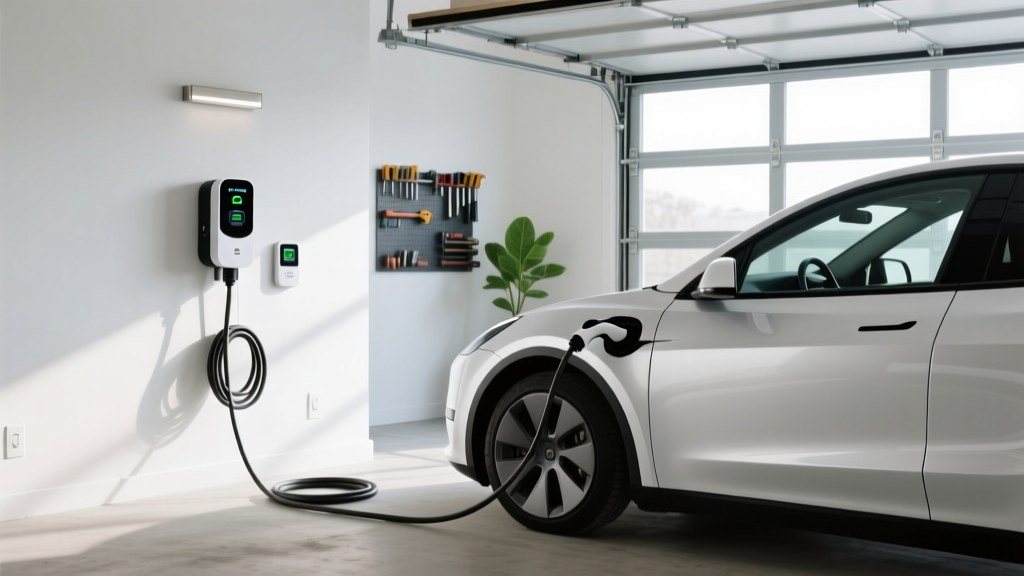
A Level 2 home charger requires a dedicated 240-volt circuit, similar to what powers an electric dryer or oven. The most common configurations are:
- 40-amp circuit: Supports up to 32 amps continuous (9.6 kW). Sufficient for most EVs with overnight charging.
- 50-amp circuit: Supports up to 40 amps continuous (9.6–11.5 kW). The sweet spot for most installations.
- 60-amp circuit: Supports up to 48 amps continuous (11.5 kW). Ideal for larger batteries (100+ kWh) or faster daily replenishment.
Key safety and code considerations:
- Dedicated circuit: NEC requires EV chargers to have their own breaker — no sharing with other appliances.
- GFCI protection: The 2020 NEC and later require GFCI protection for outdoor receptacles; many hardwired chargers include built-in ground-fault protection.
- Outdoor rating: If mounting outside, the charger must carry a NEMA 4 or NEMA 4X rating for weather resistance.
- Wire gauge: A 50A circuit typically requires 6 AWG copper wire; a 60A circuit requires 4 AWG. Your electrician will size this correctly.
- Hardwired vs. plug: Hardwired installations (no plug) avoid the NEC 80% derating rule for receptacles and allow full circuit utilization. NEMA 14-50 outlets are common but limit continuous draw to 40A on a 50A circuit.
Connector Compatibility: NACS, CCS, and CHAdeMO in 2026
The connector landscape has shifted decisively toward NACS (North American Charging Standard, originally Tesla's proprietary connector). As of 2026, nearly every major automaker has adopted NACS for new vehicles sold in North America. Here is where things stand:
| Connector | Brands Using It | Adapter Needed? |
|---|---|---|
| NACS (J3400) | Tesla (all), Ford, GM, Rivian, Volvo, Polestar, Mercedes-Benz, BMW, Hyundai, Kia, Nissan (2026+) | Legacy CCS vehicles need a NACS-to-CCS adapter (~$200-$250) for Tesla Supercharger access |
| CCS1 | Legacy models (2024 and earlier from most brands); some remaining inventory | NACS adapter included or available from most automakers for Supercharger access |
| CHAdeMO | Nissan Leaf (discontinued after 2025), Mitsubishi Outlander PHEV (legacy) | Limited DC fast-charging network; adapters to CCS or NACS are rare and expensive |
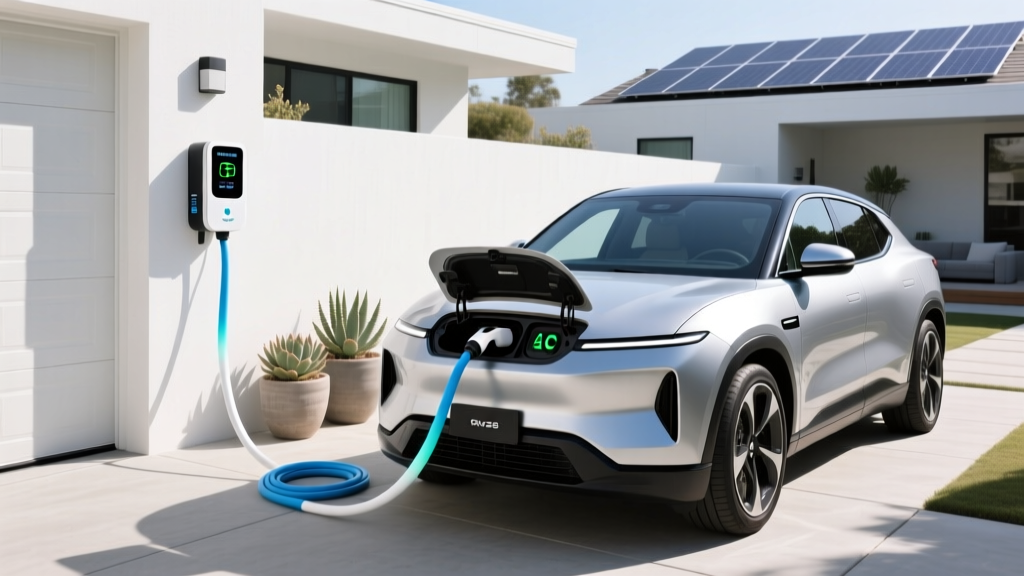
For home Level 2 charging, NACS-equipped vehicles use the same J3400 connector. Most Level 2 chargers sold in 2026 ship with a NACS plug by default, and CCS-to-NACS adapters are widely available for older vehicles. According to fueleconomy.gov, verifying your vehicle's onboard charger capacity is just as important as the connector — a vehicle with a 7.7 kW onboard charger won't charge any faster on a 19.2 kW wall unit.
Cost to Charge: EV Electricity vs. Gasoline Per Mile
The economics of EV charging depend heavily on where and when you charge. Here is a realistic cost-per-mile comparison using 2026 national averages:
| Scenario | Rate | Cost Per Mile (EV at 3.5 mi/kWh) | Cost Per Mile (Gas at 28 MPG) |
|---|---|---|---|
| Home charging (off-peak utility rate) | $0.09–$0.13/kWh | $0.026–$0.037 | $0.125 (at $3.50/gal) |
| Home charging (standard residential rate) | $0.14–$0.18/kWh | $0.040–$0.051 | $0.125 (at $3.50/gal) |
| Public Level 2 (ChargePoint, EVgo L2) | $0.20–$0.35/kWh | $0.057–$0.100 | $0.125 (at $3.50/gal) |
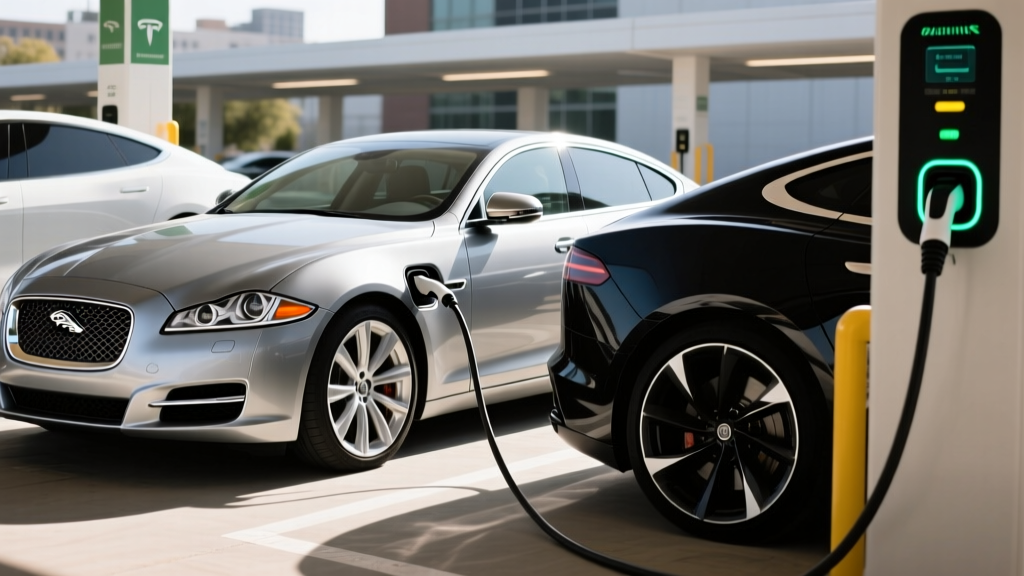
| DC Fast Charging (Electrify America, Tesla) | $0.30–$0.55/kWh | $0.086–$0.157 | $0.125 (at $3.50/gal) |
The takeaway: home charging is dramatically cheaper than gasoline — typically 70-80% less per mile. Public DC fast charging, however, can approach or even exceed gasoline costs on a per-mile basis, especially in states with high electricity rates or at chargers that bill idle fees. The smart EV owner charges at home 85-95% of the time and uses DC fast charging primarily for road trips.
For a concrete example: a Chevrolet Equinox EV with an 85 kWh battery charged from 10% to 80% at home ($0.14/kWh) costs about $8.33. That same charge at a $0.48/kWh DC fast charger costs $28.56. According to EPA's EV cost calculator, the average EV driver who charges predominantly at home saves $800-$1,200 annually on fuel compared to a 25 MPG gasoline vehicle.
Charging Time Examples: 10-80% for Common Battery Sizes
Charging time depends on both the charger's output (kW) and the vehicle's maximum acceptance rate. Here are real-world 10-80% times for common EV battery sizes at various charge rates:
| Battery Size | Vehicle Example | Level 2 at 11.5 kW | DC Fast at 150 kW (peak) | DC Fast at 350 kW (peak) |
|---|---|---|---|---|
| 58 kWh (usable) | Volkswagen ID.4 Standard | ~3.5 hours | ~28 min | ~28 min (vehicle-limited to 135 kW) |
| 77 kWh (usable) | Ford Mustang Mach-E ER | ~4.6 hours | ~32 min | ~32 min (vehicle-limited to 150 kW) |
| 85 kWh (usable) | Chevrolet Equinox EV | ~5.1 hours | ~35 min | ~35 min (vehicle-limited to 150 kW) |
| 100 kWh (usable) | Tesla Model S / Rivian R1S | ~6.0 hours | ~30 min | ~22 min (if vehicle supports 250+ kW) |
Important caveat: DC fast-charging times reflect peak rates that are sustained only between roughly 10-50% SoC. Above 50%, the charge curve tapers; above 80%, it drops sharply to protect battery longevity. A charger rated at 350 kW does not deliver 350 kW for the entire session. The vehicle's battery management system (BMS) controls the actual charge curve based on temperature, SoC, and chemistry.
Recommended Home EV Chargers for 2026
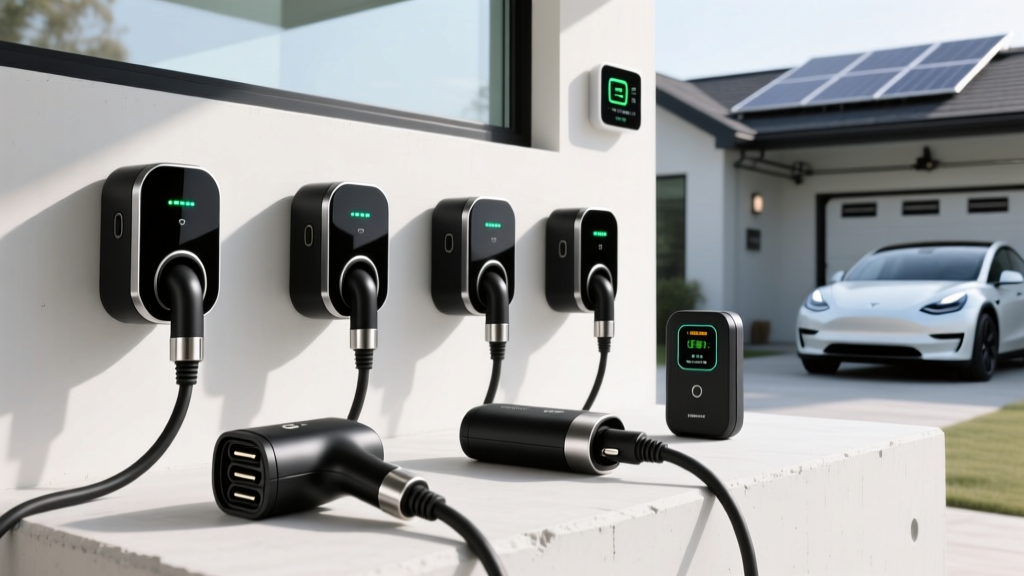
Based on real-world testing, reliability data, and feature sets, here are top-performing Level 2 home chargers currently available:
Emporia Level 2 EV Charger
- Power Output: 48A / 11.5 kW (hardwired on 60A circuit)
- Connector: NACS (J3400)
- Cable Length: 24 feet
- Smart Features: Wi-Fi, energy monitoring, scheduled charging, solar integration, app control
- Price: ~$399
- Best For: Budget-conscious buyers who want full smart features and energy tracking
ChargePoint Home Flex
- Power Output: Up to 50A / 12 kW (adjustable via DIP switches, NEMA 14-50 or hardwired)
- Connector: NACS (J3400) with CCS adapter available
- Cable Length: 23 feet
- Smart Features: Wi-Fi, Alexa integration, ChargePoint app, scheduled charging, load sharing between two units
- Price: ~$599
- Best For: Multi-EV households needing flexible amperage and dual-unit load management
Grizzl-E Smart
- Power Output: 40A / 9.6 kW (NEMA 14-50) or 48A / 11.5 kW (hardwired)
- Connector: NACS (J3400)
- Cable Length: 24 feet
- Smart Features: Wi-Fi, OCPP-compatible, app control, extreme cold rating (-40°F)
- Price: ~$499
- Best For: Cold-climate owners and outdoor installations requiring rugged build quality
Tesla Wall Connector
- Power Output: 48A / 11.5 kW (hardwired on 60A circuit)
- Connector: NACS native (also includes J1772 adapter in box for non-Tesla EVs)
- Cable Length: 24 feet
- Smart Features: Wi-Fi, over-the-air updates, power sharing between multiple units, Tesla app integration
- Price: ~$420
- Best For: Tesla owners and mixed-fleet garages wanting reliable, simple operation
When choosing a charger, match its amperage to your vehicle's onboard charger capacity. A Hyundai Ioniq 5 with a 10.9 kW onboard charger won't benefit from a 48A (11.5 kW) unit over a 40A (9.6 kW) unit — but a Rivian R1T with an 11.5 kW onboard charger will.
Frequently Asked Questions
How much does it cost to install a home EV charger?
A typical Level 2 home charger installation costs $750-$2,400 when no panel upgrade is needed. This includes the charger unit ($300-$700), electrician labor ($400-$1,500), and permit fees ($50-$200). If your home requires a panel upgrade from 100A to 200A service, add $1,500-$3,500. Homes with existing 200A panels and a nearby garage or driveway usually fall on the lower end of the range.
How fast will each charging level add range?
Level 1 (120V) adds 3-7 miles of range per hour — adequate for plug-in hybrids with 20-40 miles of electric range but painfully slow for a full BEV. Level 2 (240V) at 11.5 kW adds roughly 35-45 miles per hour, enough to fully replenish most EVs overnight. DC fast charging at 150 kW can add 150-200 miles in 20-30 minutes, depending on the vehicle's acceptance rate and battery state of charge.
Which connector/charger is compatible with my EV?
If you bought a 2025 or 2026 model-year EV from a major brand, it almost certainly uses NACS (J3400). Older CCS-equipped vehicles can access Tesla Superchargers with a NACS adapter ($200-$250, often provided free by the automaker). CHAdeMO vehicles (Nissan Leaf) are limited to the shrinking CHAdeMO public network. For home charging, buy a NACS wall connector — it is now the universal standard.
How much does charging cost per mile vs gas?
Charging at home on an off-peak rate of $0.11/kWh costs roughly $0.03 per mile for an EV averaging 3.5 miles/kWh. The same distance in a 28 MPG gasoline vehicle at $3.50/gallon costs $0.125 per mile — about 4x more. Public DC fast charging at $0.45/kWh raises the EV cost to about $0.13/mile, roughly equal to gasoline. Home charging is where the savings live.
What electrical upgrades might I need?
The most common upgrade is a panel capacity increase. If your home has a 100A or 150A service panel that is already heavily loaded, adding a 40-60A EV circuit may require upgrading to 200A service ($1,500-$3,500). Other potential costs include trenching for detached garages ($500-$2,000), sub-panel installation ($500-$1,200), and utility service upgrades for homes with very old infrastructure. Always have a licensed electrician perform a NEC Article 220 load calculation before committing to a charger amperage.
Does the federal tax credit cover home charger installation?
The federal Alternative Fuel Vehicle Refueling Property Credit (IRS Form 8911) covers 30% of the cost of home EV charger equipment and installation, up to $1,000. However, eligibility depends on your census tract meeting certain low-income or non-urban criteria, and the credit is non-refundable. State and utility rebates may stack on top — check your local utility and AFDC for current programs in your area.