If you're transitioning from a gas vehicle — whether you previously owned a supercharged Range Rover Sport 2014 that guzzled premium at 14 MPG combined or you're stepping out of any other combustion vehicle — the single biggest ownership shift is fueling at home. A proper home charging setup turns an EV into the most convenient vehicle you've ever owned: you wake up with a full "tank" every morning. But getting that setup right requires understanding charging speeds, electrical requirements, real costs, and which equipment actually delivers on its promises.
This guide covers every practical aspect of EV charging for US-based owners and buyers in 2026, from plugging into a standard 120V outlet to installing a hardwired Level 2 station and navigating public DC fast charging networks.
The Three Charging Levels Explained: Speeds and Real-World Range Added
EV charging is categorized into three levels. The critical distinction to internalize: kW (kilowatts) measures power — the rate at which energy flows — while kWh (kilowatt-hours) measures energy — the total capacity stored in your battery. Think of kW as the width of a pipe and kWh as the size of the tank it's filling.
| Level | Voltage | Power (kW) | Miles of Range Added/Hour | Typical Use Case |
|---|---|---|---|---|
| Level 1 (120V) | 120V AC | 1.0–1.4 kW | 3–5 mi/hr | Overnight top-up, PHEVs, emergency |
| Level 2 (240V) | 240V AC | 3.3–19.2 kW | 12–75 mi/hr | Daily home charging, workplace |
| DC Fast Charge | 200–900V DC | 50–350 kW | 150–1,200+ mi/hr (peak) | Road trips, rapid top-up |
Level 1 uses a standard household 120V outlet and the portable cord that comes with most EVs. At roughly 1.2 kW continuous, you'll gain about 4 miles of range per hour of charging. For a PHEV with 30 miles of electric range, that's an overnight fill. For a BEV with a 75 kWh battery, a full charge takes 60+ hours — impractical as a primary strategy but useful for occasional top-ups or low-mileage drivers.
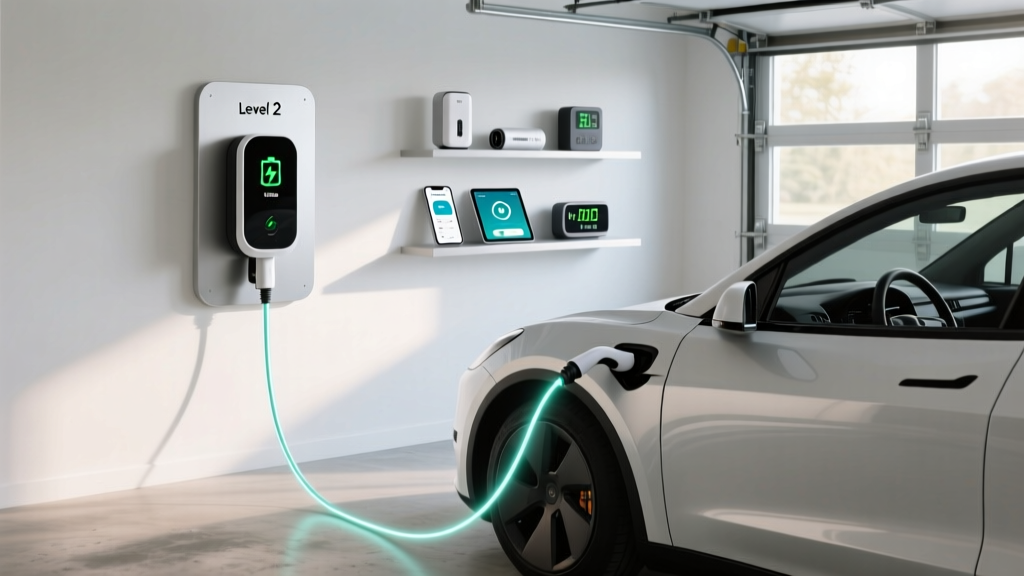
Level 2 is the home charging standard. A 240V circuit — the same voltage as your electric dryer — delivers 7.7 kW to 19.2 kW depending on circuit amperage and your vehicle's onboard charger limit. At 11.5 kW (a 60A circuit / 48A continuous), most EVs gain 35–45 miles of range per hour. A 75 kWh battery charges from 10–80% in roughly 5–6 hours.
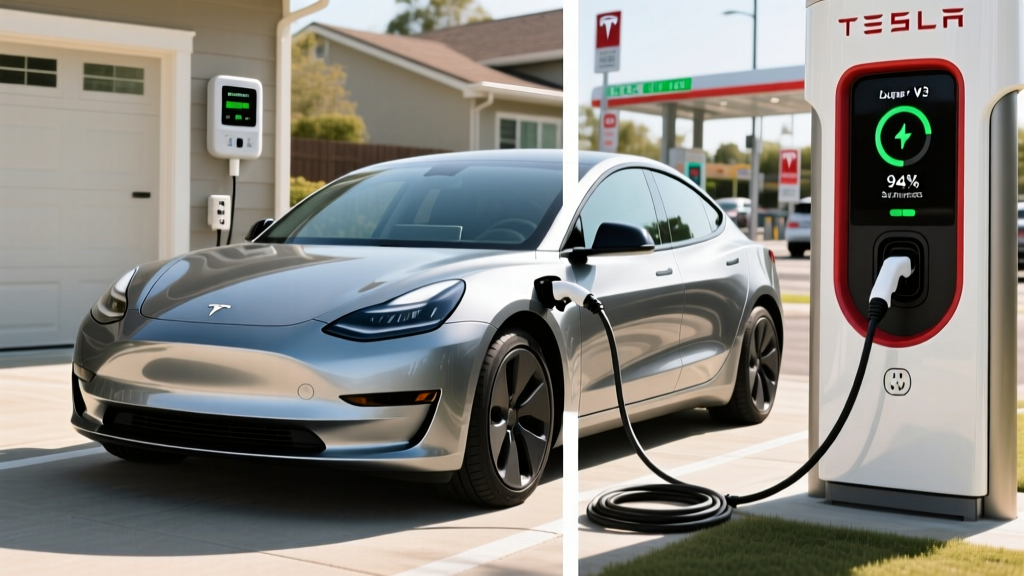
DC Fast Charging bypasses the vehicle's onboard charger and pushes direct current straight into the battery at 50–350 kW. Peak speeds add 200+ miles in 15–20 minutes on compatible vehicles. However, charge curves taper significantly above 80% State of Charge (SoC), so published peak kW rates are sustained only in the mid-SoC range. A vehicle that peaks at 250 kW may average 150 kW across a 10–80% session.
How Much Does It Cost to Install a Home EV Charger?
Installation costs vary dramatically based on your home's electrical panel capacity, the distance from panel to charger location, and local labor rates. Here's a realistic breakdown based on 2026 national averages:
| Component | Simple Install (Near Panel) | Complex Install (Far Run / Panel Upgrade) |
|---|---|---|
| Level 2 EVSE Equipment | $350–$700 | $350–$700 |
| Electrician Labor (2–8 hrs @ $85–$150/hr) | $170–$400 | $680–$1,200 |
| Electrical Permit | $50–$200 | $50–$200 |
| Conduit, Wiring, Materials | $50–$150 | $200–$600 |
| Panel Upgrade (if needed, 100A→200A) | $0 | $1,500–$3,500 |
| Total | $620–$1,450 | $2,880–$6,200 |
The single biggest cost variable is whether your electrical panel can handle the additional load. Most Level 2 chargers require a dedicated 40A to 60A circuit at 240V. If you have a 200A panel with available capacity, the install is straightforward. If you have a 100A panel — common in homes built before the 1990s — you may need a panel upgrade or a load-management device that throttles charger amperage when other appliances are running.
Always get a licensed electrician to perform a load calculation per NEC Article 220 before committing to a circuit size. Some utilities offer rebates of $250–$1,000 for home charger installation or panel upgrades — check your local utility's EV programs.
What Electrical Upgrades Might My Home Need?
Beyond the panel itself, consider these common upgrade scenarios:
- 200A service requirement: A 48A continuous charger draw (on a 60A breaker) consumes roughly 25% of a 200A panel's capacity. Older 100A or 150A panels often cannot accommodate this alongside electric ranges, dryers, and HVAC.
- Dedicated circuit: NEC code requires EVSE to have its own dedicated circuit — it cannot share with other outlets or appliances.
- GFCI protection: The 2020 and 2023 NEC updates require GFCI protection for 240V receptacles used for EV charging in garages. Hardwired EVSE installations may have different requirements — your electrician will advise based on local code adoption.
- Outdoor-rated equipment: If your charger is mounted outside, it needs a NEMA 4 or NEMA 4X rated enclosure. Most quality 2026 chargers carry this rating, but verify before purchasing for outdoor use.
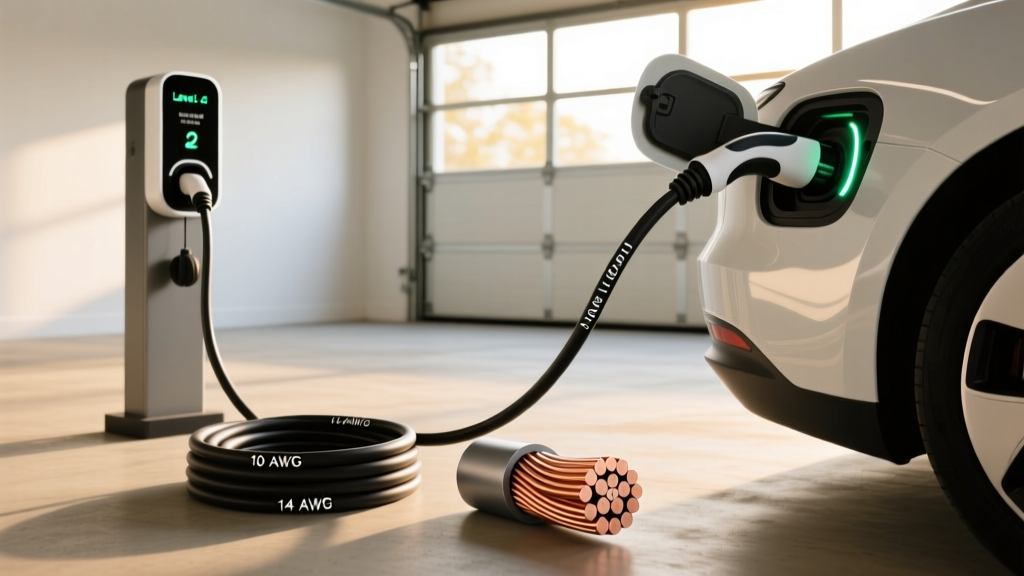
- Conduit runs over 25 feet: Long runs from panel to charger location may require larger-gauge wire (6 AWG or 4 AWG copper) to prevent voltage drop, increasing material costs.
Connector Compatibility: NACS, CCS, and CHAdeMO in 2026
The connector landscape has consolidated significantly. As of 2026, the North American Charging Standard (NACS) — originally developed by Tesla — is the dominant connector for new EVs sold in the US. Here's where each brand stands:
| Connector | Brands Using Natively | DC Fast Charge Networks |
|---|---|---|
| NACS (Tesla) | Tesla (all models), Ford, GM, Rivian, Volvo, Polestar, Fisker, Mercedes-Benz (new models) | Tesla Supercharger (20,000+ stalls), Electrify America (NACS stalls added), EVgo |
| CCS1 | Hyundai, Kia, BMW, VW (remaining models), Stellantis, Honda, Subaru | Electrify America, EVgo, ChargePoint, Ionity (Europe) |
| CHAdeMO | Nissan Leaf (legacy only — no new US models) | Limited; being phased out at most networks |
If you own a CCS-equipped vehicle and want access to Tesla's Supercharger network — the largest and most reliable in North America — you'll need a CCS-to-NACS adapter. Tesla sells an official adapter for ~$250, and Ford and GM include adapters with many 2024–2026 models. Conversely, new NACS-native vehicles can use CCS stations with a NACS-to-CCS adapter.
For home Level 2 charging, the connector situation is simpler: Level 2 charging uses the J1772 connector for CCS vehicles and the NACS connector for Tesla-connector vehicles. Many Level 2 chargers now ship with interchangeable connectors or include adapters in the box.
How Much Does Charging Cost Per Mile vs. Gas?
This is where EV ownership economics shine — but the savings depend heavily on your electricity rate and where you charge. Here's a realistic cost-per-mile comparison using 2026 averages:
| Scenario | Rate / Price | Vehicle Efficiency | Cost Per Mile |
|---|---|---|---|
| Home charging (national avg $0.16/kWh) | $0.16/kWh | 3.0 mi/kWh (110 MPGe) | $0.053 |
| Home off-peak TOU rate ($0.09/kWh) | $0.09/kWh | 3.0 mi/kWh | $0.030 |
| Public Level 2 ($0.30/kWh avg) | $0.30/kWh | 3.0 mi/kWh | $0.100 |
| DC Fast Charge ($0.48/kWh avg) | $0.48/kWh | 3.0 mi/kWh | $0.160 |
| Gas vehicle (25 MPG combined, $3.40/gal) | $3.40/gal | 25 MPG | $0.136 |
| Gas truck/SUV (16 MPG combined, $3.40/gal) | $3.40/gal | 16 MPG | $0.213 |
At home on an off-peak time-of-use rate, an efficient EV costs roughly 3–5 cents per mile to fuel — less than a quarter of what a mid-efficiency gas car costs. Even at DC fast charger rates, most EVs still undercut or match gasoline per mile. However, if you rely exclusively on expensive public DC fast charging, your cost advantage shrinks considerably. This is why home charging access is the single most important factor in EV ownership satisfaction.
The IRS §30D federal tax credit does not apply to home charger equipment in 2026 (the Alternative Fuel Vehicle Refueling Property Credit, §30C, expired for most residential installations). Check your state and utility for local rebates — many offer $250–$1,000 for EVSE installation. Refer to AFDC's state incentive database for current programs.
Charging Time Examples for Common Battery Sizes
Charging time depends on battery capacity (kWh), the charger's power output (kW), and your vehicle's onboard charger limit. Here are real-world estimates for the 10–80% charging window — the practical range most owners use, since charging slows significantly above 80% to protect battery health:
Charge Curve Reality Check: A vehicle advertised with "250 kW peak DC fast charging" does not sustain 250 kW for the entire session. Typical charge curves peak between 10–40% SoC, then taper progressively. A 250 kW-capable vehicle might average 160–180 kW across a 10–80% session. Always look at 10–80% times, not peak kW, for practical planning.
- 40 kWh battery (e.g., Nissan Leaf, base PHEV packs): Level 2 at 7.7 kW → 10–80% in ~3.5 hours. DC fast at 50 kW → 10–80% in ~35 minutes.
- 60 kWh battery (e.g., Chevy Equinox EV): Level 2 at 11.5 kW → 10–80% in ~3.5 hours. DC fast at 150 kW → 10–80% in ~25 minutes.
- 75 kWh battery (e.g., Tesla Model Y Long Range): Level 2 at 11.5 kW → 10–80% in ~4.5 hours. DC fast at 250 kW → 10–80% in ~22 minutes.
- 100 kWh battery (e.g., Rivian R1S, GMC Sierra EV): Level 2 at 11.5 kW → 10–80% in ~6 hours. DC fast at 350 kW → 10–80% in ~20 minutes (800V architecture vehicles only).
Best Home EV Chargers for 2026: Equipment Picks
After evaluating chargers across power output, build quality, smart features, cable management, and connector options, here are the top picks for 2026:
🏆 Best Overall: ChargePoint Home Flex
- Power: Up to 12 kW (50A circuit / 40A continuous) — adjustable down to 16A
- Connector: J1772 (CCS) or NACS — select at purchase
- Cable: 23 feet
- Smart Features: Wi-Fi, app scheduling, energy tracking, Alexa integration
- Price: ~$599
- Best for: Most homes, flexible amperage for older panels
⚡ Highest Power: Tesla Wall Connector
- Power: Up to 11.5 kW (60A circuit / 48A continuous) on NACS; 7.7 kW with J1772 adapter
- Connector: NACS native; J1772 adapter available
- Cable: 24 feet
- Smart Features: Wi-Fi, OTA updates, power sharing (link multiple units on one circuit), vehicle-specific access control
- Price: ~$475
- Best for: Tesla and NACS-connector owners seeking maximum home charge speed
💰 Best Budget: Emporia Vue Level 2
- Power: Up to 11.5 kW (60A circuit / 48A continuous)
- Connector: J1772
- Cable: 24 feet
- Smart Features: Wi-Fi, whole-home energy monitoring integration, scheduling, solar-aware charging
- Price: ~$399
- Best for: Cost-conscious buyers who still want full amperage and smart features
🔌 Best Universal: Grizzl-E Smart
- Power: Up to 10 kW (50A circuit / 40A continuous) — DIP-switch adjustable
- Connector: J1772 or NACS (select at purchase)
- Cable: 24 feet
- Smart Features: Wi-Fi, OCPP protocol support, extreme cold rated (-40°F)
- Price: ~$549
- Best for: Cold-climate owners and those wanting a rugged, adjustable unit
When choosing, match the charger's maximum amperage to your available circuit. A 60A breaker supports 48A continuous (NEC 80% rule). A 50A breaker supports 40A continuous. If your panel is tight on capacity, chargers like the ChargePoint Home Flex let you dial down amperage via DIP switches, avoiding a panel upgrade.
Safety, Code, and Best Practices
EV charging involves sustained high-current draw — often for 6–8 hours at a time. This is fundamentally different from a dryer's 45-minute cycle. Follow these safety guidelines:
- Always use a dedicated circuit. Sharing a circuit with other loads risks overheating and breaker trips.
- Hardwired vs. plug-in: Hardwired installations (no NEMA receptacle) are preferred for 48A+ chargers — they eliminate the receptacle as a failure point and often don't require GFCI breakers, which can cause nuisance trips with EVSE. For plug-in units, use a NEMA 14-50 receptacle on a 50A breaker and ensure it's installed with proper torque specifications.
- Inspect receptacles annually. NEMA 14-50 outlets under sustained EV charging loads can develop heat at loose connections. Check for discoloration or warmth at the plug face periodically.
- Use UL-listed or ETL-listed equipment only. Avoid uncertified chargers from online marketplaces — they may lack overcurrent, ground-fault, or thermal protection.
- Outdoor installations: Ensure your EVSE carries a NEMA 4 rating for weather resistance. Use an in-use cover for receptacle-based installations.
Reference the National Electrical Code (NEC) Article 625, which governs EV charging system installation. Your licensed electrician should pull a permit and schedule an inspection — this protects you and is required for most utility rebate programs.
Frequently Asked Questions
How much does it cost to install a home EV charger?
A straightforward Level 2 installation near your electrical panel typically costs $620–$1,450 including equipment, labor, and permit. If you need a long wire run or a panel upgrade from 100A to 200A service, expect $2,880–$6,200+. Always get a licensed electrician's load calculation first.
How fast will each charging level add range?
Level 1 (120V) adds 3–5 miles per hour. Level 2 (240V at 11.5 kW) adds 35–45 miles per hour. DC fast charging at 150 kW can add 200+ miles in 15–20 minutes at peak rates, though speeds taper above 80% SoC.
Which connector is compatible with my EV?
Check your vehicle's charge port. 2025–2026 Tesla, Ford, GM, Rivian, Volvo, and Polestar vehicles use NACS. Most Hyundai, Kia, BMW, VW, and Stellantis models still use CCS1. Nissan Leaf (legacy) uses CHAdeMO. For home Level 2, buy an EVSE matching your vehicle's connector — or use an adapter.
How much does charging cost per mile vs. gas?
Home charging on average US electricity rates ($0.16/kWh) costs about $0.05/mile. Off-peak TOU rates drop this to ~$0.03/mile. A 25 MPG gas car at $3.40/gallon costs $0.14/mile. Even DC fast charging at $0.48/kWh ($0.16/mile) is competitive with gasoline. According to fueleconomy.gov, EVs consistently show lower fuel costs per mile across all US regions.
What electrical upgrades might I need?
The most common upgrade is a panel increase from 100A to 200A service ($1,500–$3,500). You'll also need a dedicated 40A–60A 240V circuit. Homes with modern 200A panels usually have sufficient capacity without upgrades. A load-management device ($200–$500) can avoid a panel upgrade by dynamically reducing charger amperage when other loads are active.
Can I charge my EV with solar panels?
Yes. Smart chargers like the Emporia Vue and ChargePoint Home Flex offer solar-aware charging modes that prioritize excess solar production, effectively charging your EV for near-zero marginal cost. This requires a home energy management system or compatible inverter integration.