Installing a Level 2 charger at home is the single highest-impact upgrade an EV owner can make. It cuts your fueling cost to a fraction of gas, eliminates trips to public stations for daily driving, and—thanks to the federal Alternative Fuel Vehicle Refueling Property Credit (Internal Revenue Code §30C)—can shave up to $1,000 off your hardware and installation bill. But the electric vehicle home charger tax credit has specific eligibility rules, cost caps, and geographic requirements that trip up many buyers. This guide breaks down exactly what the credit covers, what a real home installation costs in 2026, which charger to buy, and what your electrical panel can actually handle.
The Federal EV Home Charger Tax Credit (§30C) Explained
The IRS §30C credit covers 30% of the cost of qualified refueling property installed at your primary residence, including both the charger hardware and the electrical labor to install it. Here are the hard numbers for 2026:
- Maximum credit: $1,000 per tax year for residential installations
- Credit rate: 30% of combined equipment + installation costs
- Eligible property: Level 2 (240V) EV charging equipment installed at your main home in the United States
- Geographic requirement: The property must be placed in service in an eligible census tract (non-urbanized area or a low-income community as defined by the IRS). This is the most commonly overlooked restriction.
- Claim method: Filed on IRS Form 8911 with your annual tax return; not available as a point-of-sale rebate for charger equipment
- ☐ Charger installed at your primary U.S. residence (not a rental property you don't occupy)
- ☐ Equipment is new and placed in service during the tax year
- ☐ Your address falls within a qualifying census tract (check the IRS Eligible Census Tract tool or consult a tax professional)
- ☐ You have sufficient federal tax liability to absorb a nonrefundable credit
- ☐ Installation performed by a licensed electrician with proper permits
Because the credit is nonrefundable, it can only reduce your tax liability to zero—it won't generate a refund if you owe less than the credit amount. If your installation costs $3,334 or more, you'll max out the $1,000 credit. Always confirm your census tract eligibility and consult a tax professional before counting on this credit in your budget.
Charging Levels: Speed, Power, and Real-World Range Added
Understanding charging speed starts with one critical distinction: kW (kilowatts) measures power—how fast energy flows into your car. kWh (kilowatt-hours) measures energy—the total capacity of your battery. Think of kW as the width of a hose and kWh as the size of the bucket you're filling. A wider hose (higher kW) fills the bucket faster, but the bucket size (kWh) doesn't change.
| Level | Voltage | Max Power (kW) | Miles of Range / Hour | Typical Use Case |
|---|---|---|---|---|
| Level 1 | 120V AC | 1.0–1.4 kW | 3–5 mi/hr | Overnight top-off; emergency; PHEV daily needs |
| Level 2 | 240V AC | 7.2–19.2 kW | 20–60 mi/hr | Home daily charging; workplace; destination |
| DC Fast Charge | 400–800V DC | 50–350 kW | 150–1,000+ mi/hr (peak) | Road trips; highway corridors; commercial fleets |
Real-world context: A typical EV with an 80 kWh battery (e.g., Ford Mustang Mach-E Extended Range) driven 40 miles per day needs roughly 12 kWh replenished nightly. A 48-amp Level 2 charger delivering 11.5 kW will refill that in just over one hour. A Level 1 outlet at 1.2 kW would take 10 hours for the same energy—borderline sufficient for a PHEV with a 15 kWh battery, but inadequate for a full BEV used daily.
DC fast charging reality check: Peak kW ratings are not sustained. A charger rated at 250 kW may deliver that speed only between 10–30% State of Charge (SoC), then taper significantly. Expect a 10–80% session on a 150 kW DC charger to take 25–35 minutes for an 80 kWh battery, not the theoretical 20 minutes the peak rate implies. Battery preconditioning—warming the pack via navigation to a charger—can shave 5–10 minutes off cold-weather sessions.
Home Level 2 Installation: Electrical Requirements and Costs
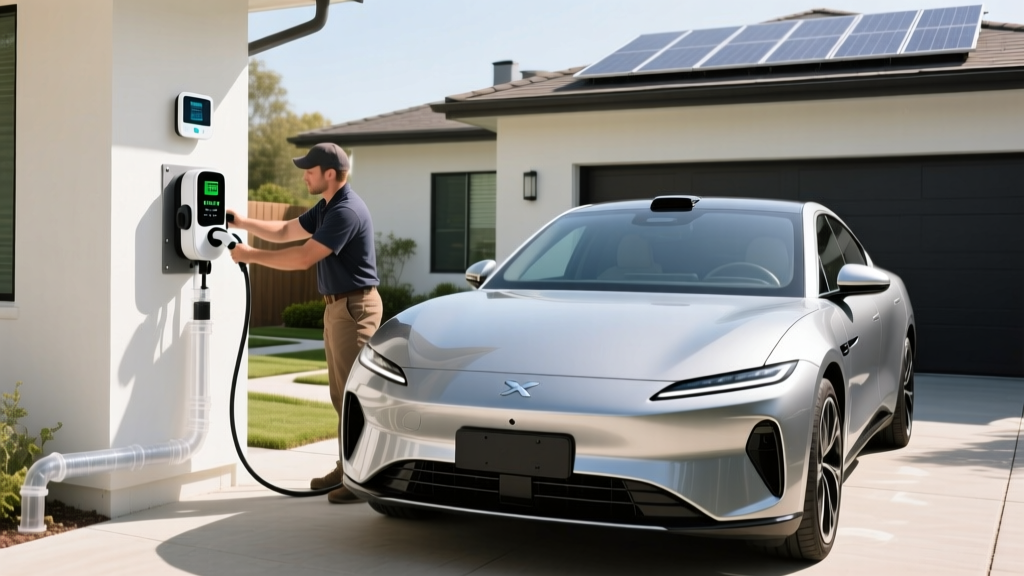
A Level 2 home charger requires a dedicated 240-volt circuit, the same voltage your electric dryer or oven uses. The most common residential setup is a 60-amp breaker feeding a 48-amp continuous-load charger (National Electrical Code requires circuits be rated at 125% of continuous load, so a 48A charger needs a 60A breaker). Here's what determines your total cost:
Electrical Panel Capacity
Your home's electrical panel (breaker box) has a total amperage rating—typically 100A, 150A, or 200A in modern homes. A 60A EV circuit consumes a significant portion of that capacity. If your panel is already near its limit (common in older homes with 100A service), you'll need a panel upgrade to 200A before adding an EV circuit. This is the single biggest variable in installation cost.
Wiring Distance and Conduit
The farther your charger is from the electrical panel, the more copper wire, conduit, and labor are required. A garage-mounted charger 10 feet from the panel is a best-case scenario. A charger on the exterior wall of a house with the panel in the basement at the opposite end can triple the wiring cost.
| Component | Simple Install (Near Panel) | Complex Install (Far Run / Outdoor) | Panel Upgrade Required |
|---|---|---|---|
| Level 2 Charger (48A, hardwired) | $500–$700 | $500–$700 | $500–$700 |
| Electrician labor | $400–$800 | $1,000–$2,000 | $800–$1,500 |
| Wire, conduit, breaker, materials | $100–$300 | $400–$800 | $200–$500 |
| Permit and inspection | $50–$200 | $100–$300 | $100–$300 |
| Panel upgrade (100A → 200A) | N/A | N/A | $1,500–$3,500 |
| TOTAL RANGE | $1,050–$2,000 | $2,000–$3,800 | $3,100–$6,500 |
After the §30C credit: A $2,000 simple installation nets a $600 credit (30%). A $3,800 complex install maxes out the $1,000 credit. A $6,500 panel-upgrade scenario also maxes out at $1,000—but you've gained capacity for future electrification (heat pump, solar, second EV).
Connector Compatibility: NACS, CCS, and CHAdeMO
The EV connector landscape has consolidated significantly since 2024, when Ford, GM, Rivian, Volvo, and most major automakers adopted Tesla's North American Charging Standard (NACS). Here's where things stand for the 2026 model year:
| Connector | Brands Using It | Home Charger Availability | Adapter Needed? |
|---|---|---|---|
| NACS (J3400) | Tesla, Ford, GM, Rivian, Volvo, Polestar, Mercedes, Nissan (new), Honda (new), Fisker, Lucid | Widely available (Tesla Wall Connector, ChargePoint, Emporia, Wallbox) | No (native on most 2025+ EVs) |
| CCS1 (Combo) | Hyundai, Kia (some), BMW, VW, Audi, Porsche, older Ford/GM models (pre-2025) | Available (most chargers offer CCS cable option) | CCS-to-NACS adapter ($150–$250) if charger is NACS-only |
| CHAdeMO | Nissan Leaf (legacy), Mitsubishi Outlander PHEV (older) | Limited; most new home chargers do not offer CHAdeMO cables | CHAdeMO-to-NACS adapter (limited availability, ~$300+) |
Practical advice for 2026 buyers: If you're purchasing a new EV, it almost certainly has a NACS port. Buy a NACS home charger. If you own a 2023–2024 CCS-equipped vehicle (like a Hyundai Ioniq 5 or VW ID.4), you can either buy a CCS-cable home charger or use a manufacturer-approved adapter. For Nissan Leaf owners with CHAdeMO, home charging options are narrowing—plan accordingly if you intend to keep the vehicle long-term.
Charging Cost Per Mile: Home vs. Public vs. Gas
The economics of EV charging depend entirely on where and when you charge. A kWh of electricity at home on an off-peak rate costs a fraction of a DC fast-charging session on a highway corridor. Here's how the numbers stack up for a typical EV averaging 3.5 miles per kWh (roughly equivalent to 115 MPGe per EPA methodology):
| Scenario | Rate ($/kWh) | Cost Per Mile | Annual Cost (12,000 mi) |
|---|---|---|---|
| Home Level 2 (off-peak utility rate) | $0.09–$0.14 | $0.026–$0.040 | $312–$480 |
| Home Level 2 (standard rate, no TOU) | $0.14–$0.20 | $0.040–$0.057 | $480–$684 |
| Public Level 2 (ChargePoint, EVgo L2) | $0.25–$0.49 | $0.071–$0.140 | $852–$1,680 |
| DC Fast Charge (Electrify America, Tesla Supercharger) | $0.32–$0.56 | $0.091–$0.160 | $1,092–$1,920 |
| Gas Vehicle (30 MPG combined, $3.50/gal) | — | $0.117 | $1,400 |
The takeaway is clear: home charging is where the savings live. An EV owner charging exclusively at home on off-peak rates spends roughly $350–$480 per year on fuel versus $1,400 for a 30 MPG gas car. That's $900–$1,050 in annual savings. Relying exclusively on DC fast charging, however, erases most of that advantage—another reason the home charger investment pays for itself within 1–2 years.
Time-of-use (TOU) tip: Most utilities offer TOU plans that drop electricity rates to $0.07–$0.10/kWh between 10 PM and 6 AM. Setting your charger to start at midnight can cut your charging cost by 40–60% compared to standard rates. Every smart charger recommended below supports scheduled charging to automate this.
Equipment Recommendations: Top Level 2 Chargers for 2026
These are the chargers we recommend based on power output, build quality, smart features, connector options, and real-world reliability. All support NACS natively; most offer CCS cable options or are compatible via adapter.
Tesla Wall Connector (Gen 3)
- Power: 11.5 kW (48A) on 60A circuit; up to 17.3 kW (72A) on 90A circuit where panel allows
- Connector: NACS native
- Cable length: 24 ft
- Smart features: Wi-Fi updates, load sharing (pair two units on one circuit), access control, energy tracking via Tesla app
- Price: ~$475
- Best for: Tesla owners; anyone with a NACS-equipped EV wanting maximum power on a 60A circuit
ChargePoint Home Flex
- Power: Up to 12 kW (50A) configurable from 16A to 50A to match your circuit
- Connector: NACS or CCS1 cable options
- Cable length: 23 ft
- Smart features: Alexa integration, scheduled charging, detailed energy reports, flexible amperage setting
- Price: ~$550–$650
- Best for: Multi-EV households (CCS + NACS cable swap); renters who may move (NEMA 14-50 plug option available)
Emporia Vue EV Charger
- Power: 11.5 kW (48A) on 60A circuit
- Connector: NACS native
- Cable length: 24 ft
- Smart features: Whole-home energy monitoring integration, solar-aware charging, TOU scheduling, real-time cost tracking
- Price: ~$400–$500
- Best for: Budget-conscious buyers; solar-panel owners wanting to charge only on excess production
Wallbox Pulsar Plus
- Power: 11.5 kW (48A) on 60A circuit
- Connector: NACS or J1772 (with adapter)
- Cable length: 25 ft
- Smart features: Power Sharing (distribute load across two chargers), app scheduling, compact form factor
- Price: ~$450–$550
- Best for: Tight garage spaces; two-EV households needing load management on a single panel
Charging Time Examples: 10–80% for Common Battery Sizes
Most EV owners charge between 10% and 80% State of Charge for daily use—this preserves battery health and avoids the slow taper that occurs above 80%. Here's how long that takes at different power levels for representative 2026 EV batteries:
| Vehicle (Example) | Usable Battery (kWh) | Max AC Charge Rate | 10–80% at 11.5 kW (48A) | 10–80% at 7.7 kW (32A) |
|---|---|---|---|---|
| Tesla Model 3 Long Range | 75 kWh | 11.5 kW | ~4.5 hours | ~6.8 hours |
| Ford Mustang Mach-E Ext. Range | 84 kWh | 10.5 kW | ~5.4 hours | ~7.7 hours |
| Hyundai Ioniq 5 (Long Range) | 77.4 kWh | 10.9 kW | ~4.9 hours | ~7.0 hours |
| Chevrolet Equinox EV | 85 kWh | 11.5 kW | ~5.1 hours | ~7.7 hours |
| Toyota bZ4X | 66 kWh | 7.2 kW | ~6.4 hours (limited by car) | ~6.4 hours |
Note that the vehicle's onboard charger limits AC charging speed. Even if your home charger can deliver 11.5 kW, a car with a 7.2 kW onboard charger (like the bZ4X) will never exceed that rate. Always check your EV's maximum AC charge acceptance rate before investing in a higher-amperage circuit.
Safety, Code, and Permit Requirements
Electrical work for EV charging is not a DIY project. The NEC (National Electrical Code) and most local jurisdictions require the following for a compliant, safe installation:
- Dedicated circuit: Your Level 2 charger must have its own breaker—no sharing with other appliances. A 48A charger requires a dedicated 60A breaker.
- GFCI protection: NEC 2020 and later requires Ground Fault Circuit Interrupter protection for all 240V EV outlets (NEMA 14-50). Hardwired installations are generally exempt from the GFCI breaker requirement since the charger itself provides ground fault protection—but verify with your local inspector.
- Outdoor rating: If your charger is mounted outdoors, it must carry a NEMA 4 (weatherproof) rating. All chargers recommended above meet this standard.
- Permit and inspection: Virtually all jurisdictions require an electrical permit for a new 240V circuit. Permit fees typically range from $50 to $300. The work must pass a municipal inspection before the credit documentation is valid.
- Wire gauge: 6 AWG copper wire for a 60A circuit; 4 AWG for runs over 50 feet to minimize voltage drop. Your electrician will size this correctly.
- NEMA 14-50 vs. hardwired: A NEMA 14-50 outlet allows you to unplug and take the charger when you move, but requires a GFCI breaker under current code (adding $50–$100 to the breaker cost). Hardwired connections eliminate the GFCI breaker requirement and are slightly more reliable (no plug connection to corrode).
Frequently Asked Questions
How much does it cost to install a home EV charger?
A typical Level 2 home charger installation costs between $1,050 and $2,000 for a straightforward setup (panel has capacity, charger is near the breaker box). Complex installations with long wire runs or outdoor mounting run $2,000–$3,800. If your home needs a panel upgrade from 100A to 200A, expect $3,100–$6,500 total. The §30C tax credit covers 30% of these costs up to $1,000.
How fast will each charging level add range?
Level 1 (120V) adds 3–5 miles of range per hour—adequate for PHEVs with small batteries. Level 2 (240V, 48A) adds 25–40 miles per hour depending on your EV's efficiency—enough to fully replenish a day's driving in 1–2 hours. DC fast charging adds 150–1,000+ miles per hour at peak power, but sustained rates taper significantly above 50% SoC.
Which connector is compatible with my EV?
For 2026 model-year vehicles: Tesla, Ford, GM, Rivian, Volvo, Polestar, and most new models use NACS. Hyundai, Kia, BMW, VW, and Porsche still use CCS1 on most models. Nissan Leaf (legacy) uses CHAdeMO. Check your vehicle's charge port or owner's manual. Adapters are available for cross-compatibility but should be purchased from the vehicle manufacturer or a certified supplier.
How much does charging cost per mile compared to gas?
Home charging on off-peak rates costs $0.03–$0.04 per mile for a typical EV—roughly 75% less than a 30 MPG gas car at $3.50/gallon ($0.12/mile). Public DC fast charging at $0.40–$0.56/kWh costs $0.11–$0.16 per mile, which is comparable to or slightly more than gasoline. The financial case for EV ownership depends heavily on consistent access to home or workplace charging.
What electrical upgrades might I need?
The most common upgrade is a panel capacity increase from 100A to 200A, which costs $1,500–$3,500. Other potential upgrades include: replacing a Federal Pacific or Zinsco panel (known fire hazards, $2,000–$4,000 to replace), adding a sub-panel in a detached garage, or upgrading the utility service drop for homes with very old wiring. An electrician's load calculation ($100–$200) will determine what's needed before you commit to a charger purchase.
Can I claim the §30C charger tax credit if I rent my home?
No. The §30C credit applies only to refueling property installed at a dwelling unit you own and use as a primary residence. Renters and landlords installing chargers at rental properties are not eligible for the residential credit (commercial installations have a separate, more complex credit structure under §30C with prevailing-wage requirements).
Is a smart charger worth the extra cost?
Yes, for most owners. Smart features like scheduled charging (to exploit TOU rates), energy tracking, and remote monitoring typically add only $50–$100 to the charger price but can save $200–$400 per year in electricity costs through off-peak optimization. The Emporia and ChargePoint units recommended above include these features at no premium over basic "dumb" chargers.
Sources: IRS §30C Alternative Fuel Vehicle Refueling Property Credit; U.S. Department of Energy Alternative Fuels Data Center; EPA fueleconomy.gov. Tax credit rules and census tract eligibility are subject to change; consult a tax professional for your specific situation. All installation costs are 2026 estimates and vary by region and electrician.