If you're driving a 2020 Dodge Charger — whether the SXT with its 3.6L V6 getting 23 MPG combined or the R/T with the 5.7L HEMI V8 sipping around 19 MPG combined — you already know what fueling costs. At $3.20 per gallon and 19-23 MPG, you're spending roughly $0.14-$0.17 per mile on gas. The question isn't whether an EV can match that Charger's presence; it's whether you can charge at home efficiently and what the real economics look like. This guide breaks down home EV charger installation, public charging costs, and exactly what you need to make the switch practical.
Why Home Charging Is the Real EV Ownership Advantage
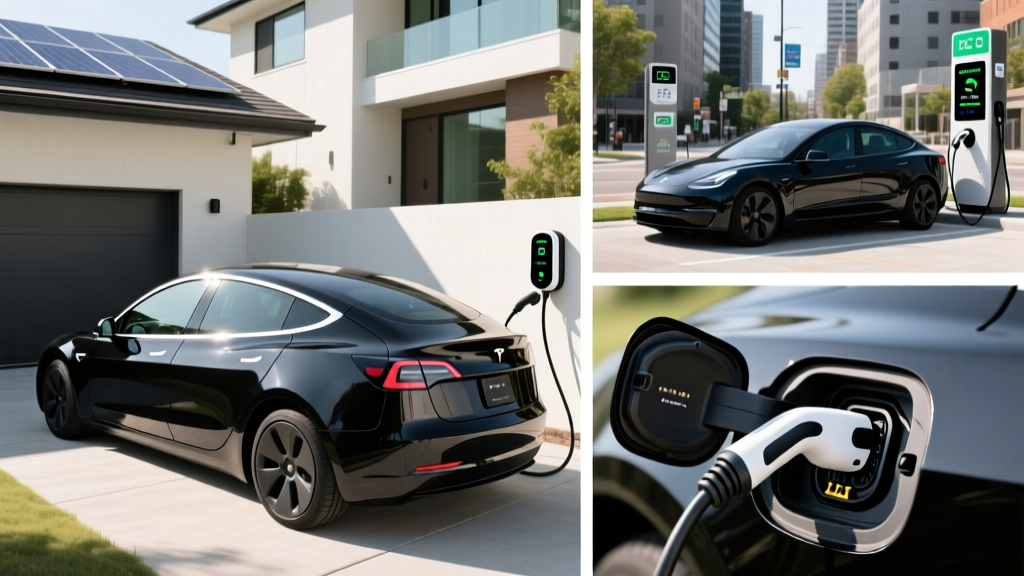
The 2020 Dodge Charger has a 18.5-gallon fuel tank, giving you roughly 350-425 miles of range before hunting for a gas station. An EV flips that model: instead of stopping to refuel, you plug in at home and wake up to a full "tank" every morning. Over 80% of EV charging happens at home, according to the U.S. Department of Energy. But to make that work, you need the right Level 2 home charger, proper electrical infrastructure, and a clear picture of the costs.
Before diving into installation, let's clarify the most common point of confusion in EV charging: kW (kilowatts) measures power — how fast energy flows into your battery. kWh (kilowatt-hours) measures energy — the total capacity of your battery, like gallons in a gas tank. A 75 kWh battery charged at 11.5 kW takes roughly 6.5 hours from empty to full. Never confuse the two.
Charging Levels Explained: Speed, Power, and Practical Use
EV charging falls into three tiers, each with different power delivery and use cases. Here's exactly what each level adds in real-world range per hour of charging:
| Level | Voltage | Power (kW) | Miles of Range Per Hour | Best Use Case |
|---|---|---|---|---|
| Level 1 | 120V AC | 1.2 - 1.9 kW | 3 - 5 miles | Overnight top-ups, PHEVs, low-mileage drivers |
| Level 2 | 240V AC | 7.2 - 19.2 kW | 25 - 75 miles | Daily home charging, most EV owners' primary method |
| DC Fast Charging | 400-800V DC | 50 - 350 kW | 150 - 1,000+ miles | Road trips, commercial fleets, quick top-ups away from home |
Real-world context: A Level 2 charger at 11.5 kW (the most common home setup on a 48-amp circuit) will add roughly 40-45 miles of range per hour to a mid-size EV like the Hyundai Ioniq 5 or Tesla Model Y. That means an 8-hour overnight session delivers 320-360 miles — more than enough for nearly any daily commute and far more practical than the Level 1 cord that ships with most EVs.
DC fast charging operates differently. A 350 kW charger can take a compatible vehicle from 10% to 80% in 18-20 minutes. However, charge speed follows a taper curve — peak kW only applies at low state-of-charge (SoC). Above 80%, charging slows dramatically to protect battery chemistry. This is why you'll see "10-80% in 18 minutes" advertised rather than 0-100% times.
Home EV Charger Installation: Electrical Requirements and Costs
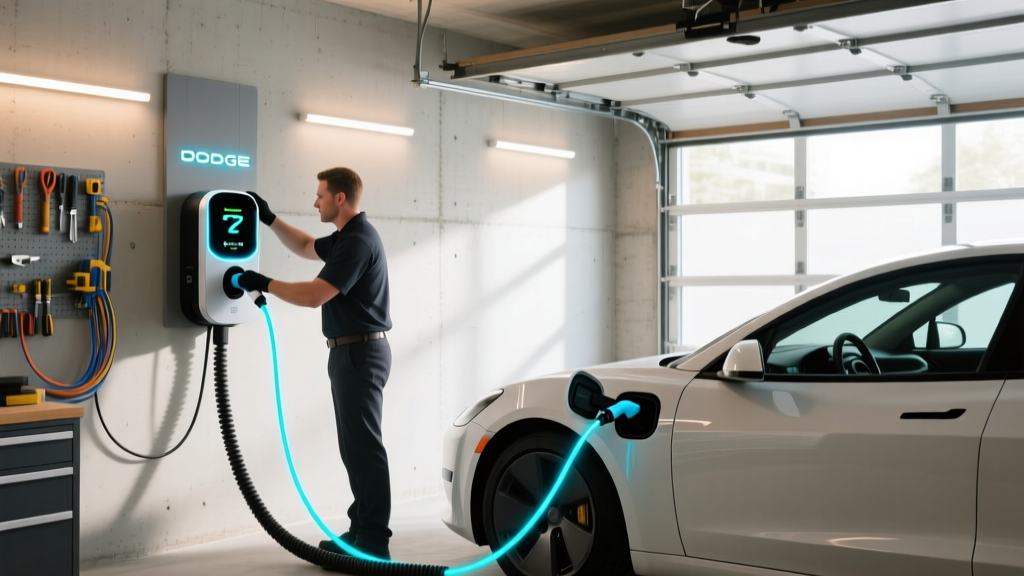
Installing a Level 2 home charger requires a dedicated 240V circuit — the same voltage your electric dryer or oven uses. Here's what's involved and what it actually costs:
Electrical Requirements
- Circuit: Dedicated 40-amp to 60-amp breaker (matching your charger's max draw)
- Wire: 6 AWG copper for 40A circuits; 4 AWG for 50-60A circuits
- Outlet: NEMA 14-50 (most common) or hardwired connection (preferred for 48A+ chargers)
- Panel capacity: Your electrical panel must have spare amperage — typically 200A service for modern homes
The Panel Upgrade Reality
Many homes built before 2000 have 100-amp or 150-amp electrical panels. If your panel is near capacity — running electric heat, a dryer, an electric oven, and AC simultaneously — adding a 40-amp EV circuit may require a panel upgrade to 200 amps. This is the single biggest variable in installation cost and can add $1,500-$3,500 to your project. A licensed electrician will perform a load calculation to determine if an upgrade is necessary.
Installation Cost Breakdown
| Item | Low-End Cost | High-End Cost | Notes |
|---|---|---|---|
| Level 2 Charger (Equipment) | $350 | $750 | Varies by brand, power output, smart features |
| Electrician Labor (standard install) | $400 | $1,200 | Depends on distance from panel to garage/carport |
| Electrical Permit | $50 | $250 | Required in most jurisdictions; varies by municipality |
| Panel Upgrade (if needed) | $1,500 | $3,500 | Only if existing panel lacks capacity |
| Conduit/Wire (long runs) | $100 | $600 | If charger is far from the electrical panel |
| Total (no panel upgrade) | $900 | $2,800 | Most typical installs fall in $1,200-$1,800 |
| Total (with panel upgrade) | $2,400 | $6,350 | Older homes with 100A service |
The federal Residential Clean Energy Credit (§25D) covers 30% of home EV charger equipment and installation costs up to $1,000 through 2032. That can knock $270-$840 off your total bill. Some states and utilities add additional rebates — check your local utility and the AFDC state incentive database for specifics.
Connector Compatibility: NACS, CCS, and CHAdeMO Explained
Your EV's charge port determines which connectors you can use at home and in public. As of 2026, the North American market has largely standardized around two connectors, with a third legacy standard still in use:
| Connector | Used By | Home Charger Availability | Public DC Fast Availability |
|---|---|---|---|
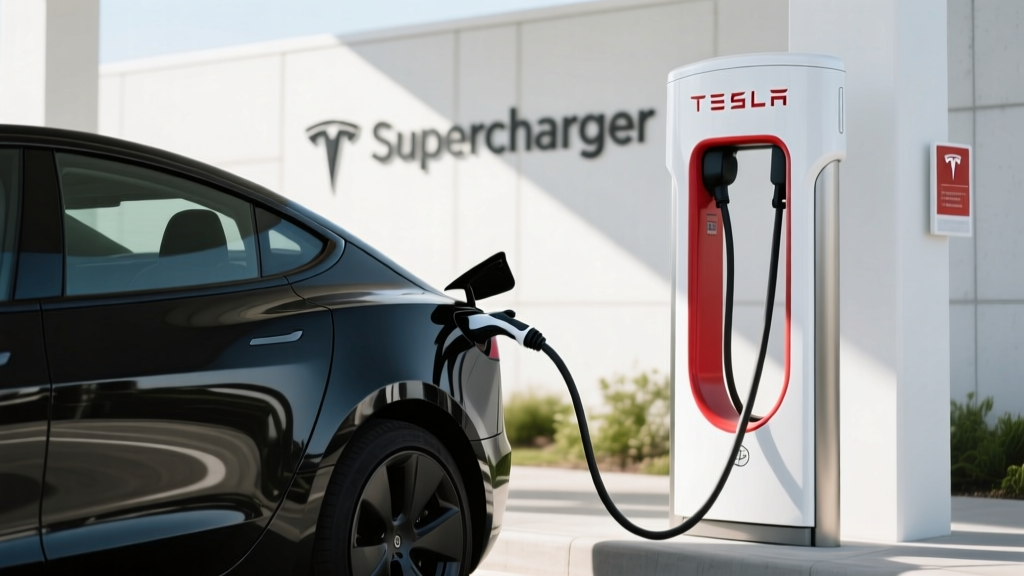
| NACS (Tesla/J3400) | Tesla (all years), Ford, GM, Rivian, Hyundai, Kia, and most 2025+ models | Widely available — Tesla Wall Connector, ChargePoint, Emporia | Tesla Supercharger network (25,000+ stalls), growing third-party NACS stations |
| CCS1 (Combo) | 2024 and earlier non-Tesla EVs (VW ID.4, older Bolt, Ioniq 5 pre-2025) | Widely available — most Level 2 chargers ship with J1772/CCS | Electrify America, EVgo, ChargePoint DC stations |
| CHAdeMO | Nissan Leaf (legacy), Mitsubishi Outlander PHEV (older) | Available but declining | Limited and shrinking — most new DC stations omit CHAdeMO |
Adapter note: If you own a CCS-equipped EV but want access to Tesla Superchargers, Tesla sells a CCS-to-NACS adapter (~$250) that unlocks the Supercharger network. Ford and GM provide these adapters to EV owners. For home charging, most Level 2 chargers use the J1772 connector (which is the AC portion of CCS1), and NACS-to-J1772 adapters are available for $100-$180.
Charging Cost Per Mile: EV vs. Your 2020 Dodge Charger
This is where the economics get compelling. Let's compare real fueling costs between a 2020 Dodge Charger R/T and a comparable mid-size EV like the 2026 Hyundai Ioniq 6 (which achieves roughly 130 MPGe combined, or about 26 kWh/100 miles):
| Scenario | Cost Per kWh / Gallon | Cost Per Mile | Annual Cost (12,000 mi) |
|---|---|---|---|
| 2020 Dodge Charger R/T (19 MPG combined) | $3.20/gallon | $0.168 | $2,016 |
| EV — Home charging (off-peak utility rate) | $0.12/kWh | $0.031 | $374 |
| EV — Home charging (national avg residential) | $0.17/kWh | $0.044 | $530 |
| EV — Public Level 2 (network pricing) | $0.30/kWh | $0.078 | $936 |
| EV — DC Fast Charging (road trip pricing) | $0.48/kWh | $0.125 | $1,500 |
Even at the national average residential electricity rate of ~$0.17/kWh, home EV charging costs roughly 74% less per mile than fueling a Charger R/T. Over five years and 60,000 miles, that's a fuel savings of approximately $7,400 — which nearly covers the entire cost of a home charger installation and then some.
The caveat: if you rely exclusively on DC fast charging (no home charging access), your cost per mile approaches that of an efficient gas car. Home charging is the economic backbone of EV ownership.
Charging Time Examples by Battery Size
How long a charge session takes depends on battery capacity (kWh) and charger power (kW). Here are realistic 10-80% charging times for common scenarios:
- 60 kWh battery (Chevy Equinox EV) on 11.5 kW Level 2: ~4.5 hours (10-100%)
- 77 kWh battery (Ford Mustang Mach-E) on 11.5 kW Level 2: ~6 hours (10-100%)
- 84 kWh battery (Hyundai Ioniq 5) on 11.5 kW Level 2: ~6.5 hours (10-100%)
- 77 kWh battery on 150 kW DC fast: ~18 minutes (10-80%, with taper curve)
- 100 kWh battery (Tesla Model S) on 250 kW DC fast: ~25 minutes (10-80%)
Recommended Home EV Chargers for 2026
Not all Level 2 chargers are equal. Here are three proven options across price and feature tiers, each with specific power output and connector details:
Budget Pick: Emporia Vue EV Charger
- Power Output: 48 amps / 11.5 kW (hardwired) or 40 amps / 9.6 kW (NEMA 14-50 plug)
- Connector: J1772 (CCS-compatible vehicles); NACS version available
- Cable Length: 24 feet
- Smart Features: Wi-Fi, scheduling, energy monitoring via Emporia app, solar integration
- Price: ~$399
- Best For: Value-focused buyers who want smart scheduling and energy tracking
Best Overall: ChargePoint Home Flex
- Power Output: Up to 50 amps / 12 kW (adjustable via DIP switches: 16A-50A)
- Connector: J1772 (standard); NACS adapter available
- Cable Length: 23 feet
- Smart Features: Wi-Fi, ChargePoint app scheduling, Alexa/Google integration, flexible amperage to match your circuit
- Price: ~$549
- Best For: Most EV owners — flexible amperage means it works on 20A to 60A circuits
Premium Pick: Tesla Wall Connector
- Power Output: Up to 48 amps / 11.5 kW
- Connector: NACS (native Tesla); includes J1772 adapter for non-Tesla EVs
- Cable Length: 24 feet
- Smart Features: Wi-Fi, over-the-air updates, power sharing between two units on one circuit, load management
- Price: ~$475
- Best For: Tesla owners or households with NACS-equipped EVs; excellent build quality
Pro tip: Buy a charger rated for at least 48 amps even if your current circuit is 40 amps. This future-proofs you for a panel or circuit upgrade and ensures the charger isn't the bottleneck when you eventually buy an EV with faster onboard charging capability.
Safety, Code Compliance, and Installation Best Practices
EV chargers draw significant continuous current — often for 6-10 hours straight. The National Electrical Code (NEC) treats this as a continuous load, which means your circuit must be rated for 125% of the charger's maximum draw. A 48-amp charger requires a 60-amp breaker. Never undersize the circuit.
Key Safety Requirements
- Dedicated circuit: Your EV charger must have its own breaker — it cannot share a circuit with other appliances
- GFCI protection: NEC 2020 and later requires GFCI (Ground Fault Circuit Interrupter) protection for all EV charging outlets. Hardwired installations may have different GFCI requirements depending on jurisdiction
- Outdoor rating: If your charger is installed outside (carport, driveway), it must carry a NEMA 4 or IP65 weather-resistance rating. All three chargers recommended above meet this standard
- Permit and inspection: Most municipalities require an electrical permit and a post-installation inspection. Skipping this can void your homeowner's insurance coverage for electrical fires
- Wire gauge: Undersized wire causes overheating. Your electrician will pull the correct gauge based on circuit amperage and run length — don't cut corners here
Always hire a licensed electrician familiar with EV charger installations. Ask for their experience with 240V EV circuits specifically — this is not the same as adding a standard outlet. Many utilities maintain lists of vetted EV charger installers, and some offer rebates that require professional installation to qualify.
Frequently Asked Questions
How much does it cost to install a home EV charger?
A typical Level 2 home charger installation costs $1,200-$1,800 all-in (equipment, electrician, permit) if your electrical panel has sufficient capacity. If you need a panel upgrade from 100A to 200A service, expect $2,400-$6,350 total. The 30% federal Residential Clean Energy Credit can offset up to $1,000 of these costs through 2032.
How fast will each charging level add range?
Level 1 (120V) adds 3-5 miles per hour — suitable only for plug-in hybrids or very low daily mileage. Level 2 (240V, 11.5 kW typical) adds 25-45 miles per hour, fully replenishing most EV batteries overnight. DC fast charging (50-350 kW) can add 150-300+ miles in 20-30 minutes, though speed tapers significantly above 80% state of charge.
Which connector and charger is compatible with my EV?
Check your EV's charge port. Most 2025+ EVs from major manufacturers now use NACS (the Tesla-style connector). Older non-Tesla EVs typically use CCS1. For home Level 2 charging, nearly all EVs accept the J1772 connector (the AC standard), and adapters are available to bridge NACS and J1772. Nissan Leaf owners with CHAdeMO should verify that their chosen public DC fast stations still support this declining standard.
How much does charging cost per mile compared to gas?
Home charging at the national average residential rate ($0.17/kWh) costs roughly $0.04-$0.05 per mile for a typical EV. A 2020 Dodge Charger R/T at 19 MPG combined costs about $0.17 per mile at $3.20/gallon. That's a 70-75% per-mile savings with home EV charging. Public DC fast charging at $0.48/kWh narrows the gap to roughly 25% savings.
What electrical upgrades might I need?
The most common upgrade is a panel capacity increase from 100A or 150A to 200A service — necessary if your existing panel is near its load limit. You may also need a new dedicated circuit run from the panel to your garage or carport, which involves conduit, wire, and a new breaker. Homes with 200A panels and available breaker slots typically need no upgrades beyond the new circuit itself.
Can I just plug into a regular 120V outlet?
Yes — that's Level 1 charging, and every EV ships with a cord that does this. But at 1.2-1.9 kW, you'll only gain 3-5 miles of range per hour. A full charge from empty could take 40-70 hours. For a battery-electric vehicle with a 75+ kWh battery, Level 1 is impractical as a primary charging method. It works fine for plug-in hybrids with 15-40 miles of electric range.
Making the switch from a 2020 Dodge Charger to an EV is a significant change in how you think about "refueling." The upfront investment in a home Level 2 charger — typically $1,200-$1,800 installed — pays for itself within 2-4 years through fuel savings alone. The convenience of starting every morning with 250-300+ miles of range, without a single trip to a gas station, is something the Charger's 18.5-gallon tank simply can't match. Get a licensed electrician to assess your panel, pick a 48-amp smart charger, and pull the proper permits. The infrastructure you install today will serve every EV you own for the next decade.