The Real Cost of Installing a Home Level 2 EV Charger in 2026
Home charging is where the EV ownership experience is won or lost. A proper Level 2 (240V) setup adds 25-44 miles of range per hour, fully replenishing most EV batteries overnight. But installation costs vary wildly — from $800 for a simple outlet near your panel to $4,500+ if you need a service panel upgrade. This guide breaks down every cost factor, electrical requirement, and equipment decision so you can budget accurately.
If you're transitioning from a gas vehicle — say, a 2006 Range Rover Sport Supercharged that got 12 MPG combined — the economics of home charging will feel like a revelation. At national average electricity rates, that same mile costs roughly one-quarter what premium gasoline does. But first, you need the infrastructure right.
Charging Levels Explained: Speeds in kW and Miles Per Hour
The single most common EV confusion is mixing up kW (power, or how fast energy flows) with kWh (energy, or how much your battery holds). Think of kW as the width of a hose and kWh as the size of the bucket. A bigger hose fills the bucket faster, but the bucket size stays the same.
| Level | Voltage | Power (kW) | Miles Added/Hour | Best For |
|---|---|---|---|---|
| Level 1 | 120V (standard outlet) | 1.2-1.8 kW | 3-5 mi/hr | PHEVs, overnight top-ups, emergency |
| Level 2 | 240V (dryer-style) | 7.2-19.2 kW | 25-65 mi/hr | Daily home charging, full overnight |
| DC Fast | 400-800V DC | 50-350 kW | 150-400+ mi/hr | Road trips, rapid public charging |
Real-world context: A 75 kWh battery (like a Tesla Model Y Long Range) charging at 11.5 kW (a common 48A Level 2 circuit) goes from 10% to 80% in roughly 4.5 hours. That same battery on a 350 kW DC fast charger hits 10-80% in about 18-22 minutes — though charge speed tapers significantly above 80% to protect the battery cells. This taper is why DC fast charging is rated 10-80%, not 0-100%.
Electrical Requirements: What Your Home Actually Needs
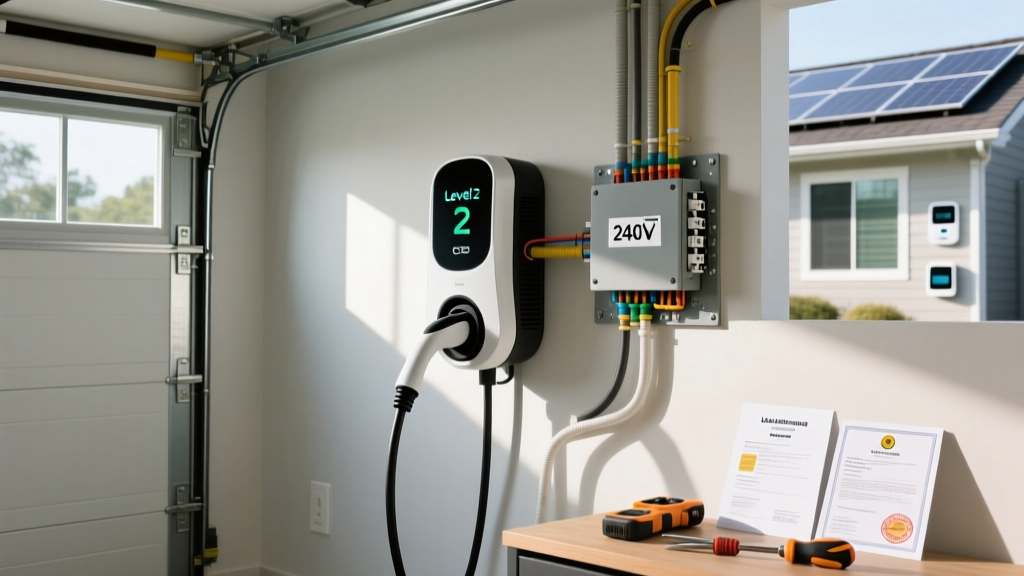
A Level 2 charger requires a dedicated 240V circuit, similar to what an electric dryer or oven uses. Here are the typical configurations:
- 40A circuit / 32A continuous (7.7 kW): Minimum practical setup, works on most 100A home panels
- 50A circuit / 40A continuous (9.6 kW): Most popular, balances speed and panel load
- 60A circuit / 48A continuous (11.5 kW): Fastest common residential, needs 150A+ panel
- 80A circuit / 64A continuous (15.4 kW): Requires 200A panel, specialized wiring
The 80% rule matters here: the National Electrical Code (NEC) requires that continuous loads (anything running 3+ hours, which includes EV charging) use only 80% of a circuit breaker's rated capacity. A 50A breaker delivers 40A continuous. This is non-negotiable code, not a suggestion.
Panel Upgrade Reality Check
Older homes — particularly those built before 1990 — often have 100A or even 60A service panels. If your panel is already near capacity running central A/C, an electric dryer, and an electric range, adding a 40-50A EV circuit may require a panel upgrade to 200A. This is the single biggest cost variable in home charger installation.
Homes that previously relied heavily on natural gas (gas furnace, gas water heater, gas range) typically have more electrical headroom, since the panel wasn't sized for all-electric loads.
| Component | Simple Install | Moderate Install | Complex Install (Panel Upgrade) |
|---|---|---|---|
| EV Charger Equipment | $400-$700 | $500-$800 | $500-$800 |
| Electrical Permit | $50-$150 | $100-$250 | $150-$400 |
| Electrician Labor (240V run) | $300-$600 | $600-$1,500 | $800-$1,500 |
| Panel Upgrade (if needed) | $0 | $0 | $1,500-$3,500 |
| Conduit, Wire, Misc Materials | $100-$200 | $200-$500 | $300-$600 |
| Total Estimated Cost | $850-$1,650 | $1,400-$3,050 | $3,250-$6,800 |
Cost-saving tip: Some utilities offer rebates of $250-$1,000 for Level 2 charger installation, and the federal §30C Alternative Fuel Vehicle Refueling Property Credit covers 30% of home charging equipment and installation costs up to $1,000 (subject to income caps and census-tract eligibility — consult a tax professional). Check with your local utility before scheduling work.
Connector Compatibility: NACS, CCS1, and CHAdeMO
The North American charging connector landscape consolidated significantly by 2026. Here's where things stand:
| Connector | Brands Using It (2026) | Notes |
|---|---|---|
| NACS (Tesla/J3400) | Tesla, Ford, GM, Rivian, Volvo, Polestar, Hyundai, Kia, BMW, most new 2025+ models | Now the dominant standard; smaller, lighter plug; access to Tesla Supercharger network |
| CCS1 | Older VW ID.4, legacy BMW i4/iX, older Hyundai/Kia models, Stellantis EVs | Still widely supported at public chargers; being phased out on new vehicles |
| CHAdeMO | Legacy Nissan Leaf, Mitsubishi Outlander PHEV | Effectively discontinued for new vehicles; declining public infrastructure |
Adapter options: If your EV has a CCS1 port but you want Tesla Supercharger access, a CCS-to-NACS adapter ($150-$250) is available. Conversely, NACS-equipped vehicles can use NACS-to-CCS adapters at Electrify America and other CCS stations. Tesla includes a NACS-to-J1772 adapter for Level 2 charging at non-Tesla destinations.
For home Level 2 charging, nearly all chargers use a J1772 connector (or NACS, which includes a J1772 adapter). Your EV will accept either — the J1772 standard has been universal for AC charging since 2010.
Home Charger Equipment Recommendations for 2026
Not all Level 2 chargers are equal. Key specs to evaluate: maximum amperage (determines charge speed), cable length (25 ft is standard; 18 ft may not reach), smart features (scheduling, energy monitoring), and hardwired vs. plug-in (NEMA 14-50 outlet).
ChargePoint Home Flex (Best Overall)
- Power: Up to 50A (12 kW) — adjustable via DIP switches
- Connector: J1772 (NACS adapter included)
- Cable: 23 ft
- Smart features: Wi-Fi, app scheduling, Alexa, energy dashboard
- Install type: Hardwire or NEMA 14-50
- Price: ~$599
Tesla Wall Connector (Best for NACS Vehicles)
- Power: Up to 48A (11.5 kW)
- Connector: NACS native (J1772 adapter available)
- Cable: 24 ft
- Smart features: Wi-Fi, OTA updates, power sharing (multiple units on one circuit)
- Install type: Hardwire only
- Price: ~$475
Emporia Vue Level 2 (Best Budget Smart Charger)
- Power: Up to 48A (11.5 kW)
- Connector: J1772 (NACS version available)
- Cable: 24 ft
- Smart features: Wi-Fi, solar integration, energy monitoring, scheduling
- Install type: Hardwire or NEMA 14-50
- Price: ~$399
Grizzl-E Smart (Best for Cold/Outdoor)
- Power: Up to 40A (9.6 kW)
- Connector: J1772 or NACS
- Cable: 24 ft
- Smart features: OCPP compatible, app control, -40°F rated
- Install type: Hardwire or NEMA 14-50
- Price: ~$449
Pro tip: Buy a charger rated for more amperage than you currently need. If you install a 60A circuit now, a 48A charger uses it fully. If you later buy an EV with a larger battery or dual onboard chargers, you won't need to rewire.
Cost to Charge: Electricity vs. Gas Per Mile
This is where EV ownership economics make sense — especially compared to thirsty vehicles. The 2006 Range Rover Sport Supercharged with its 4.2L supercharged V8 returned roughly 13 MPG combined on premium fuel. At $4.50/gallon (2026 national premium average), that's $0.346 per mile in fuel alone.
| Charging Scenario | Rate ($/kWh) | Cost per Mile (3.5 mi/kWh EV) | Annual Cost (12,000 mi) |
|---|---|---|---|
| Home Off-Peak (utility rate) | $0.09-$0.14 | $0.026-$0.040 | $312-$480 |
| Home Standard Rate | $0.14-$0.20 | $0.040-$0.057 | $480-$684 |
| Public Level 2 (ChargePoint, etc.) | $0.25-$0.45 | $0.071-$0.129 | $852-$1,548 |
| DC Fast Charging (EA, EVgo) | $0.35-$0.60 | $0.100-$0.171 | $1,200-$2,052 |
| Gas Vehicle (13 MPG, premium) | $4.50/gal | $0.346 | $4,152 |
Even charging exclusively on expensive DC fast chargers, an EV costs less per mile than a 13 MPG vehicle on premium. But home off-peak charging is the economic sweet spot — roughly 10x cheaper per mile than the Range Rover Sport Supercharged. According to fueleconomy.gov, the average EV achieves 3-4 miles per kWh, making electricity costs predictable once you know your utility rate.
Time-of-use (TOU) rates: Many utilities offer EV-specific plans with off-peak rates of $0.07-$0.10/kWh between 10 PM and 6 AM. A smart charger with scheduling features automates this — plug in when you get home, and charging starts at 10 PM automatically.
Safety, Code, and Installation Best Practices
EV charging draws sustained high current for hours — this is fundamentally different from a dryer that cycles on and off. Proper installation isn't optional.
Non-Negotiable Safety Requirements
- Dedicated circuit: Your EV charger must have its own breaker — no sharing with other appliances
- GFCI protection: NEC 2020+ requires ground-fault protection for all 240V EV receptacles; hardwired chargers have internal GFCI
- Outdoor rating: If mounted outside, the charger must carry a NEMA 3R or NEMA 4 rating for weather resistance
- Wire gauge: 6 AWG copper for 50A circuits; 4 AWG for 60A circuits — undersized wire is a fire hazard
- Permit and inspection: Nearly all jurisdictions require an electrical permit and post-installation inspection; skipping this can void home insurance coverage
Hardwired vs. plug-in (NEMA 14-50): Hardwired installations are generally safer and can support higher amperage (up to 80A). A NEMA 14-50 outlet offers portability — you can take the charger when you move — but is limited to 50A and requires a GFCI breaker ($80-$150 additional). Many electricians now recommend hardwired for permanent installations.
The Panel Load Calculation
Before any work begins, your electrician should perform an NEC Article 220 load calculation. This determines whether your existing panel can handle the EV circuit alongside your other loads. If the calculation shows you're near capacity, options include:
- Panel upgrade to 200A ($1,500-$3,500): The permanent solution
- Load management device ($200-$500 installed): Automatically reduces EV charge rate when other loads spike (e.g., A/C kicks on)
- Lower-amperage circuit: Drop from 60A to 40A — still delivers 25+ miles/hour, sufficient for most daily driving
Load management devices (like the Emporia Smart Load Manager or Tesla Wall Connector's built-in load sharing) are increasingly popular alternatives to panel upgrades, especially in homes with solar or where utility interconnection rules complicate panel work.
Charging Time Examples: How Long for Common Battery Sizes
Charge time depends on battery capacity (kWh), onboard charger acceptance rate, and circuit amperage. Most EVs accept 11.5 kW on Level 2 — some accept only 7.7 kW. The car limits the speed, not just the charger.
| Vehicle (Example) | Battery (kWh) | Max AC Accept | 40A Circuit (7.7 kW) | 48A Circuit (11.5 kW) |
|---|---|---|---|---|
| Tesla Model Y LR (2026) | 78 kWh usable | 11.5 kW | 10-80%: ~6.7 hrs | 10-80%: ~4.5 hrs |
| Hyundai Ioniq 5 (2026) | 77.4 kWh usable | 10.9 kW | 10-80%: ~7.0 hrs | 10-80%: ~4.7 hrs |
| Ford F-150 Lightning Ext | 131 kWh usable | 19.2 kW | 10-80%: ~11.9 hrs | 10-80%: ~8.0 hrs |
| Toyota RAV4 Prime (PHEV) | 18.1 kWh usable | 6.6 kW | 0-100%: ~2.4 hrs | 0-100%: ~2.4 hrs (car-limited) |
| Chevrolet Equinox EV (2026) | 85 kWh usable | 11.5 kW | 10-80%: ~7.3 hrs | 10-80%: ~4.9 hrs |
Key insight: If you drive 35-40 miles per day (the U.S. average is ~37 miles per FHWA data), even a 40A circuit fully replenishes your daily use in under 2 hours. You rarely need the full 10-80% charge overnight — most nights you're topping up 15-20 kWh, which takes 1.5-2.5 hours on Level 2.
Frequently Asked Questions
How much does it cost to install a home EV charger?
A straightforward Level 2 installation (panel near garage, adequate capacity) typically costs $850-$1,650 including equipment, electrician labor, permit, and materials. If your panel needs upgrading from 100A to 200A, expect $3,250-$6,800 total. The federal §30C credit can offset 30% up to $1,000 if you meet income and census-tract requirements.
How fast will each charging level add range?
Level 1 (120V): 3-5 miles per hour. Level 2 (240V, 48A): 25-44 miles per hour depending on vehicle efficiency. DC Fast (150-350 kW): 150-400+ miles per hour, though speeds taper above 80% state of charge. For daily use, Level 2 is the practical standard.
Which connector/charger is compatible with my EV?
For 2025-2026 model year vehicles, most use NACS (Tesla standard, now SAE J3400). Older EVs and some 2024 models use CCS1. For home Level 2, all EVs accept J1772 or NACS (with adapter). Check your vehicle's charge port — if it's the smaller Tesla-style plug, you need NACS. If it's the larger CCS plug with two extra DC pins below, you need CCS1/J1772.
How much does charging cost per mile vs gas?
Home charging at average rates costs $0.03-$0.06 per mile. Public DC fast charging runs $0.10-$0.17 per mile. Compare this to a 25 MPG gas car at $3.50/gallon ($0.14/mile) or a 13 MPG vehicle like the 2006 Range Rover Sport Supercharged on premium ($0.35/mile). Home-charged EVs are typically 3-10x cheaper per mile than gasoline.
What electrical upgrades might I need?
The most common upgrade is a panel capacity increase (100A to 200A, $1,500-$3,500). You may also need: a new dedicated circuit with appropriately sized wire (6 AWG for 50A, 4 AWG for 60A), a GFCI breaker if using a plug-in receptacle ($80-$150), or a load management device ($200-$500) as an alternative to panel upgrades. Your electrician's load calculation determines what's required.
Can I install a Level 2 charger myself?
While physically possible for experienced DIYers, 240V circuits carry serious arc-flash and fire risk if wired incorrectly. Most jurisdictions require a licensed electrician for permit and inspection. Insurance companies may deny claims related to unpermitted electrical work. Budget for professional installation — it's typically 40-60% of total project cost and ensures code compliance.