Why Your EV Hatchback Deserves a Dedicated Home Charger
Owning an electric hatchback — whether it's a Chevrolet Bolt EV, Nissan LEAF, Hyundai Ioniq 5, or the latest Volkswagen ID.3 — changes how you think about fueling. Instead of weekly gas station stops, the ideal routine is plugging in at home overnight and waking up to a full battery every morning. But making that routine work requires matching the right charger hardware to your car's onboard charger capacity, your home's electrical panel, and your daily driving needs.
This guide walks through every decision point: charging levels and real-world speeds, what your home's wiring actually needs, which connector your hatchback uses, what equipment to buy, and what it all costs — down to the dollar per mile.
Charging Levels Explained: Speed, Power, and Real-World Range Added
Before picking hardware, you need to understand the three charging tiers available to EV owners. The critical distinction: kW (kilowatts) measures power — how fast energy flows into your battery. kWh (kilowatt-hours) measures energy — the total capacity of your battery pack. A 60 kWh battery charged at 7.2 kW takes roughly 8.3 hours from empty to full. Confusing these two is the single most common mistake new EV buyers make.
| Level | Voltage / Amperage | Power (kW) | Miles of Range Added Per Hour | 0–80% Time (60 kWh pack) | Best Use Case |
|---|---|---|---|---|---|
| Level 1 | 120V / 12A | 1.4 kW | 3–5 mi/hr | ~34 hours | Overnight trickle; low-mileage commuters |
| Level 2 (Home) | 240V / 32A | 7.7 kW | 22–28 mi/hr | ~6.2 hours | Daily home charging; covers most commutes |
| Level 2 (Max Home) | 240V / 48A | 11.5 kW | 32–40 mi/hr | ~4.2 hours | High-capacity onboard chargers; larger batteries |
| DC Fast (Public) | 400–800V DC | 50–350 kW | 150–600+ mi/hr | 18–40 min (10–80%) | Road trips; quick top-ups away from home |
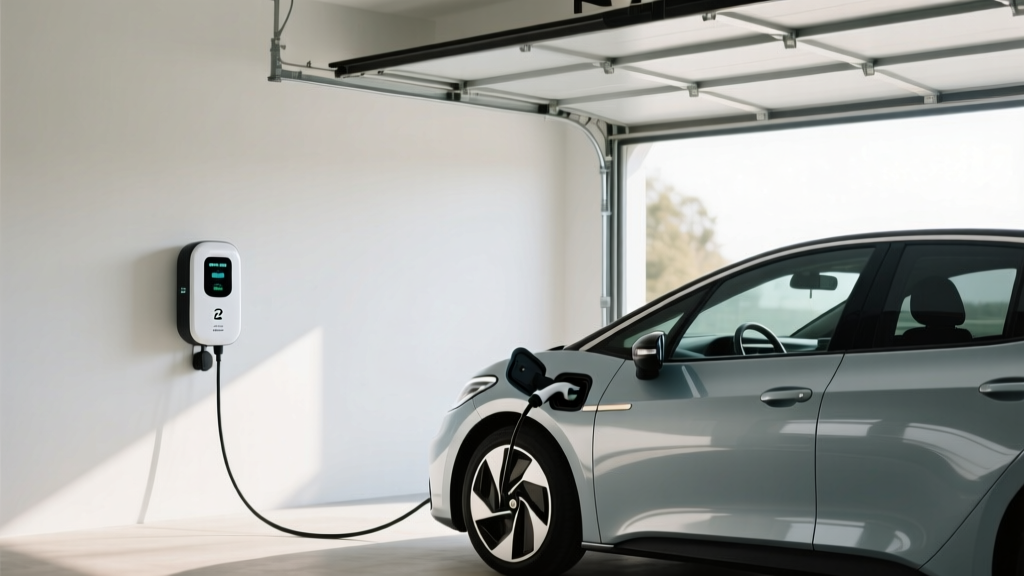
For most hatchback owners, a Level 2 home charger delivering 7.7 kW to 11.5 kW is the sweet spot. A Chevrolet Bolt EV with its 65 kWh usable battery and 11.5 kW onboard charger can fully replenish overnight on a 48A circuit. A Nissan LEAF with a smaller 40 kWh pack needs even less — a 32A / 7.7 kW unit fills it in about five hours.
Home Charger Installation: Electrical Requirements, Panel Upgrades, and Costs
Installing a Level 2 home charger is an electrical project, not just a plug-and-play purchase. Here's what's involved.
Electrical Requirements
A Level 2 charger requires a dedicated 240-volt circuit — the same voltage your electric dryer or oven uses. The amperage depends on your charger's output:
- 32A charger (7.7 kW): Requires a 40A breaker (National Electrical Code requires circuits be rated at 125% of continuous load).
- 40A charger (9.6 kW): Requires a 50A breaker.
- 48A charger (11.5 kW): Requires a 60A breaker.
The circuit must be dedicated — sharing it with other major appliances is a code violation and a fire risk. Your electrician will run appropriately gauged wire (typically 6 AWG copper for a 50A circuit, 4 AWG for 60A) from your panel to the charger location.
Panel Upgrade Reality Check
Many older homes have 100A electrical panels that are already near capacity. Adding a 40–60A EV circuit may require a panel upgrade to 200A. This is the single biggest variable in installation cost and the one most online guides gloss over. A load calculation performed by a licensed electrician will determine if your existing panel can handle the additional draw.
| Cost Component | Low Estimate | High Estimate | Notes |
|---|---|---|---|
| Level 2 Charger Unit (Equipment) | $350 | $750 | Smart Wi-Fi-enabled units with 24–25 ft cable |
| Electrician Labor (Standard Install) | $500 | $1,500 | Varies by run length, wall type, conduit needs |
| Electrical Permit | $50 | $250 | Required by most municipalities; varies by jurisdiction |
| Panel Upgrade (if needed) | $1,500 | $4,000 | 100A → 200A upgrade; not always required |
| Utility Rebate / Credit | -$100 | -$500 | Many utilities offer charger or install rebates |
| Total (No Panel Upgrade) | $800 | $2,500 | |
| Total (With Panel Upgrade) | $2,300 | $6,250 |
According to data compiled by the U.S. Department of Energy, most straightforward home installations without panel upgrades fall between $1,000 and $2,000 all-in. Always get at least two quotes from licensed electricians and confirm they pull the required permits — unpermitted work can void your homeowner's insurance coverage.
Safety and Code Considerations
- Dedicated circuit: Mandatory per NEC Article 625. Never share the EV circuit with other loads.
- GFCI protection: Required for outdoor installations and garages in most jurisdictions (NEC 2023 and later). Hardwired chargers typically include internal GFCI; plug-in units rely on the breaker.
- Outdoor rating: If your charger is mounted outside, it must be rated NEMA 4 (weatherproof). Most quality units carry this rating, but verify before purchasing.
- NEMA 14-50 vs. hardwired: Plug-in chargers using a NEMA 14-50 outlet offer portability but require a GFCI breaker (adding $100–$200). Hardwired units are generally more reliable, avoid GFCI nuisance tripping, and are preferred by most electricians for dedicated EV use.
Connector Compatibility: NACS, CCS1, and CHAdeMO for Hatchbacks
The connector landscape has shifted dramatically. As of 2026, the North American Charging Standard (NACS) — originally Tesla's proprietary connector — has been adopted by Ford, GM, Hyundai/Kia, Rivian, Volvo, and most major automakers. However, millions of CCS1-equipped EVs remain on the road, and the Nissan LEAF still uses the older CHAdeMO standard.
| EV Hatchback Model | AC Home Charging Connector | DC Fast Charging Connector | Adapter Needed for Tesla Superchargers? |
|---|---|---|---|
| Chevrolet Bolt EV / EUV (2025+) | J1772 | NACS (native) | No — native NACS |
| Hyundai Ioniq 5 | J1772 | CCS1 | Yes — CCS-to-NACS adapter (~$200–$250) |
| Kia EV6 | J1772 | CCS1 | Yes — CCS-to-NACS adapter |
| Nissan LEAF | J1772 | CHAdeMO | Limited — no reliable CHAdeMO-to-NACS adapter available |
| Volkswagen ID.4 (hatchback variant) | J1772 | CCS1 | Yes — CCS-to-NACS adapter |
| Tesla Model 3 (sedan, for reference) | NACS | NACS | No — native |
For home Level 2 charging: All non-Tesla EVs sold in North America use the J1772 connector for AC charging. Tesla vehicles use NACS natively but include a J1772 adapter in the trunk. When buying a home charger, purchase a J1772 unit — it will work with every EV on the road (Tesla owners simply use their adapter). If you own a NACS-native vehicle like the updated Bolt, some newer chargers now ship with NACS connectors; otherwise, a J1772-to-NACS adapter solves it.
For DC fast charging on road trips: Check your hatchback's DC port. If it's CCS1 and you want access to Tesla Superchargers (the largest and most reliable network), you'll need a CCS-to-NACS adapter. Hyundai and Kia began shipping these adapters with new vehicles in late 2024. For CHAdeMO vehicles like the LEAF, public charging options are shrinking — Electrify America still supports CHAdeMO at many stations, but new installations increasingly prioritize CCS and NACS.
Charging Cost Per Mile: Home vs. Public vs. Gas
One of the strongest arguments for an EV hatchback is fuel cost savings — but the math depends heavily on where and when you charge. Here's a realistic breakdown using 2026 electricity rates.
| Scenario | Rate ($/kWh) | Efficiency (mi/kWh) | Cost Per Mile | Annual Cost (12,000 mi) |
|---|---|---|---|---|
| Home — Off-Peak TOU Rate | $0.09 | 3.5 | $0.026 | $312 |
| Home — Standard Residential Rate | $0.16 | 3.5 | $0.046 | $552 |
| Public Level 2 (ChargePoint, EVgo L2) | $0.30 | 3.5 | $0.086 | $1,032 |
| DC Fast Charging (Electrify America, EA Pass) | $0.48 | 3.5 | $0.137 | $1,644 |
| Gasoline Car (30 MPG avg, $3.40/gal) | — | — | $0.113 | $1,356 |
The numbers tell a clear story: home charging on an off-peak time-of-use (TOU) rate is the cheapest way to "fuel" any vehicle on the road. Even at standard residential rates, an EV hatchback costs roughly 60% less per mile than a 30 MPG gas car. However, exclusive reliance on DC fast charging can actually exceed gasoline costs — another reason a home Level 2 charger is a near-mandatory investment for EV ownership economics.
Many utilities now offer dedicated EV TOU plans. According to fueleconomy.gov, the average U.S. electricity rate for EV charging is approximately $0.14/kWh, but off-peak rates in markets like California, Texas, and the Southeast can drop to $0.06–$0.10/kWh. Check with your local utility for EV-specific rate plans before your charger is installed.
Equipment Recommendations: Best Level 2 Chargers for EV Hatchbacks in 2026
Based on power output, build quality, smart features, cable management, and price, these are the top home chargers for hatchback owners this year.
ChargePoint Home Flex
- Power Output: Up to 11.5 kW (48A) on a 60A circuit; adjustable down to 16A for smaller panels
- Connector: J1772 (25-foot cable)
- Smart Features: Wi-Fi, ChargePoint app scheduling, Alexa integration, energy-use tracking, off-peak optimization
- Price: ~$550 (unit only)
- Best For: Most hatchback owners; flexible amperage accommodates older electrical panels without upgrade
Emporia Vue Level 2 EV Charger
- Power Output: Up to 11.5 kW (48A); configurable in 4A increments
- Connector: J1772 (24-foot cable)
- Smart Features: Wi-Fi, Emporia app with solar-integration scheduling, real-time cost tracking, load management with Emporia panel monitor
- Price: ~$400 (unit only)
- Best For: Budget-conscious buyers and homes with solar panels — the load-management feature avoids panel upgrades by throttling charge when household demand spikes
Tesla Wall Connector
- Power Output: Up to 11.5 kW (48A)
- Connector: NACS native (24-foot cable); J1772 version also available
- Smart Features: Wi-Fi, firmware updates, power sharing (link two units on one circuit), Tesla app integration
- Price: ~$475 (unit only)
- Best For: NACS-native hatchback owners (Chevy Bolt 2025+, upcoming models); cleanest aesthetic and robust build
Grizzl-E Smart
- Power Output: Up to 10 kW (40A) on a 50A circuit
- Connector: J1772 (24-foot cable)
- Smart Features: Wi-Fi, OCPP-compatible, adjustable amperage, extreme cold rated (-40°F)
- Price: ~$450 (unit only)
- Best For: Cold-climate hatchback owners — built in Canada and tested to -40°F; one of the most rugged units on the market
Pro tip: Match the charger's max amperage to your hatchback's onboard charger. The Hyundai Ioniq 5 has a 10.9 kW onboard charger, so a 48A unit extracts its full potential. The Nissan LEAF's onboard charger maxes at 6.6 kW, so even a 32A / 7.7 kW charger is more than sufficient — paying extra for 48A provides no benefit.
Charging Time Examples: How Long Does It Actually Take?
Here are realistic 10–80% charging times for popular EV hatchbacks, accounting for charge-curve taper at higher states of charge:
| Vehicle | Usable Battery (kWh) | Max DC Fast Charge (kW) | 10–80% DC Fast Time | Level 2 Home (7.7 kW) 0–100% | Level 2 Home (11.5 kW) 0–100% |
|---|---|---|---|---|---|
| Chevrolet Bolt EV | 65 kWh | 115 kW (CCS via adapter) | ~30 min | ~8.5 hrs | ~5.7 hrs |
| Hyundai Ioniq 5 (Standard Range) | 58 kWh | 175 kW | ~18 min | ~7.5 hrs | ~5.0 hrs |
| Hyundai Ioniq 5 (Long Range) | 77.4 kWh | 240 kW | ~18 min | ~10.1 hrs | ~6.7 hrs |
| Kia EV6 (Long Range) | 77.4 kWh | 240 kW | ~18 min | ~10.1 hrs | ~6.7 hrs |
| Nissan LEAF (40 kWh) | 40 kWh | 50 kW (CHAdeMO) | ~45 min | ~5.2 hrs | N/A (6.6 kW onboard limit) |
| Nissan LEAF (60 kWh) | 60 kWh | 100 kW (CHAdeMO) | ~35 min | ~7.8 hrs | N/A (6.6 kW onboard limit) |
Tax Credits and Incentives for Home Charger Installation
The federal Alternative Fuel Vehicle Refueling Property Credit (IRS Form 8911) covers 30% of home EV charger equipment and installation costs, up to a maximum credit of $1,000. However, this credit is subject to significant restrictions:
- The charger must be installed at your principal residence.
- The property must be located in an eligible census tract (generally non-urban or low-income communities — many suburban areas qualify, but check the IRS census tract locator).
- The credit is non-refundable — it reduces your tax liability but won't generate a refund if you owe less than the credit amount.
- State and utility rebates may stack on top. States like California, Colorado, and Maryland offer additional $200–$750 rebates for charger equipment or installation.
Always consult a tax professional to confirm eligibility based on your specific location and tax situation.
Frequently Asked Questions
How much does it cost to install a home EV charger?
A typical Level 2 home charger installation costs between $800 and $2,500 when no panel upgrade is needed, including the charger unit ($350–$750), electrician labor ($500–$1,500), and permit fees ($50–$250). If your home requires a 100A-to-200A panel upgrade, add $1,500–$4,000. Utility rebates and the federal 30% refueling property credit (up to $1,000) can offset a meaningful portion.
How fast will each charging level add range to my hatchback?
Level 1 (120V) adds roughly 3–5 miles of range per hour — adequate only for drivers covering under 30 miles daily. Level 2 (240V) at 7.7 kW adds 22–28 miles per hour, replenishing most hatchback batteries overnight. DC fast charging at public stations adds 150–600+ miles per hour at peak rates, though real-world sessions average lower due to charge-curve taper above 80% SoC.
Which connector and charger is compatible with my EV hatchback?
For home AC charging, all non-Tesla EVs use the J1772 connector — buy a J1772 Level 2 charger and it will work with any hatchback on the market (Tesla owners use the included adapter). For DC fast charging, check your vehicle's port: newer models are shifting to NACS, many 2022–2025 models use CCS1, and the Nissan LEAF uses CHAdeMO. CCS-to-NACS adapters (~$200–$250) unlock the Tesla Supercharger network for CCS vehicles.
How much does charging cost per mile compared to gas?
Charging at home on an off-peak rate (~$0.09/kWh) costs approximately $0.026 per mile for a typical EV hatchback — about 77% less than a 30 MPG gas car at $3.40/gallon ($0.113/mile). Even at a standard residential rate of $0.16/kWh, home charging costs just $0.046/mile. Public DC fast charging at $0.48/kWh rises to $0.137/mile, which can exceed gasoline costs. The economic case for EVs depends heavily on reliable home charging access.
What electrical upgrades might I need for a home charger?
The most common upgrade is a panel capacity increase from 100A to 200A, needed when your existing panel is already near its load limit. Your electrician will perform a load calculation per NEC Article 220 to determine this. Other potential upgrades include: running new 6 AWG or 4 AWG wire from the panel to the charger location (especially in homes where the garage is far from the panel), adding a GFCI breaker for plug-in installations ($100–$200), and upgrading the meter socket if your utility requires it for a dedicated EV TOU rate plan.
Is a smart charger worth the extra cost?
Yes, for most hatchback owners. Smart chargers ($50–$150 more than dumb units) offer scheduled charging to hit off-peak electricity rates, energy-use monitoring, remote start/stop via app, and integration with utility demand-response programs that can earn you bill credits. Over a year, off-peak scheduling alone can save $150–$300 depending on your utility's TOU rate spread.