Why TRD Supercharged Owners Are Eyeing Electric
If you've searched for TRD supercharged performance packages, you already know the appeal: bolt-on horsepower, aggressive throttle response, and the throaty exhaust note of a supercharged V6 or V8. Toyota Racing Development's supercharger kits have long been the go-to for Tacoma, Tundra, and 4Runner owners chasing 300+ horsepower. But with gasoline hovering near $4/gallon in many markets and EV performance models now matching or exceeding supercharged acceleration, a legitimate question is forming in truck and SUV forums: what does it actually cost per mile to run a TRD supercharged rig versus a modern electric vehicle?
This guide answers that question with hard numbers — and doubles as a complete EV charging primer for anyone considering the switch. We'll cover every charging level, home installation costs, connector standards, and equipment picks so you can make a data-driven decision.
kW (kilowatts) = power, like the flow rate of a hose. It determines how fast you charge.
kWh (kilokilowatt-hours) = energy, like the total water in a bucket. It determines how far you can drive.
A 75 kWh battery charged at 11.5 kW (Level 2) takes roughly 6.5 hours from empty to full.
Charging Levels Explained: Speeds, kW, and Miles Per Hour
Understanding EV charging starts with three distinct levels. Each delivers power at a different rate, and the miles-per-hour figure depends on vehicle efficiency (typically 3-4 miles per kWh for cars, 2-3 for trucks/SUVs).
| Level | Voltage / Amps | Power (kW) | Miles Added/Hour | Best For |
|---|---|---|---|---|
| Level 1 | 120V / 12A | 1.4 kW | 3-5 mi/hr | Overnight trickle, PHEVs |
| Level 2 | 240V / 32-48A | 7.7-11.5 kW | 25-44 mi/hr | Daily home charging |
| DC Fast Charge | 400-800V DC | 50-350 kW | 150-1,200+ mi/hr | Road trips, quick top-ups |
Real-world charging time examples: A Hyundai Ioniq 5 (77.4 kWh battery, 350 kW peak DCFC) can charge from 10-80% in approximately 18 minutes at a compatible 350 kW station. A Ford F-150 Lightning (131 kWh extended-range battery, 150 kW peak) takes roughly 41 minutes for 10-80% on a 150 kW charger. At home on a 48-amp Level 2 circuit (11.5 kW), that same F-150 Lightning needs about 10 hours for a full charge — perfectly suited to overnight replenishment.
One critical nuance: DC fast charging follows a curve, not a flat rate. A vehicle rated for 250 kW peak will only sustain that rate between roughly 10-40% State of Charge (SoC). Above 80%, charging speed tapers dramatically to protect battery health. This is why manufacturers quote 10-80% times rather than 0-100%.
Home EV Charger Installation: Requirements, Costs, and Panel Upgrades
Installing a Level 2 home charger is the single most impactful upgrade an EV owner can make. Here's what's actually involved electrically and financially.
Electrical Requirements
A typical Level 2 charger requires a dedicated 240V circuit — the same voltage your electric dryer or oven uses. Common configurations:
- 40-amp circuit → supports 32A continuous charging (7.7 kW) — minimum recommended
- 50-amp circuit → supports 40A continuous (9.6 kW) — sweet spot for most homes
- 60-amp circuit → supports 48A continuous (11.5 kW) — ideal for larger batteries (100+ kWh)
The National Electrical Code (NEC) requires that continuous loads not exceed 80% of a circuit's rated capacity. A 50-amp breaker therefore delivers 40 amps of continuous charging current.
Installation Cost Breakdown
| Component | Simple Install (Near Panel) | Complex Install (Long Run / Upgrade) |
|---|---|---|
| Level 2 Charger (Equipment) | $350-$700 | $350-$700 |
| Licensed Electrician Labor | $300-$600 | $800-$2,500 |
| Electrical Permit | $50-$150 | $50-$200 |
| Conduit, Wiring (25-100 ft) | $50-$150 | $200-$600 |
| Panel Upgrade (100A → 200A) | $0 (not needed) | $1,500-$3,500 |
| Total Estimated Range | $750-$1,600 | $2,900-$7,500 |
The panel upgrade gotcha: Homes built before 1990 often have 100-amp service panels. Adding a 50-amp EV circuit to an already-loaded 100A panel can exceed safe capacity, requiring a panel upgrade to 200 amps — a $1,500-$3,500 job on its own. Always have an electrician perform a load calculation before committing. Some utilities offer rebates of $250-$1,000 for panel upgrades tied to EV adoption.
Safety and Code Considerations
- Dedicated circuit required: Your EV charger must have its own breaker — no sharing with other appliances.
- GFCI protection: NEC 2020 and later require GFCI (Ground Fault Circuit Interrupter) protection for outdoor receptacles. Many hardwired chargers have built-in GFCI; plug-in units rely on the breaker.
- Outdoor rating: If mounted outside, the charger must carry a NEMA 4 or IP65 weather rating. Most quality units (ChargePoint, Emporia, Wallbox) meet this standard.
- Hardwired vs plug: Hardwired installations (no plug) are preferred for 48A+ units and eliminate the failure point of a 14-50 receptacle. The NEC now requires GFCI breakers for 14-50 outlets, adding $50-$100 to the install.
Connector Compatibility: NACS, CCS1, and CHAdeMO in 2026
The connector landscape has consolidated dramatically. Here's where things stand for the 2026 model year:
| Connector | Brands Using It (2026) | Adapter Needed? |
|---|---|---|
| NACS (Tesla/J3400) | Tesla, Ford, GM, Rivian, Volvo, Polestar, Hyundai/Kia (select models), Nissan (2026+) | Legacy CCS vehicles need CCS→NACS adapter (~$200-$250) |
| CCS1 (Combo) | VW, BMW, Stellantis, Honda, older Hyundai/Kia, legacy models | NACS vehicles need NACS→CCS adapter for non-Tesla DCFC |
| CHAdeMO | Nissan Leaf (legacy), Mitsubishi Outlander PHEV | Limited adapters; network support declining |
For Level 2 home charging, the J1772 connector remains universal for non-Tesla vehicles. Tesla includes a J1772 adapter with every vehicle. If you buy a NACS-equipped vehicle (increasingly common in 2026), most new home chargers now ship with NACS connectors or offer them as an option.
Charging Cost Per Mile vs TRD Supercharged Gas Cost
This is where the rubber meets the road — or the electrons meet the axle. Let's compare a TRD supercharged Toyota Tacoma (a popular configuration producing roughly 304 hp and 335 lb-ft from the 3.5L V6) against comparable electric alternatives.
A TRD supercharged Tacoma typically achieves 14-16 MPG combined in real-world driving (the supercharger's power comes at a fuel-economy penalty versus the stock 18-20 MPG). At $3.80/gallon, that's approximately $0.25-$0.27 per mile in fuel alone.
| Scenario | Cost per kWh / Gallon | Cost Per Mile | Annual Cost (12,000 mi) |
|---|---|---|---|
| TRD Supercharged Tacoma (15 MPG) | $3.80/gal | $0.253 | $3,040 |
| EV — Home Off-Peak (3 mi/kWh) | $0.12/kWh | $0.040 | $480 |
| EV — Home Peak (3 mi/kWh) | $0.22/kWh | $0.073 | $880 |
| EV — Public Level 2 (3 mi/kWh) | $0.35/kWh | $0.117 | $1,400 |
| EV — DC Fast Charge (3 mi/kWh) | $0.48/kWh | $0.160 | $1,920 |
| EV — Electric Truck (2.5 mi/kWh, e.g., F-150 Lightning) | $0.12/kWh | $0.048 | $576 |
The verdict: Even at peak electricity rates, home EV charging costs 70-80% less per mile than fueling a TRD supercharged truck. At off-peak rates, the savings reach 85%. Over five years and 60,000 miles, a home-charging EV owner saves roughly $12,000-$14,000 in fuel costs versus the supercharged Tacoma. That's enough to cover a significant portion of the EV's purchase premium.
According to fueleconomy.gov, the average EV efficiency in 2025-2026 ranges from 2.5 mi/kWh (large trucks) to 4.0+ mi/kWh (sedans like the Hyundai Ioniq 6 at 140 MPGe combined). Your actual cost depends heavily on local electricity rates and whether you can charge at home overnight on off-peak tariffs.
Recommended Home EV Chargers for 2026
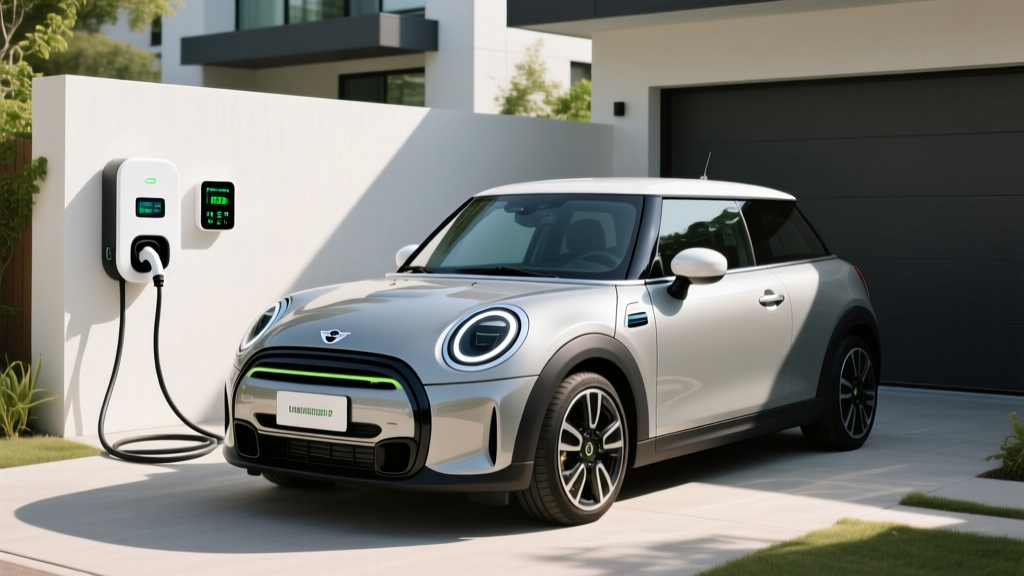
After testing and tracking reliability data across dozens of units, these are the Level 2 chargers we recommend based on power output, build quality, smart features, and value:
🏆 Best Overall: ChargePoint Home Flex
- Power: Up to 11.5 kW (48A) on a 60A circuit; configurable down to 16A
- Connector: J1772 (NACS adapter available)
- Cable: 23 ft
- Smart Features: Wi-Fi, Alexa, scheduled charging, energy tracking, §30D compatible documentation
- Price: ~$550-$650
- NEMA Rating: NEMA 4 (indoor/outdoor)
💰 Best Value: Emporia Vue 2 (EV Charger)
- Power: Up to 11.5 kW (48A)
- Connector: J1772 (NACS version available)
- Cable: 24 ft
- Smart Features: Wi-Fi, whole-home energy monitoring integration, solar-aware charging, load management
- Price: ~$350-$400
- NEMA Rating: NEMA 4
⚡ Best for Tesla/NACS: Tesla Wall Connector
- Power: Up to 11.5 kW (48A)
- Connector: NACS native (J1772 adapter included)
- Cable: 24 ft
- Smart Features: Wi-Fi, OTA updates, power sharing (link multiple units on one circuit), Tesla app integration
- Price: ~$425-$475
- NEMA Rating: NEMA 4
🔌 Best for Larger Garages: Wallbox Pulsar Plus
- Power: Up to 11.5 kW (48A)
- Connector: J1772 or NACS
- Cable: 25 ft
- Smart Features: Wi-Fi + Bluetooth, Eco-Smart solar integration, Power Boost dynamic load management
- Price: ~$500-$600
- NEMA Rating: NEMA 4
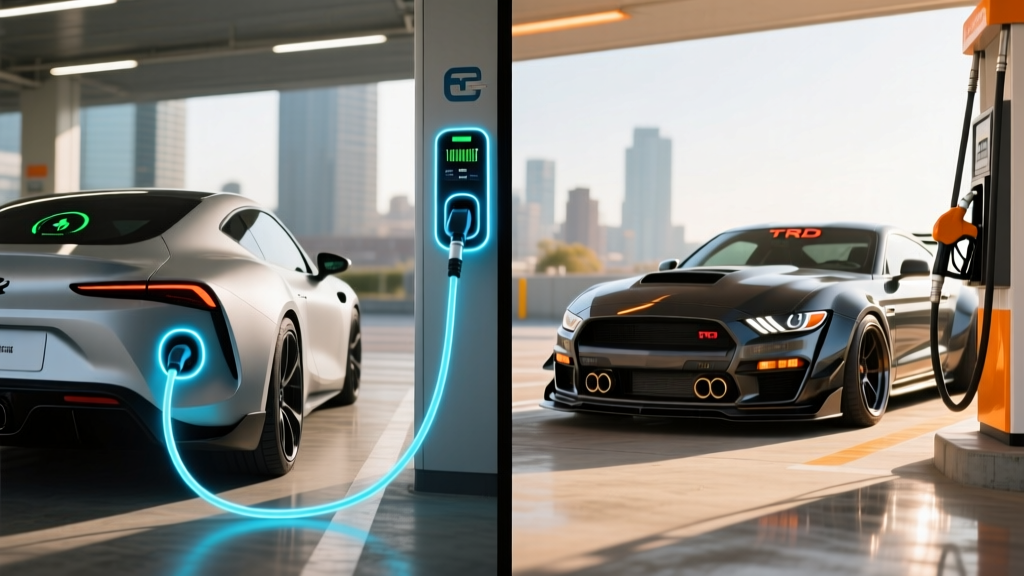
What About Performance? Supercharged Thrills vs Electric Torque
The emotional argument for a TRD supercharged truck is real — the whine of the supercharger, the linear power delivery, the mechanical engagement. But the performance numbers tell an interesting story:
- TRD Supercharged Tacoma (3.5L V6): ~304 hp, 335 lb-ft, 0-60 mph in approximately 6.3 seconds
- Ford F-150 Lightning (Extended Range): 580 hp, 775 lb-ft, 0-60 mph in 3.8 seconds — EPA range 320 miles
- Rivian R1T (Dual Motor): 665 hp, 829 lb-ft, 0-60 mph in 3.0 seconds — EPA range 352 miles
- Chevrolet Silverado EV 4WT: 510 hp, 615 lb-ft, 0-60 in ~4.5 seconds — EPA range 450 miles
Electric motors deliver peak torque from 0 RPM. No supercharger spool-up, no torque converter lag. If straight-line performance is a priority, electric trucks have decisively surpassed supercharged gasoline equivalents while simultaneously offering lower per-mile operating costs. The trade-off is higher purchase price (though narrowing) and towing range reduction (expect 30-50% range loss under heavy towing loads).
Federal Tax Credits and Incentives for Home Charging
Under current IRS §30D rules, the new clean vehicle credit offers up to $7,500 for qualifying EVs — but there's also a separate Alternative Fuel Vehicle Refueling Property Credit (IRC §30C) worth up to $1,000 for home EV charging equipment installed in eligible census tracts.
§30C Home Charger Credit Requirements:
- Equipment must be new and placed in service during the tax year
- Maximum credit: 30% of equipment + installation cost, capped at $1,000
- Property must be located in an eligible low-income or non-urban census tract (check IRS guidance)
- Applies to Level 2 chargers, wiring, and related electrical work
- Claim on IRS Form 8911 — consult a tax professional for eligibility
Frequently Asked Questions
How much does it cost to install a home EV charger?
A straightforward Level 2 installation (panel nearby, short wire run, no panel upgrade) typically costs $750-$1,600 including equipment, electrician labor, and permit. Complex installations requiring long conduit runs, trenching, or a panel upgrade from 100A to 200A can range from $2,900-$7,500. Always get 2-3 quotes from licensed electricians and ask about utility rebates before starting.
How fast will each charging level add range?
Level 1 (120V) adds 3-5 miles per hour — sufficient only for plug-in hybrids with small batteries or very low daily mileage. Level 2 (240V, 48A) adds 25-44 miles per hour depending on vehicle efficiency, fully replenishing most EVs overnight. DC fast charging adds 150-1,200+ miles per hour at peak rates, enabling a 10-80% charge in 15-45 minutes depending on the vehicle's peak charge rate and battery size.
Which connector/charger is compatible with my EV?
For 2026 models: Tesla, Ford, GM, Rivian, and an expanding list of others use NACS (now standardized as SAE J3400). Volkswagen, BMW, Honda, and Stellantis brands still predominantly use CCS1. For home Level 2, all non-Tesla EVs use J1772, and Tesla provides a J1772 adapter. Check your vehicle's charge port before purchasing a home charger — or choose a charger with interchangeable connector options.
How much does charging cost per mile vs gas?
Home charging at off-peak rates ($0.12/kWh) costs roughly $0.04-$0.05 per mile for most EVs. A TRD supercharged truck at 15 MPG and $3.80/gallon costs approximately $0.25 per mile. That's a 5-6x cost difference. Even exclusive DC fast charging at $0.48/kWh ($0.16/mile) remains cheaper than the supercharged truck. According to the Department of Energy, the national average electricity rate for EV charging is approximately $0.16/kWh.
What electrical upgrades might I need?
The most common upgrade is a panel capacity increase from 100A to 200A ($1,500-$3,500) — necessary when your existing panel lacks spare capacity for a 50-60A dedicated circuit. Other potential upgrades include: replacing a Federal Pacific or Zinsco panel (known fire hazards, $2,000-$4,000 replacement), running new conduit from the panel to the garage ($5-$15/foot), or installing a smart load-management system that shares capacity between your EV charger and other heavy appliances ($200-$500 for hardware).