Why EV Owners Are Searching for Charging Electric Scooters Info
If you own or are shopping for an electric vehicle, you've likely noticed a flood of searches around charging electric scooters — stand-up kick scooters, seated commuter scooters, and electric mopeds that share urban roadways with full-size EVs. The confusion is understandable: both plug into a wall, both use lithium-ion batteries, and both promise freedom from the gas pump. But the electrical infrastructure, charging hardware, and cost calculus behind a 75 kWh EV battery versus a 0.5 kWh scooter battery are fundamentally different.
This guide breaks down EV home-charging requirements, public-charging realities, and equipment costs — while clarifying where scooter charging overlaps and diverges. If you're installing a Level 2 charger at home, the good news is that the same 240V circuit can often serve your EV and keep a scooter topped up overnight.
Charging Levels Explained: kW, kWh, and Miles Per Hour
The single most important distinction in EV literacy is kW (kilowatts) = power, the rate at which energy flows, versus kWh (kilowatt-hours) = energy, the amount stored in the battery. Think of kW as the diameter of a hose and kWh as the size of the bucket. Charging electric scooters typically involves a 40–65W (0.04–0.065 kW) wall adapter filling a 0.3–1.5 kWh pack — a trickle compared to EV hardware.
| Level | Voltage | Max Power (kW) | Miles of Range Per Hour | Typical Use |
|---|---|---|---|---|
| Level 1 | 120V AC | 1.4–1.9 kW | 3–5 mi/hr | Overnight top-ups, PHEVs, scooters via adapter |
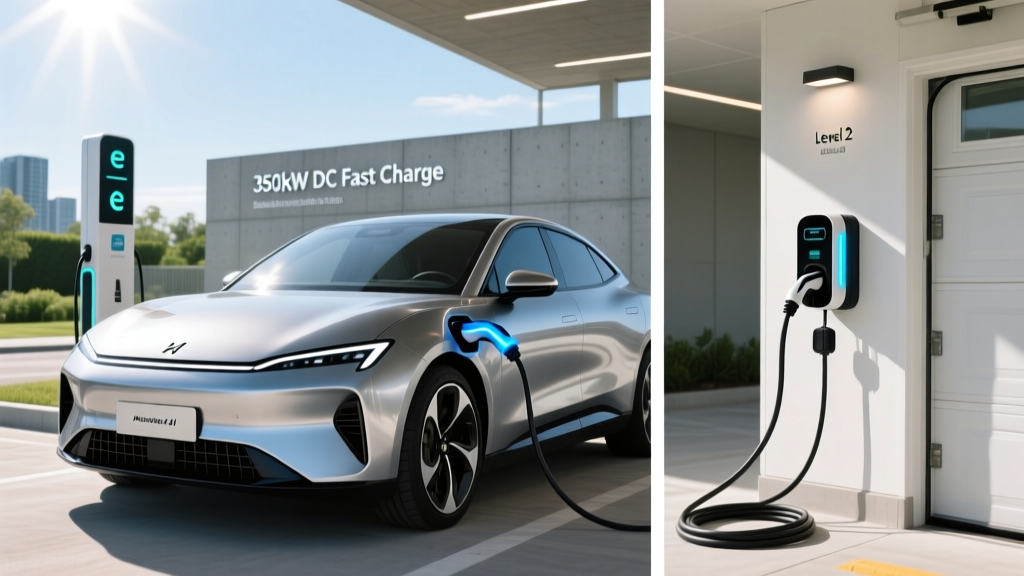
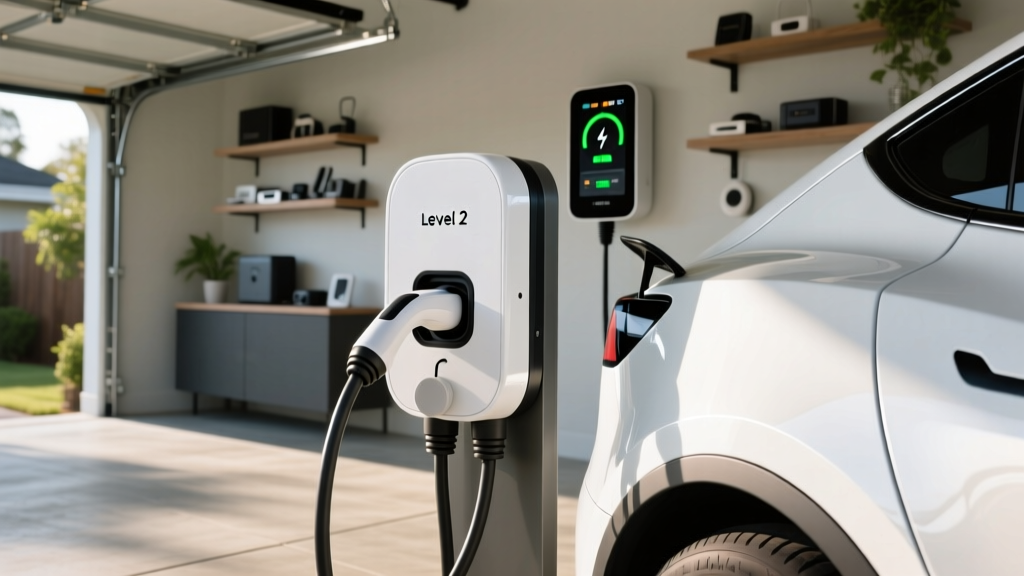
| Level 2 | 240V AC | 7.2–19.2 kW | 20–60 mi/hr | Home daily charging, workplaces, destinations |
| DC Fast | 400–800V DC | 50–350 kW | 150–1,200 mi/hr (peak) | Highway travel, 10–80% in 15–30 min |
For context, a typical electric kick scooter (e.g., Segway Ninebot Max G3 or NIU Kqi3) charges from 0–100% on a standard 120V outlet in 4–6 hours using its included brick adapter — effectively Level 1 speeds. A 75 kWh EV battery like the Tesla Model Y Long Range would take over 40 hours at that same rate, which is why Level 2 home installation is the standard recommendation for BEV owners.
Home Charger Installation: Electrical Requirements and Real Costs
Installing a dedicated Level 2 home EV charger requires a 240V circuit on a dedicated breaker, typically rated for 40A, 48A, or 60A depending on the charger's maximum draw. The National Electrical Code (NEC) requires that continuous loads (anything running 3+ hours, which includes EV charging) use only 80% of the breaker's rated capacity — so a 48A charger requires a 60A breaker.
| Component | Typical Range | Notes |
|---|---|---|
| Level 2 Charger (hardware) | $350–$750 | Smart Wi-Fi models with NACS or J1772 connector |
| Electrician labor (2–6 hrs) | $500–$2,000 | Depends on panel proximity, conduit run, wall type |
| Electrical permit | $50–$300 | Required in most US jurisdictions; varies by city/county |
| Panel upgrade (if needed) | $1,500–$4,000 | Older 100A panels often need 200A service upgrade |
| Total (no panel upgrade) | $900–$3,050 | Most homes with modern 200A panels fall here |
| Total (with panel upgrade) | $2,400–$7,050 | Common in pre-1990 homes |
What Electrical Upgrades Might I Need?
Before scheduling an install, check your main service panel's amperage rating (printed on the main breaker). A 200A panel with available breaker slots can usually accommodate a 60A EV circuit without issue. A 100A panel — common in homes built before the 1990s — may already be near capacity with HVAC, electric range, and dryer loads. In that case, you'll need either a service upgrade to 200A (the $1,500–$4,000 line item above) or a lower-amperage charger (e.g., 32A/7.7 kW) that fits within existing headroom.
Some utilities and states offer rebates that offset panel-upgrade costs when paired with an EV charger install. Check with your local utility or the AFDC state incentive database for current programs. The federal §30C Alternative Fuel Vehicle Refueling Property Credit covers 30% of home charging equipment and installation costs up to $1,000, subject to census-tract eligibility and income requirements — consult a tax professional for your specific situation.
Connector Compatibility: NACS, CCS1, CHAdeMO, and Scooter Plugs
Full-size EVs sold in North America use one of three DC fast-charging connector standards, while Level 2 AC charging has largely standardized on either the Tesla NACS connector or the J1772 connector (used by all non-Tesla EVs, with adapters widely available).
| Connector | Type | Used By | Adapter Needed? |
|---|---|---|---|
| NACS (Tesla) | AC Level 2 + DC Fast | Tesla (all), Ford, GM, Rivian, Hyundai, Kia, Volvo, others (2025+ models) | CCS-to-NACS adapter for older CCS vehicles at Tesla Superchargers |
| J1772 | AC Level 1/2 | All non-Tesla EVs/PHEVs for home and destination charging | Tesla Mobile Connector includes J1772 adapter; NACS-to-J1772 adapters available |
| CCS1 | DC Fast | Legacy non-Tesla EVs (pre-2025 models: VW ID.4, BMW iX, older Ford/GM) | Phasing out; NACS adapters needed for Tesla Supercharger access |
| CHAdeMO | DC Fast | Nissan Leaf (legacy); infrastructure declining | No practical adapter to NACS; CHAdeMO stations shrinking |
Which Connector/Charger Is Compatible with My EV?
For home Level 2 charging: If your EV has a NACS port (all Teslas, plus most 2025–2026 model-year EVs from Ford, GM, Hyundai, Kia, and Rivian), buy a NACS-connector wall charger. If your EV has a J1772 port (older non-Tesla models, most PHEVs), buy a J1772 charger or use the NACS-to-J1772 adapter that many manufacturers now include. The charger's connector must match the car's inlet — or you need a certified adapter rated for the charger's full amperage.
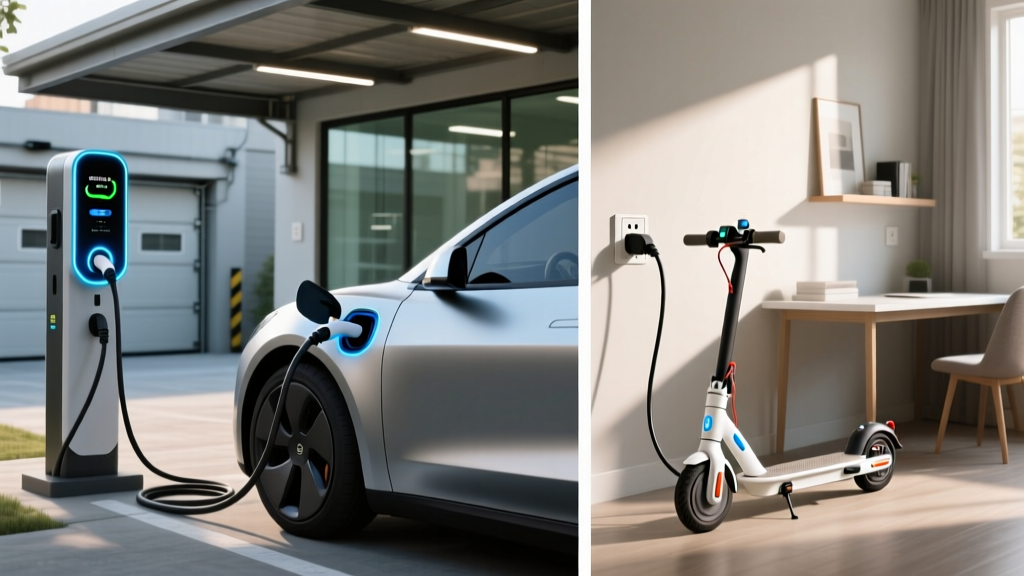
For charging electric scooters: Stand-up and seated e-scooters use proprietary DC barrel plugs, GX16 connectors, or IEC C13/C14 AC inlets tied to an external power brick. They do not use NACS, CCS, or J1772 connectors. However, because scooter chargers draw only 40–100W, they plug into any standard 120V household outlet — the same outlet used for Level 1 EV trickle charging.
Cost to Charge: $/kWh Scenarios and Cost Per Mile vs Gas
EV charging economics depend on your local electricity rate and whether you charge at home (cheapest), on public Level 2 (moderate), or via DC fast charging (most expensive). Here's how the numbers stack up against gasoline in 2026.
| Scenario | Rate | Vehicle Efficiency | Cost Per Mile |
|---|---|---|---|
| Home (off-peak utility rate) | $0.12/kWh | 3.5 mi/kWh (typical BEV sedan) | $0.034/mi |
| Home (national avg residential) | $0.17/kWh | 3.5 mi/kWh | $0.049/mi |
| Public Level 2 (network pricing) | $0.35/kWh | 3.5 mi/kWh | $0.100/mi |
| DC Fast Charging ( Electrify America, EVgo, etc.) | $0.48/kWh | 3.0 mi/kWh (highway speeds) | $0.160/mi |
| Gasoline (US avg $3.40/gal, 28 MPG combined) | $3.40/gal | 28 MPG | $0.121/mi |
| Electric scooter (home charging) | $0.17/kWh | 40 mi/kWh (typical kick scooter) | $0.004/mi |
Home-charged EVs cost roughly 60–75% less per mile than a 28 MPG gas car. DC fast charging on road trips narrows the gap but still undercuts gas in most scenarios. Electric scooters, with their tiny batteries and extreme efficiency, cost less than half a cent per mile — essentially negligible.
Charging Time Examples for Common Battery Sizes
Charging time depends on battery capacity (kWh) and the charger's power output (kW), minus losses from heat, taper, and the charge curve. DC fast charging slows dramatically above 80% state of charge (SoC) to protect battery health — this is why 10–80% time is the industry-standard metric, not 0–100%.
- Tesla Model Y Long Range (75 kWh usable, NMC): Level 2 at 11.5 kW — 0–100% in ~7 hours. DC fast at 250 kW peak — 10–80% in ~22 minutes.
- Hyundai Ioniq 5 (77.4 kWh usable, NMC, 800V architecture): Level 2 at 10.9 kW — 0–100% in ~7.5 hours. DC fast at 240 kW peak — 10–80% in ~18 minutes.
- Ford F-150 Lightning Extended Range (131 kWh usable, NMC): Level 2 at 19.2 kW — 0–100% in ~7.5 hours. DC fast at 150 kW peak — 10–80% in ~42 minutes (larger battery, lower peak rate).
- Chevrolet Equinox EV (85 kWh usable, NMC): Level 2 at 11.5 kW — 0–100% in ~8 hours. DC fast at 150 kW peak — 10–80% in ~30 minutes.
- Segway Ninebot Max G3 electric scooter (0.55 kWh, NMC): Wall adapter at 0.065 kW — 0–100% in ~5.5 hours. No DC fast-charging capability.
Equipment Recommendations: Level 2 Chargers Worth Buying
The home charger market has matured significantly. In 2026, the best units combine Wi-Fi smart features (scheduling, energy tracking, utility demand-response integration), robust build quality, and a connector matching your EV. Here are four proven picks across price points:
Emporia Level 2 Smart Charger
- Power output: 48A / 11.5 kW (requires 60A breaker)
- Connector: J1772 (NACS version available)
- Cable length: 24 ft
- Smart features: Wi-Fi scheduling, solar integration, energy monitoring via Emporia app, utility demand-response compatible
- Price: ~$399
- Best for: Budget-conscious buyers with solar panels or time-of-use utility rates
ChargePoint Home Flex
- Power output: Configurable 16A–50A / 3.8–12 kW (adjustable to match your circuit)
- Connector: J1772 (NACS adapter included in 2025+ kits)
- Cable length: 23 ft
- Smart features: Wi-Fi, Alexa/Google Home integration, ChargePoint network account, detailed session history
- Price: ~$649
- Best for: Flexible amperage for older panels; proven brand reliability
Tesla Wall Connector (Gen 4)
- Power output: 48A / 11.5 kW (requires 60A breaker)
- Connector: NACS native
- Cable length: 24 ft
- Smart features: Wi-Fi, OTA firmware updates, Power-Share (two units share one circuit), Tesla app integration
- Price: ~$475
- Best for: Tesla owners; cleanest NACS-native install
Grizzl-E Smart
- Power output: 40A / 9.6 kW (requires 50A breaker)
- Connector: J1772 (NACS version available)
- Cable length: 24 ft
- Smart features: Wi-Fi via United Chargers app, OCPP protocol support, adjustable amperage, extreme cold rating (-40°F)
- Price: ~$549
- Best for: Cold-climate outdoor installs; Canadian-built durability
Safety, Code, and Outdoor Considerations
Home EV charging is safe when installed to code, but cutting corners on electrical work is a fire risk. Key requirements and best practices:
- Dedicated circuit: Your Level 2 charger must be on its own breaker — no shared circuits with dryers, ranges, or HVAC. The NEC treats EV charging as a continuous load.
- GFCI protection: The 2023 NEC (adopted by most jurisdictions by 2026) requires GFCI (Ground Fault Circuit Interrupter) protection for all outdoor receptacles and is increasingly required for indoor EV charging circuits. Many modern hardwired chargers have built-in GFCI protection; plug-in units rely on the breaker panel's GFCI breaker.
- Outdoor rating: If your charger is mounted outside (garage exterior, carport, driveway pedestal), it must carry a NEMA 4 or NEMA 4X weatherproof rating. All four chargers recommended above meet this standard.
- Hardwired vs plug-in: Hardwired installations (no plug, direct wire connection) are generally preferred for 48A+ chargers because NEMA 14-50 receptacles are rated for intermittent use, not daily 8–10 hour continuous loads. If you choose a plug-in setup, invest in a commercial-grade receptacle (Hubbell, Bryant) — residential-grade 14-50 outlets have been linked to overheating failures under continuous EV charging loads.
- Permit and inspection: Most US jurisdictions require an electrical permit for a new 240V circuit. The inspection ensures wire gauge, breaker sizing, and grounding meet code. Skipping the permit can void homeowner's insurance claims related to electrical fires.
FAQ: EV and Scooter Charging Questions
How much does it cost to install a home EV charger?
A typical Level 2 home charger installation costs $900–$3,050 when no panel upgrade is needed (equipment + electrician + permit). If your home has an older 100A electrical panel that needs upgrading to 200A, add $1,500–$4,000 for the service upgrade, bringing the total to $2,400–$7,050. The federal §30C credit can offset 30% of equipment and installation up to $1,000 if you're in an eligible census tract.
How fast will each charging level add range?
Level 1 (120V) adds 3–5 miles of range per hour — sufficient for PHEVs with small batteries or overnight scooter charging. Level 2 (240V) adds 20–60 miles per hour depending on amperage and vehicle efficiency — this is the standard for daily home EV charging. DC fast charging adds 150–1,200 miles per hour at peak rates, though the charge curve tapers significantly above 80% SoC, making 10–80% the practical metric (typically 15–30 minutes for modern BEVs).
Which connector/charger is compatible with my EV?
Check your EV's charge port. If it's a NACS (Tesla-style) port — standard on all Teslas and most 2025+ EVs from Ford, GM, Hyundai, Kia, Rivian, and Volvo — buy a NACS charger. If it's a J1772 port (most pre-2025 non-Tesla EVs and PHEVs), buy a J1772 charger or use a NACS-to-J1772 adapter. For DC fast charging on road trips, NACS-equipped vehicles can use Tesla Superchargers directly; CCS1 vehicles may need a CCS-to-NACS adapter for Supercharger access. CHAdeMO (Nissan Leaf) infrastructure is declining and has no adapter path to NACS.
How much does charging cost per mile vs gas?
Home-charged EVs at the US average residential rate ($0.17/kWh) cost roughly $0.049 per mile for a typical 3.5 mi/kWh sedan, compared to $0.121 per mile for a 28 MPG gas car at $3.40/gallon — a 60% savings. DC fast charging at $0.48/kWh costs ~$0.16/mile, slightly more than gas but used only on road trips. Electric scooters cost under $0.005/mile due to extreme efficiency and tiny battery packs.
Can I charge an electric scooter from my EV charger?
No — electric scooters use proprietary low-voltage DC connectors and are not compatible with NACS, CCS, or J1772 EV chargers. Scooters charge from standard 120V household outlets using their included power adapter (typically 40–100W). However, if you've already installed a 240V circuit for your EV charger, a licensed electrician can add a standard 120V outlet nearby on the same panel, giving you a dedicated scooter-charging station without a separate circuit.
What electrical upgrades might I need?
The most common upgrade is a panel service increase from 100A to 200A ($1,500–$4,000) in older homes. You may also need additional breaker slots (a sub-panel can solve this for $300–$800), upgraded wire gauge if the run from panel to charger exceeds 100 feet, or a GFCI breaker if your jurisdiction's adopted NEC version requires it. An electrical load calculation performed by a licensed electrician will determine whether your existing panel can handle a 40A–60A continuous EV charging load alongside your other appliances.