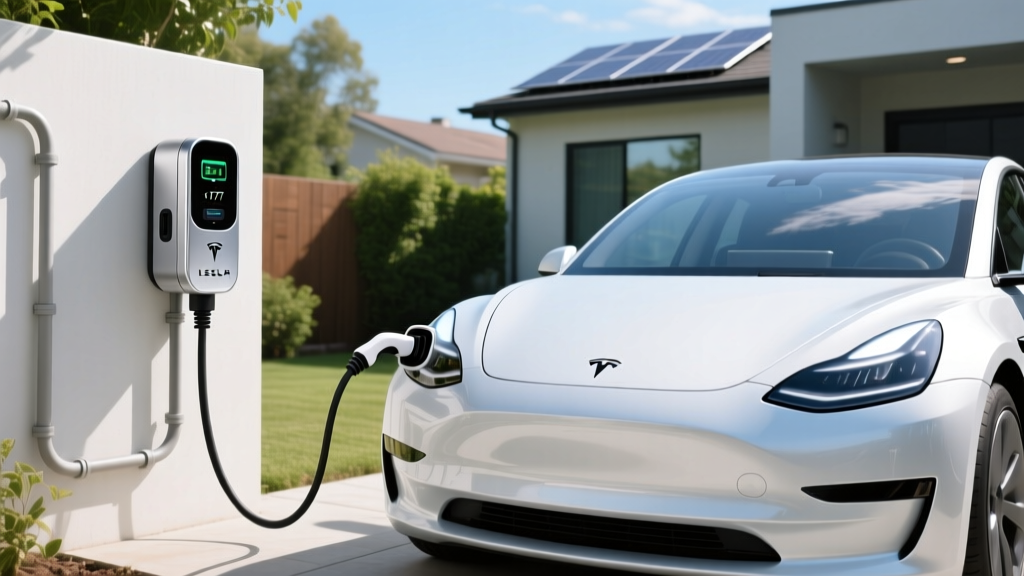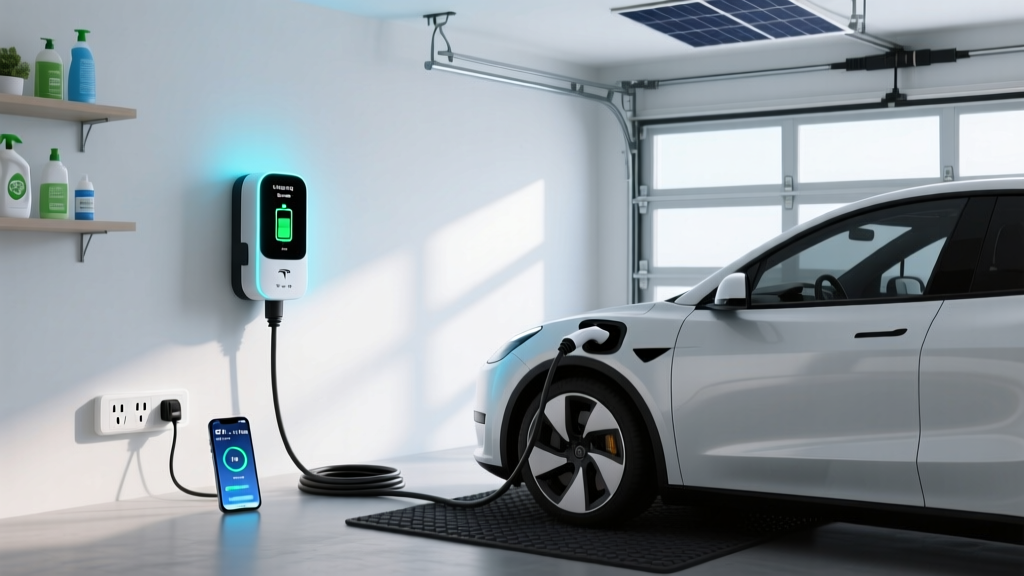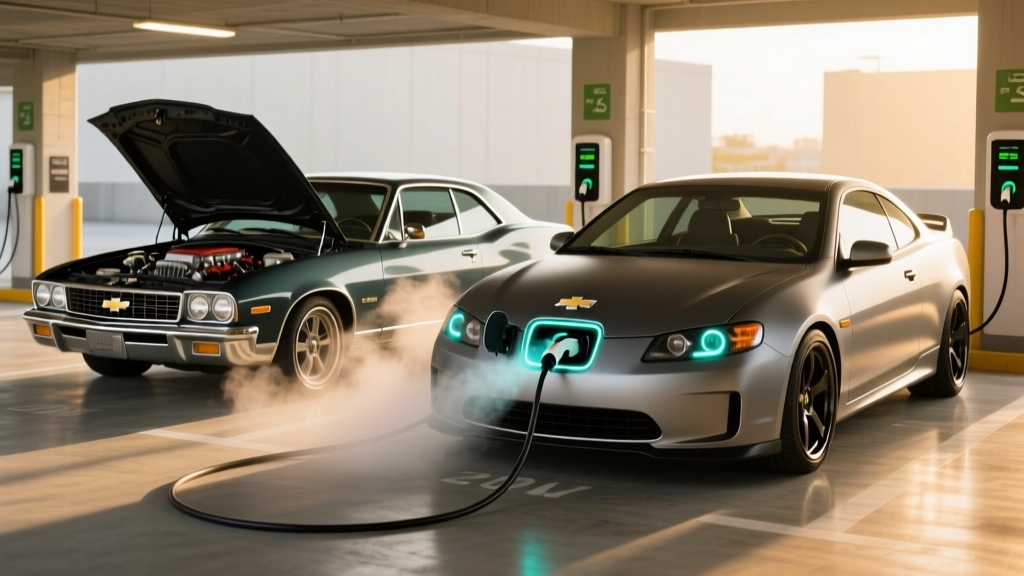
If you're cross-shopping a modern EV against a legacy performance car like the 2004 Chevrolet Monte Carlo Supercharged SS — with its 3.8L supercharged V6 pushing 240 hp and returning roughly 18 MPG combined per fueleconomy.gov — the charging-versus-fueling math is one of the biggest decision factors. This guide breaks down exactly what it costs and what it takes to charge an EV at home and on the road, using the Monte Carlo SS as a real-world gas-car baseline.
Why Compare EV Charging to a 2004 Monte Carlo Supercharged SS?
The 2004 Monte Carlo SS (supercharged 3800 Series II V6) is a useful benchmark because it sits right where many enthusiasts and daily drivers land: a mid-size coupe with moderate fuel economy (EPA-rated 17 city / 26 highway / ~20 combined, though real-world driving often nets 17–19 MPG) and a 17-gallon fuel tank. At $3.40/gallon (2026 national average for regular unleaded), a fill-up costs roughly $58 and yields about 310 miles of range. That's $0.187 per mile in fuel alone, before oil changes, spark plugs, or supercharger-belt maintenance.
An EV flips that equation: higher upfront cost, dramatically lower per-mile energy cost, and the ability to "refuel" at home overnight. Let's quantify every piece of that puzzle.
Charging Levels Explained: Speeds in kW and Miles Per Hour
The single most important distinction in EV charging is kW (kilowatts) versus kWh (kilowatt-hours). A kW is a unit of power — how fast energy flows into the battery, like water pressure from a hose. A kWh is a unit of energy — how much the battery holds, like the size of the tank. A 75 kWh battery charged at 11.5 kW takes roughly 6.5 hours from 0–100%. Confusing the two is the #1 mistake new EV buyers make.
| Level | Voltage / Amps | Power (kW) | Miles of Range Added Per Hour | Best For |
|---|---|---|---|---|
| Level 1 (120V) | 120V / 12A | ~1.4 kW | 3–5 mi/hr | Overnight trickle, PHEVs, low-mileage drivers |
| Level 2 (240V) | 240V / 32–48A | 7.7–11.5 kW | 25–44 mi/hr | Daily home charging, most EVs |
| DC Fast Charge | 400–800V DC | 50–350 kW | 150–1,200 mi/hr (peak) | Road trips, quick top-ups |
Charging Time Examples for Common Battery Sizes (10–80%)
| Battery Size | Example EV | Level 2 (11.5 kW) | DC Fast (peak rate) | 10–80% DC Time |
|---|---|---|---|---|
| 60 kWh | Chevrolet Equinox EV | ~3.5 hours | 150 kW peak | ~20–24 min |
| 75 kWh | Tesla Model Y LR | ~4.5 hours | 250 kW peak | ~18–22 min |
| 85 kWh | Ford F-150 Lightning ER | ~5 hours | 150 kW peak | ~35–41 min |
| 100 kWh | GMC Hummer EV | ~6 hours | 350 kW peak | ~25–30 min |
Home Charger Installation: Electrical Requirements, Costs, and Panel Upgrades
Installing a Level 2 home charger is the single biggest infrastructure decision for EV ownership. Here's exactly what's involved.
Electrical Requirements
A typical Level 2 charger requires a dedicated 240V circuit, similar to a clothes dryer or electric range. Common configurations:
- 40A circuit / 32A continuous charge — 7.7 kW output. Sufficient for most EVs with overnight charging.
- 50A circuit / 40A continuous — 9.6 kW output. Faster, recommended for larger batteries (85+ kWh).
- 60A circuit / 48A continuous — 11.5 kW output. Maximum Level 2 speed for most North American EVs.
The National Electrical Code (NEC) requires that continuous loads (like EV charging) not exceed 80% of the circuit's rated amperage. So a 50A breaker delivers 40A continuous — not 50A.
Do You Need a Panel Upgrade?
This is the hidden cost that catches many homeowners off guard, especially those in older homes with 100A or 125A main panels. A licensed electrician will perform a load calculation (NEC Article 220) to determine if your panel can handle the added 40–60A draw alongside existing appliances (HVAC, water heater, dryer, range).
If your panel is already near capacity — common in homes with electric heat, electric range, and electric water heater — you'll need a panel upgrade to 200A, which adds $1,500–$3,500 to the project. Some utilities offer rebates for panel upgrades tied to EV adoption; check your local provider.
Installation Cost Breakdown
| Component | Cost Range | Notes |
|---|---|---|
| Level 2 Charger (hardware) | $350–$750 | Varies by brand, power, cable length, smart features |
| Electrician labor (standard install) | $500–$1,500 | Assumes panel has capacity, run <50 ft from panel |
| Electrical panel upgrade (if needed) | $1,500–$3,500 | 100A → 200A service upgrade |
| Permit and inspection | $50–$300 | Varies by municipality; some waive for EV installs |
| Conduit/wire (long runs >50 ft) | $200–$800 | Garage-to-panel distance matters significantly |
| Total (no panel upgrade) | $900–$2,550 | Most common scenario for newer homes |
| Total (with panel upgrade) | $2,400–$5,350 | Older homes, full electric loads |
The IRS Residential Clean Energy Credit (§25D) covers 30% of home charging equipment and installation costs (up to $1,000 annually) through 2032 — a meaningful offset. Note: this is separate from the §30D vehicle purchase credit and applies specifically to the charger hardware and install labor.
Connector Compatibility: NACS, CCS1, CHAdeMO, and Adapters
As of 2026, the North American EV charging connector landscape has largely consolidated around the North American Charging Standard (NACS), originally developed by Tesla and now adopted by Ford, GM, Rivian, Hyundai/Kia, BMW, and most major automakers. However, hundreds of thousands of CCS1-equipped EVs remain on the road, and CHAdeMO persists on older Nissan Leaf and Mitsubishi models.
| Connector | Brands Using It (2026) | Adapter Needed? |
|---|---|---|
| NACS (native) | Tesla (all), Ford (2025+), GM (2025+), Rivian (2025+), Hyundai/Kia (2026+) | None for Superchargers; CCS adapter for Electrify America |
| CCS1 | VW ID.4 (2024 and earlier), BMW i4 (2024 and earlier), older Ford/GM EVs | NACS-to-CCS adapter (~$200) for Tesla Superchargers |
| CHAdeMO | Nissan Leaf (all years), Mitsubishi Outlander PHEV | Limited network; no viable NACS adapter |
Key takeaway for 2026 buyers: If you're purchasing a new EV, prioritize a NACS-equipped model for the widest access to Tesla's Supercharger network (20,000+ stalls in North America) plus growing third-party NACS deployments from Electrify America and EVgo. If you own a CCS1 vehicle, budget $150–$250 for a NACS-to-CCS adapter to unlock Supercharger access.
Cost to Charge: $/kWh Scenarios and Cost Per Mile vs Gas (Monte Carlo SS Baseline)
Here's where the 2004 Monte Carlo Supercharged SS comparison gets concrete. We'll calculate per-mile energy cost for both vehicles across multiple charging/fueling scenarios.
| Scenario | Rate | EV Cost/Mile (3.5 mi/kWh avg) | Monte Carlo SS Cost/Mile (~19 MPG avg) |
|---|---|---|---|
| Home charging (off-peak utility rate) | $0.09/kWh | $0.026 | $0.179 (at $3.40/gal) |
| Home charging (standard rate) | $0.14/kWh | $0.040 | $0.179 |
| Home charging (high-cost state: CA, CT) | $0.28/kWh | $0.080 | $0.179 |
| Public Level 2 (ChargePoint, etc.) | $0.35/kWh | $0.100 | $0.179 |
| DC Fast Charge (Electrify America, EVgo) | $0.48/kWh | $0.137 | $0.179 |
| DC Fast Charge (Tesla Supercharger avg) | $0.30/kWh | $0.086 | $0.179 |
Even at the most expensive public DC fast-charging rates, the EV costs less per mile than the Monte Carlo SS burning gas at $3.40/gallon. At home on off-peak rates, the EV is 85% cheaper per mile — roughly $0.026 versus $0.179. Over 15,000 miles/year, that's a fuel savings of $2,295 annually.
- Choose EV charging if: You have home charging access (garage/driveway with 240V circuit potential), drive >8,000 miles/year, and your utility rate is under $0.20/kWh. The per-mile savings compound massively.
- Stick with gas (or hybrid) if: You live in an apartment without charging access, rely exclusively on expensive public DC fast chargers ($0.50+/kWh), or drive fewer than 5,000 miles/year where fuel savings won't offset the EV purchase premium.
Recommended Home Level 2 Chargers: Power, Features, and Price
Not all Level 2 chargers are equal. Here are five proven models for 2026, selected for reliability, connector options, and smart features:
ChargePoint Home Flex
- Power: Up to 11.5 kW (48A) — configurable 16A–50A
- Connector: NACS or J1772 (select at purchase)
- Cable length: 23 ft
- Smart features: Wi-Fi, app scheduling, utility demand-response, Alexa
- Price: ~$650
- Best for: Flexible amperage to match your panel capacity
Emporia Vue EV Charger
- Power: Up to 11.5 kW (48A)
- Connector: NACS or J1772
- Cable length: 24 ft
- Smart features: Energy monitoring integration, solar-aware scheduling, app control
- Price: ~$400
- Best for: Budget-conscious buyers who want energy monitoring
Tesla Wall Connector
- Power: Up to 11.5 kW (48A)
- Connector: NACS native; J1772 adapter included
- Cable length: 24 ft
- Smart features: Wi-Fi, over-the-air updates, power sharing (link multiple units)
- Price: ~$475
- Best for: Tesla owners and NACS-equipped EVs; excellent build quality
Grizzl-E Smart
- Power: Up to 9.6 kW (40A)
- Connector: J1772 (NACS adapter available)
- Cable length: 24 ft
- Smart features: OCPP-compatible, app scheduling, load balancing
- Price: ~$550
- Best for: Extreme cold climates (rated to -40°F), Canadian-built
EnelX JuiceBox 48
- Power: Up to 11.5 kW (48A)
- Connector: J1772 (NACS via adapter)
- Cable length: 25 ft
- Smart features: Wi-Fi, app control, utility integration, energy dashboard
- Price: ~$599
- Best for: Long cable needs and utility demand-response programs
Safety, Code, and Installation Best Practices
EV charging is a high-draw, continuous electrical load. Cutting corners here is a fire risk. Follow these non-negotiable requirements:
- Dedicated circuit: Your Level 2 charger must have its own dedicated breaker — never share a circuit with other appliances. A 50A charger on a shared 50A breaker with a dryer is a code violation and a hazard.
- GFCI protection: NEC 2020 (Article 625.54) requires GFCI protection for all receptacles used for EV charging. Hardwired installations may be exempt in some jurisdictions — ask your electrician.
- Outdoor rating: If installing outside, ensure the charger carries a NEMA 4 (weatherproof) rating. Most quality chargers (ChargePoint, Tesla, Grizzl-E) meet this standard, but verify before mounting on an exterior wall.
- Permit and inspection: Most municipalities require an electrical permit for a new 240V circuit. The inspection ensures proper wire gauge, breaker sizing, grounding, and conduit. Skipping the permit can void homeowner's insurance claims related to electrical fires.
- Wire gauge: A 50A circuit requires 6 AWG copper wire (THHN in conduit or NM-B/Romex for indoor runs). A 60A circuit requires 4 AWG. Your electrician will size this correctly — don't DIY this step.
Frequently Asked Questions
How much does it cost to install a home EV charger?
For a standard Level 2 installation with an existing panel that has capacity, expect $900–$2,550 total (charger hardware + electrician labor + permit). If your home needs a 200A panel upgrade, add $1,500–$3,500, bringing the total to $2,400–$5,350. The IRS §25D Residential Clean Energy Credit covers 30% of this cost up to $1,000.
How fast will each charging level add range?
Level 1 (120V) adds 3–5 miles of range per hour — adequate for PHEVs with small batteries or drivers covering under 30 miles/day. Level 2 (240V) adds 25–44 miles per hour depending on amperage, fully recharging most EVs overnight. DC fast charging adds 150–1,200 miles per hour at peak rates, but sustained rates taper significantly above 80% SoC.
Which connector/charger is compatible with my EV?
For 2026 model-year EVs, most new vehicles from Tesla, Ford, GM, Rivian, and Hyundai/Kia use the NACS connector natively. VW and BMW models from 2024 and earlier typically use CCS1 and require a NACS-to-CCS adapter (~$200) for Tesla Supercharger access. Older Nissan Leafs use CHAdeMO, which has the most limited public network. Check your vehicle's charge port or the manufacturer's spec sheet before purchasing a home charger.
How much does charging cost per mile vs gas?
At home on an average US utility rate of $0.14/kWh, an EV with 3.5 miles/kWh efficiency costs about $0.04/mile. The 2004 Monte Carlo Supercharged SS at 19 MPG real-world and $3.40/gallon costs $0.179/mile. Even at expensive public DC fast-charging rates ($0.48/kWh), the EV costs $0.137/mile — still cheaper than gasoline. Over 15,000 miles/year, home charging saves roughly $2,000+ annually versus the Monte Carlo SS.
What electrical upgrades might I need?
The most common upgrade is a panel capacity increase from 100A or 125A to 200A service, needed when your existing panel is near its load limit. Other potential upgrades include running new conduit for long wire runs (>50 ft from panel to garage), replacing a Federal Pacific or Zinsco panel (known fire hazards that insurers may require replacing), or adding a sub-panel if your main panel is full. Always get a professional load calculation before assuming your panel is sufficient.
Switching from a supercharged V6 to an EV isn't just about tailpipe emissions — it's a fundamental shift in how you "refuel." With a Level 2 home charger properly installed, you'll spend $0.03–$0.04 per mile versus the Monte Carlo SS's $0.18, start every morning with a full "tank," and never visit a gas station again. The infrastructure investment ($1,000–$5,000 depending on your panel) typically pays for itself in fuel savings within 1–3 years of typical driving.