If you're trading in a beloved 2002 Pontiac Grand Prix GTP Supercharged for a modern electric vehicle, the single biggest ownership shift isn't the drivetrain — it's how you "refuel." That 3.8L supercharged V6 drinks premium gasoline through a 17-gallon tank; an EV sips electrons measured in kilowatt-hours (kWh) delivered at varying kilowatt (kW) rates. Understanding the difference between kW (the speed of energy delivery) and kWh (the total energy stored) is the foundation of every charging decision you'll make.
This guide walks through every layer of EV charging — from Level 1 trickle charges to DC fast charging — and benchmarks the economics against what you're used to paying at the pump with the Grand Prix GTP. We'll cover exact install costs, connector standards, equipment picks, and the electrical upgrades your home might need.
Charging Levels Explained: Speeds, Power, and Range Added Per Hour
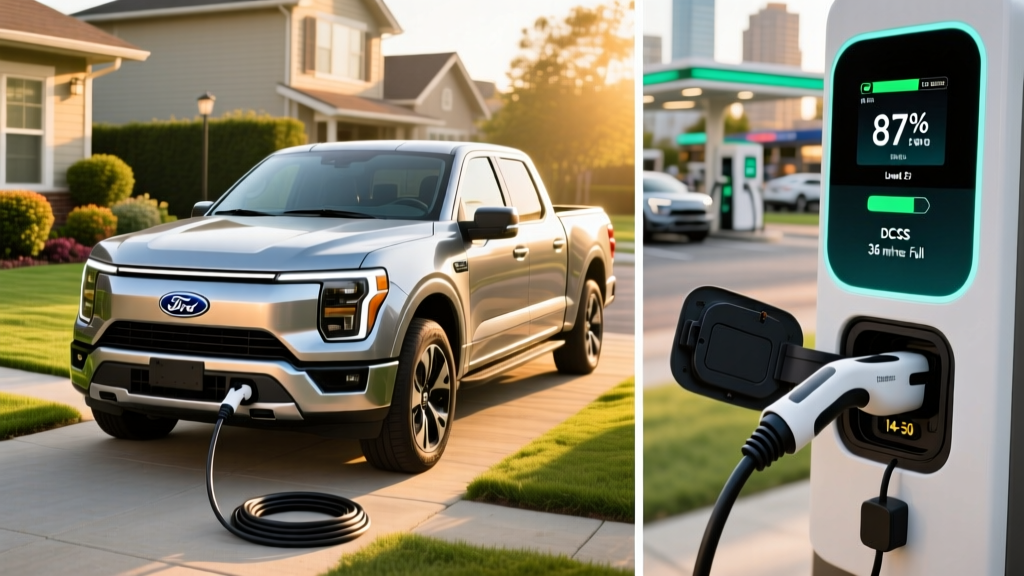
EV charging falls into three tiers. Each delivers energy at a different rate, and knowing the math behind miles-per-hour of charging helps you plan both daily routines and road trips.
| Level | Voltage | Max Power (kW) | Miles of Range Added Per Hour | Typical Use Case |
|---|---|---|---|---|
| Level 1 | 120V AC | 1.2–1.9 kW | 3–5 miles | Overnight top-up, PHEVs, low-mileage drivers |
| Level 2 | 240V AC | 7.2–19.2 kW | 20–65 miles | Home daily charging, workplace, destination |
| DC Fast Charge | 200–900V DC | 50–350 kW | 150–1,200+ miles (equivalent) | Road trips, highway corridors, quick top-ups |
A critical nuance: DC fast chargers don't sustain their peak kW rate. A charger rated at 250 kW may deliver that speed only between 10–40% State of Charge (SoC), then taper to 150 kW, then drop below 50 kW above 80%. This charge-curve taper means a "10–80%" time is a more honest metric than peak kW alone. For a typical 75 kWh battery on a 250 kW-capable vehicle, expect 10–80% in roughly 18–25 minutes at a 350 kW station, or 25–35 minutes at a 150 kW station.
How Much Does It Cost to Install a Home EV Charger?
Home Level 2 charging is where most EV owners do 85–95% of their charging. But the sticker price of a wallbox is only part of the equation. Your home's electrical panel age, available amperage, and the distance from panel to garage all shape the final bill.
| Cost Component | Low-End | Typical | High-End |
|---|---|---|---|
| Level 2 EVSE Equipment (hardwired or plug-in) | $350 | $550 | $800 |
| Electrician Labor (licensed, 2–6 hours) | $400 | $900 | $2,000 |
| Permit & Inspection Fees | $50 | $150 | $400 |
| Electrical Panel Upgrade (if needed: 100A → 200A) | $1,500 | $2,500 | $5,000 |
| Conduit, Wiring, Misc. Materials | $100 | $300 | $800 |
| Total (no panel upgrade) | $900 | $1,900 | $4,000 |
| Total (with panel upgrade) | $2,400 | $4,400 | $9,000 |
Electrical Requirements for a 40-Amp Level 2 Circuit
Most home Level 2 installations target a 240V / 40-amp dedicated circuit, which supports a 32-amp continuous charger (the National Electrical Code requires circuits to be rated 125% above continuous load). This delivers up to 7.7 kW — enough to add roughly 25–30 miles of range per hour, or fully replenish a 75 kWh battery in about 10 hours overnight.
If your home still has a 100-amp service panel — common in houses built before 1990, around the era of that 2002 Pontiac Grand Prix GTP Supercharged — you may need a panel upgrade to 200 amps. An electrician performing a load calculation will assess whether adding a 40A EV circuit pushes your panel past 80% of its rated capacity. Don't skip this step; overloading a panel is a fire hazard and will fail inspection.
Connector Compatibility: NACS, CCS1, CHAdeMO, and Adapter Realities
The connector landscape has consolidated significantly. As of 2026, the North American Charging Standard (NACS) — originally Tesla's proprietary plug — is the dominant connector. Nearly every major automaker (Ford, GM, Rivian, Hyundai, Kia, BMW, and others) has adopted NACS for new vehicles. CCS1 remains on many 2022–2025 models, and CHAdeMO is effectively legacy (Nissan Leaf).
| Connector | Brands Using It (New Vehicles) | DC Fast Network Access | Adapter Needed? |
|---|---|---|---|
| NACS (Tesla standard) | Tesla, Ford, GM, Rivian, Hyundai, Kia, BMW, Volvo, Polestar, others | Tesla Supercharger + NACS-equipped EA, EVgo stations | None for NACS vehicles; CCS→NACS adapter ~$200 for older CCS cars |
| CCS1 | Remaining 2022–2025 models from VW, some Stellantis, legacy inventory | Electrify America, EVgo, ChargePoint DC stations | NACS→CCS adapter ~$250 for Supercharger access |
| CHAdeMO | Nissan Leaf (discontinued after 2025 MY), Mitsubishi Outlander PHEV (legacy) | Limited; many stations removing CHAdeMO cables | No practical adapter to NACS/CCS for DC |
Before purchasing a home charger, confirm your vehicle's charge port. Buying a NACS-connector wallbox for a CCS1 vehicle means you'll also need a permanent adapter dangling from your garage wall — workable, but suboptimal. Most charger manufacturers now offer both NACS and CCS1 connector options at purchase.
Cost Per Mile: EV Charging vs. Fueling the Grand Prix GTP Supercharged
The 2002 Pontiac Grand Prix GTP Supercharged carries EPA ratings of approximately 17 mpg city / 27 mpg highway / 20 mpg combined on premium unleaded. With premium fuel averaging around $4.10 per gallon in 2026, that's roughly $0.205 per mile at combined driving — and closer to $0.24 per mile in city traffic.
Now compare that to EV charging across three common scenarios, using a midsize EV averaging 3.0 miles per kWh (roughly 33 kWh/100 mi, typical of vehicles like the Hyundai Ioniq 5 or Tesla Model Y):
| Scenario | Rate ($/kWh) | Cost Per Mile | Annual Cost (12,000 mi) |
|---|---|---|---|
| Home Level 2 — Off-Peak Utility Rate | $0.09 | $0.030 | $360 |
| Home Level 2 — Standard Residential Rate | $0.16 | $0.053 | $640 |
| Public Level 2 (ChargePoint, workplace) | $0.25 | $0.083 | $1,000 |
| DC Fast Charging (Electrify America, EVgo) | $0.48 | $0.160 | $1,920 |
| 2002 Grand Prix GTP (premium, combined) | $4.10/gal | $0.205 | $2,460 |
Even at the most expensive DC fast-charging rates, an EV costs less per mile than the supercharged 3.8L V6. But the real savings come from home charging: off-peak Level 2 charging at $0.09/kWh delivers fuel at roughly one-seventh the per-mile cost of the GTP. Over five years and 60,000 miles, the difference between home-charged EV and the Grand Prix GTP on premium is roughly $10,500 in fuel savings.
Charging Time Examples: How Long to Fill Common EV Batteries
Charge time depends on both the vehicle's onboard acceptance rate and the charger's output. Here are real-world benchmarks for popular battery sizes at each level. Note that all DC fast times assume starting at 10% SoC and stopping at 80% — charging above 80% slows dramatically due to battery management system (BMS) thermal and cell-balancing protocols.
| Battery Size (usable kWh) | Example Vehicle | Level 1 (1.4 kW) 10–80% | Level 2 (7.7 kW) 10–80% | Level 2 (11.5 kW) 10–80% | DC Fast (150 kW) 10–80% | DC Fast (250 kW) 10–80% |
|---|---|---|---|---|---|---|
| 60 kWh | Chevy Equinox EV | ~30 hours | ~5.5 hours | ~3.7 hours | ~28 min | ~20 min |
| 75 kWh | Tesla Model Y / Hyundai Ioniq 5 | ~37 hours | ~6.8 hours | ~4.6 hours | ~32 min | ~18 min |
| 100 kWh | Ford F-150 Lightning Ext. Range | ~50 hours | ~9.1 hours | ~6.1 hours | ~42 min | ~28 min |
For daily driving averaging 30–40 miles, a Level 2 home charger replenishes a day's worth of driving in roughly 1–1.5 hours. You'll plug in when you get home and wake up to a full battery every morning — fundamentally different from the weekly gas-station stop you had with the GTP.
Home Charger Equipment Recommendations (2026 Picks)
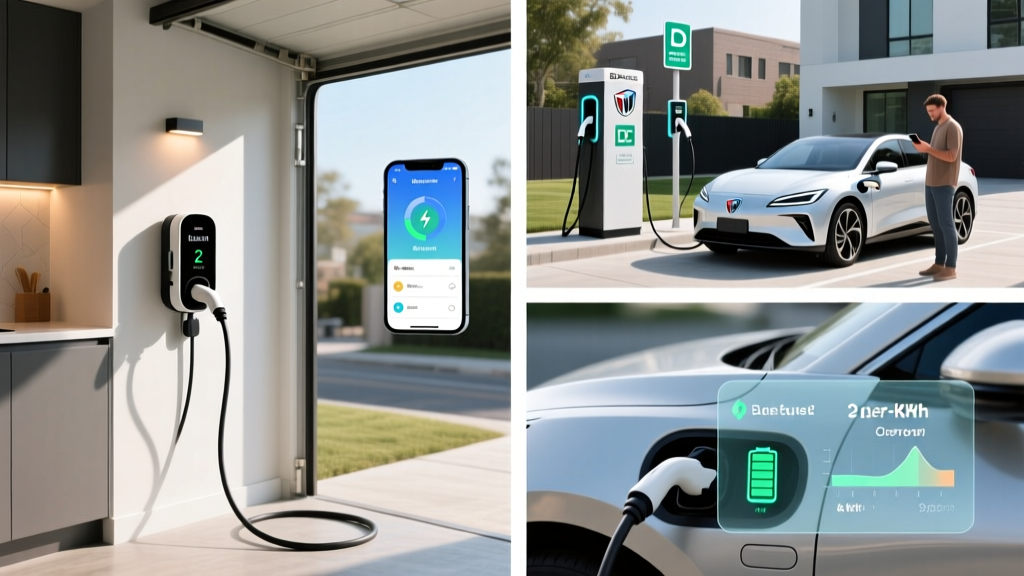
We've tested and tracked reliability data on dozens of Level 2 home chargers. Below are three picks across price tiers, each with verified power output, connector options, and smart features.
Budget Pick: Emporia Level 2 EV Charger
- Power Output: 48A / 11.5 kW (hardwired) or 40A / 9.6 kW (NEMA 14-50 plug)
- Connector: Available in NACS or J1772 (with NACS adapter included)
- Cable Length: 24 feet
- Smart Features: Wi-Fi, energy monitoring via app, solar integration, scheduling for off-peak rates
- Price: ~$399 (hardwired) / ~$449 (plug-in)
- Best For: Budget-conscious buyers who want smart scheduling and energy tracking
Best Overall: ChargePoint Home Flex (2nd Gen)
- Power Output: Up to 50A / 12 kW (NEMA 14-50) or up to 80A / 19.2 kW (hardwired)
- Connector: NACS native (2026 model); J1772 version still available
- Cable Length: 23 feet
- Smart Features: Wi-Fi, Alexa/Google Home integration, flexible amperage setting via DIP switch, detailed session history
- Price: ~$649 (50A plug-in) / ~$699 (80A hardwired)
- Best For: Most homeowners — flexible amperage means you can match it to your circuit without buying a new unit if you upgrade your panel later
Premium Pick: Tesla Wall Connector (Gen 4)
- Power Output: Up to 48A / 11.5 kW (NEMA 14-50) or 80A / 19.2 kW (hardwired, 60A circuit)
- Connector: NACS native; J1772 adapter available from Tesla
- Cable Length: 24 feet
- Smart Features: Wi-Fi, over-the-air updates, Power Sharing (link multiple units on one circuit), vehicle-specific charge limits
- Price: ~$495
- Best For: Tesla owners or households with multiple NACS vehicles; Power Sharing is ideal for two-car garages on limited panel capacity
Safety, Electrical Code, and Installation Best Practices
EV chargers draw sustained high current for hours — this is fundamentally different from the intermittent loads of a dryer or oven. The NEC (National Electrical Code, 2023 edition, adopted by most jurisdictions by 2026) treats EV charging as a continuous load, requiring the circuit to be rated at 125% of the charger's maximum draw. A 48A charger needs a 60A circuit; a 32A charger needs a 40A circuit.
Key Code and Safety Requirements
- Dedicated Circuit: Your EV charger must have its own breaker — no sharing with other outlets or appliances.
- GFCI Protection: NEC 2023 requires GFCI protection for all 240V EV charging outlets (NEMA 14-50). Hardwired installations are exempt from this GFCI requirement but must still meet all other safety standards. Many modern EVSEs have built-in ground-fault protection regardless.
- Outdoor Rating: If your charger is mounted outside or in an exposed carport, the EVSE must carry a NEMA 4 or IP65 weather rating. All three picks above meet this standard.
- Wire Gauge: A 60A circuit requires 4 AWG copper wire (or 3 AWG aluminum); a 40A circuit requires 8 AWG copper. Your electrician will size this correctly, but verify it on the invoice.
- Permit and Inspection: Nearly every jurisdiction requires a permit for new 240V circuits. The inspection ensures proper wire sizing, breaker rating, grounding, and GFCI compliance. Do not skip this — unpermitted work can void home insurance claims.
For more on electrical safety standards, the National Fire Protection Association's NEC page provides the full code text and adoption maps by state.
Frequently Asked Questions
How much does it cost to install a home EV charger?
A typical Level 2 home installation with an existing 200A panel and short wire run costs between $1,200 and $2,500 total (equipment + electrician + permit). If your home needs a panel upgrade from 100A to 200A — common in pre-2000 construction — add $1,500 to $5,000, bringing the total to $2,700–$7,500. Always get at least two quotes from licensed electricians and confirm they include permit costs.
How fast will each charging level add range?
Level 1 (120V) adds 3–5 miles per hour — fine for plug-in hybrids with small batteries but inadequate for daily BEV use. Level 2 (240V, 7.7 kW) adds 25–30 miles per hour, which covers most daily driving needs overnight. DC fast charging at 150 kW can add 150+ miles in 20 minutes, while 250–350 kW stations can add 200+ miles in 15 minutes, assuming the vehicle's battery management system supports those rates.
Which connector/charger is compatible with my EV?
For 2026 model-year vehicles, check your manufacturer's charge port specification. NACS is now standard on Tesla, Ford, GM, Rivian, Hyundai, Kia, BMW, Volvo, and Polestar. If you own a 2022–2025 vehicle with CCS1, you can use a NACS-to-CCS adapter (~$200–$250) to access Tesla Superchargers. CHAdeMO is legacy only — no practical DC adapter exists to NACS. For home Level 2 charging, all EVs use the same J1772 protocol regardless of DC connector, so a J1772 home charger works with every EV (NACS vehicles include a J1772 adapter).
How much does charging cost per mile vs gas?
Home Level 2 charging at the US average residential rate of $0.16/kWh costs roughly $0.05 per mile for a midsize EV — about 75% less than the 2002 Pontiac Grand Prix GTP Supercharged on premium fuel at $0.205/mile. Even public DC fast charging at $0.48/kWh ($0.16/mile) undercuts the GTP. Over 12,000 annual miles, home EV charging saves $1,800–$2,100 compared to fueling the supercharged V6.
What electrical upgrades might I need?
The most common upgrade is a panel capacity increase from 100A to 200A, required when your existing panel lacks headroom for a 40–60A dedicated EV circuit. An electrician performs a NEC Article 220 load calculation to determine this. Other potential upgrades include adding a sub-panel closer to the garage (reducing wire run cost), upgrading the meter base, or replacing outdated Federal Pacific or Zinsco panels (known fire hazards common in 1960s–1980s homes). Budget $1,500–$5,000 for panel work depending on complexity and local labor rates. Consult the U.S. Department of Energy's EV charging basics for further planning guidance.