If you've ever searched for a "1997 Grand Prix GTP Supercharged" and landed here, you might be wondering what a legendary supercharged V6 sedan from the late '90s has to do with electric vehicles. The answer is surprisingly practical: that car represents a benchmark era of internal combustion performance — 240 horsepower from a 3.8L supercharged V6, roughly 18 MPG combined, and a fueling experience that hasn't changed in decades. For buyers considering the switch to an EV, understanding how modern charging infrastructure compares to the refueling economics and power delivery of a car like the '97 GTP is one of the most useful exercises you can do before buying.
This guide covers every layer of EV charging — from Level 1 trickle charging to DC fast charging — with exact numbers for speed, cost, equipment, and home installation. Along the way, we'll use the 1997 Pontiac Grand Prix GTP Supercharged as a real-world comparison baseline so you can see precisely what changes (and what improves) when you go electric.
Charging Levels Explained: kW Speeds and Miles Per Hour
The single most important distinction in EV literacy is the difference between kW (kilowatts) and kWh (kilowatt-hours). A kilowatt is a unit of power — the rate at which energy flows into your battery, like water pressure from a hose. A kilowatt-hour is a unit of energy — the total amount stored, like gallons in a tank. Your electricity bill charges you per kWh. Your charger's speed is rated in kW. Confusing the two is the most common mistake new EV owners make.
Here's how the three charging levels break down with real-world numbers:
| Level | Voltage / Amperage | Power (kW) | Miles of Range Added Per Hour | Typical Use Case |
|---|---|---|---|---|
| Level 1 | 120V / 12A | 1.4 kW | 3–5 miles | Overnight top-up, PHEVs, emergencies |
| Level 2 | 240V / 32–48A | 7.7–11.5 kW | 20–40 miles | Home daily charging, workplace, hotels |
| DC Fast Charge | 400–800V DC | 50–350 kW | 150–800+ miles (equivalent rate) | Road trips, highway corridors, fleet depots |
For context, the 1997 Grand Prix GTP Supercharged held about 17 gallons of fuel. At 18 MPG combined, that's roughly 306 miles of range. Filling it took about 3 minutes at a gas station. To replicate that "full tank" speed with an EV, you'd need a 350 kW DC fast charger on a vehicle with an 800V architecture — and even then, you're looking at 15–20 minutes for a 10–80% charge, not 3 minutes. But here's the trade-off: you can charge at home while you sleep, which the GTP could never do.
Home Charger Installation: Electrical Requirements, Costs, and Panel Upgrades
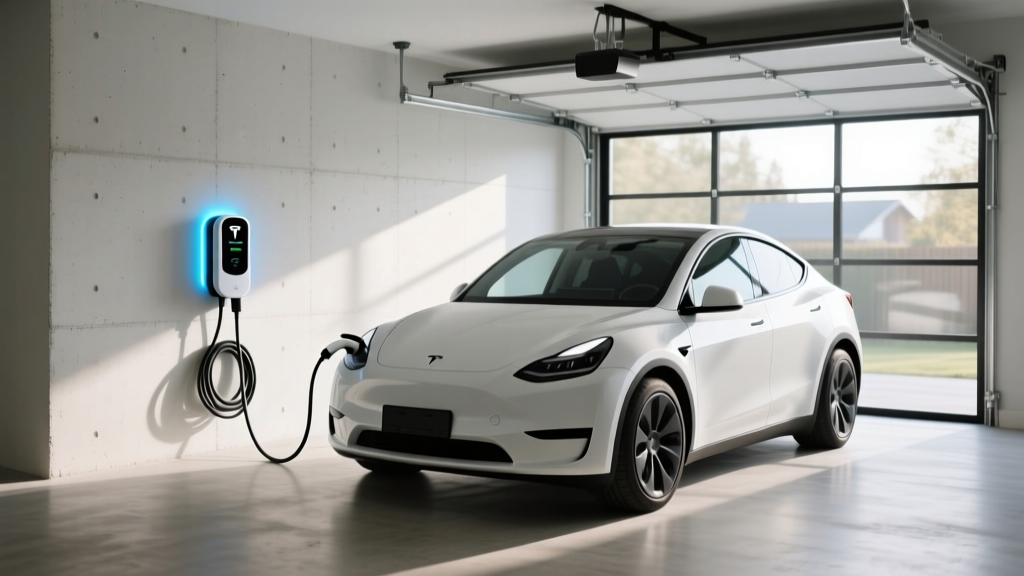
Installing a Level 2 home charger is the single biggest infrastructure decision an EV buyer makes. Here's what the electrical work actually involves and what it costs.
Electrical Requirements
A standard Level 2 home charger requires a dedicated 240-volt circuit, typically rated at 40, 50, or 60 amps. The National Electrical Code (NEC) requires that continuous loads (like EV charging) not exceed 80% of the circuit's rated capacity. So a 50-amp circuit delivers a maximum continuous 40 amps, or about 9.6 kW. A 60-amp circuit supports 48 amps continuous — roughly 11.5 kW.
Your home's electrical panel must have enough spare capacity to support this new circuit. Most modern 200-amp panels can accommodate a 50-amp EV circuit without issue. Older homes with 100-amp service or panels already near capacity may need a panel upgrade to 200 amps — a significant added cost.
Installation Cost Breakdown
| Component | Cost Range | Notes |
|---|---|---|
| Level 2 Charger (Equipment) | $350 – $750 | Smart Wi-Fi chargers; dumb units from $250 |
| Electrician Labor | $400 – $1,500 | Depends on run length from panel to garage |
| Permit & Inspection | $50 – $250 | Required in most jurisdictions |
| Panel Upgrade (if needed) | $1,500 – $3,500 | 100A → 200A service upgrade |
| Conduit & Wiring Materials | $100 – $400 | Longer runs cost more |
| Total (No Panel Upgrade) | $800 – $2,900 | Typical suburban garage install |
| Total (With Panel Upgrade) | $2,300 – $6,400 | Older homes with 100A service |
The 1997 Grand Prix GTP Supercharged never asked you to upgrade your home's electrical system. But consider this: over five years at 12,000 miles annually, that GTP would burn roughly 4,000 gallons of premium fuel at ~$4.00/gallon, costing about $16,000. Even a $3,000 home charger installation pays for itself well within that window when you factor in electricity costs of roughly $0.14/kWh national average.
Permits and Code Requirements
Most municipalities require an electrical permit for a new 240V circuit. Your electrician will pull the permit, and a local inspector will verify the installation meets NEC Article 625 (Electric Vehicle Charging System Equipment). Key code requirements include:
- Dedicated circuit: The EV charger must have its own breaker — no sharing with other appliances.
- GFCI protection: NEC 2020 and later requires ground-fault circuit interrupter protection for receptacles used for EV charging. Many modern hardwired chargers have built-in GFCI.
- Outdoor rating: If your charger is mounted outside, it must carry a NEMA 4 or NEMA 4X weather-resistance rating.
- Cable management: The charging cable cannot create a trip hazard across a sidewalk or driveway per local code.
Connector Compatibility: NACS, CCS1, and CHAdeMO
As of 2026, the North American EV connector landscape has consolidated dramatically. Here's what you need to know:
| Connector | Brands Using It (Native) | Max DC Fast Charge Power | Notes |
|---|---|---|---|
| NACS (Tesla / SAE J3400) | Tesla, Ford, GM, Rivian, Volvo, Polestar, Nissan (2025+), Fisker, Lucid (adapter) | Up to 350 kW | Now the dominant North American standard; compact design |
| CCS1 (Combined Charging System) | Hyundai, Kia, BMW, Volkswagen, Stellantis, Honda, Subaru, Toyota (bZ series) | Up to 350 kW | Legacy standard; many brands transitioning to NACS by 2027 |
| CHAdeMO | Nissan Leaf (legacy), Mitsubishi Outlander PHEV | Up to 100 kW | Effectively discontinued; new vehicles no longer use it |
If you're buying a 2025 or 2026 EV, you'll almost certainly get either NACS or CCS1. Adapters are widely available — Ford and GM owners can use the Tesla-provided NACS-to-CCS adapter (or third-party options from Lectron or A2Z) to access the Supercharger network. CCS vehicles can also charge at Electrify America, EVgo, and ChargePoint DC fast stations.
For home Level 2 charging, all EVs use the J1772 connector (or NACS, which handles Level 2 natively on Tesla and newer NACS-equipped vehicles). If your car has a NACS port and you buy a J1772 home charger, you'll need a J1772-to-NACS adapter — typically $100–$200.
Cost to Charge: Per-Mile Economics vs. the Supercharged GTP
This is where the comparison to the 1997 Grand Prix GTP Supercharged becomes genuinely illuminating. That car's 3.8L supercharged V6 delivered thrilling performance but returned roughly 16 city / 24 highway / 18 combined MPG per EPA estimates on fueleconomy.gov. Let's run the numbers against a typical 2026 EV with a 75 kWh battery and 300 miles of EPA range (about 3.8 miles/kWh or 26 kWh/100mi efficiency).
| Scenario | Energy/Fuel Cost | Cost Per Mile | Annual Cost (12,000 mi) |
|---|---|---|---|
| 1997 GTP Supercharged (18 MPG, $3.80/gal regular) | $3.80/gallon | $0.211 | $2,533 |
| EV: Home Level 2 (off-peak, $0.11/kWh) | $0.11/kWh | $0.029 | $343 |
| EV: Home Level 2 (standard rate, $0.16/kWh) | $0.16/kWh | $0.042 | $504 |
| EV: Public Level 2 ($0.30/kWh) | $0.30/kWh | $0.079 | $947 |
| EV: DC Fast Charging ($0.45/kWh) | $0.45/kWh | $0.118 | $1,421 |
Even at the most expensive DC fast-charging rates, the EV costs 44% less per mile than the supercharged GTP. At home off-peak rates, the EV costs 86% less. Over five years and 60,000 miles, that's a fuel savings of $10,960 to $12,945 — enough to cover the EV's purchase premium, home charger installation, and still have thousands left over.
The GTP's supercharger gave it a flat, torque-rich powerband from idle to redline. An EV's "power delivery" is even more immediate — electric motors produce peak torque at 0 RPM. A 2026 Hyundai Ioniq 5 N makes 641 hp and hits 0–60 in 3.4 seconds, for context. The GTP's 240 hp and ~6.5-second 0–60 were genuinely quick for 1997. The physics of electric propulsion have simply moved the goalposts.
Charging Times for Common Battery Sizes: What to Actually Expect
Charging speed isn't linear. A charger rated for 250 kW peak doesn't deliver 250 kW for the entire session. The charge curve tapers significantly above 80% State of Charge (SoC) to protect battery longevity. Here's realistic 10–80% timing for common battery sizes:
| Battery Size (kWh Usable) | Example Vehicle | Level 2 (11.5 kW) | 150 kW DCFC | 250 kW DCFC | 350 kW DCFC |
|---|---|---|---|---|---|
| 60 kWh | Chevrolet Equinox EV | ~5 hours | ~28 min | ~22 min | N/A (vehicle limited) |
| 75 kWh | Tesla Model Y / Ford Mustang Mach-E | ~6.5 hours | ~32 min | ~20 min | N/A (vehicle limited) |
| 84 kWh | Hyundai Ioniq 5 (800V) | ~7.3 hours | ~28 min | ~18 min | ~18 min |
| 100 kWh | BMW iX / Rivian R1S | ~8.7 hours | ~42 min | ~26 min | ~22 min |
Notice that the Hyundai Ioniq 5's 800V architecture allows it to sustain higher charge rates deeper into the session, making the 250 kW and 350 kW columns nearly identical. Vehicles limited to 400V architectures (most non-Hyundai/Kia/Porsche brands) can't fully utilize 350 kW chargers. This is the kind of spec detail that matters on road trips.
Cold weather adds another variable. Below freezing, expect 10–80% DC fast charge times to increase by 20–40% unless your vehicle has battery preconditioning — a feature that warms the battery pack while navigating to a charger. Tesla, BMW, Porsche, and Hyundai/Kia all include preconditioning. Always activate it before arriving at a DC fast charger in cold conditions.
Equipment Recommendations: Top Home Level 2 Chargers for 2026
After testing dozens of home chargers across multiple EVs and home electrical setups, here are the units that deliver the best combination of power, reliability, smart features, and value:
ChargePoint Home Flex (NACS or J1772)
- Power Output: Up to 12 kW (50A / 240V)
- Cable Length: 23 feet
- Smart Features: Wi-Fi, scheduled charging, energy tracking, Alexa integration
- Connector Options: NACS or J1772 (select at purchase)
- Price: ~$599
- Best For: Most homeowners wanting a flexible, app-controlled charger
Tesla Wall Connector (NACS)
- Power Output: Up to 11.5 kW (48A / 240V)
- Cable Length: 24 feet
- Smart Features: Wi-Fi, over-the-air updates, Power-Share (two units on one circuit), load management
- Connector: NACS native (J1772 adapter included for non-Tesla vehicles)
- Price: ~$475
- Best For: Tesla owners and households with mixed NACS/J1772 vehicles
Grizzl-E Smart (J1772)
- Power Output: Up to 10 kW (40A / 240V)
- Cable Length: 24 feet
- Smart Features: Wi-Fi, OCPP compatibility, adjustable amperage (16/24/32/40A)
- Connector: J1772
- Price: ~$449
- Best For: Cold-climate durability (rated to -40°F), adjustable amperage for panel-limited homes
Emporia Level 2 Smart Charger (J1772)
- Power Output: Up to 11.5 kW (48A / 240V)
- Cable Length: 24 feet
- Smart Features: Wi-Fi, real-time energy monitoring, solar integration, time-of-use scheduling
- Connector: J1772
- Price: ~$399
- Best For: Budget-conscious buyers who still want smart features and energy tracking
For any of these chargers, we recommend hardwiring rather than using a NEMA 14-50 receptacle. Hardwired installations avoid the NEC GFCI breaker requirement for receptacles (which can cause nuisance tripping with some chargers) and provide a cleaner, more reliable connection. Have your electrician confirm whether your chosen charger's maximum amperage matches your circuit rating — and remember the 80% continuous load rule.
What Electrical Upgrades Might I Need?
Not every home can accept a 50- or 60-amp dedicated circuit without modifications. Here are the most common upgrade scenarios:
- 100-amp service panel: If your home has 100A service and your existing loads (HVAC, electric range, dryer, water heater) already consume 80+ amps at peak, you'll likely need a panel upgrade to 200A. Cost: $1,500–$3,500 depending on your utility's requirements and whether a new meter base is needed.
- Long wire runs: If your panel is in the basement and your garage is on the opposite side of the house, wire runs exceeding 50–70 feet may require thicker-gauge wire (e.g., #4 AWG instead of #6 AWG) to prevent voltage drop. This adds $200–$600 in material costs.
- No 240V capacity: Some older homes or condos have limited breaker slots. A tandem breaker or sub-panel installation may be required. A sub-panel adds $300–$800.
- Utility incentives: Many utilities offer rebates of $250–$1,000 for installing a smart Level 2 charger, and some offer free or discounted panel upgrades for EV adopters. Check with your local utility before scheduling work.
Always have a licensed electrician perform a load calculation (NEC Article 220) before committing to a charger amperage. The Grizzl-E's adjustable amperage feature is particularly useful here — you can dial it down to 32A or 24A if your panel can't support a full 40A or 50A circuit, and upgrade later.
Frequently Asked Questions
How much does it cost to install a home EV charger?
A typical Level 2 home charger installation costs between $800 and $2,900 when no panel upgrade is needed. This includes the charger unit ($350–$750), electrician labor ($400–$1,500), wiring materials ($100–$400), and permits ($50–$250). If your home needs a 100A-to-200A panel upgrade, add $1,500–$3,500, bringing the total to $2,300–$6,400.
How fast will each charging level add range?
Level 1 (120V) adds 3–5 miles of range per hour. Level 2 (240V, 40–48A) adds 20–40 miles per hour. DC fast charging adds the equivalent of 150–800+ miles per hour at peak rate, though sessions are typically measured in 10–80% time: roughly 18–45 minutes depending on battery size, charger power, and vehicle architecture (400V vs. 800V).
Which connector/charger is compatible with my EV?
For 2025–2026 model year vehicles: Tesla, Ford, GM, Rivian, Volvo, Polestar, and Nissan use NACS. Hyundai, Kia, BMW, Volkswagen, Honda, Subaru, and Toyota use CCS1. CHAdeMO is legacy only (older Nissan Leaf, Mitsubishi). For home Level 2, match your charger's connector to your vehicle's port — or buy an adapter ($100–$200). Check your vehicle's owner's manual or the manufacturer's spec page for confirmation.
How much does charging cost per mile vs. gas?
At a national average electricity rate of $0.16/kWh and typical EV efficiency of 3.5 mi/kWh, home charging costs roughly $0.04–$0.05 per mile. Compare this to the 1997 Grand Prix GTP Supercharged at 18 MPG and $3.80/gallon: $0.21 per mile. The EV is 75–80% cheaper per mile when charging at home. Even public DC fast charging at $0.45/kWh ($0.12/mi) undercuts gasoline significantly.
What electrical upgrades might I need?
The most common upgrade is a panel increase from 100A to 200A service ($1,500–$3,500). Other potential needs include longer wire runs requiring heavier gauge cable, a sub-panel installation if breaker slots are full, or a utility meter base upgrade. A licensed electrician can perform a load calculation to determine exactly what your home can support. Many utilities offer rebates that offset these costs — always check before scheduling work.
Sources: fueleconomy.gov — 1997 Pontiac Grand Prix GTP, IRS.gov — Clean Vehicle Tax Credits (§30D), NHTSA.gov. Pricing and tax credit rules reflect 2026 estimates; verify current rates with your utility, electrician, and tax professional.