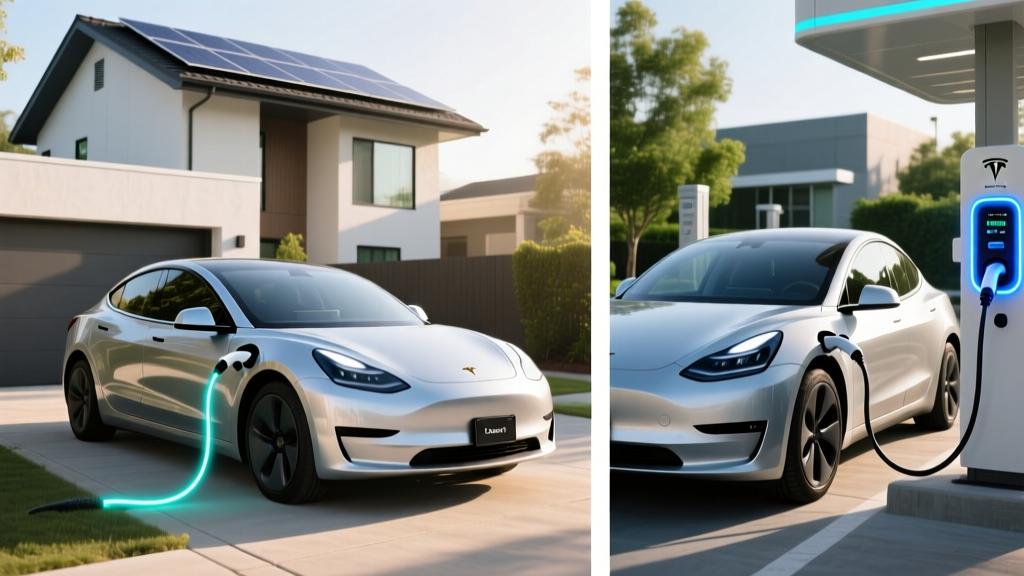
Why Range Rover Sport Owners Are Making the Switch to Electric
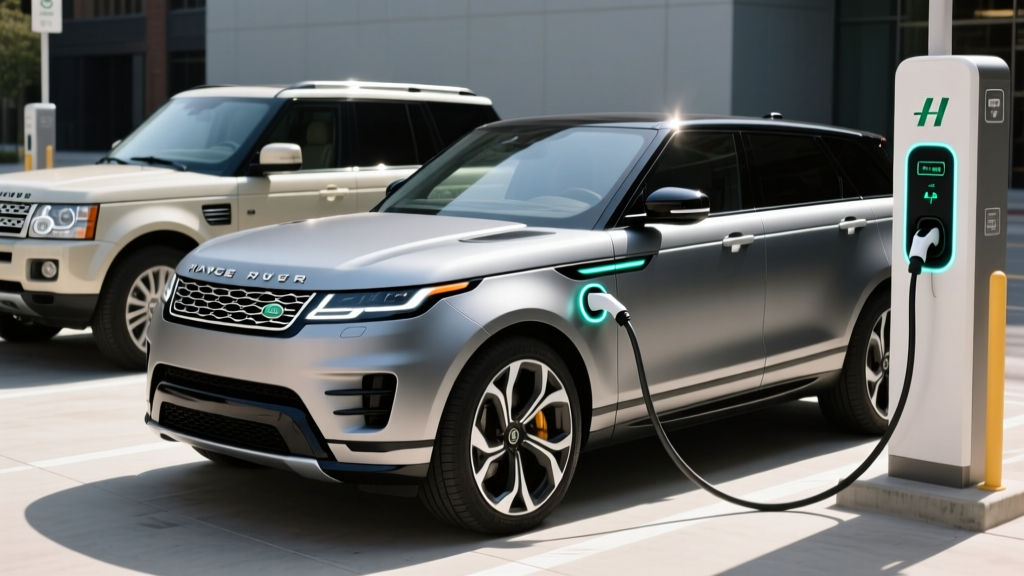
The 2010 Land Rover Range Rover Sport Supercharged remains an icon — a 510-horsepower, 5.0-liter V8 luxury SUV that commands attention. But with EPA fuel economy hovering around 12 mpg city and 17 mpg highway (per fueleconomy.gov), annual fuel costs routinely exceed $4,000 for moderate drivers. Add aging supercharger components, costly air suspension repairs, and rising insurance premiums, and the total cost of ownership for a 16-year-old luxury SUV becomes difficult to justify.
For owners considering the leap to a modern electric SUV — whether a Range Rover Electric (announced for late 2025/2026), a Tesla Model X, a Rivian R1S, or a BMW iX — understanding EV charging infrastructure is the single most important homework assignment. This guide covers every charging level, home installation realities, connector compatibility, cost-per-mile math versus that supercharged V8, and specific equipment recommendations for 2026.
Understanding EV Charging Levels: Speed, Power, and Practical Use
EV charging is categorized into three levels, each defined by voltage, power output (measured in kilowatts, or kW), and the practical miles of range added per hour. Note: kW measures the rate of power delivery, while kWh (kilowatt-hours) measures total energy stored in the battery — think of kW as the speed of water flowing through a hose and kWh as the total gallons in the bucket.
| Level | Voltage | Power (kW) | Miles of Range/Hour | Best Use Case |
|---|---|---|---|---|
| Level 1 | 120V AC | 1.0–1.4 kW | 3–5 mi/hr | Overnight top-ups, PHEVs, emergencies |
| Level 2 | 240V AC | 3.3–19.2 kW | 12–75 mi/hr | Daily home charging, workplace, destinations |
| DC Fast Charging | 400–800V DC | 50–350+ kW | 150–1,000+ mi/hr | Road trips, highway corridors, rapid top-ups |
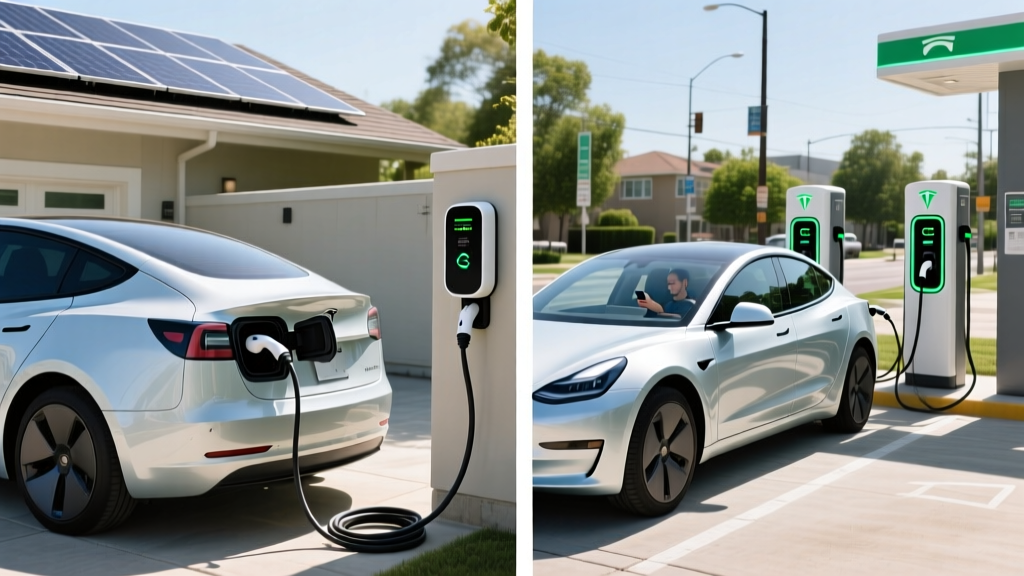
For a former Range Rover Sport Supercharged owner accustomed to 5-minute gas station stops, Level 2 home charging is the practical daily solution: plug in when you arrive home, wake up to a full battery every morning. DC fast charging handles road trips, with most modern EVs achieving a 10–80% charge in 18–35 minutes at appropriately rated stations.
Real-World Charging Time Examples
Charging speed depends on battery size, vehicle acceptance rate, and charger output. Here are representative examples for popular electric SUVs that cross-shop with the Range Rover Sport segment:
- Tesla Model X (100 kWh battery, 250 kW peak): 10–80% in approximately 30 minutes at a V3 Supercharger; ~10 hours on a 48A Level 2 home charger (11.5 kW).
- Rivian R1S Dual-Motor (128.9 kWh Max Pack, 200 kW peak): 10–80% in roughly 35 minutes at a 200+ kW DC station; ~13 hours on a 48A Level 2.
- BMW iX xDrive50 (111.5 kWh usable, 195 kW peak): 10–80% in about 34 minutes; ~11 hours on a 48A Level 2.
- Hyundai Ioniq 9 Long Range (110.3 kWh, 350 kW peak via 800V): 10–80% in approximately 18 minutes at a 350 kW charger; ~11 hours on Level 2.
Note: DC fast charging follows a taper curve — peak kW is sustained only between roughly 10–50% state of charge. Above 80%, charging slows dramatically to protect battery health. This is why 10–80% times are the industry standard metric.
Home EV Charger Installation: Costs, Electrical Requirements, and Gotchas
Installing a Level 2 home charger is the single highest-impact upgrade for EV ownership. For owners of older homes — the kind of residences where a 2010 Range Rover Sport might have lived in the garage — electrical panel capacity is the variable that determines whether installation costs $800 or $4,500.
Electrical Requirements for Level 2 Charging
A typical Level 2 home charger requires:
- Voltage: 240V (same as a clothes dryer or electric oven)
- Amperage: 40A, 48A, or 60A dedicated circuit (breaker rated at 125% of continuous load, so a 48A charger needs a 60A breaker)
- Circuit: Dedicated — no sharing with other appliances
- Wire gauge: 6 AWG copper for 48A; 4 AWG for 60A circuits
- Panel capacity: Minimum 200A service recommended; older homes with 100A panels often require a panel upgrade
Installation Cost Breakdown
| Component | Basic Install (Near Panel) | Standard Install (25–50 ft run) | Complex Install (Long Run + Panel Upgrade) |
|---|---|---|---|
| Level 2 Charger (48A, hardwired) | $400–$700 | $400–$700 | $400–$700 |
| Electrician labor | $300–$600 | $600–$1,500 | $1,200–$2,500 |
| Materials (wire, conduit, breaker) | $50–$150 | $150–$400 | $300–$800 |
| Permit & inspection | $50–$200 | $100–$300 | $150–$400 |
| Panel upgrade (if needed) | $0 | $0 | $1,500–$3,500 |
| TOTAL RANGE | $800–$1,650 | $1,250–$2,900 | $3,550–$7,900 |
Always hire a licensed electrician and pull a permit. Unpermitted EV charger installations can void homeowner's insurance claims and create fire hazards. The National Electrical Code (NEC Article 625) governs EV charging equipment installation, and local inspectors verify compliance.
Connector Compatibility: NACS, CCS1, and CHAdeMO Explained
The EV charging connector landscape has consolidated significantly as of 2026. Here's what you need to know based on which electric SUV you choose as your Range Rover Sport replacement:
| Connector | Brands Using It (2026) | Adapter Needed? |
|---|---|---|
| NACS (North American Charging Standard) | Tesla (native), Ford, GM, Rivian, Volvo, Polestar, Hyundai/Kia, BMW, Mercedes-Benz, JLR (Range Rover Electric) | No — native on most 2025+ EVs. CCS-to-NACS adapters available for legacy CCS chargers ($200–$300). |
| CCS1 (Combined Charging System) | Older 2020–2024 EVs (legacy Ford, GM, VW, Hyundai/Kia models) | NACS-to-CCS adapter needed for Tesla Superchargers (~$200). |
| CHAdeMO | Nissan Leaf (legacy), Mitsubishi Outlander PHEV (older) | Largely discontinued infrastructure; not recommended for new EV buyers. |
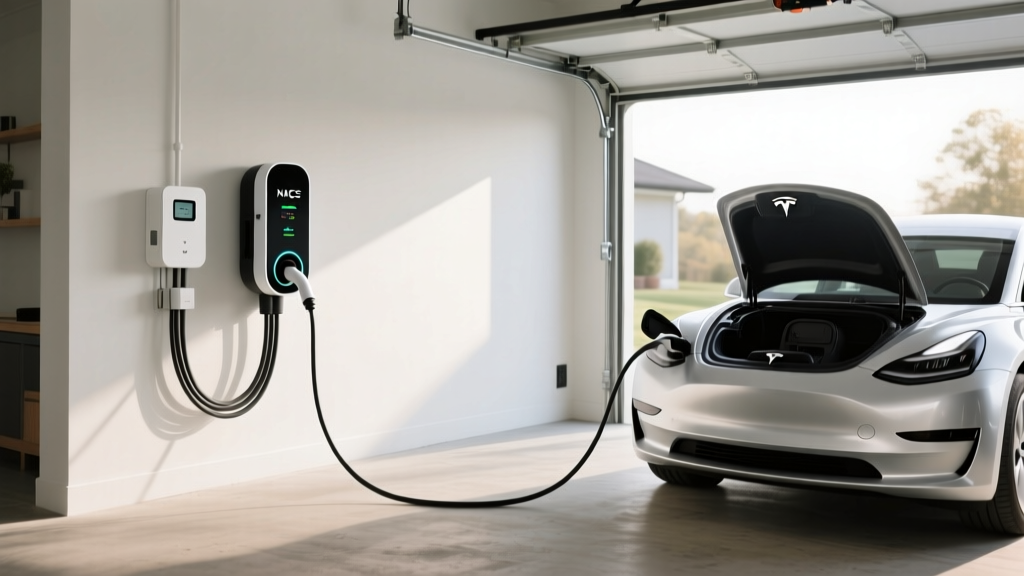
For 2026, NACS is the dominant standard. If you're buying a new electric SUV, it almost certainly ships with a native NACS port. Home Level 2 chargers are widely available with NACS connectors, and the Tesla Supercharger network — now open to most major brands — uses NACS exclusively.
Cost to Charge: EV Electricity vs. Supercharged V8 Gasoline
This is where the financial case for switching from a 2010 Range Rover Sport Supercharged becomes overwhelming. Let's run the numbers with real 2026 electricity and fuel prices.
| Scenario | Rate | Cost per Mile | Annual Cost (12,000 mi) |
|---|---|---|---|
| 2010 Range Rover Sport SC (14 mpg combined, $3.50/gal) | $3.50/gallon | $0.250 | $3,000 |
| Home Level 2, off-peak ($0.13/kWh, 3 mi/kWh avg) | $0.13/kWh | $0.043 | $520 |
| Home Level 2, standard rate ($0.18/kWh) | $0.18/kWh | $0.060 | $720 |
| Public Level 2 ($0.25/kWh avg) | $0.25/kWh | $0.083 | $1,000 |
| DC Fast Charging ($0.40/kWh avg, Electrify America/Tesla) | $0.40/kWh | $0.133 | $1,600 |
Even in the worst-case scenario — exclusively using DC fast chargers at highway rates — an electric SUV costs roughly half what the supercharged V8 demands in fuel. For drivers who charge primarily at home on off-peak rates, the annual fuel savings exceed $2,400. Over a typical 5-year ownership period, that's $12,000+ in fuel savings alone, before factoring in the elimination of oil changes, supercharger belt replacements, and other maintenance items specific to the AJ-V8 engine.
Equipment Recommendations: Best Home Level 2 Chargers for 2026
The home charger market has matured considerably. Here are proven units suited for luxury SUV owners who value reliability, smart features, and build quality:
Tesla Wall Connector (Gen 4)
- Power: 48A / 11.5 kW (hardwired, 240V)
- Connector: NACS native
- Cable length: 24 feet
- Smart features: Wi-Fi, OTA updates, load sharing, power metering via Tesla app
- Price: ~$425
- Best for: Tesla owners and NACS-native EVs; excellent reliability record
ChargePoint Home Flex (2nd Gen)
- Power: Up to 50A / 12 kW (hardwired); adjustable 16A–50A
- Connector: NACS or J1772 (NACS version for 2025+)
- Cable length: 23 feet
- Smart features: Wi-Fi, Alexa, scheduling, energy tracking, utility demand-response
- Price: ~$550
- Best for: Flexible amperage for older panels; robust app ecosystem
Emporia Level 2 EV Charger
- Power: 48A / 11.5 kW (hardwired)
- Connector: NACS or J1772
- Cable length: 24 feet
- Smart features: Real-time energy monitoring, solar integration, circuit-level load management with Emporia Vue panel monitor
- Price: ~$400
- Best for: Homes with solar panels or tight panel capacity; avoids panel upgrade with smart load management
Grizzl-E Smart (United Chargers)
- Power: 40A / 9.6 kW (NEMA 14-50 plug or hardwired)
- Connector: NACS or J1772
- Cable length: 24 feet
- Smart features: OCPP-compatible, works with multiple apps, -40°F rated
- Price: ~$450
- Best for: Cold-climate garages (Canadian-built, extreme cold tested); plug-in option avoids hardwiring
Safety, Code Compliance, and Installation Best Practices
EV charging involves sustained high-current draw — often 8+ hours continuously. This places demands on your electrical system that far exceed intermittent loads like a microwave or hair dryer. Safety is non-negotiable:
- Dedicated circuit: Your EV charger must be on its own breaker — never shared with other outlets or appliances. NEC Article 625 requires this for all EVSE (Electric Vehicle Supply Equipment).
- GFCI protection: Outdoor installations require GFCI (Ground Fault Circuit Interrupter) protection per NEC 2023 and later. Many modern hardwired chargers include built-in GFCI; plug-in units require a GFCI breaker.
- Outdoor rating: If your charger is mounted outside or in an unconditioned garage, ensure it carries a NEMA 4 (weatherproof) rating. All chargers listed above meet this standard.
- Hardwired vs. plug-in: Hardwired installations (directly connected to your panel wiring) support higher amperage (48A+) and eliminate the failure point of a NEMA 14-50 receptacle. Plug-in units (limited to 40A/9.6 kW on a 50A breaker) offer portability but require a properly installed and inspected 14-50 outlet. Note: many electricians now recommend against using standard 14-50 receptacles for continuous EV charging due to thermal concerns with consumer-grade outlets — specify an industrial-grade Hubbell or Bryant receptacle if going plug-in.
- Cable management: Use a wall-mounted cable organizer to prevent tripping hazards and connector damage. Never run charging cables across walkways or driveways where vehicles could drive over them.
- Permit and inspection: Always pull an electrical permit. The inspection verifies wire gauge, breaker sizing, grounding, and GFCI compliance. This protects you legally and ensures insurance coverage in the event of an electrical fire.
Making the Switch: A Decision Framework for Range Rover Sport Owners
Choose an EV if:
- You can install Level 2 charging at home (owned garage or driveway with panel access)
- Your daily driving is under 250 miles (covers most commutes and errands with range to spare)
- You want to eliminate $2,000–$4,000/year in fuel costs and $800–$1,500/year in V8 maintenance
- You value instant torque (electric SUVs deliver 0-60 in 3.5–5.0 seconds, rivaling or beating the 510hp supercharged V8)
- You're ready to accept that road trips require 20–35 minute charging stops every 200–280 miles
Hold off or consider a PHEV if:
- You live in an apartment or condo without charging access and cannot install a home charger
- You regularly tow heavy loads (EV towing range drops 30–50%; the Range Rover Sport's 7,700-lb tow rating is difficult to match in current EVs)
- You frequently drive 400+ mile remote routes with limited charging infrastructure
- Your home needs a $3,000+ panel upgrade and you plan to move within 2 years
The 2010 Range Rover Sport Supercharged was a product of its era — thrilling, luxurious, and brutally thirsty. Modern electric SUVs deliver comparable (or superior) performance, dramatically lower operating costs, and zero tailpipe emissions. With a properly installed home Level 2 charger, the daily ownership experience is arguably more convenient: no gas station detours, just plug in at home and start each day with 250–350 miles of range.
Frequently Asked Questions
How much does it cost to install a home EV charger?
A standard Level 2 home charger installation ranges from $800 to $2,900 for most homes, including the charger unit ($400–$700), electrician labor, materials, and permits. Homes requiring a 200A panel upgrade can see total costs of $3,500–$7,900. Always get 2–3 quotes from licensed electricians and verify they have EV charger installation experience.
How fast will each charging level add range?
Level 1 (120V standard outlet) adds 3–5 miles per hour — adequate for plug-in hybrids but impractical for full EVs with 100+ kWh batteries. Level 2 (240V, 48A) adds 25–40 miles per hour for most electric SUVs, fully recharging overnight. DC fast charging at 150–350 kW adds 150–1,000+ miles per hour, enabling a 10–80% charge in 18–35 minutes depending on the vehicle.
Which connector or charger is compatible with my EV?
As of 2026, nearly all new EVs sold in North America use the NACS (Tesla-style) connector, including Ford, GM, Rivian, Hyundai, Kia, BMW, Mercedes-Benz, and the upcoming Range Rover Electric. Older 2020–2024 EVs may have CCS1 ports, which require a NACS-to-CCS adapter (~$200) to use Tesla Superchargers. CHAdeMO is effectively discontinued. For home Level 2 charging, purchase a charger with the connector matching your vehicle's native port.
How much does charging cost per mile compared to gas?
Home charging on off-peak rates (~$0.13/kWh) costs approximately $0.04 per mile for a typical electric SUV achieving 3 miles per kWh. The 2010 Range Rover Sport Supercharged at 14 mpg combined and $3.50/gallon costs $0.25 per mile. That's a per-mile fuel cost reduction of roughly 83%. Even exclusive DC fast charging at $0.40/kWh ($0.13/mile) remains about half the cost of gasoline.
What electrical upgrades might I need?
The most common upgrade is ensuring your electrical panel has sufficient capacity. A 200A panel with available breaker slots typically accommodates a 48A–60A EV circuit without issue. Homes with 100A panels often require a service upgrade ($1,500–$3,500). Some utilities offer "make-ready" programs that subsidize panel upgrades for EV adopters. Additionally, if your charger location is far from the panel (50+ feet), wire costs increase significantly. A smart charger with load management (like the Emporia with Vue panel monitor) can sometimes avoid a panel upgrade by dynamically reducing charge rate when other home loads are high.
Will charging at home increase my electric bill significantly?
Yes, but far less than you currently spend on gasoline. Charging a 100 kWh battery from empty to full costs roughly $13 at $0.13/kWh. If you drive 12,000 miles per year at 3 mi/kWh, you'll use about 4,000 kWh annually — adding roughly $520 to your yearly electric bill. Compare that to $3,000+ in annual gasoline costs for the Range Rover Sport Supercharged. Many utilities offer time-of-use (TOU) plans with super off-peak rates as low as $0.06–$0.09/kWh between midnight and 6 AM, further reducing costs.
Do I need a Tesla-specific charger for a Tesla, or can I use any Level 2 unit?
Any NACS-connector Level 2 charger works with Tesla vehicles. The Tesla Wall Connector offers the best integration (power metering in the Tesla app, load sharing between multiple units), but third-party NACS chargers from ChargePoint, Emporia, and Grizzl-E charge at identical speeds. The vehicle's onboard charger determines the maximum Level 2 acceptance rate — for Tesla Model X, that's 11.5 kW (48A), so any 48A+ NACS charger delivers maximum speed.