The Three EV Charging Types: What Every Owner Needs to Know
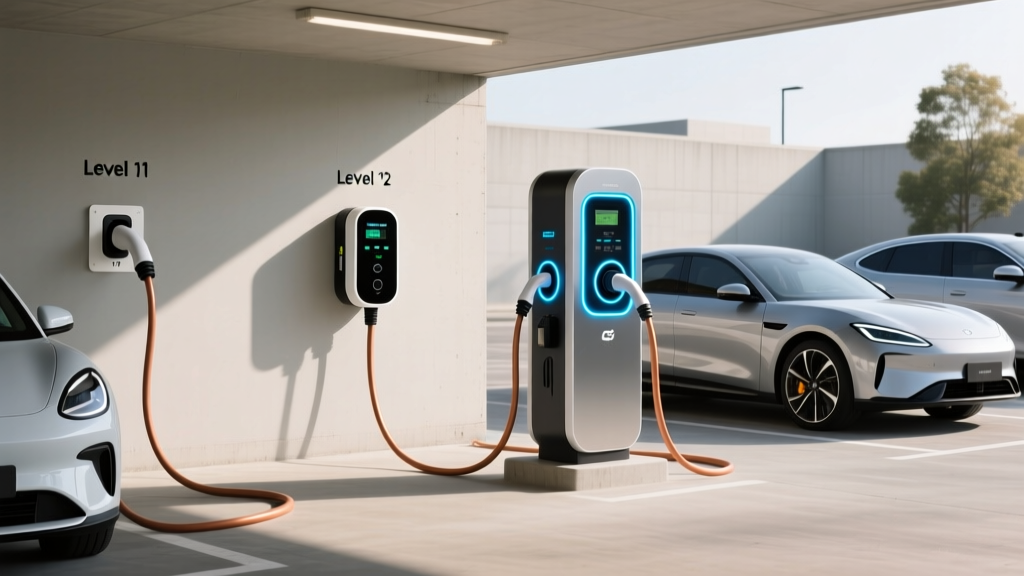
If you're shopping for an electric vehicle or just took delivery of one, understanding EV charging types is the single most important piece of ownership homework you'll do. The charging ecosystem breaks into three distinct tiers — Level 1, Level 2, and DC Fast Charging — each defined by its power delivery in kilowatts (kW), the connector it uses, and where you'll actually encounter it.
A quick but critical distinction before we go further: kW (kilowatts) measures power — how fast energy flows into your battery. kWh (kilowatt-hours) measures energy — the total capacity of your battery, like gallons in a gas tank. A 75 kWh battery charged at 11.5 kW takes roughly 6.5 hours from empty to full. Confusing these two units is the most common mistake in EV coverage, and it leads to wildly wrong expectations about charging time.
Here's how each charging type performs in the real world:
| Level | Voltage | Max Power (kW) | Miles of Range per Hour | Typical Location | Best For |
|---|---|---|---|---|---|
| Level 1 | 120V AC | 1.0–1.9 kW | 3–5 mi/hr | Any standard outlet | PHEVs, overnight top-offs, low-mileage drivers |
| Level 2 | 240V AC | 3.3–19.2 kW | 12–75 mi/hr | Home (installed), workplaces, public destinations | Daily charging for BEVs, overnight full charges |
| DC Fast | 400–800V DC | 50–350 kW | 150–1,000+ mi/hr (peak) | Highway corridors, dedicated stations | Road trips, quick top-ups, fleet turnover |
Those miles-per-hour figures assume an efficient sedan around 3.0–3.5 miles/kWh (like a Tesla Model 3 or Hyundai Ioniq 6). Larger, heavier vehicles like the Ford F-150 Lightning or Rivian R1S consume more energy per mile, so expect 20–30% fewer miles added per hour at each level.
Level 1 Charging: The Emergency Backup
Every EV ships with a mobile charging cord that plugs into a standard 120V household outlet. This is Level 1. It delivers between 1.0 kW (on a 15-amp circuit) and 1.9 kW (on a 20-amp circuit), adding roughly 3 to 5 miles of range per hour of charging.
For a plug-in hybrid like the Toyota RAV4 Prime with 42 miles of electric range, Level 1 is perfectly adequate — you'll fully recharge the 18.1 kWh battery in about 10 hours overnight. For a full battery-electric vehicle with a 75–100 kWh battery, Level 1 is painfully slow: a depleted Tesla Model Y Long Range (75 kWh usable) would take over 40 hours to fill from zero.
Level 1 is best understood as a fallback — useful for hotel stays, visiting family without charging infrastructure, or PHEV owners with short commutes. It's not a daily charging strategy for BEV owners who drive more than 30 miles a day.
Level 2 Charging: The Home Charging Standard
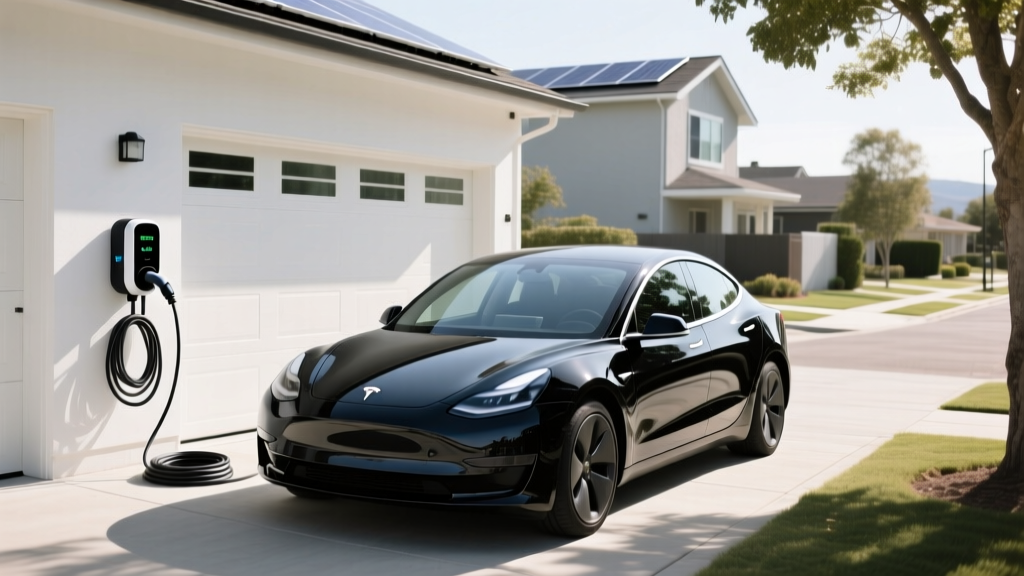
Level 2 operates on 240V AC — the same voltage as your electric dryer or oven — and is the backbone of practical EV ownership. Most BEV owners do 80–90% of their charging at home on Level 2, plugging in when they arrive and waking up to a full battery every morning.
Level 2 chargers range from 3.3 kW (16 amps) to 19.2 kW (80 amps), though the most common home installations fall between 7.7 kW (32A) and 11.5 kW (48A). The practical sweet spot for most households is a 48-amp charger on a 60-amp dedicated circuit, delivering 11.5 kW and adding roughly 35–44 miles of range per hour. That means an 80 kWh battery charges from 10% to 80% in about 5 hours — easily overnight.
The vehicle's onboard charger also caps the speed. A Chevrolet Equinox EV accepts up to 11.5 kW on Level 2, while a Ford F-150 Lightning with the extended-range battery can accept up to 19.2 kW if you have an 80-amp circuit. Always check your vehicle's onboard charger spec before overspending on a high-amperage wall unit.
Charging Time Examples: 10% to 80% on Level 2
| Vehicle (Battery Size) | 7.7 kW (32A) | 11.5 kW (48A) | 19.2 kW (80A) |
|---|---|---|---|
| Hyundai Ioniq 5 (77.4 kWh) | ~7.0 hrs | ~4.7 hrs | ~2.8 hrs* |
| Tesla Model Y LR (75 kWh) | ~6.8 hrs | ~4.5 hrs | ~2.7 hrs* |
| Ford F-150 Lightning ER (131 kWh) | ~11.9 hrs | ~8.0 hrs | ~4.8 hrs |
| BMW i4 eDrive40 (81.5 kWh) | ~7.4 hrs | ~5.0 hrs | ~3.0 hrs* |
*Vehicle's onboard charger may cap at 11.5 kW; check manufacturer specs. Times assume 10%–80% State of Charge; charging slows significantly above 80% to protect battery health.
DC Fast Charging: Road-Trip Speed
DC Fast Charging (DCFC) bypasses your vehicle's onboard charger entirely, sending direct current straight into the battery at far higher power levels. Public DCFC stations range from 50 kW legacy units to 350 kW ultra-fast chargers from networks like Electrify America, EVgo, and Tesla Superchargers.
Here's where the charging curve matters most. A vehicle advertised as "capable of 250 kW" doesn't sustain that rate for the entire session. Lithium-ion batteries accept peak power only at a low State of Charge (SoC), typically between 10% and 30%. As the battery fills, the Battery Management System (BMS) tapers the charge rate to prevent overheating and degradation. A Hyundai Ioniq 5 that peaks at 240 kW at 15% SoC may drop to 150 kW by 50% and 60 kW by 80%. That's why the industry uses 10%–80% charge time as the standard benchmark.
DC Fast Charging: 10%–80% Benchmarks
| Vehicle | Peak DC Rate | 10–80% Time (Ideal) | Connector |
|---|---|---|---|
| Hyundai Ioniq 5 (800V architecture) | 240 kW | ~18 min | NACS (2025+), CCS1 (prior) |
| Tesla Model 3 Highland LR | 250 kW | ~22 min | NACS |
| Ford Mustang Mach-E ER | 150 kW | ~35 min | NACS (2025+), CCS1 (prior) |
| Cadillac Lyriq | 190 kW | ~28 min | NACS (2025+), CCS1 (prior) |
| Rivian R1T Dual-Motor (Large) | 200 kW | ~30 min | NACS |
| Nissan Ariya e-4ORCE (91 kWh) | 130 kW | ~40 min | NACS (2025+), CCS1 (prior) |
Those times assume preconditioning — the vehicle's thermal management system warming or cooling the battery to its ideal charging temperature before you arrive. Tesla, Hyundai/Kia, and most modern EVs precondition automatically when you navigate to a charger. Without preconditioning, especially in cold weather, expect 10–80% times to stretch by 30–50%.
Connector Compatibility: NACS, CCS1, and CHAdeMO
The North American EV charging connector landscape has undergone a massive consolidation. Tesla's North American Charging Standard (NACS) has been adopted by nearly every major automaker starting with 2025 model-year vehicles, effectively making it the dominant standard for both Level 2 and DC fast charging.
| Connector | Brands Using It (Native Port) | Level 2 | DC Fast | Adapter Needed? |
|---|---|---|---|---|
| NACS (Tesla standard) | Tesla, Ford, GM, Rivian, Volvo, Polestar, Mercedes, Hyundai/Kia (2025+), BMW, Toyota, Subaru, Lucid | Yes | Yes | CCS1-to-NACS adapter for older CCS vehicles at NACS stalls |
| CCS1 (Combined Charging System) | Pre-2025 models from most non-Tesla brands; remaining VW ID.4, some Stellantis models | Yes | Yes | NACS-to-CCS1 adapter for CCS vehicles at Tesla Superchargers |
| CHAdeMO | Nissan Leaf (discontinued), Mitsubishi Outlander PHEV (legacy) | Yes | Yes (declining) | No native adapter to NACS/CCS; stations being phased out |
If you're buying a new EV in 2026, you'll almost certainly get a NACS port. If you own a 2022–2024 model with CCS1, adapters are widely available — Ford provides a complimentary CCS-to-NACS adapter for Supercharger access, and third-party options from Lectron and A2Z run $150–$250. The key question for your home charger: most Level 2 wall connectors now ship with NACS, but CCS-terminated units are still available, and J1772-to-NACS adapters (for Level 2) are inexpensive.
For authoritative connector and infrastructure data, the U.S. Department of Energy's Alternative Fuels Data Center maintains a live map of station connector availability.
Home Charger Installation: Costs, Electrical Requirements, and Gotchas
Installing a Level 2 home charger is where most new EV owners encounter unexpected complexity and cost. The total expense depends on your home's electrical panel capacity, the distance from panel to charger location, and local permit requirements.
Electrical Requirements
A standard 48-amp Level 2 charger requires a dedicated 60-amp, 240V circuit. The National Electrical Code (NEC) requires that continuous loads (defined as running 3 hours or more — which EV charging qualifies as) not exceed 80% of the circuit's rated capacity. So a 60-amp breaker supports a 48-amp continuous draw, a 50-amp breaker supports 40 amps, and so on.
If your home's main electrical panel is 100 amps — common in homes built before the 1990s — you may not have enough spare capacity to add a 60-amp circuit alongside existing loads like an electric range, dryer, and central AC. This is where a panel upgrade to 200 amps becomes necessary, and it's the single biggest cost variable in home charger installation.
| Component | Simple Install (Panel Has Capacity, Short Run) | Moderate Install (Longer Run, Minor Upgrades) | Complex Install (Panel Upgrade Required) |
|---|---|---|---|
| Level 2 Charger (hardware) | $300–$700 | $300–$700 | $300–$700 |
| Electrical permit | $50–$150 | $50–$200 | $100–$300 |
| Electrician labor + materials (conduit, wire, breaker) | $400–$1,200 | $1,200–$2,500 | $1,500–$3,000 |
| Panel upgrade (100A → 200A, if needed) | $0 | $0 | $1,800–$4,000 |
| Total estimated cost | $750–$2,050 | $1,550–$3,400 | $3,700–$8,000 |
Always hire a licensed electrician familiar with EV charger installs. Ask for a load calculation on your panel before committing to a circuit size. Some utilities offer rebates of $250–$1,000 for home charger installation — check with your local provider before starting work.
There is also a federal tax incentive: the Alternative Fuel Vehicle Refueling Property Credit (IRS Form 8911) can cover up to 30% of home charging equipment and installation costs, capped at $1,000, for installations in eligible census tracts. Check the IRS guidelines on Form 8911 for current eligibility requirements, as census tract qualification is specific and varies by address.
Safety and Code Considerations
- Dedicated circuit: Your EV charger must be on its own dedicated breaker — never shared with other appliances.
- GFCI protection: The 2020 NEC and later require GFCI (Ground Fault Circuit Interrupter) protection for outdoor receptacles. Many hardwired wall connectors have built-in GFCI; if you're using a plug-in NEMA 14-50 outlet outdoors, your electrician must install a GFCI breaker.
- Outdoor rating: If mounting outside, ensure the charger carries a NEMA 4 or NEMA 4X rating for weather resistance. Most major brands (ChargePoint, Wallbox, Tesla) rate their units for indoor and outdoor use.
- Cable management: Longer cables (24–25 feet) are worth the small upcharge for flexibility in reaching your charge port, especially if you park in a driveway or have a two-car garage.
- Wi-Fi connectivity: Smart chargers let you schedule charging during off-peak utility hours, monitor energy use, and receive firmware updates. Non-smart ("dumb") chargers are cheaper but forfeit these savings.
Level 2 Charger Equipment Picks: What to Buy
The market is flooded with Level 2 chargers, but a few consistently earn top marks for reliability, build quality, and smart features. Here are three we recommend across different budgets:
Emporia Vue Level 2 Smart Charger
Power: Up to 11.5 kW (48A) | Connector: NACS or J1772 | Cable: 24 ft | Smart features: Wi-Fi, app scheduling, solar integration, energy monitoring | Price: ~$399
Best value in smart chargers. Excellent app, real-time energy tracking, and the ability to integrate with Emporia's whole-home energy monitor. Works on 40A or 60A circuits (dip-switch configurable).
ChargePoint Home Flex
Power: Up to 12 kW (50A) | Connector: NACS or J1772 | Cable: 23 ft | Smart features: Wi-Fi, Alexa, scheduling, charge history | Price: ~$549–$649
Long-running industry favorite. Amperage is adjustable from 16A to 50A via the app, making it flexible for different circuit sizes. UL-listed and widely available at big-box retailers.
Tesla Wall Connector (Gen 3)
Power: Up to 11.5 kW (48A) | Connector: NACS (native), J1772 adapter available | Cable: 24 ft | Smart features: Wi-Fi, OTA updates, access control, power sharing between units | Price: ~$475
Sleek design, reliable, and the power-sharing feature lets you install two units on a single circuit — ideal for two-EV households. Best paired with Tesla or NACS-equipped vehicles.
The Real Cost of Charging: Home vs. Public vs. Gas
One of the strongest arguments for EV ownership is fuel cost savings — but the math depends heavily on where and when you charge. Here's a realistic breakdown using national average electricity rates and gasoline prices as of early 2026.
| Scenario | Rate | Cost per kWh | Cost per Mile (at 3.2 mi/kWh) |
|---|---|---|---|
| Home, off-peak utility rate | $0.09–$0.13/kWh | $0.11 avg | $0.034 |
| Home, standard residential rate | $0.14–$0.18/kWh | $0.16 avg | $0.050 |
| Public Level 2 (workplace, destination) | $0.20–$0.35/kWh | $0.28 avg | $0.088 |
| DC Fast Charging (public) | $0.30–$0.55/kWh | $0.42 avg | $0.131 |
| Gasoline (28 MPG avg sedan, $3.20/gal) | $3.20/gal | — | $0.114 |
The takeaway: home charging is dramatically cheaper than gasoline, typically one-third to one-quarter the per-mile cost. Public DC fast charging, however, can actually cost more per mile than gasoline. This is why home charging access is the single biggest predictor of EV ownership satisfaction. If you rely exclusively on public DCFC, your fuel cost advantage shrinks considerably.
For a driver covering 12,000 miles per year, home off-peak charging costs roughly $410 annually. The same miles in a 28 MPG gas car cost about $1,370 — a savings of nearly $960 per year. Over five years, that's $4,800 in fuel savings, partially offsetting the higher purchase price of many EVs. The EPA's fueleconomy.gov provides a personalized calculator based on your local electricity rates and specific vehicle model.
Frequently Asked Questions
How much does it cost to install a home EV charger?
A straightforward Level 2 installation with adequate panel capacity typically costs $750–$2,050 all-in (charger, permit, electrician labor and materials). If your home needs a 200-amp panel upgrade, expect $3,700–$8,000 total. Always get a load calculation from a licensed electrician first, and check for utility rebates that can offset $250–$1,000 of the cost.
How fast will each charging level add range?
Level 1 (120V) adds 3–5 miles per hour. Level 2 (240V) adds 12–75 miles per hour depending on amperage — a typical 48A home charger adds about 35–44 mi/hr. DC fast charging adds 150–1,000+ miles per hour at peak, but the rate tapers significantly as the battery fills, which is why 10–80% time (typically 18–40 minutes) is the useful metric.
Which connector and charger is compatible with my EV?
For 2025–2026 model-year vehicles, nearly all new EVs use the NACS connector natively. If you own a 2022–2024 model with CCS1, you'll need a NACS adapter for Tesla Supercharger access. CHAdeMO is being phased out. For home Level 2 charging, match your wall connector's plug to your vehicle's port, or use a J1772-to-NACS adapter.
How much does EV charging cost per mile compared to gas?
Charging at home on off-peak rates costs about $0.03–$0.05 per mile — roughly one-third the cost of gasoline at $3.20/gallon in a 28 MPG car ($0.11/mi). Public DC fast charging averages $0.13/mile, which can exceed gas costs. Maximizing home charging is the key to EV fuel savings.
What electrical upgrades might I need for a home charger?
The most common upgrade is a panel capacity increase from 100A to 200A, required when your existing panel can't support an additional 60-amp dedicated circuit. Older homes may also need new conduit runs, a NEMA 14-50 outlet installation, or a GFCI breaker for outdoor mounting. Your electrician's load calculation will determine what's needed.
Does DC fast charging degrade my battery?
Occasional DC fast charging has minimal impact on battery health. However, exclusive reliance on DCFC — especially frequent charging to 100% — accelerates degradation compared to predominantly Level 2 charging. Modern Battery Management Systems actively manage thermal loads, and most manufacturers warranty their batteries for 8 years/100,000 miles with a minimum 70% capacity retention threshold. For daily use, stick to Level 2 and reserve DCFC for road trips.