The 30% Federal Tax Credit for Home EV Chargers: What You Can Actually Claim
Buying and installing a home Level 2 EV charger qualifies for the Alternative Fuel Vehicle Refueling Property Credit under IRS §30C — a federal tax credit worth up to $1,000 for residential charging equipment. For the electric vehicle charging stations tax credit to apply, your charger must be placed in service at your primary residence in a qualifying census tract (generally low-income or non-urban areas). The credit covers 30% of combined hardware and installation costs, capped at $1,000 per year.
Here's the reality most buyers miss: if you spend $1,200 on a charger and electrician, you'll claim $360 back (30%). To max out the $1,000 credit, your total project cost needs to hit at least $3,334 — which typically means a panel upgrade is involved. The credit is non-refundable, meaning it can only reduce your federal tax liability to zero; it won't generate a refund if you owe less than the credit amount.
As of 2026, eligibility hinges on three factors the IRS §30C guidelines enforce:
- Location: Your home must be in a qualifying census tract (check the IRS eligibility tool or your tax professional)
- Equipment: Must be new, UL-listed (or equivalent safety certification), and permanently installed
- Use: Residential property for personal use — commercial installations have separate, higher caps
Always confirm eligibility with a qualified tax professional before filing. Census tract qualifications update periodically, and IRS guidance can shift.
Charging Levels Explained: kW, Miles per Hour, and Real Charge Times
The single most important EV literacy concept: kW (kilowatts) measures power — how fast energy flows into your battery. kWh (kilowatt-hours) measures energy — how much your battery stores. A 48 kW charger doesn't deliver 48 kWh; it delivers energy at a rate of 48 kW. Think of kW as the width of a hose and kWh as the size of the bucket.
| Level | Voltage | Power (kW) | Miles Added/Hour | Best For |
|---|---|---|---|---|
| Level 1 | 120V AC | 1.0–1.4 kW | 3–5 mi/hr | Overnight top-ups, PHEVs, low-mileage drivers |
| Level 2 (Home) | 240V AC | 7.2–11.5 kW | 23–44 mi/hr | Daily charging, full overnight replenishment |
| Level 2 (Public) | 208–240V AC | 6.6–19.2 kW | 21–60 mi/hr | Destination charging, workplace, shopping |
| DC Fast | 200–900V DC | 50–350 kW | 150–1,200 mi/hr* | Road trips, rapid replenishment |
*Miles-per-hour figures for DC fast charging apply only at peak rate during the 10–40% state of charge window. Charging slows significantly above 80% to protect battery health — a phenomenon called the charge curve taper.
Real-World 10–80% Charge Times by Battery Size
Charging time depends on battery capacity (kWh), the charger's peak output (kW), and your vehicle's onboard charge acceptance rate. Here's what to expect at a DC fast charger for common EV architectures:
- Hyundai Ioniq 5 (77.4 kWh battery, 800V architecture): Peaks at ~240 kW; 10–80% in approximately 18 minutes on a 350 kW charger
- Tesla Model Y Long Range (75 kWh usable, 400V): Peaks at ~250 kW at V3/V4 Superchargers; 10–80% in approximately 22 minutes
- Ford F-150 Lightning Extended Range (131 kWh, 400V): Peaks at ~155 kW; 10–80% in approximately 41 minutes
- Chevrolet Equinox EV (85 kWh, 400V): Peaks at ~150 kW; 10–80% in approximately 32 minutes
At home on a Level 2 charger (typically 11.5 kW / 48A), expect a full overnight charge to replenish 35–50 miles of range per hour of charging. Most EV owners charging from 20–80% overnight will wake to a full battery in 6–8 hours.
Home Charger Installation: Electrical Requirements and Real Costs
A Level 2 home charger requires a dedicated 240V circuit — the same voltage as your electric dryer or oven. The most common residential setup is a 240V/48A circuit on a 60A breaker, which supports chargers rated up to 48 amps (NEC code requires the breaker to be rated 125% of the continuous load).
What Determines Your Installation Cost?
Your total project cost depends on four variables:
- Distance from panel to charger location: Every foot of conduit and 240V wiring adds $8–$15 in labor and materials
- Panel capacity: Most homes need at least a 100A main panel; a 48A EV charger draws significant continuous load. Homes with 100A panels may need a $1,500–$3,000 upgrade to 200A
- Permitting: Most jurisdictions require an electrical permit ($50–$200) and a post-installation inspection
- Wall-mount vs. pedestal: Garage wall-mounts are simplest; outdoor pedestals require trenching and concrete work
| Component | Simple Install (Near Panel) | Complex Install (Far Run + Panel Upgrade) |
|---|---|---|
| Level 2 Charger (Hardware) | $350–$700 | $350–$700 |
| Electrician Labor | $400–$800 | $1,500–$3,000 |
| Wiring, Conduit, Materials | $100–$300 | $500–$1,200 |
| Electrical Panel Upgrade (if needed) | $0 | $1,500–$3,000 |
| Permit and Inspection | $50–$150 | $100–$250 |
| Total | $900–$1,950 | $3,950–$8,150 |
Panel upgrade reality check: Homes built before 2000 frequently have 100A panels. Adding a 48A continuous-load EV charger can exceed the panel's safe capacity, especially if you also run electric heat, an electric dryer, and an electric oven simultaneously. A licensed electrician will perform a load calculation before recommending whether an upgrade is necessary. Don't skip this step — an overloaded panel is a fire hazard.
Connector Compatibility: NACS, CCS, and CHAdeMO in 2026
The connector landscape has consolidated significantly. As of 2026, NACS (North American Charging Standard — Tesla's connector) is the dominant standard for new vehicles sold in the US. Ford, GM, Rivian, Volvo, Polestar, and others have adopted NACS natively. Legacy CCS1 vehicles still populate the road and require adapters at NACS-only stations.
| Connector | Brands Using Natively | Adapter Needed For |
|---|---|---|
| NACS (Tesla) | Tesla, Ford, GM, Rivian, Volvo, Polestar, Hyundai (newer models), Kia (newer models) | CCS public stations (use NACS-to-CCS adapter) |
| CCS1 | Volkswagen, BMW, Mercedes (some), older Hyundai/Kia, Honda Prologue (early models) | Tesla Superchargers (use CCS-to-NACS adapter, ~$200–$250) |
| CHAdeMO | Nissan Leaf (legacy only — no new models) | Limited network; no viable adapter path to NACS |
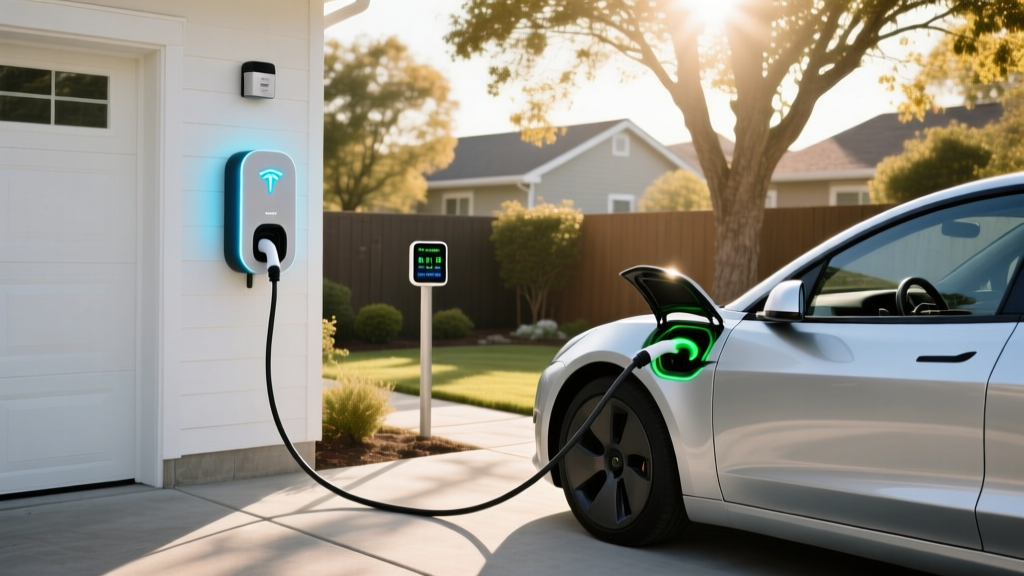
For home chargers: Most Level 2 chargers sold in 2026 ship with a J1772 connector (the legacy Level 2 standard). NACS-equipped vehicles use the included J1772-to-NACS adapter that ships with the car. Tesla Wall Connectors use NACS natively. If you drive a CCS1 vehicle, buy a charger with a J1772 connector — it's the universal Level 2 standard and works with every EV via adapter.
Cost to Charge: Home vs. Public vs. Gas per Mile
The economic case for home charging is overwhelming — but public DC fast charging narrows the gap with gasoline considerably. Here's how the numbers break down using 2026 national averages.
| Scenario | Rate | Cost per Mile (at 3.5 mi/kWh) | Cost for 300-Mile Trip |
|---|---|---|---|
| Home Level 2 (off-peak TOU rate) | $0.08–$0.12/kWh | $0.025–$0.034 | $7.50–$10.30 |
| Home Level 2 (standard rate) | $0.13–$0.18/kWh | $0.037–$0.051 | $11.10–$15.40 |
| Public Level 2 (ChargePoint, etc.) | $0.25–$0.49/kWh | $0.071–$0.140 | $21.40–$42.00 |
| DC Fast (Electrify America, EVgo) | $0.35–$0.56/kWh | $0.100–$0.160 | $30.00–$48.00 |
| Tesla Supercharger (varies by location) | $0.25–$0.40/kWh | $0.071–$0.114 | $21.40–$34.30 |
| Gasoline (28 MPG combined, $3.40/gal) | $3.40/gallon | $0.121 | $36.40 |
The takeaway: home charging on an off-peak time-of-use (TOU) plan delivers fuel costs roughly 75–80% below gasoline. Public DC fast charging at peak rates can match or exceed the cost of gas. This is why home charging access is the single biggest factor in EV ownership satisfaction.
Many utilities offer TOU plans that drop rates to $0.06–$0.09/kWh between midnight and 6 AM. Pair this with your charger's scheduled charging feature and you'll consistently hit the lowest cost-per-mile tier.
Level 2 Home Charger Recommendations (2026)
Every charger below is UL-listed, supports the NEMA 14-50 plug or hardwired installation, and includes smart scheduling features. Prices reflect 2026 retail availability.
Emporia Vue Level 2 EV Charger
- Power output: 48A / 11.5 kW (hardwired) or 40A / 9.6 kW (NEMA 14-50 plug)
- Connector: J1772 (works with all EVs via included adapters)
- Cable length: 24 ft
- Smart features: Wi-Fi, app scheduling, solar integration, energy monitoring, TOU optimization
- Price: ~$399 (hardwired) / ~$379 (plug-in)
- Best for: Budget-conscious buyers who want full smart features and solar-home integration
Tesla Wall Connector (Gen 4)
- Power output: 48A / 11.5 kW (hardwired)
- Connector: NACS native (J1772 adapter included for non-Tesla vehicles)
- Cable length: 24 ft
- Smart features: Wi-Fi, OTA updates, load sharing (pair two units on one circuit), power management with Tesla Powerwall
- Price: ~$475
- Best for: Tesla owners and NACS-adopting households; cleanest integration with Tesla ecosystem
ChargePoint Home Flex
- Power output: Up to 50A / 12.0 kW (hardwired); adjustable down to 16A for lower-capacity panels
- Connector: J1772 (NACS adapter included)
- Cable length: 23 ft
- Smart features: Wi-Fi, app scheduling, Alexa integration, detailed session history, amperage dial for panel-limited homes
- Price: ~$649
- Best for: Homes with limited panel capacity (dial down amperage without buying a different unit); strong app experience
Grizzl-E Smart
- Power output: 40A / 9.6 kW (NEMA 14-50) or 48A / 11.5 kW (hardwired)
- Connector: J1772 (NACS adapter available)
- Cable length: 24 ft
- Smart features: Wi-Fi, OCPP compatibility, adjustable amperage, extreme-cold rated (-40°F)
- Price: ~$549
- Best for: Cold-climate installations and outdoor mounting; built in Canada with rugged enclosure
Safety, Electrical Code, and Installation Requirements
EV chargers draw significant continuous current — more than most household appliances. The National Electrical Code (NEC) treats EV charging as a continuous load, which triggers specific requirements:
- Dedicated circuit: Your EV charger must be on its own dedicated breaker — it cannot share a circuit with other appliances or outlets
- Breaker sizing: The breaker must be rated at 125% of the charger's maximum amperage. A 48A charger requires a 60A breaker; a 32A charger requires a 40A breaker
- GFCI protection: NEC 2020 and later requires GFCI protection for all EV charging outlets (NEMA 14-50 receptacles). Hardwired chargers with built-in ground-fault protection may not require an additional GFCI breaker, but local code varies — confirm with your electrician and AHJ (Authority Having Jurisdiction)
- Outdoor rating: If your charger is installed outdoors or in an unenclosed carport, the unit must carry a NEMA 4 or IP65 weatherproof rating. All four chargers recommended above meet this standard
- Wire gauge: A 60A circuit requires 6 AWG copper wire (or 4 AWG aluminum). Your electrician will size wire based on run length and local amendments to the NEC
- Permit and inspection: Nearly all US jurisdictions require an electrical permit for EV charger installation. The inspector will verify breaker sizing, wire gauge, grounding, and GFCI compliance. Skipping the permit risks insurance claim denial in the event of an electrical fire
NEMA 14-50 vs. hardwired: A plug-in charger on a NEMA 14-50 outlet offers portability — you can take it when you move. However, hardwired installations eliminate the GFCI breaker requirement in many jurisdictions (since the charger has internal protection), can support higher amperage, and avoid the known issue of NEMA 14-50 receptacle overheating under continuous EV loads. For a permanent installation, hardwired is the safer, higher-performance choice.
Frequently Asked Questions
How much does it cost to install a home EV charger?
A straightforward installation with the electrical panel nearby typically costs $900–$1,950 including the charger, electrician labor, materials, and permit. Complex installations requiring long wire runs, conduit, or a panel upgrade to 200A can range from $3,950 to $8,150. The §30C electric vehicle charging stations tax credit can offset 30% of these costs, up to $1,000, if your home is in a qualifying census tract.
How fast will each charging level add range?
Level 1 (120V) adds 3–5 miles of range per hour — sufficient for PHEVs and low-mileage drivers. Level 2 (240V) adds 23–44 miles per hour depending on amperage and your vehicle's onboard charger acceptance rate. DC fast charging adds 150–1,200 miles per hour at peak rate, but only during the 10–40% state of charge window before the charge curve tapers.
Which connector and charger is compatible with my EV?
If you drive a 2025–2026 Tesla, Ford, GM, Rivian, Volvo, or Polestar, your vehicle uses NACS natively. Choose a Tesla Wall Connector for seamless integration, or any J1772 charger with the NACS adapter included with your car. If you drive a Volkswagen, BMW, or older CCS1 vehicle, choose a J1772 charger — it's the universal Level 2 standard. CHAdeMO (Nissan Leaf) is a legacy connector with no adapter path to NACS; use J1772 for home charging.
How much does charging cost per mile compared to gas?
Home charging on an off-peak utility rate ($0.08–$0.12/kWh) costs roughly $0.025–$0.034 per mile — about 75% less than gasoline at $3.40/gallon and 28 MPG combined. Public DC fast charging at $0.35–$0.56/kWh costs $0.10–$0.16 per mile, which is comparable to or slightly above gasoline. The economic advantage of EV ownership depends heavily on reliable home charging access.
What electrical upgrades might I need for a home charger?
Homes with 100A electrical panels often need an upgrade to 200A to safely support a 48A continuous-load EV charger alongside other electric appliances. This upgrade costs $1,500–$3,000 and requires a licensed electrician and utility coordination. Older homes with knob-and-tube wiring, aluminum branch circuits, or insufficient grounding may need additional remediation. Always get a professional load calculation before purchasing equipment.
For the most current §30C credit rules and qualifying census tract maps, consult IRS.gov's official guidance and work with a tax professional familiar with energy credits. Utility incentive programs for charger installation and TOU rate plans vary by provider — check Energy.gov's home charging resources for state-specific programs.