The kW vs kWh Distinction You Must Know First
Before comparing charging speeds, lock down the single most misunderstood pair of terms in EV ownership:
- kW (kilowatts) measures power — how fast energy flows into your car. Think of it as the width of the hose.
- kWh (kilowatt-hours) measures energy — the total capacity of your battery. Think of it as the size of the bucket.
A 75 kWh battery charged at 11.5 kW (a typical Level 2 home charger) needs roughly 6.5 hours from empty to full. That same battery on a 150 kW DC fast charger could go from 10% to 80% in about 30 minutes — but the charge curve tapers sharply above 80%, so the last 20% takes disproportionately longer. Understanding this relationship is the foundation of every charging-speed claim in this guide.
Charging Levels and How Much Range Each Adds Per Hour
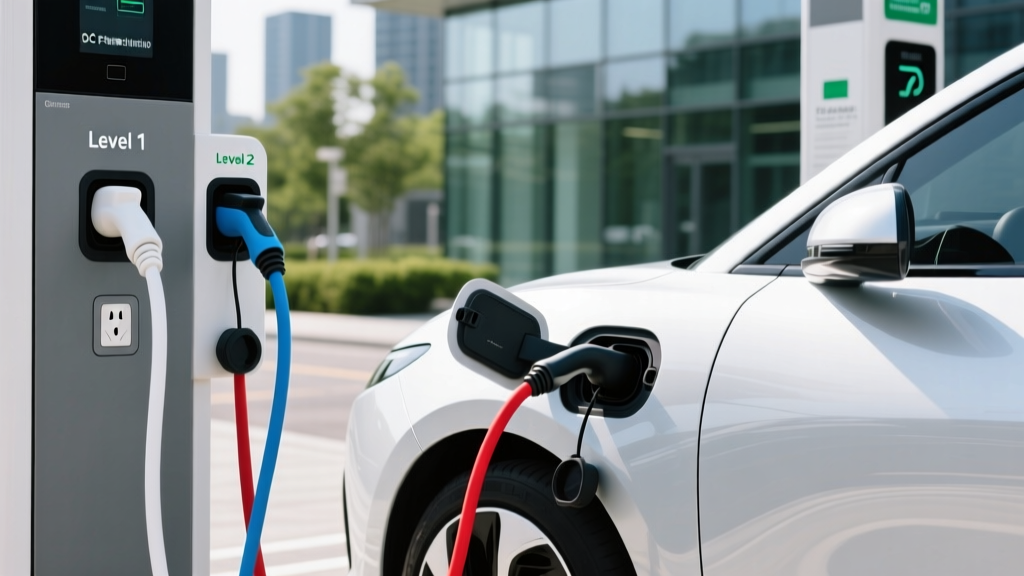
There are three tiers of EV charging available to consumers. Each delivers dramatically different charging speed, and your daily routine should determine which you rely on.
| Level | Voltage | Power (kW) | Miles of Range Per Hour | Best For |
|---|---|---|---|---|
| Level 1 | 120V AC | 1.0–1.4 kW | 3–5 mi/hr | Overnight top-up, low-mileage drivers, PHEVs |
| Level 2 | 240V AC | 3.3–19.2 kW | 12–75 mi/hr | Daily home charging, workplace, destination |
| DC Fast Charging | 400–800V DC | 50–350 kW | 150–1,200+ mi/hr (peak) | Road trips, rapid top-ups, commercial fleets |
A few real-world nuances matter here. Level 1 charging from a standard household outlet delivers roughly 1.2 kW continuously — enough for a plug-in hybrid with 30 miles of electric range, but painfully slow for a 90 kWh BEV that might need 75+ hours for a full charge. Level 2 at 48 amps (11.5 kW on a 60-amp circuit) is the practical home standard; most EVs accept between 7.2 kW and 11.5 kW on Level 2, limited by their onboard charger.
DC fast charging speed is where marketing gets misleading. A charger may be rated for 350 kW, but your vehicle's battery management system (BMS) controls the actual acceptance rate. A Hyundai Ioniq 5 with its 800V architecture can accept up to 240 kW and charge 10–80% in roughly 18 minutes under ideal conditions. A Chevrolet Equinox EV peaks around 150 kW and takes about 30 minutes for the same 10–80% window. Always check your vehicle's max DC charge rate — not just the charger's rating.
Home Charger Installation: Electrical Requirements and Real Costs
Installing a Level 2 home charger is the single highest-impact upgrade for EV ownership. Here is what the electrical work actually involves and what it costs.
Electrical Requirements
A typical Level 2 home charger runs on a 240V circuit — the same voltage as an electric dryer or oven. The most common setup is a NEMA 14-50 outlet on a 50-amp breaker, which delivers up to 40 amps (9.6 kW) of continuous charging power. For faster 48-amp (11.5 kW) charging, you need a 60-amp breaker, and the charger should be hardwired rather than plugged in, per National Electrical Code (NEC) requirements for circuits above 50 amps.
Your home's electrical panel is the bottleneck. Most modern homes have a 200-amp main panel, which can usually accommodate a 50- or 60-amp EV circuit. Older homes with 100-amp service may require a panel upgrade to 200 amps — a significant added cost. A licensed electrician will perform a load calculation (NEC Article 220) to determine whether your panel has headroom.
Installation Cost Breakdown
| Component | Low End | High End | Notes |
|---|---|---|---|
| Level 2 Charger Equipment | $300 | $700 | 32A–48A smart charger, 20–25 ft cable |
| Electrician Labor (standard install) | $500 | $1,500 | Outlet or hardwire, panel proximity matters |
| Electrical Permit | $50 | $200 | Varies by municipality |
| Panel Upgrade (if needed) | $1,500 | $3,500 | 100A → 200A service upgrade |
| Conduit / Trenching (long runs) | $200 | $2,000+ | Garage adjacent to panel vs. detached |
| Total (no panel upgrade) | $850 | $2,400 | Most common scenario |
| Total (with panel upgrade) | $2,350 | $5,900 | Older homes, 100A service |
The biggest cost variable is distance. If your panel is in the garage next to where you park, expect the lower end. If your panel is in the basement and you need conduit run 60 feet to a detached garage, costs climb fast. Always get at least two quotes from licensed electricians, and confirm they pull a permit — unpermitted work can void homeowner's insurance claims.
Connector Compatibility: NACS, CCS, and CHAdeMO in 2026
The North American charging connector landscape has consolidated significantly. Here is where things stand for the current model year.
| Connector | AC Level 2 | DC Fast | Brands Using It |
|---|---|---|---|
| NACS (Tesla / SAE J3400) | Yes | Yes | Tesla, Ford, GM, Rivian, Volvo, Polestar, Mercedes, Nissan, Fisker, and most major OEMs by 2026 |
| CCS1 (Combined Charging System) | Yes (via J1772) | Yes | Legacy models (pre-2025 VW ID.4, some Hyundai/Kia, BMW iX remaining stock) |
| CHAdeMO | No (uses J1772 for AC) | Yes | Nissan Leaf (legacy), Mitsubishi Outlander PHEV (legacy) — effectively discontinued for new models |
If you are buying a new EV in 2026, it almost certainly uses NACS or has a manufacturer-supplied NACS adapter. Ford, GM, and Rivian owners can access Tesla Superchargers directly with the included adapter. Hyundai and Kia's newer models (Ioniq 5 refresh, EV6 refresh, EV9) now ship with native NACS ports.
For CCS-equipped vehicles from prior model years, adapters exist — Tesla sells a CCS-to-NACS adapter, and third-party options from companies like Lectron are available for roughly $200–$300. CHAdeMO infrastructure is shrinking; if you own a Nissan Leaf, plan your road trips around remaining CHAdeMO stations or use an adapter where available.
Cost to Charge: Home Electricity vs Public DC Fast vs Gas
The financial case for EV charging hinges on where you charge. The spread between home off-peak rates and public DC fast charging is enormous.
| Charging Scenario | Typical $/kWh | Cost Per Mile (at 3.5 mi/kWh) | Full Charge (75 kWh Battery) |
|---|---|---|---|
| Home (national avg. residential) | $0.16 | $0.046 | $12.00 |
| Home (off-peak utility rate) | $0.08–$0.10 | $0.023–$0.029 | $6.00–$7.50 |
| Public Level 2 (workplace/destination) | $0.20–$0.35 | $0.057–$0.10 | $15.00–$26.25 |
| DC Fast Charging (Electrify America, EVgo) | $0.35–$0.55 | $0.10–$0.16 | $26.25–$41.25 |
| Tesla Supercharger (varies by location) | $0.25–$0.40 | $0.071–$0.114 | $18.75–$30.00 |
| Gas equivalent (25 MPG, $3.50/gal) | — | $0.14 | — |
According to EIA data, the U.S. average residential electricity rate hovers around $0.16/kWh. At that rate, charging a 75 kWh battery at home costs about $12 — roughly a third of what a comparable gas fill-up costs at 25 MPG and $3.50/gallon. The cost advantage evaporates if you rely exclusively on public DC fast charging at $0.45+/kWh, which is why home charging access remains the single biggest factor in EV satisfaction.
Many utilities offer time-of-use (TOU) plans with off-peak rates as low as $0.06–$0.10/kWh overnight. If you can schedule charging between midnight and 6 AM, your per-mile fuel cost drops below $0.03 — less than a quarter of what gas costs.
Charging Time Examples: How Long Does 10–80% Actually Take?
The 10–80% metric is the industry standard because charging speed tapers dramatically above 80% SoC to protect battery health. Here are real-world charging times for popular EV battery sizes at various charger outputs.
| Vehicle (Battery Size) | Max DC Rate | 150 kW Charger | 250 kW Charger | 350 kW Charger |
|---|---|---|---|---|
| Tesla Model 3 LR (75 kWh, NMC) | 250 kW | ~28 min | ~22 min | ~22 min (capped) |
| Hyundai Ioniq 5 (77.4 kWh, NMC) | 240 kW (800V) | ~25 min | ~18 min | ~18 min |
| Ford F-150 Lightning Ext. (131 kWh, NMC) | 150 kW | ~50 min | ~50 min (capped) | ~50 min (capped) |
| Chevrolet Equinox EV (85 kWh, NMC) | 150 kW | ~32 min | ~32 min (capped) | ~32 min (capped) |
| Tesla Model Y LR (75 kWh, NMC/LFP) | 250 kW | ~28 min | ~22 min | ~22 min (capped) |
The critical takeaway: if your vehicle's max charge rate is 150 kW, plugging into a 350 kW charger provides zero benefit. Match the charger to your vehicle's capability. Conversely, an 800V vehicle like the Ioniq 5 or Porsche Taycan genuinely benefits from high-power 250–350 kW chargers.
Recommended Home Level 2 Chargers for 2026
After testing and tracking reliability across dozens of units, these are the chargers that deliver the best combination of charging speed, build quality, and smart features.
ChargePoint Home Flex
- Power: Up to 12 kW (50A) on a 60A circuit; configurable down to 16A
- Connector: NACS (J3400) native; J1772 version also available
- Cable Length: 23 feet
- Smart Features: Wi-Fi, app scheduling, Alexa integration, energy tracking
- Price: ~$550–$650
- Best For: Versatility — adjustable amperage works with any panel capacity
Tesla Wall Connector
- Power: Up to 11.5 kW (48A) on a 60A circuit
- Connector: NACS native; includes J1772 adapter in box
- Cable Length: 24 feet
- Smart Features: Wi-Fi, over-the-air updates, power sharing between units
- Price: ~$425–$475
- Best For: Tesla and NACS-vehicle owners seeking best value
Emporia Level 2 EV Charger
- Power: Up to 11.5 kW (48A) on a 60A circuit
- Connector: J1772 (NACS adapter available separately)
- Cable Length: 24 feet
- Smart Features: Wi-Fi, real-time energy monitoring via Emporia app, solar integration
- Price: ~$350–$400
- Best For: Budget-conscious buyers who want energy monitoring
Grizzl-E Smart
- Power: Up to 10 kW (40A) on a 50A circuit
- Connector: J1772 or NACS (select at purchase)
- Cable Length: 24 feet
- Smart Features: Wi-Fi, OCPP support, adjustable amperage
- Price: ~$450–$550
- Best For: Cold climates — rated to -40°F, rugged aluminum enclosure
A critical note: any hardwired charger above 40 amps requires a dedicated circuit with appropriate breaker sizing. The NEC requires EV circuits to be rated at 125% of the continuous load — so a 48A charger needs a 60A breaker. Always confirm your electrician sizes the circuit correctly.
Safety, Electrical Code, and Permit Requirements
EV charging is a high-draw, continuous electrical load — it runs at near-maximum capacity for hours. This makes code compliance non-negotiable.
- Dedicated circuit: Your EV charger must have its own dedicated breaker — it cannot share a circuit with other appliances. This prevents overloads and tripped breakers during extended charging sessions.
- GFCI protection: NEC 2020 and later require GFCI (Ground Fault Circuit Interrupter) protection for all 125V and 250V receptacles used for EV charging in garages and outdoor locations. Hardwired units are exempt from the GFCI receptacle requirement but must still meet ground-fault protection standards.
- Outdoor rating: If your charger is installed outdoors, the unit must carry a NEMA 4 or NEMA 4X weather-resistance rating. All recommended chargers above meet this standard.
- Permit and inspection: Virtually all jurisdictions require an electrical permit for a new 240V circuit. The inspection ensures proper wire gauge, breaker sizing, grounding, and bonding. Skipping the permit risks insurance denial in the event of an electrical fire.
- Wire gauge: A 50A circuit requires minimum 6 AWG copper wire; a 60A circuit requires 4 AWG. Longer wire runs may need upsizing to prevent voltage drop.
Frequently Asked Questions
How much does it cost to install a home EV charger?
For a standard Level 2 installation without a panel upgrade, expect to spend $850–$2,400 total (equipment, electrician labor, and permit combined). If your home needs a 200A panel upgrade, total costs range from $2,350 to $5,900. The single biggest variables are the distance from your electrical panel to the charging location and whether your existing panel has sufficient amperage headroom.
How fast will each charging level add range?
Level 1 (120V) adds roughly 3–5 miles of range per hour. Level 2 (240V) at 48 amps adds 30–45 miles per hour for most EVs, depending on vehicle efficiency. DC fast charging at 150 kW can add 150–250 miles in 20–30 minutes, though the rate tapers significantly above 80% state of charge.
Which connector and charger is compatible with my EV?
For 2026 model-year vehicles, NACS (SAE J3400) is the dominant standard — Tesla, Ford, GM, Rivian, Hyundai, Kia, Volvo, and most others now use it natively or via adapter. Older CCS1 vehicles can use adapters to access NACS/Supercharger networks. CHAdeMO is effectively discontinued for new vehicles. Check your vehicle's charge port or owner's manual for the specific connector type.
How much does EV charging cost per mile compared to gas?
At the U.S. average residential rate of ~$0.16/kWh and an EV efficiency of 3.5 miles per kWh, home charging costs approximately $0.046 per mile. Gasoline at $3.50/gallon in a 25 MPG vehicle costs $0.14 per mile — roughly three times more. Even public DC fast charging at $0.40/kWh ($0.114/mile) undercuts gasoline on a per-mile basis.
What electrical upgrades might I need for a home charger?
The most common upgrade is a new 240V dedicated circuit with a 50A or 60A breaker. Older homes with 100A electrical service may need a full panel upgrade to 200A, which costs $1,500–$3,500. Homes with modern 200A panels typically have sufficient capacity. Your electrician will perform a NEC Article 220 load calculation to determine your panel's available headroom before recommending a circuit size.