Buying an electric vehicle in 2026 means making one critical infrastructure decision before the car even arrives: how will you charge it? Whether you're plugging in a Tesla Model Y, a Hyundai IONIQ 5, or preparing your garage for the next generation of level 3 autonomous cars that manufacturers like Mercedes-Benz and BMW are beginning to certify for limited hands-off driving, your home charging setup determines daily convenience, cost per mile, and long-term battery health.
This guide breaks down every charging tier with exact kW speeds, real installation costs including panel upgrades, connector compatibility across NACS, CCS, and CHAdeMO, and equipment picks that won't bottleneck your EV's onboard charger. We'll also address how emerging SAE Level 3 autonomy — where the vehicle assumes full driving responsibility under specific conditions — intersects with charging infrastructure planning.
Charging Levels Explained: kW Speeds and Miles Per Hour
The single most common confusion in EV ownership is the difference between kW (kilowatts) and kWh (kilowatt-hours). Think of kW as the flow rate of a hose (power), and kWh as the total volume of water in the tank (energy). A 100 kWh battery charged at 10 kW takes 10 hours. The same battery at 150 kW DC fast charging can reach 80% in roughly 20-30 minutes, depending on the charge curve.
| Level | Voltage | Power (kW) | Miles of Range Added Per Hour | Typical Use Case |
|---|---|---|---|---|
| Level 1 | 120V AC | 1.0–1.9 kW | 3–5 mi/hr | Overnight top-off, PHEVs, emergencies |
| Level 2 | 240V AC | 3.3–19.2 kW | 12–75 mi/hr | Daily home/workplace charging |
| DC Fast Charge | 400–900V DC | 50–350 kW | 150–1,200+ mi/hr (peak) | Road trips, rapid top-ups |
Most modern EVs accept Level 2 charging between 7.2 kW and 11.5 kW via their onboard charger. The Ford F-150 Lightning with the extended-range battery accepts up to 19.2 kW on Level 2, while the Tesla Model 3 caps at 11.5 kW. DC fast charging bypasses the onboard charger entirely, delivering current directly to the battery — which is why peak rates can exceed 250 kW on vehicles with 800V architectures like the Hyundai IONIQ 5, Kia EV6, and Porsche Taycan.
A critical reality check: DC fast charging speeds follow a charge curve, not a flat rate. A vehicle rated for "250 kW peak" may sustain that rate only between 10-40% state of charge, then taper progressively. Real-world 10-80% charging times for popular 2026 models:
- Hyundai IONIQ 5 (84 kWh, 800V): ~18 minutes at a 350 kW charger
- Tesla Model Y (75 kWh, 400V): ~25-30 minutes at a V3/V4 Supercharger (250 kW peak)
- Ford F-150 Lightning (131 kWh): ~41 minutes at a 150 kW charger
- Chevrolet Equinox EV (85 kWh): ~30 minutes at a 150 kW charger
Home EV Charger Installation: Costs, Electrical Requirements, and Panel Upgrades
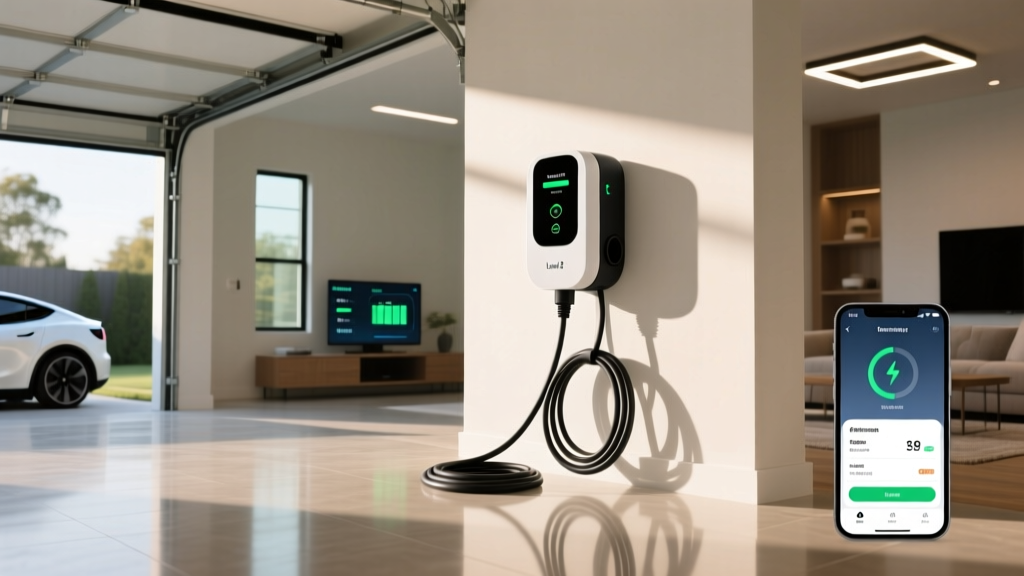
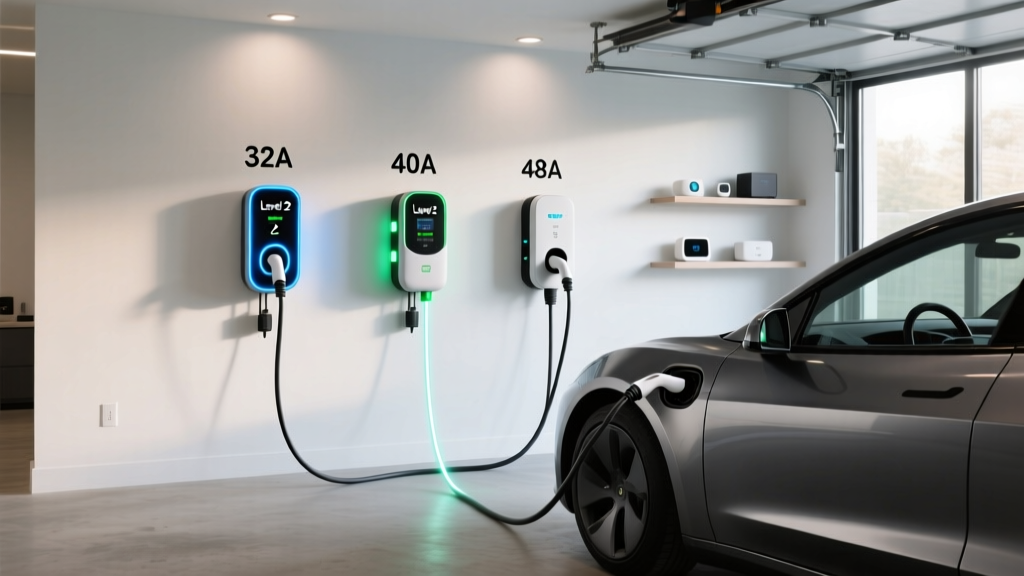
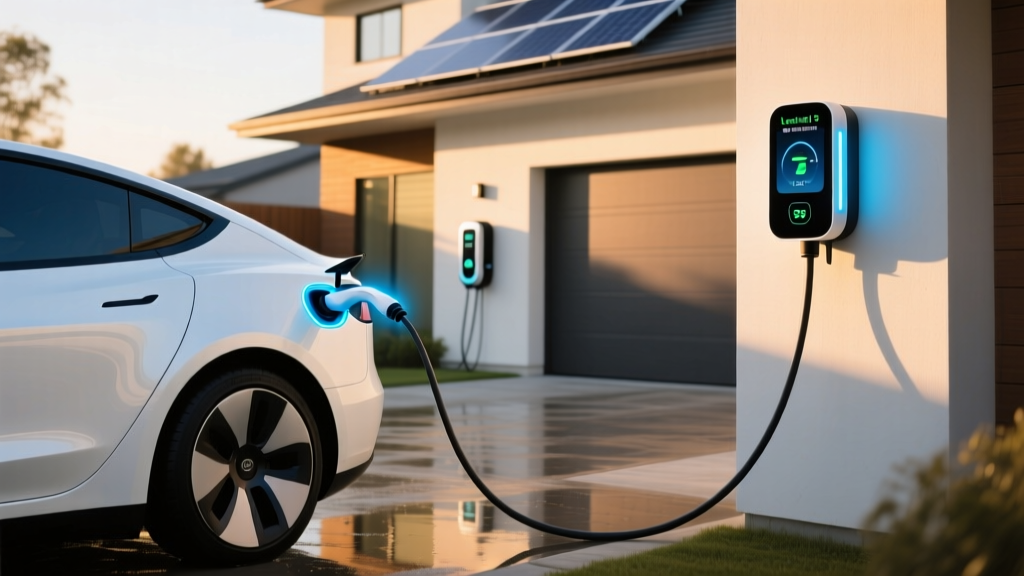
A Level 2 home charger is the backbone of practical EV ownership. Most drivers install a 240V, 40-amp or 48-amp hardwired wall connector on a dedicated 50-amp or 60-amp circuit. Here's what that actually costs in 2026:
| Component | Cost Range | Notes |
|---|---|---|
| Level 2 charger (hardware) | $350–$700 | Smart Wi-Fi-enabled units; basic units from $250 |
| Electrician labor | $500–$2,000 | Depends on run length, conduit, wall material |
| Electrical permit | $50–$250 | Varies by municipality; required in most jurisdictions |
| Panel upgrade (if needed) | $1,500–$4,000 | Upgrading from 100A to 200A service for older homes |
| Total (no panel upgrade) | $900–$2,950 | Most homes with 200A service |
| Total (with panel upgrade) | $2,400–$6,950 | Homes with 100A or maxed-out panels |
Homes built before 2000 often have 100-amp electrical panels with limited spare breaker slots. Adding a 50-amp dedicated circuit for an EV charger may require a panel upgrade to 200 amps — this is the single biggest surprise cost for new EV owners. Before purchasing a charger, have a licensed electrician perform a load calculation to determine your panel's available capacity.
Some utilities and states offer rebates that offset installation costs. The federal Residential Clean Energy Credit (IRS Form 5695) covers 30% of qualified EV charger equipment and installation costs up to $1,000 for equipment placed in service through 2032, though eligibility depends on your tax liability and whether you're in a qualifying census tract. Always consult a tax professional for your specific situation.
Safety and Code Requirements
The National Electrical Code (NEC) requires a dedicated circuit for EV charging — you cannot share the circuit with other appliances. Key code considerations:
- Dedicated breaker: The charger circuit must be dedicated and sized at 125% of the charger's rated amperage (a 40A charger needs a 50A breaker)
- GFCI protection: NEC 2020 and later requires GFCI protection for outdoor receptacles used for EV charging; hardwired units may have built-in ground fault protection
- Outdoor rating: If mounted outside, the unit must carry a NEMA 4 or NEMA 4X rating for weather resistance
- Cable management: Wall-mounted units should keep cables off the ground; some jurisdictions require retracted cable height minimums
Connector Compatibility: NACS, CCS, and CHAdeMO in 2026
The connector landscape has consolidated dramatically since 2023. Tesla's North American Charging Standard (NACS) has become the dominant connector, with Ford, GM, Rivian, Volvo, Hyundai, and most major automakers adopting it for 2025-2026 model-year vehicles.
| Connector | Brands Using It (2026) | DC Fast Charging Network Access | Adapter Needed? |
|---|---|---|---|
| NACS (Tesla standard) | Tesla, Ford, GM, Rivian, Hyundai, Kia, Volvo, Polestar, BMW | Tesla Supercharger, Electrify America (NACS stalls), EVgo | CCS-to-NACS adapter for legacy CCS vehicles (~$200-$300) |
| CCS1 (Combined Charging System) | Volkswagen ID.4 (some trims), Stellantis, Honda Prologue (early builds), Lucid | Electrify America, EVgo, ChargePoint, Ionity (EU) | NACS-to-CCS adapter for Tesla Supercharger access |
| CHAdeMO | Nissan Leaf (legacy only — discontinued in US) | Limited; many networks phasing out CHAdeMO stalls | No practical adapter; network access shrinking |
If you're purchasing a new EV in 2026, NACS is the safest bet for long-term charging network access. Tesla has opened its Supercharger network — over 30,000 stalls in North America — to non-Tesla vehicles equipped with NACS connectors, making it the most reliable DC fast-charging ecosystem. Owners of older CCS-equipped vehicles can purchase manufacturer-approved adapters (such as the Ford or GM NACS adapter) to access Superchargers.
What Charging Means for Level 3 Autonomous Cars
The arrival of level 3 autonomous cars — vehicles certified under SAE J3016 to handle all driving tasks under defined conditions with the driver free to disengage — introduces new charging considerations. Mercedes-Benz received the first US certification for its DRIVE PILOT system (SAE Level 3) in Nevada and California, operational up to 40 mph on suitable highways. BMW's Personal Pilot L3 has been approved in Germany and is expanding to limited US markets.
For home charging planning, level 3 autonomous cars use the same NACS or CCS connectors and Level 2/DC fast charging infrastructure as any other EV. However, two emerging trends intersect with autonomy and charging:
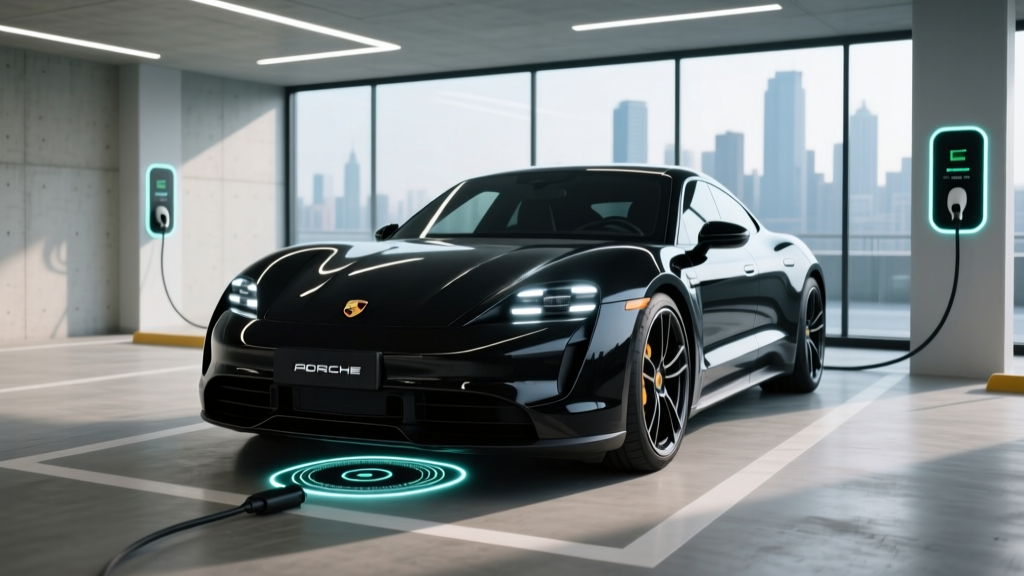
- Automated valet charging: Mercedes, Bosch, and other suppliers are developing inductive (wireless) charging pads and robotic plug-in systems for garages and parking structures. These are not yet widely available but may complement future Level 3/4 vehicles that can self-park.
- Larger battery packs: Vehicles equipped with Level 3 sensor suites (lidar, redundant computing, multiple cameras) draw additional power, prompting automakers to fit larger batteries. The 2026 Mercedes EQS with DRIVE PILOT carries a 107.8 kWh battery, making Level 2 home charging at 9.6 kW or higher essential for overnight replenishment.
If you're planning a home charging setup with an eye toward future autonomous-capable vehicles, prioritize a 48-amp or 60-amp hardwired Level 2 circuit. This ensures compatibility with larger battery packs (100+ kWh) that autonomous-ready luxury EVs increasingly carry.
Charging Cost Per Mile: EV vs. Gas in 2026
One of the strongest economic arguments for EV ownership is fuel cost savings — but the actual per-mile cost depends heavily on where and when you charge.
| Scenario | Rate ($/kWh) | Vehicle Efficiency (kWh/100 mi) | Cost Per Mile |
|---|---|---|---|
| Home, off-peak utility rate | $0.08–$0.14 | 28 kWh/100 mi (avg EV) | $0.022–$0.039 |
| Home, standard residential rate | $0.15–$0.22 | 28 kWh/100 mi | $0.042–$0.062 |
| Public Level 2 (ChargePoint, etc.) | $0.25–$0.49 | 28 kWh/100 mi | $0.070–$0.137 |
| DC Fast Charging (Electrify America, EVgo) | $0.35–$0.60 | 28 kWh/100 mi | $0.098–$0.168 |
| Tesla Supercharger (member pricing) | $0.25–$0.40 | 28 kWh/100 mi | $0.070–$0.112 |
| Gasoline vehicle (28 MPG avg, $3.40/gal) | — | — | $0.121 |
Home charging at off-peak rates delivers the lowest per-mile cost — often one-third to one-quarter the cost of gasoline. Even public DC fast charging at premium rates is frequently cheaper than gas on a per-mile basis, though the gap narrows significantly. Drivers who rely exclusively on public DC fast charging may see costs approach or exceed gasoline in high-rate markets.
According to fueleconomy.gov, the average 2026 EV achieves 97-132 MPGe combined, translating to 25-35 kWh per 100 miles. Efficiency varies widely: the Lucid Air Grand Touring achieves 30 kWh/100mi (146 MPGe), while the Ford F-150 Lightning consumes roughly 48 kWh/100mi (70 MPGe).
Recommended Home EV Chargers for 2026
The best Level 2 home charger depends on your EV's onboard charger capacity, your electrical panel's available amperage, and whether you need smart scheduling for time-of-use utility rates. Here are top picks:
Tesla Wall Connector (Gen 4)
- Power Output: Up to 11.5 kW (48A) on a 60A circuit
- Connector: NACS (native); CCS adapter available separately
- Cable Length: 24 feet
- Smart Features: Wi-Fi, OTA updates, load sharing between multiple units, power-sharing for multi-EV households
- Price: ~$475
- Best For: Tesla owners and NACS-equipped Ford/GM/Hyundai vehicles
ChargePoint Home Flex
- Power Output: Up to 12 kW (50A) configurable via DIP switch (20A–50A)
- Connector: J1772 (standard for non-Tesla); NACS adapter included with some 2026 bundles
- Cable Length: 23 feet
- Smart Features: Wi-Fi, Alexa integration, scheduled charging, energy dashboard, utility demand-response programs
- Price: ~$550–$650
- Best For: Non-Tesla EVs, multi-vehicle households, utility TOU optimization
Emporia Level 2 EV Charger
- Power Output: Up to 11.5 kW (48A) on a 60A circuit
- Connector: J1772 or NACS (select at purchase)
- Cable Length: 24 feet
- Smart Features: Wi-Fi, real-time energy monitoring, solar integration with Emporia Vue panel monitor, scheduled charging
- Price: ~$399–$449
- Best For: Budget-conscious buyers, solar-equipped homes
Grizzl-E Smart
- Power Output: Up to 10 kW (40A) on a 50A circuit
- Connector: J1772 (NACS adapter available)
- Cable Length: 24 feet
- Smart Features: Wi-Fi, OCPP-compatible for commercial/fleet use, adjustable amperage
- Price: ~$449–$499
- Best For: Canadian and cold-climate owners (rated to -40°F), commercial installations
When selecting a charger, match its output to your EV's onboard charger. A 48A charger delivers no benefit to a vehicle with a 7.2 kW (32A) onboard charger. Conversely, undersizing a charger wastes the potential of vehicles like the F-150 Lightning Extended Range (19.2 kW onboard).
Public Charging Networks: What to Expect in 2026
Public DC fast charging infrastructure has expanded considerably. As of early 2026, the US has over 200,000 public charging ports, with DC fast chargers representing roughly 45,000 of those. Key networks:
- Tesla Supercharger: 30,000+ stalls, 250-350 kW peak, NACS connector. Open to non-Tesla NACS vehicles via the Tesla app.
- Electrify America: 5,000+ DC fast chargers, 150-350 kW, CCS and NACS connectors. Membership pricing at $0.36/kWh; guest rate $0.48/kWh.
- EVgo: 3,500+ DC fast chargers, 50-350 kW, CCS and NACS. Auto+ plan at $0.33/kWh.
- ChargePoint: Primarily Level 2, with growing DC fast presence. Pricing varies by site host.
Reliability has improved but remains inconsistent. The National Highway Traffic Safety Administration and the Joint Office of Energy and Transportation monitor network uptime under the National Electric Vehicle Infrastructure (NEVI) program, which requires 97% uptime for federally funded chargers. In practice, Tesla Superchargers consistently deliver the highest reliability (99%+ uptime), while other networks average 85-92%.
Frequently Asked Questions
How much does it cost to install a home EV charger?
A typical Level 2 home charger installation costs $900–$2,950 when no panel upgrade is needed, covering the charger unit ($350–$700), electrician labor ($500–$2,000), and permits ($50–$250). If your home has a 100-amp panel that needs upgrading to 200 amps, add $1,500–$4,000. Always get a load calculation from a licensed electrician before purchasing equipment.
How fast will each charging level add range?
Level 1 (120V) adds 3–5 miles of range per hour — sufficient for PHEVs with small batteries but impractical for full BEVs. Level 2 (240V) adds 12–75 miles per hour depending on amperage and the vehicle's onboard charger. DC fast charging adds 150–1,200+ miles per hour at peak rates, though sustained rates taper significantly above 60-70% state of charge.
Which connector is compatible with my EV?
For 2026 models: Tesla, Ford, GM, Rivian, Hyundai, Kia, Volvo, and BMW use NACS. Most Volkswagen, Stellantis, and Honda models use CCS1. CHAdeMO is limited to legacy Nissan Leaf vehicles. Check your vehicle's charge port or the manufacturer's spec sheet. Adapters are available to cross-connect NACS and CCS, typically costing $200–$300.
How much does charging cost per mile compared to gas?
Home charging at off-peak rates costs $0.02–$0.04 per mile — roughly one-third the cost of gasoline at $3.40/gallon and 28 MPG ($0.12/mile). Standard residential rates bring EV costs to $0.04–$0.06 per mile. Public DC fast charging at $0.35–$0.60/kWh costs $0.10–$0.17 per mile, still competitive with or cheaper than gas for most vehicles.
What electrical upgrades might I need?
The most common upgrade is a panel replacement from 100A to 200A service ($1,500–$4,000) if your panel lacks capacity for a dedicated 50A or 60A circuit. Some homes need a new conduit run from the panel to the garage or exterior wall ($500–$1,500 depending on distance and wall material). Homes with 200A service and available breaker slots typically need no upgrades beyond the dedicated circuit itself.
Will level 3 autonomous cars need special chargers?
No. Level 3 autonomous vehicles like the Mercedes EQS with DRIVE PILOT or BMW 7 Series with Personal Pilot L3 use the same NACS or CCS connectors and standard Level 2/DC fast charging infrastructure. However, their larger battery packs (often 100+ kWh) benefit from higher-amperage Level 2 circuits (48A–60A) for practical overnight charging. Future Level 4 vehicles may eventually support automated wireless or robotic plug-in systems, but these are not yet commercially available for consumer vehicles.
Sources: EPA fuel economy data via fueleconomy.gov; IRS Residential Clean Energy Credit guidelines via irs.gov; NHTSA vehicle safety and automation standards via nhtsa.gov. Tax credit eligibility and charger rebate programs vary by jurisdiction and are subject to change — consult a licensed electrician and tax professional for your specific situation.