Buying an electric vehicle is only half the equation. The other half — arguably the more confusing half — is understanding how to actually put electrons into it. If you've seen terms like NACS, CCS1, Level 2, or DC fast charging and felt your eyes glaze over, you're not alone. But these EV charging protocols directly determine how quickly your car charges, where you can plug in, and how much you'll spend over the life of the vehicle.
This guide breaks down every charging protocol currently used in the United States, translates the specs into real-world miles and minutes, and walks through the exact costs and electrical requirements for setting up home charging. All figures reflect 2026 model-year vehicles and current utility rates.
The Three Charging Levels: Speeds in kW and Miles Per Hour
Every EV sold in the US accepts power at one or more of three defined charging levels. The critical distinction here is between kW (kilowatts), which measures power — the rate at which energy flows — and kWh (kilowatt-hours), which measures energy — the total amount stored in your battery. Think of kW as the width of a hose and kWh as the size of the bucket. A wider hose (higher kW) fills the bucket (battery kWh) faster.
| Level | Voltage | Power (kW) | Miles of Range Added Per Hour | Typical Use Case |
|---|---|---|---|---|
| Level 1 | 120V AC | 1.0 – 1.4 kW | 3 – 5 miles/hr | Overnight top-up, PHEVs, emergencies |
| Level 2 | 240V AC | 3.3 – 19.2 kW | 12 – 70 miles/hr | Home daily charging, workplaces, public destinations |
| DC Fast Charging (Level 3) | 200 – 900V DC | 50 – 350+ kW | 150 – 1,200+ miles/hr (peak) | Road trips, highway corridors, rapid top-ups |
A few important caveats. The "miles per hour" figures assume an average efficiency of roughly 3 – 4 miles per kWh, which covers most mainstream EVs like the Tesla Model Y, Hyundai Ioniq 5, and Ford Mustang Mach-E. Larger, less efficient vehicles like the GMC Hummer EV or Rivian R1T will see fewer miles per hour at each level. And DC fast charging speeds represent peak rates — sustained rates are always lower due to charge-curve tapering above 80% State of Charge (SoC).
Connector Compatibility: NACS, CCS1, and CHAdeMO in 2026
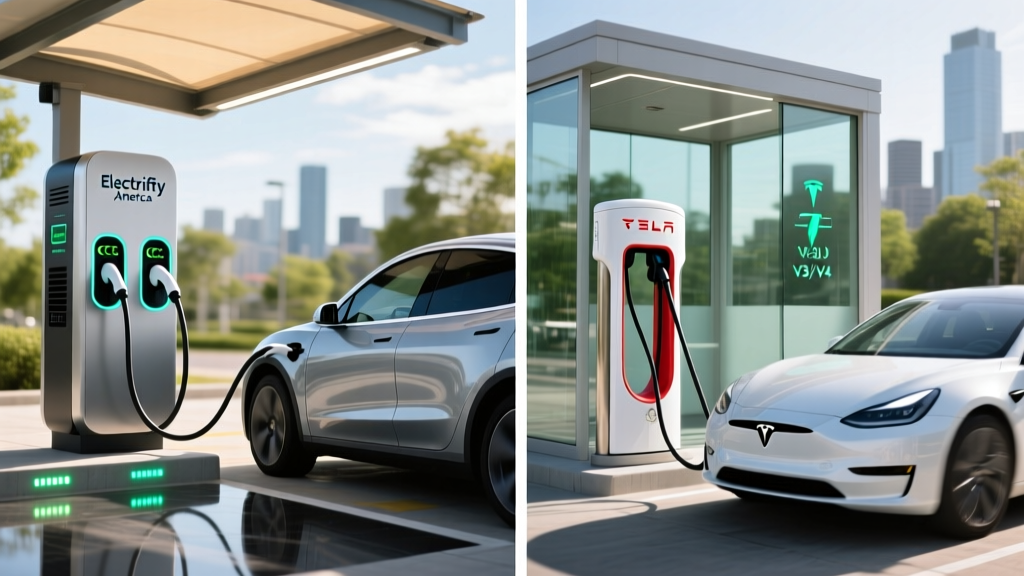
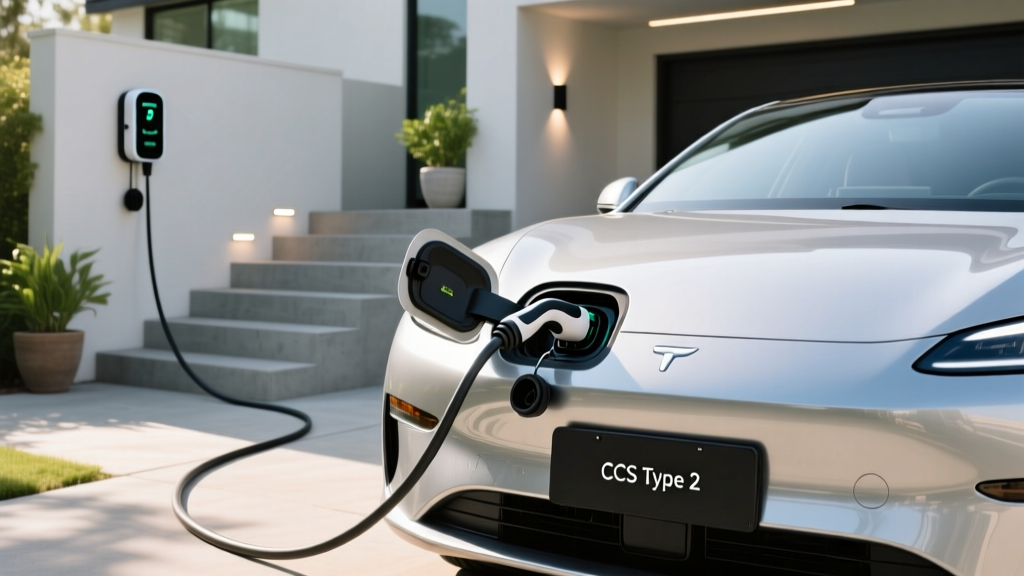
The physical plug your EV uses is arguably the most consequential EV charging protocol decision you'll make, because it determines which public networks you can access without adapters. As of 2026, the North American market has largely consolidated around NACS, but legacy connectors remain in wide use.
| Connector | Brands Using It (Native) | DC Fast Charge Availability | Adapter Needed For |
|---|---|---|---|
| NACS (J3400) | Tesla (all models), Ford, GM, Rivian, Volvo, Polestar, Mercedes-Benz, Nissan (Ariya 2026+), Honda (2026+) | Tesla Supercharger network (20,000+ stalls), Electrify America NACS stalls, EVgo, ChargePoint | CCS1 adapters for legacy public chargers (~$200-$300) |
| CCS1 (Combo) | Hyundai, Kia, Volkswagen, BMW, Stellantis/Jeep, Subaru (Solterra), Toyota (bZ4X) | Electrify America, EVgo, ChargePoint, Ionity (EU) | NACS adapter for Tesla Supercharger access (~$200-$250) |
| CHAdeMO | Nissan Leaf (legacy, pre-2026), Mitsubishi Outlander PHEV (older models) | Limited and declining — mostly Electrify America legacy stalls | No viable adapter to NACS/CCS1 for DC fast charging |
What this means for buyers in 2026: NACS is the clear long-term winner. If you're buying a new EV with a native CCS1 port, budget for a NACS adapter to access the Tesla Supercharger network, which remains the most reliable DC fast-charging network in North America according to J.D. Power EV charging satisfaction data. CHAdeMO is effectively end-of-life for new vehicles — avoid it unless you're buying a used Nissan Leaf and only need local driving.
Home Charger Installation: Electrical Requirements, Costs, and Panel Upgrades
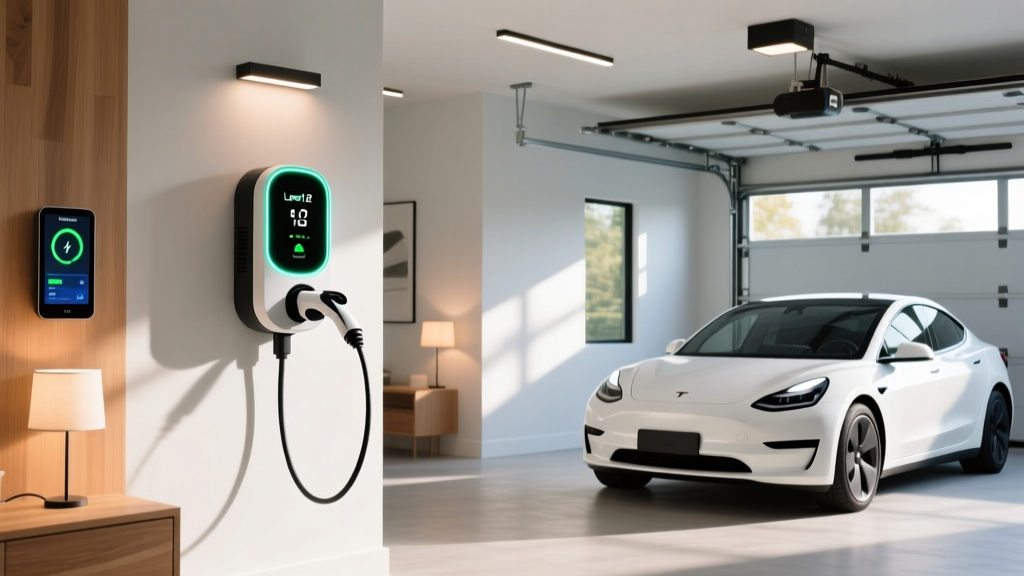
Home Level 2 charging is where 80%+ of all EV charging happens for owners with garage or driveway access. But the install cost varies enormously depending on your home's electrical infrastructure.
Electrical Requirements for Level 2 Charging
A typical home Level 2 charger requires a 240-volt dedicated circuit, similar to what powers an electric dryer or oven. The most common configurations:
- 40-amp circuit / 32-amp continuous (7.7 kW): Sufficient for most EVs. Charges a 75 kWh battery from 10-80% in roughly 7 hours.
- 50-amp circuit / 40-amp continuous (9.6 kW): Better for larger batteries (100+ kWh). 10-80% in roughly 5.5 hours.
- 60-amp circuit / 48-amp continuous (11.5 kW): Maximum single-phase residential. Required to fully utilize vehicles like the Ford F-150 Lightning's onboard charger (19.2 kW requires a 100-amp circuit and is rarely residential).
Installation Cost Breakdown
| Cost Component | Simple Install (Panel Adjacent) | Complex Install (Long Run / Panel Upgrade) |
|---|---|---|
| Level 2 Charger Equipment | $350 – $700 | $350 – $700 |
| Electrical Permit | $50 – $200 | $50 – $300 |
| Electrician Labor (licensed) | $300 – $800 | $1,500 – $4,000 |
| Conduit, Wire, Breaker | $100 – $300 | $400 – $1,200 |
| Electrical Panel Upgrade (if needed) | $0 (not needed) | $2,000 – $5,000 |
| Total Estimated Cost | $800 – $2,000 | $4,300 – $11,200 |
The panel upgrade gotcha: Homes built before 1990 often have 100-amp main panels. Adding a 40- or 50-amp EV circuit can push total load past the panel's capacity, requiring an upgrade to 200 amps. This is the single biggest cost variable. Before buying a charger, have a licensed electrician perform a load calculation on your panel — it typically costs $100-$200 and prevents expensive surprises.
Some utilities and states offer rebates of $250-$1,000 for home charger installation. Check your local utility's EV program page. The federal Alternative Fuel Vehicle Refueling Property Credit (IRC §30C) offers up to $1,000 (30% of cost) for home charging equipment installed in eligible census tracts — verify eligibility with a tax professional.
Recommended Home Chargers: Power Output, Features, and Price
Not all Level 2 chargers are equal. Here are four proven units for 2026, selected for reliability, connector availability, and smart features.
ChargePoint Home Flex
- Power: Up to 12 kW (50A circuit)
- Connector: NACS or J1772 (select at purchase)
- Cable Length: 23 feet
- Smart Features: Wi-Fi, app scheduling, utility integration, Alexa
- Price: ~$599
Best for: Flexible amperage adjustment (dial down to 16A if your panel is tight).
Tesla Wall Connector
- Power: Up to 11.5 kW (48A / 60A circuit)
- Connector: NACS native
- Cable Length: 24 feet
- Smart Features: Wi-Fi, OTA updates, power sharing (multiple units on one circuit)
- Price: ~$475
Best for: Tesla owners and NACS-native vehicles. Excellent value-to-power ratio.
Emporia Vue EV Charger
- Power: Up to 11.5 kW (48A / 60A circuit)
- Connector: J1772 (NACS adapter available)
- Cable Length: 24 feet
- Smart Features: Wi-Fi, solar integration, energy monitoring, time-of-use scheduling
- Price: ~$399
Best for: Budget-conscious buyers with solar panels or energy-monitoring needs.
Grizzl-E Smart
- Power: Up to 10 kW (40A / 50A circuit)
- Connector: J1772 or NACS
- Cable Length: 24 feet
- Smart Features: Wi-Fi, OCPP protocol, adjustable amperage
- Price: ~$449
Best for: Cold-climate durability (rated to -40°F) and rugged outdoor installs.
Cost to Charge: Home vs. Public vs. DC Fast Charging Per Mile
One of the strongest economic arguments for EVs is lower fueling cost — but only if you're charging at home at residential electricity rates. Public DC fast charging can approach or exceed gasoline costs per mile.
| Charging Scenario | Rate ($/kWh) | Cost Per Mile (at 3.5 mi/kWh) | Full Charge Cost (75 kWh Battery) |
|---|---|---|---|
| Home, Off-Peak (Time-of-Use) | $0.08 – $0.12 | $0.023 – $0.034 | $6.00 – $9.00 |
| Home, Standard Rate | $0.14 – $0.20 | $0.040 – $0.057 | $10.50 – $15.00 |
| Public Level 2 (Workplace/Destination) | $0.20 – $0.35 | $0.057 – $0.100 | $15.00 – $26.25 |
| DC Fast Charging (Electrify America, EVgo) | $0.35 – $0.55 | $0.100 – $0.157 | $26.25 – $41.25 |
| Tesla Supercharger (varies by location/time) | $0.25 – $0.40 | $0.071 – $0.114 | $18.75 – $30.00 |
| Gasoline comparison: 28 MPG average at $3.40/gallon = $0.121/mile | |||
The takeaway: Home off-peak charging costs roughly $0.03/mile — about one-quarter the cost of gasoline. But frequent DC fast charging at $0.45/kWh pushes cost per mile to ~$0.13, which is comparable to or more expensive than a fuel-efficient gas car. This is why home charging access is the single most important factor in EV ownership economics. According to fueleconomy.gov, the average EV driver who charges primarily at home saves $800-$1,200 annually versus a comparable gasoline vehicle.
Charging Time Examples: 10-80% for Common Battery Sizes
EV batteries charge fastest between 10% and 80% SoC. Above 80%, the charge curve tapers dramatically to protect battery health — this is why you'll see manufacturers quote "10-80%" times rather than 0-100%. Here are real-world benchmarks for popular 2026 models:
- Tesla Model Y Long Range (75 kWh, NMC): Peak 250 kW DC fast charge. 10-80% in ~20 minutes. Sustained rate averages ~140 kW due to taper above 60%.
- Hyundai Ioniq 5 (77.4 kWh, NMC): Peak 240 kW on 800V architecture. 10-80% in ~18 minutes — one of the fastest in its class.
- Ford F-150 Lightning Extended Range (131 kWh, NMC): Peak 150 kW. 10-80% in ~41 minutes. The large battery means even "fast" charging takes longer in absolute time.
- Chevrolet Equinox EV (85 kWh, NMC): Peak 150 kW. 10-80% in ~28 minutes.
- Tesla Model 3 RWD (57.5 kWh, LFP): Peak 170 kW. 10-80% in ~25 minutes. LFP chemistry tolerates higher SoC regularly — Tesla recommends charging to 100% weekly.
On Level 2 at home (7.7 kW / 32A), expect a full overnight charge to add approximately 200-250 miles of range in 8 hours — more than enough for any daily commute under 100 miles round-trip.
Safety and Electrical Code Considerations
EV charging involves sustained high-current draw over many hours — far more demanding than intermittent appliance use. Proper installation isn't optional.
- Dedicated circuit: Your Level 2 charger must have its own dedicated double-pole breaker. Never share a circuit with other major appliances.
- GFCI protection: The 2023 NEC (National Electrical Code) requires GFCI (Ground Fault Circuit Interrupter) protection for all EV charging outlets rated 150V to ground or less and 50 amps or less. Hardwired chargers may be exempt depending on jurisdiction — confirm with your local inspector.
- Outdoor rating: If your charger is installed outdoors, ensure the unit carries a NEMA 4 or NEMA 4X rating (weatherproof). All recommended chargers above meet this standard.
- Cable management: Use a holster or cable reel to keep the charging cable off the ground. A damaged cable is a shock and trip hazard.
- Permit requirement: Virtually all jurisdictions require an electrical permit for EV charger installation. The permit ensures a licensed inspector verifies the work — this protects you from fire risk and insurance claim denials.
Frequently Asked Questions
How much does it cost to install a home EV charger?
A straightforward Level 2 installation (short wire run, adequate panel capacity) typically costs $800-$2,000 including equipment, permit, and electrician labor. If your panel needs upgrading to 200 amps or the charger is far from the panel, costs can reach $4,300-$11,200. Always get a load calculation first.
How fast will each charging level add range?
Level 1 (120V) adds 3-5 miles per hour — adequate for plug-in hybrids with small batteries. Level 2 (240V, 7.7-11.5 kW) adds 25-45 miles per hour, easily replenishing a full day's driving overnight. DC fast charging (50-350 kW) adds 150-1,200+ miles per hour at peak, enabling 10-80% charges in 18-40 minutes depending on battery size and vehicle architecture.
Which connector/charger is compatible with my EV?
Check your vehicle's charge port. 2026 Tesla, Ford, GM, Rivian, Volvo, and Polestar vehicles use NACS natively. Hyundai, Kia, Volkswagen, BMW, and Subaru use CCS1. If you own a CCS1 vehicle, purchase a NACS adapter ($200-$250) to access Tesla Superchargers. CHAdeMO (older Nissan Leaf) has no viable DC fast-charge adapter path.
How much does charging cost per mile vs. gas?
Home off-peak charging costs approximately $0.03 per mile — roughly one-quarter the $0.12 per mile for an average 28 MPG gasoline car at $3.40/gallon. Public DC fast charging at $0.40-$0.55/kWh costs $0.11-$0.16 per mile, comparable to or exceeding gasoline. Maximize home charging to realize EV fuel savings.
What electrical upgrades might I need?
The most common upgrade is a panel capacity increase from 100 amps to 200 amps ($2,000-$5,000). You may also need a new double-pole breaker slot, heavier-gauge wire for long runs (2 AWG for 50A circuits over 50 feet), and a GFCI breaker to meet NEC code. A licensed electrician's load calculation will identify all requirements before you buy equipment.