Choosing the right EV charging plan starts with understanding what you're actually paying for: kilowatt-hours (kWh) of energy stored in your battery, delivered at a rate measured in kilowatts (kW). Confusing these two is the single most common mistake new EV owners make. A 75 kWh battery charged at 11.5 kW (a typical Level 2 home charger) takes about 6.5 hours from empty; that same battery on a 250 kW DC fast charger can go from 10% to 80% in roughly 20–25 minutes, depending on the vehicle's charge curve. This guide breaks down every charging scenario you'll encounter in 2026, with exact numbers for cost, speed, and equipment.
Understanding EV Charging Levels: Speeds in kW and Miles Per Hour
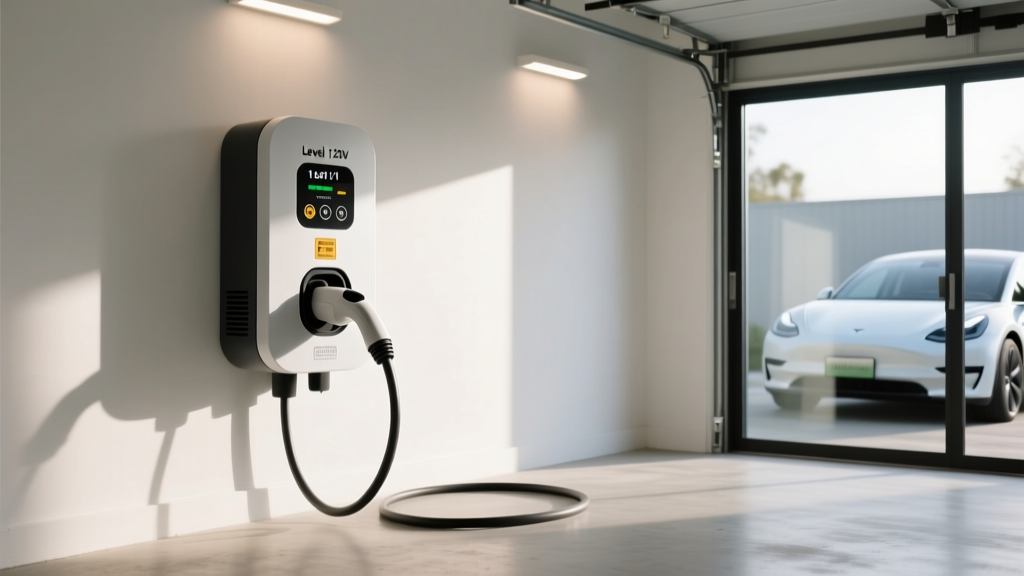
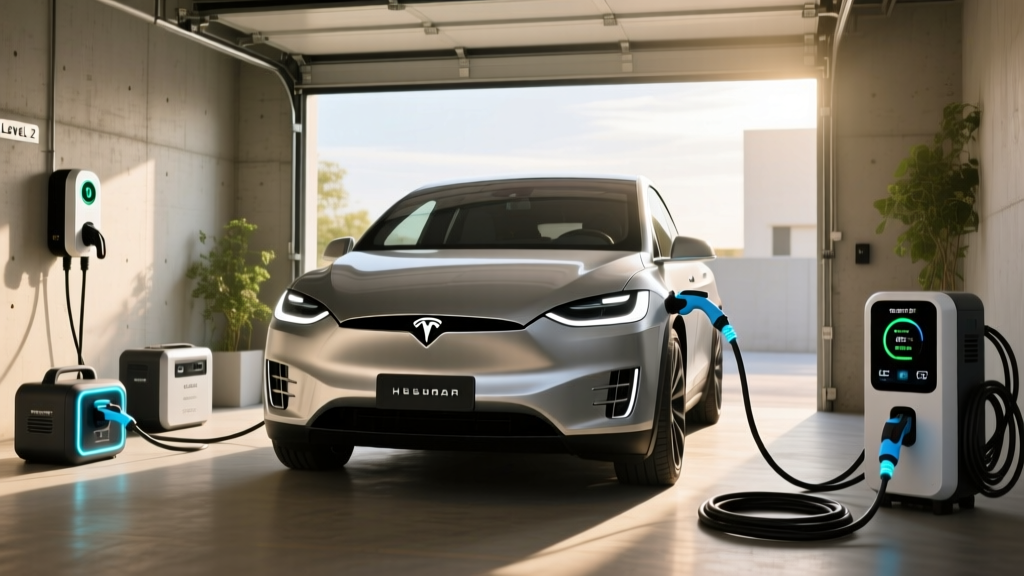
Every EV sold in the U.S. accepts three tiers of charging, though the speeds vary by vehicle and onboard charger capacity. Here's what each level actually delivers:
| Charging Level | Voltage | Power (kW) | Miles of Range Added Per Hour | Typical Use Case |
|---|---|---|---|---|
| Level 1 (120V) | 120V AC | 1.0–1.4 kW | 3–5 miles/hour | Overnight trickle; PHEVs; emergency backup |
| Level 2 (240V) | 240V AC | 3.3–19.2 kW | 12–75 miles/hour | Home daily charging; workplace; shopping centers |
| DC Fast Charging | 200–900V DC | 50–350+ kW | 150–1,200+ miles/hour (peak) | Road trips; highway corridors; rapid top-ups |
Real-world nuance: Those "miles per hour" figures assume a vehicle averaging 3–4 miles per kWh (e.g., a Tesla Model Y or Hyundai Ioniq 5). A heavier, less efficient vehicle like the Ford F-150 Lightning (averaging ~2 mi/kWh) will add fewer miles per hour at every level. DC fast charging speeds also taper significantly above 80% state of charge (SoC) to protect battery health — a 250 kW peak rarely sustains for the entire session.
How Much Does It Cost to Install a Home EV Charger?
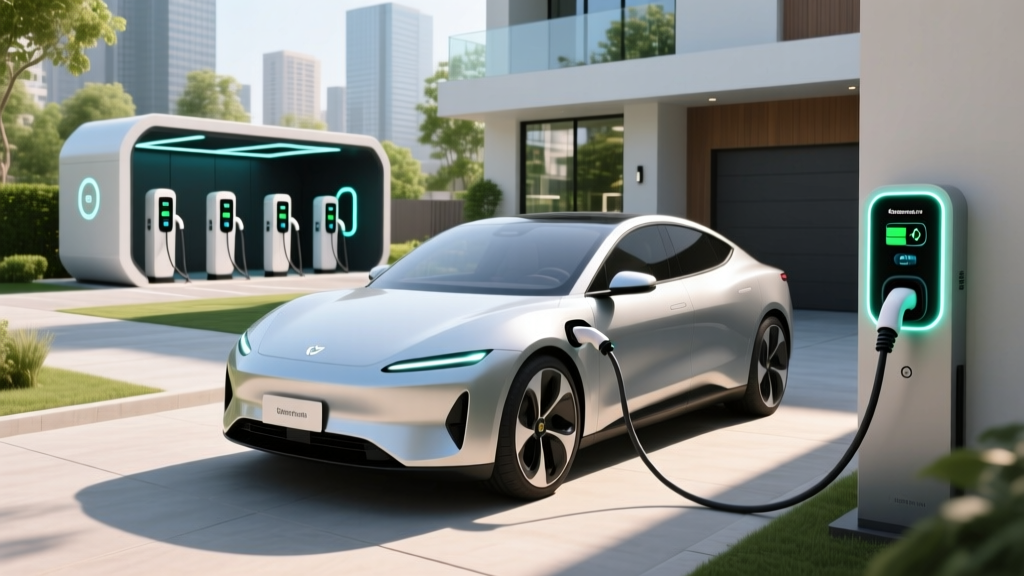
Home Level 2 charging is the cornerstone of practical EV ownership. Most owners plug in overnight and wake up to a full battery every morning, eliminating routine visits to gas stations. But the installation cost depends heavily on your home's electrical infrastructure.
| Cost Component | Typical Range | Notes |
|---|---|---|
| Level 2 Charger Equipment | $300–$700 | Smart Wi-Fi-enabled units (e.g., ChargePoint Home Flex, Wallbox Pulsar Plus) |
| Electrician Labor (standard install) | $400–$1,200 | Assumes 240V/40–50A circuit, run within 20–40 feet of panel |
| Electrical Permit | $50–$200 | Varies by municipality; required for code compliance |
| Panel Upgrade (if needed) | $1,500–$3,500+ | Required if existing panel is 100A or near capacity; 200A service recommended |
| Total (no panel upgrade) | $750–$2,100 | Most homes with 200A service fall in this range |
| Total (with panel upgrade) | $2,250–$5,800+ | Older homes (pre-2000) often need this |
Electrical requirements: A typical home Level 2 setup uses a dedicated 240V circuit rated for 40–60 amps, which delivers 9.6–14.4 kW to the vehicle (the EV's onboard charger may accept less). The National Electrical Code (NEC) requires the circuit to be rated at 125% of the continuous load — so a 48A continuous charge requires a 60A breaker. A licensed electrician should always perform this work and pull a permit.
Panel upgrade reality check: If your home has a 100-amp service panel (common in homes built before the 1990s) or your panel is already near capacity with HVAC, electric range, and dryer loads, adding a 40–60A EV circuit may exceed safe limits. Upgrading to a 200A panel is a significant but one-time investment, and some utilities offer rebates for the upgrade. As of 2026, the federal Residential Clean Energy Credit (IRC §25D) covers 30% of qualifying home charging equipment installation costs, up to $1,000 — consult a tax professional for eligibility.
Connector Compatibility: NACS, CCS1, and CHAdeMO in 2026
The connector landscape has consolidated significantly since Tesla opened its Supercharger network and the North American Charging Standard (NACS) was adopted as the industry standard. Here's where things stand for 2026 model-year vehicles:
| Connector Type | Brands Using It (2026) | Adapter Needed? |
|---|---|---|
| NACS (Tesla/J3400) | Tesla (all models), Ford, GM, Rivian, Volvo, Polestar, Hyundai, Kia, BMW, Mercedes-Benz, and most others | None for new vehicles; CCS-to-NACS adapters available for older CCS-equipped EVs (~$150–$250) |
| CCS1 (Combo) | Limited to 2023 and older models from VW, Audi, Porsche, Hyundai, Kia, Ford, GM (pre-transition) | NACS-to-CCS adapter needed for Tesla Supercharger access (~$200–$250) |
| CHAdeMO | Nissan Leaf (discontinued after 2025), Mitsubishi Outlander PHEV (older models) | Limited DC fast charging network; CHAdeMO-to-CCS adapters exist but are rare and expensive |
Home charging connector: All Level 1 and Level 2 home charging in the U.S. uses the J1772 connector (or NACS, which now supports Level 2 AC natively). Most 2026 EVs ship with NACS ports, and home chargers like the Tesla Wall Connector or ChargePoint Home Flex come with NACS or J1772 plugs accordingly. If you own an older CCS-equipped vehicle, you can still use any J1772 home charger — the DC fast charging connector is separate from the AC charging connector.
How Much Does Charging Cost Per Mile vs Gas?
The cost advantage of EV charging over gasoline depends on your local electricity rates, whether you charge at home or publicly, and your vehicle's efficiency. Let's break down real 2026 scenarios using a vehicle averaging 3.5 miles per kWh (typical for a mid-size crossover EV like the Tesla Model Y or Hyundai Ioniq 5):
| Charging Scenario | Cost per kWh | Cost per Mile | Annual Cost (12,000 mi) |
|---|---|---|---|
| Home — off-peak utility rate | $0.08–$0.14 | $0.023–$0.040 | $275–$480 |
| Home — standard residential rate | $0.14–$0.20 | $0.040–$0.057 | $480–$685 |
| Home — solar (amortized) | $0.04–$0.08 | $0.011–$0.023 | $135–$275 |
| Public Level 2 (networks) | $0.25–$0.49 | $0.071–$0.140 | $855–$1,680 |
| DC Fast Charging (public) | $0.30–$0.55 | $0.086–$0.157 | $1,030–$1,885 |
| Gasoline comparison (28 MPG, $3.40/gal) | — | $0.121 | $1,455 |
Key takeaway: Home charging at off-peak or solar rates delivers fuel costs at roughly 2–4 cents per mile — a fraction of gasoline. Even standard residential rates undercut gas. However, exclusive reliance on public DC fast charging can approach or exceed gasoline costs. This is why home charging access remains the single biggest factor in EV ownership satisfaction. According to the U.S. Department of Energy's fueleconomy.gov, EVs consistently achieve 2–3x the energy efficiency of gasoline vehicles on a per-mile basis.
Time-of-use (TOU) rates: Many utilities offer TOU plans where electricity drops to $0.06–$0.10/kWh between 10 PM and 6 AM. Programming your EV or home charger to charge during these windows can cut your fuel cost to under $300 annually for 12,000 miles of driving.
Charging Time Examples: 10% to 80% for Common Battery Sizes
Battery capacity and peak charge rate determine how long you'll wait at a DC fast charger. Here are real-world estimates for popular 2026 EVs, accounting for charge-curve taper (charging slows above ~50–60% SoC to protect battery cells):
- Tesla Model Y (75 kWh usable, LFP battery, peak ~250 kW): 10–80% in approximately 22–25 minutes on a 250 kW Supercharger. LFP batteries tolerate higher sustained charge rates and can be charged to 100% regularly without degradation concerns.
- Hyundai Ioniq 5 (77.4 kWh usable, NMC, peak ~240 kW on 800V architecture): 10–80% in approximately 18–20 minutes on a 350 kW charger. The 800V platform sustains higher power longer than 400V competitors.
- Ford F-150 Lightning Extended Range (131 kWh usable, NMC, peak ~150 kW): 10–80% in approximately 40–45 minutes. Larger batteries take longer even at high kW rates.
- Chevrolet Equinox EV (85 kWh usable, NMC, peak ~150 kW): 10–80% in approximately 30–35 minutes.
- BMW i4 eDrive40 (81.5 kWh usable, NMC, peak ~200 kW): 10–80% in approximately 28–32 minutes.
Charge curve reality: A vehicle advertising a "250 kW peak" does not charge at 250 kW for the entire session. Peak rate typically applies between ~10–30% SoC, then tapers to 150 kW by 50%, and drops below 50 kW above 80%. This is why manufacturers quote 10–80% times rather than 0–100% — charging from 80% to 100% on DC fast can take as long as the 10–80% session.
Recommended Home EV Chargers for 2026
ChargePoint Home Flex
- Power output: Up to 12 kW (50A, 240V) — adjustable down to 16A for lower-capacity circuits
- Connector: J1772 or NACS (select at purchase)
- Cable length: 23 feet
- Smart features: Wi-Fi, app scheduling, Alexa/Google Home, energy reporting, utility TOU integration
- Price: ~$550–$650
- Best for: Flexible amperage adjustment for older homes; strong app ecosystem
Tesla Wall Connector
- Power output: Up to 11.5 kW (48A, 240V)
- Connector: NACS (native Tesla); J1772 adapter included for non-Tesla EVs
- Cable length: 24 feet
- Smart features: Wi-Fi, OTA updates, Power Sharing (link multiple units on one circuit), vehicle integration
- Price: ~$450–$500
- Best for: Tesla owners; multi-EV households with Power Sharing
Wallbox Pulsar Plus
- Power output: Up to 11.5 kW (48A, 240V)
- Connector: J1772 or NACS
- Cable length: 25 feet
- Smart features: Wi-Fi + Bluetooth, app scheduling, solar integration (with Power Meter accessory), load balancing
- Price: ~$550–$700
- Best for: Solar-equipped homes; compact unit size
Emporia Level 2 EV Charger
- Power output: Up to 11.5 kW (48A, 240V)
- Connector: J1772 (NACS adapter available separately)
- Cable length: 24 feet
- Smart features: Wi-Fi, detailed energy monitoring via Emporia app, solar integration, TOU scheduling
- Price: ~$400–$500
- Best for: Budget-conscious buyers who want detailed energy data and solar pairing
When selecting a charger, match the amperage to your circuit capacity (NEC 125% rule: a 60A breaker supports 48A continuous). Hardwired installations are preferred over NEMA 14-50 outlets for safety and reliability, though outlets offer portability if you move frequently.
Safety, Code, and Electrical Considerations
EV charging is a high-draw, continuous electrical load — comparable to running an electric oven for 8 hours straight. Safety and code compliance are non-negotiable:
- Dedicated circuit: Your Level 2 charger must be on its own dedicated breaker — never shared with other appliances. A 40A charger needs a 50A breaker; a 48A charger needs a 60A breaker.
- GFCI protection: The 2020 NEC (and 2023 updates) require GFCI (Ground Fault Circuit Interrupter) protection for all EV charging outlets. Hardwired units have built-in ground fault protection. If using a NEMA 14-50 outlet, your electrician must install a GFCI breaker, which adds ~$50–$100 to the cost.
- Outdoor rating: If your charger is installed outdoors (carport, driveway, exterior wall), it must carry a NEMA 4 or IP65 weather-resistance rating. All chargers listed above meet outdoor installation standards.
- Wire gauge: A 60A circuit typically requires 6 AWG copper wire (or 4 AWG aluminum). Your electrician will calculate this based on run length and local code. Undersized wire is a fire hazard.
- Permit and inspection: Most jurisdictions require an electrical permit for EV charger installation, followed by an inspection. Skipping this can void your homeowner's insurance coverage in the event of an electrical fire. Permit fees typically range from $50–$200.
- Utility notification: Some utilities require or incentivize notification when you install a Level 2 charger, as it may affect your rate plan eligibility or qualify you for rebates. Check with your local provider.
Frequently Asked Questions
How much does it cost to install a home EV charger?
A standard Level 2 home charger installation costs $750–$2,100 when no panel upgrade is needed (equipment + electrician + permit). If your home requires a 200A panel upgrade, total costs rise to $2,250–$5,800+. The federal Residential Clean Energy Credit (IRC §25D) covers 30% of equipment and installation, up to $1,000 — see IRS guidelines for eligibility.
How fast will each charging level add range?
Level 1 (120V) adds 3–5 miles per hour. Level 2 (240V) adds 12–75 miles per hour depending on the charger's kW output and the vehicle's onboard charger. DC fast charging adds 150–1,200+ miles per hour at peak, though sessions are typically measured in 10–80% time (18–45 minutes for most 2026 EVs).
Which connector/charger is compatible with my EV?
For 2026 models, most manufacturers have adopted NACS (Tesla's connector). If you drive a 2023 or older vehicle with CCS1, you can use a NACS-to-CCS adapter (~$200–$250) to access Tesla Superchargers. For home Level 2 charging, all EVs accept J1772 or NACS — check your vehicle's port and buy the matching home charger. CHAdeMO is effectively discontinued for new vehicles.
How much does charging cost per mile vs gas?
Home charging at off-peak rates costs $0.02–$0.04 per mile — roughly 70–80% less than gasoline at $3.40/gallon and 28 MPG ($0.12/mile). Standard residential rates ($0.14–$0.20/kWh) still deliver $0.04–$0.06 per mile. Public DC fast charging at $0.35–$0.55/kWh costs $0.09–$0.16 per mile, approaching or exceeding gas costs — which is why home charging is the economic sweet spot.
What electrical upgrades might I need?
If your home has a 100A service panel, you'll likely need a 200A upgrade ($1,500–$3,500+) to safely add a 40–60A EV circuit. Homes with 200A panels usually have sufficient headroom. Your electrician will perform a load calculation per NEC Article 220 to determine capacity. Some utilities and states offer rebates for panel upgrades tied to EV adoption — check your local programs.
Can I charge my EV with solar panels?
Yes. If you have rooftop solar, your EV can effectively run on sunlight at an amortized cost of $0.04–$0.08/kWh. Smart chargers like the Wallbox Pulsar Plus and Emporia Vue integrate with solar inverters to prioritize excess solar production for EV charging, minimizing grid draw. Pairing solar with a time-of-use utility plan and home battery (like Tesla Powerwall) maximizes savings.
Do I need a smart charger or is a basic unit fine?
A basic ("dumb") Level 2 charger will charge your EV just fine. However, smart chargers offer scheduling (to exploit off-peak rates), energy monitoring, solar integration, and remote diagnostics — features that pay for themselves through utility savings within months. For most buyers, the $100–$150 premium for a smart charger is worth the investment.