The EV Charging Market in 2026: What Buyers and Owners Actually Need
The EV charging market has consolidated rapidly over the last three years. Tesla opened its Supercharger network to non-Tesla vehicles using the North American Charging Standard (NACS), most legacy CCS networks upgraded to 350 kW+ dispensers, and home charger hardware has become both cheaper and smarter. For a new EV or PHEV buyer, this is good news — but it also means more variables to sort through before you plug in for the first time.
This guide breaks down the three charging levels with exact kW and miles-per-hour numbers, walks through real home installation costs including panel upgrades, maps connector compatibility by brand, and runs the per-mile cost math against gasoline. The goal: you finish reading knowing exactly what hardware to buy, what to ask an electrician, and what your charging will actually cost.
Charging Levels Explained: Speeds, kW, and Miles Per Hour
The single most common confusion in the EV charging market is between kW (kilowatts), which measures charging power (how fast energy flows), and kWh (kilowatt-hours), which measures battery energy capacity (how much energy is stored). Think of kW as the flow rate of a hose and kWh as the size of the bucket. A 10 kW charger fills an 80 kWh battery from empty to full in roughly 8 hours; a 150 kW DC fast charger could theoretically do it in just over 30 minutes, though real-world charge curves taper significantly above 80% State of Charge.
| Level | Voltage | Typical Power (kW) | Miles of Range Added Per Hour | Best Use Case |
|---|---|---|---|---|
| Level 1 | 120V AC | 1.0–1.4 kW | 3–5 mi/hr | Overnight top-ups for PHEVs or low-mileage BEV drivers |
| Level 2 | 240V AC | 7.2–19.2 kW | 20–60 mi/hr | Primary home and workplace charging |
| DC Fast Charging (Level 3) | 400–800V DC | 50–350 kW | 150–1,200+ mi/hr (peak) | Road trips and rapid top-ups on public networks |
A few real-world caveats: Level 2 miles-per-hour figures assume a vehicle efficiency of roughly 3–4 mi/kWh (typical for a midsize crossover like the Hyundai Ioniq 5 or Tesla Model Y). Less efficient vehicles, like the Ford F-150 Lightning or Rivian R1T, will see lower miles-per-hour at the same kW. DC fast charging speeds peak only between roughly 10–40% State of Charge, then taper — so a "250 kW capable" vehicle might average 130–150 kW over a full 10–80% session. Always evaluate DC charging by 10–80% time, not peak kW.
Home Charging Installation: Electrical Requirements, Costs, and Panel Upgrades
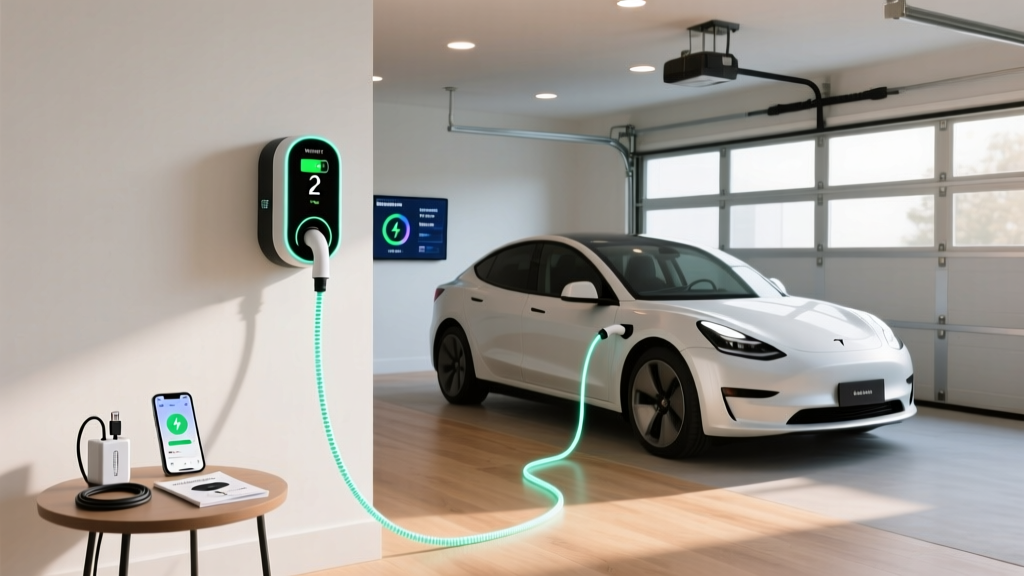
Most EV owners do 80% or more of their charging at home. The EV charging market offers dozens of Level 2 wall units, but the hardware is only part of the cost — your home's electrical infrastructure determines the real price tag.
What a Level 2 Installation Requires
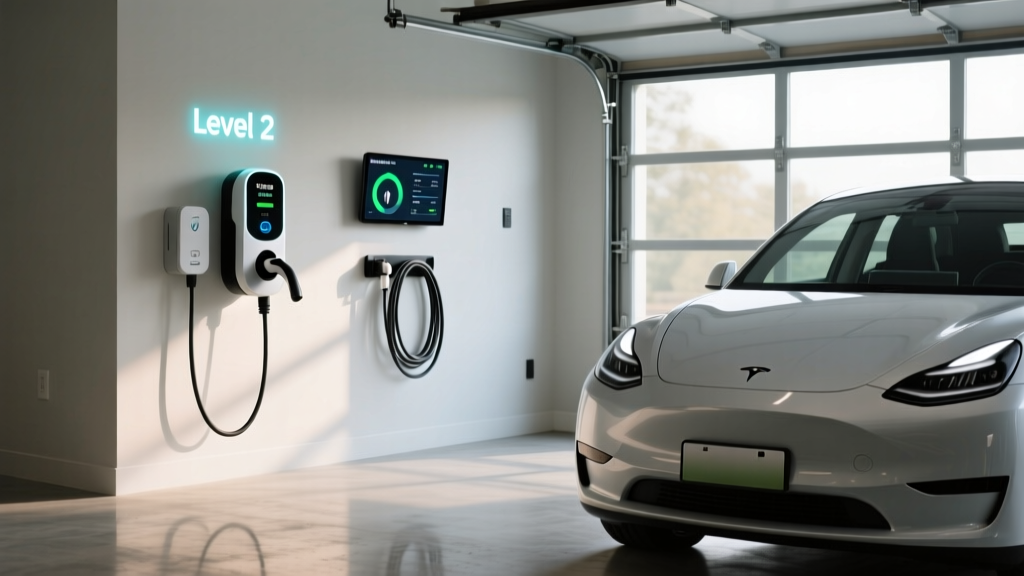
A typical Level 2 home charger runs on a 240V dedicated circuit, the same voltage as an electric dryer or oven. The most common residential setup is a 40-amp or 48-amp circuit, which delivers 7.7 kW to 9.6 kW to the vehicle (continuous loads must be derated to 80% of breaker capacity per NEC Article 210.20, so a 50-amp breaker yields 40 amps of continuous charging). Higher-power units like the 80-amp Tesla Wall Connector require a 100-amp breaker and heavier-gauge wiring.
Key installation considerations:
- Dedicated circuit: The charger must have its own breaker — no sharing with other appliances.
- GFCI protection: NEC 2020 and later require GFCI breakers for EV charging outlets (NEMA 14-50 receptacles). Hardwired units often avoid this requirement depending on local code.
- Outdoor rating: If your charger mounts outside, the unit must carry a NEMA 4 or IP65 weatherproof rating, and the installation may require a weatherproof conduit and in-use cover for receptacle-based setups.
- Permit: Most jurisdictions require an electrical permit for a new 240V circuit. Inspections ensure code compliance and are required to qualify for some utility rebates.
Installation Cost Breakdown
| Cost Component | Typical Range | Notes |
|---|---|---|
| Level 2 Charger Hardware | $200–$700 | Smart Wi-Fi chargers cost more; basic units start around $200 |
| Electrician Labor (standard install) | $400–$1,200 | Depends on run length from panel to garage/carport |
| Electrical Permit | $50–$250 | Varies by municipality |
| Panel Upgrade (if needed) | $1,500–$4,000+ | Required if existing panel lacks capacity; common in pre-2000 homes with 100A service |
| Total (no panel upgrade) | $650–$2,150 | Most homes with 200A service and short panel-to-garage runs |
| Total (with panel upgrade) | $2,150–$6,150+ | Older homes or those adding solar/battery simultaneously |
The panel upgrade is the line item that catches buyers off guard. If your home has a 100-amp main panel that is already near capacity with HVAC, an electric range, and a dryer, adding a 40-amp EV circuit may exceed your panel's rated load calculation. An electrician will perform a NEC Article 220 load calculation to determine if an upgrade to 200-amp service is required. Some homeowners pair this upgrade with solar or battery storage installations to offset the cost. Check with your utility — many offer rebates of $250–$1,000 for Level 2 installations, and some cover panel upgrades for customers who commit to off-peak EV charging.
Connector Compatibility: NACS, CCS, and CHAdeMO in 2026
The connector landscape in North America has shifted decisively toward NACS (the Tesla-designed standard, now formalized as SAE J3400). As of the 2025–2026 model years, nearly every major automaker — Ford, GM, Rivian, Volvo, Polestar, Hyundai, Kia, BMW, Mercedes, and others — has adopted NACS as the native charge port on new vehicles. CCS1 (Combined Charging System) remains on many 2022–2024 models still on the road, and CHAdeMO persists only on the Nissan Leaf and a handful of legacy vehicles.
| Connector | Native On (2025–2026 Models) | Adapter Available? | Public Network Access |
|---|---|---|---|
| NACS (SAE J3400) | Tesla (all), Ford, GM, Rivian, Hyundai, Kia, Volvo, Polestar, BMW, Mercedes, and more | N/A — becoming the default | Tesla Superchargers, Electrify America, EVgo, ChargePoint (new stalls) |
| CCS1 | Legacy 2022–2024 models (e.g., VW ID.4 early builds, older Bolt EV) | CCS-to-NACS adapters from Tesla ($250), Lectron, A2Z | Electrify America, EVgo, ChargePoint legacy stalls |
| CHAdeMO | Nissan Leaf (2025 final model year); discontinued on all other brands | Very limited; no NACS-to-CHAdeMO adapter widely available | Declining; some Electrify America and EVgo legacy stalls |
If you own a CCS-equipped vehicle, a CCS-to-NACS adapter (roughly $200–$300) unlocks access to Tesla's Supercharger network, which remains the most reliable DC fast-charging network in North America according to J.D. Power and consumer surveys. For new buyers, choosing a NACS-native vehicle eliminates adapter hassle and maximizes network access.
Cost to Charge: Home vs. Public vs. Gasoline Per-Mile Math
The EV charging market offers a wide spread of electricity prices depending on where and when you plug in. The cost advantage of EVs over gasoline hinges primarily on home charging at off-peak rates.
| Scenario | Price per kWh | Vehicle Efficiency (kWh/100 mi) | Cost per Mile | Equivalent Gas Price (at 28 MPG) |
|---|---|---|---|---|
| Home, off-peak utility rate | $0.08–$0.13 | 30 kWh | $0.024–$0.039 | $0.67–$1.09/gal |
| Home, average US residential | $0.16–$0.18 | 30 kWh | $0.048–$0.054 | $1.34–$1.51/gal |
| Public Level 2 (ChargePoint, etc.) | $0.25–$0.49 | 30 kWh | $0.075–$0.147 | $2.10–$4.12/gal |
| DC Fast Charging (Electrify America, EVgo) | $0.35–$0.56 | 30 kWh | $0.105–$0.168 | $2.94–$4.70/gal |
| Gasoline (US avg, early 2026) | — | — | $0.11–$0.13 (at 28 MPG, $3.20/gal) | $3.20/gal actual |
The takeaway: home off-peak charging delivers fuel costs equivalent to under $1/gallon gasoline. Even at average residential rates, EVs undercut most ICE vehicles on a per-mile basis. However, exclusive reliance on DC fast charging — common for apartment dwellers without home charging — can push EV fuel costs to parity with or above efficient gasoline vehicles. This is why home charging access remains the single biggest determinant of EV ownership satisfaction and economics.
Equipment Picks: Recommended Level 2 Home Chargers
The EV charging market in 2026 has matured enough that several units stand out for reliability, smart features, and value. Here are four chargers that cover different budgets and use cases, with exact specs.
Tesla Wall Connector (Gen 3)
- Power Output: Up to 11.5 kW (48A on a 60A breaker)
- Connector: NACS native; J1772 adapter available for non-Tesla EVs
- Cable Length: 24 feet
- Smart Features: Wi-Fi, OTA firmware updates, load sharing between two units on one circuit, access control via app
- Price: ~$450
- Best For: Tesla owners or NACS-native EV drivers who want a reliable, no-fuss unit with proven support
ChargePoint Home Flex
- Power Output: Configurable up to 12 kW (50A) — adjustable via DIP switches to match your circuit
- Connector: J1772 native; NACS adapter included in 2025+ bundles
- Cable Length: 23 feet
- Smart Features: Wi-Fi, ChargePoint app with scheduling, utility demand-response integration, Alexa support
- Price: ~$550–$700
- Best For: Multi-EV households with both J1772 and NACS vehicles; utility demand-response participants
Emporia Level 2 EV Charger
- Power Output: Up to 11.5 kW (48A)
- Connector: J1772 native
- Cable Length: 24 feet
- Smart Features: Wi-Fi, Emporia app with energy monitoring, solar integration (pairs with Emporia Vue home energy monitor), scheduling
- Price: ~$350–$400
- Best For: Budget-conscious buyers who want smart features and solar-aware charging without a premium price
Grizzl-E Smart
- Power Output: Up to 10 kW (40A)
- Connector: J1772 native
- Cable Length: 24 feet
- Smart Features: Wi-Fi, OCPP-compatible (works with utility programs), adjustable amperage, extreme cold rating (-40°F)
- Price: ~$400–$500
- Best For: Cold-climate owners (Canada, northern US) who need rugged, outdoor-rated hardware that performs in deep winter
For homes with NACS-native vehicles (most 2025+ models), the Tesla Wall Connector is the default pick — it is the most widely deployed, best-supported unit in the market. For mixed fleets or J1772 vehicles, the ChargePoint Home Flex offers the most flexibility. Budget buyers who want smart features should consider the Emporia, while cold-climate owners benefit from the Grizzl-E's extreme-temperature engineering.
Charging Time Examples: 10–80% for Common Battery Sizes
Charging time depends on both the charger's kW output and the vehicle's onboard acceptance rate. Below are representative 10–80% times for common battery sizes across charging levels. These assume optimal battery preconditioning and moderate ambient temperatures (60–80°F); cold batteries can double or triple these times without preconditioning.
| Battery Size (usable kWh) | Example Vehicles | Level 2 @ 7.7 kW (32A) | Level 2 @ 11.5 kW (48A) | DC Fast @ 150 kW (avg) | DC Fast @ 250 kW (avg) | |
|---|---|---|---|---|---|---|
| 60 kWh | Chevy Equinox EV, base Model 3 RWD | ~5.5 hours | ~3.6 hours | ~28 min | ~20 min | |
| 77 kWh | Ford Mustang Mach-E ER, Ioniq 5 | ~7 hours | ~4.7 hours | ~32 min | ~22 min | |
| 82–85 kWh | Tesla Model Y LR, BMW iX | ~7.5 hours | ~5 hours | ~34 min | ~24 min | |
| 100–105 kWh | F-150 Lightning ER, Rivian R1T | ~9 hours | ~6 hours | ~42 min | ~30 min | |
| 130–135 kWh | GMC Hummer EV, Silverado ER | ~12 hours | ~8 hours | ~55 min | ~40 min |
Note: DC fast charging times reflect average sustained power over the 10–80% window, not peak kW. A vehicle rated for "250 kW peak" may only sustain that rate for a few minutes before tapering. Battery preconditioning (navigating to a DC charger in the vehicle's nav system) is essential for achieving these times — without it, expect significantly slower initial charge rates, especially below 50°F ambient.
Safety, Code, and the 30D Home Charger Tax Credit
Every Level 2 installation must comply with NEC Article 625 (Electric Vehicle Charging System Equipment). Key requirements include a dedicated circuit, proper wire gauge (typically 6 AWG copper for 40–50A circuits, 4 AWG for 60A), and GFCI protection for receptacle-based installations. Hardwired chargers, which many electricians prefer, avoid the GFCI breaker requirement in many jurisdictions and eliminate the risk of a loose NEMA 14-50 receptacle connection — a known fire hazard when cheap receptacles are used with continuous high-amperage loads.
The federal Alternative Fuel Vehicle Refueling Property Credit (IRS Form 8911) covers 30% of home charger hardware and installation costs, up to $1,000, for equipment placed in service in qualifying census tracts. This is separate from the §30D vehicle tax credit and has its own eligibility requirements based on location and income. Check the IRS guidelines or consult a tax professional to confirm eligibility for your address.
Public Charging Networks: Reliability and What to Expect
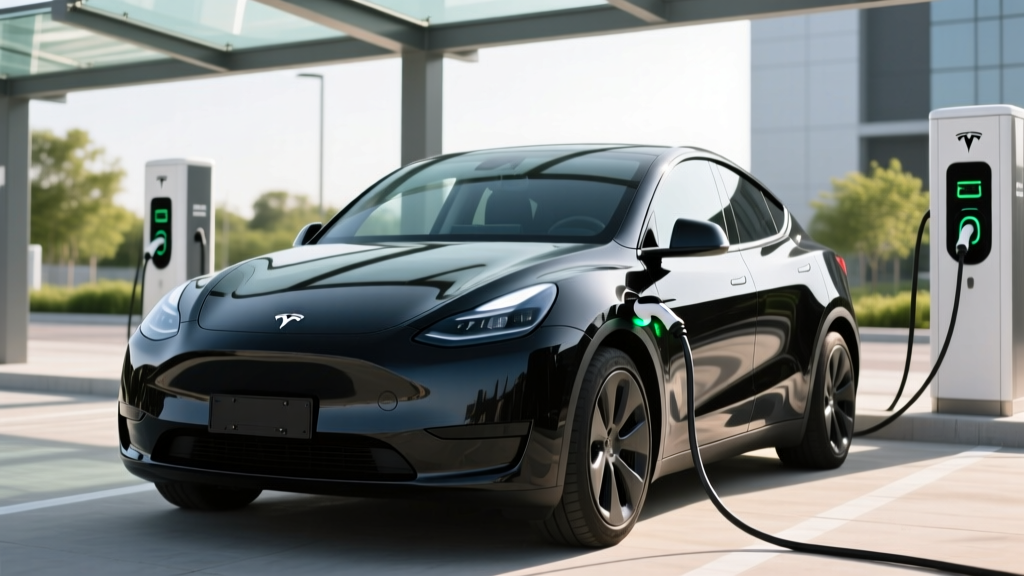
The public EV charging market in 2026 is dominated by three national networks alongside Tesla's Supercharger system:
- Tesla Supercharger: 25,000+ stalls in North America, now open to NACS-equipped non-Tesla vehicles. Consistently rated the most reliable network with 95%+ uptime. Pricing averages $0.28–$0.38/kWh depending on location and time of day.
- Electrify America: 5,000+ DC fast chargers, many upgraded to 350 kW dispensers. CCS and NACS connectors available. Pricing: $0.48–$0.56/kWh for guest rates; $0.36–$0.44 with Pass+ subscription ($7/month).
- EVgo: 3,500+ public fast chargers, strong urban presence. Pricing: $0.36–$0.48/kWh; discounts through EVgoPlus subscription.
- ChargePoint: Primarily Level 2 destination charging (workplaces, retail, apartments) with growing DC fast footprint. Pricing set by site hosts; highly variable.
For road-trip planning, the Tesla Supercharger network (via the Tesla app for non-Tesla NACS vehicles) and Electrify America offer the best coverage along major interstate corridors. Apps like PlugShare and A Better Routeplanner remain essential tools for verifying charger status before a trip.
EV Charging Market FAQ
How much does it cost to install a home EV charger?
A standard Level 2 home charger installation costs $650–$2,150 when your electrical panel has sufficient capacity. This includes $200–$700 for the charger hardware, $400–$1,200 in electrician labor, and $50–$250 for a permit. If your home needs a panel upgrade (common in pre-2000 homes with 100-amp service), add $1,500–$4,000+. Always get a load calculation from a licensed electrician before committing.
How fast will each charging level add range?
Level 1 (120V) adds roughly 3–5 miles of range per hour. Level 2 (240V) adds 20–60 miles per hour depending on the charger's kW output and your vehicle's efficiency. DC fast charging can add 150–300+ miles in 15–30 minutes, though speed tapers above 80% State of Charge. For daily driving, Level 2 is the practical baseline — most EV drivers wake up to a full battery every morning.
Which connector/charger is compatible with my EV?
For 2025–2026 model-year vehicles, NACS is the dominant standard across Tesla, Ford, GM, Hyundai, Kia, Rivian, BMW, Volvo, and others. Older CCS-equipped vehicles (2022–2024) can use CCS-to-NACS adapters ($200–$300) to access Tesla Superchargers. The Nissan Leaf uses CHAdeMO, a legacy standard with declining public infrastructure. Check your vehicle's charge port or owner's manual to confirm.
How much does charging cost per mile vs gas?
At home on off-peak utility rates ($0.10/kWh), an efficient EV costs about $0.03 per mile — equivalent to gasoline at under $1/gallon. At average US residential rates ($0.17/kWh), cost rises to about $0.05/mile, still well below the $0.11–$0.13/mile typical for a 28 MPG gasoline vehicle at $3.20/gallon. Public DC fast charging ($0.40–$0.55/kWh) can push EV costs to $0.12–$0.17/mile, approaching gas parity — another reason home charging is essential for maximizing savings.
What electrical upgrades might I need?
The most common upgrade is a panel replacement from 100-amp to 200-amp service, needed when your existing panel lacks spare capacity for a dedicated 40–60 amp EV circuit. Other potential upgrades include replacing an older fuse box with a modern breaker panel, running new conduit for long wire runs (over 50 feet from panel to garage), or adding a sub-panel if your garage is detached. A licensed electrician's load calculation (per NEC Article 220) will determine exactly what is required for your home.
Sources: fueleconomy.gov (EPA efficiency data), IRS.gov Alternative Fuel Vehicle Refueling Property Credit, National Electrical Code (NFPA 70, Article 625).