If you're new to electric vehicles, the first question is rarely about horsepower or 0–60 times. It's almost always: what is the charging situation going to look like for me? Unlike filling a gas tank in five minutes, EV charging involves multiple power levels, different connectors, home electrical upgrades, and a cost structure that rewards planning. This guide breaks down every layer — from the watts flowing into your battery to the dollars leaving your wallet — so you can make confident decisions before you buy.
A critical distinction up front: kW (kilowatts) measures power — how fast energy flows, like water pressure from a hose. kWh (kilowatt-hours) measures energy — the total amount stored in your battery, like gallons in a tank. A 75 kWh battery charged at 7 kW takes roughly 10 hours from empty. Confusing these two is the single most common mistake new EV owners make, and it leads to wildly wrong expectations about charging time.
The Three EV Charging Levels Explained
Every EV sold in the United States charges via one of three standardized levels. The level determines the voltage, amperage, power output (kW), and ultimately how many miles of range you add per hour of plug-in time. Here's the complete breakdown:
| Level | Voltage / Amperage | Power Output (kW) | Miles of Range per Hour | Typical Use Case |
|---|---|---|---|---|
| Level 1 (120V) | 120V / 12–16A | 1.2–1.9 kW | 3–5 miles/hr | Overnight top-up, low-mileage drivers, PHEVs |
| Level 2 (240V) | 240V / 16–48A | 3.3–11.5 kW | 12–44 miles/hr | Primary home charging, workplace, destination |
| DC Fast Charge | 200–800V DC | 50–350 kW | 150–1,200+ miles/hr (peak) | Road trips, highway corridors, rapid top-up |
Level 1 uses a standard household 120V outlet and the portable cord that ships with most EVs. It's universally accessible but painfully slow for battery-electric vehicles (BEVs) with large packs. A 75 kWh battery gaining 1.4 kW would take over 50 hours from empty. However, for plug-in hybrids with 10–18 kWh batteries, Level 1 is often sufficient for a full overnight charge.
Level 2 is the backbone of practical EV ownership. It requires a 240V circuit — the same voltage as your electric dryer or oven — and a dedicated EV charger (also called EVSE, for Electric Vehicle Supply Equipment). Most EV owners install a Level 2 unit at home and wake up to a full or nearly full battery every morning. At 11.5 kW (48A on a 60A circuit), you can add roughly 40–44 miles of range per hour, enough to fully replenish even a long-range EV overnight.
DC Fast Charging bypasses the vehicle's onboard charger and feeds direct current straight into the battery at high power. Speeds range from 50 kW on older stations to 350 kW on modern Electrify America or Tesla V4 Superchargers. However, peak power is not sustained power. Most EVs hit their peak charge rate only between roughly 10–50% State of Charge (SoC), then taper significantly. A vehicle advertising "250 kW peak" might sustain that for only 5–8 minutes before dropping to 100–150 kW through the rest of the session. Always look at the 10–80% charge time, not the peak kW figure, for a realistic comparison.
Real-World Charging Time Examples (10–80% SoC)
To make this concrete, here's what 10–80% charging looks like for popular battery sizes across the three levels:
| Battery Size | Example Vehicle | Level 1 (1.4 kW) | Level 2 (11.5 kW) | DC Fast (Peak Rate → Avg) |
|---|---|---|---|---|
| 18 kWh | Toyota RAV4 Prime (PHEV) | ~9 hours | ~1.5 hours (at 6.6 kW onboard limit) | N/A (most PHEVs lack DC fast) |
| 62 kWh | Chevrolet Equinox EV | ~31 hours | ~5.5 hours | ~28 min (150 kW peak → ~100 kW avg) |
| 75 kWh | Tesla Model Y Long Range | ~37 hours | ~6.5 hours | ~22 min (250 kW peak → ~140 kW avg) |
| 84 kWh | Hyundai Ioniq 5 (Long Range) | ~42 hours | ~7.3 hours | ~18 min (240 kW peak, 800V architecture) |
| 100 kWh | Ford F-150 Lightning (Extended) | ~50 hours | ~8.7 hours | ~35 min (150 kW peak → ~110 kW avg) |
Note that Level 2 charging speed is also limited by the vehicle's onboard charger. Even if your wall unit outputs 11.5 kW, a vehicle with a 7.2 kW onboard charger (common on base-trim models) will only accept 7.2 kW. Always check your vehicle's maximum AC charge rate before overspending on a high-amperage wall unit.
Home Charger Installation: Requirements, Costs & Panel Upgrades
Installing a Level 2 home charger is the single biggest infrastructure decision you'll make as an EV owner. Done right, it transforms EV ownership into a "plug in at night, wake up full" routine. Done wrong — or without understanding your electrical panel — it can balloon into an expensive surprise.
Electrical Requirements
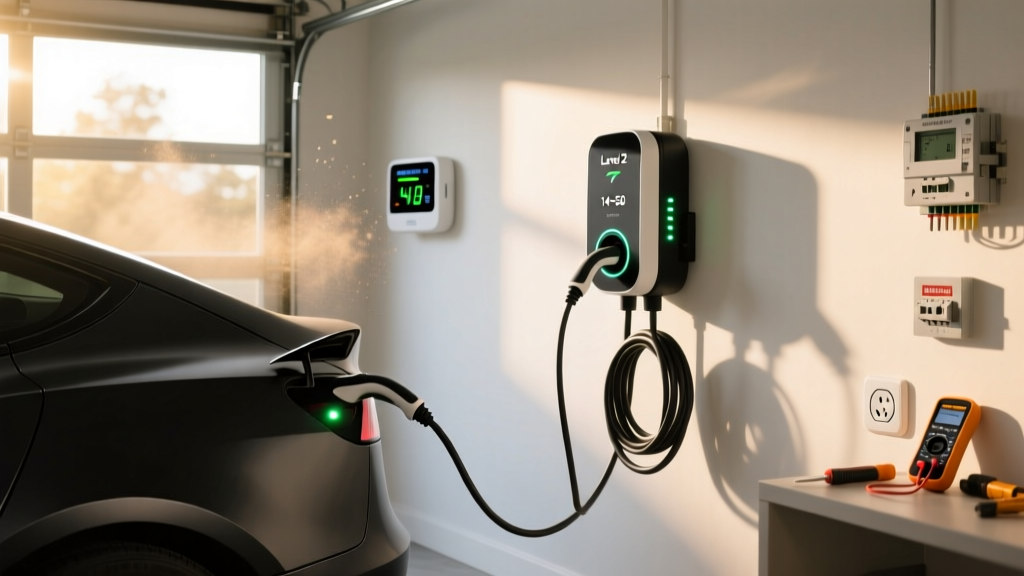
A Level 2 charger requires a dedicated 240V circuit with sufficient amperage. The National Electrical Code (NEC) requires that continuous loads (including EV charging) not exceed 80% of a circuit breaker's rating. This means:
- 16A charger (3.8 kW) → requires a 20A breaker
- 32A charger (7.7 kW) → requires a 40A breaker
- 40A charger (9.6 kW) → requires a 50A breaker
- 48A charger (11.5 kW) → requires a 60A breaker
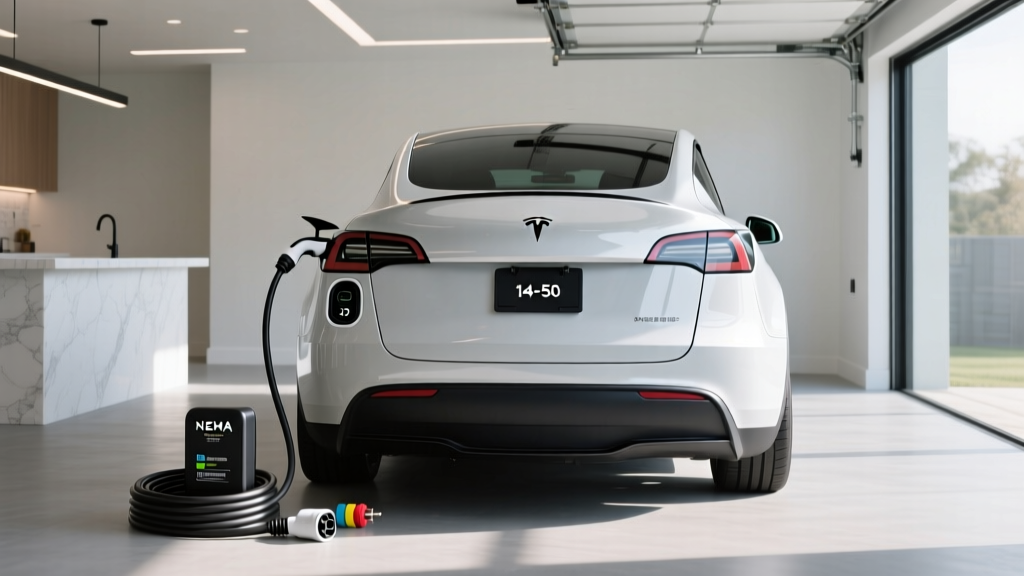
The wire gauge must match the breaker: typically 6 AWG copper for 60A circuits, 8 AWG for 40A. Your charger should be hardwired (preferred for 48A+ units) or plugged into a NEMA 14-50 outlet (common for 40A and below). Hardwiring eliminates a common failure point and satisfies some local code requirements.
Panel Capacity and the Upgrade Question
Most modern homes have a 200A main electrical panel. Before adding a 40–60A EV circuit, an electrician will perform a load calculation (per NEC Article 220) to determine if your panel has enough spare capacity. Homes with electric heating, electric ovens, electric dryers, and hot tubs may already be near capacity.
If your panel is maxed out, you have three options:
- Downsize the charger amperage. A 32A (7.7 kW) charger draws significantly less than a 48A unit and may fit within existing capacity. For most daily driving (30–50 miles), 32A overnight is more than enough.
- Install a smart load-management system. Devices like the Emporia Smart Load Center or the Span Drive panel dynamically reduce EV charging power when other household loads spike, avoiding the need for a panel upgrade.
- Upgrade your electrical panel. Going from 100A to 200A, or from 200A to 400A, is a significant project. Costs vary enormously by region and complexity.
Installation Cost Breakdown
Here's what you can realistically expect to pay for a Level 2 home charger installation in 2026:
| Component | Low End | Typical | High End |
|---|---|---|---|
| Level 2 EVSE (charger hardware) | $250 | $450 | $750 |
| Electrician labor (2–6 hours) | $300 | $600 | $1,200 |
| Electrical permit | $50 | $150 | $300 |
| Wire, conduit, breaker, misc. materials | $100 | $250 | $500 |
| Total (no panel upgrade) | $700 | $1,450 | $2,750 |
| Panel upgrade (if needed: 100A → 200A) | $1,500 | $2,500 | $4,500 |
| Total (with panel upgrade) | $2,200 | $3,950 | $7,250 |
Factors that push costs toward the high end: long wire runs from the panel to the garage (50+ feet), conduit requirements through finished walls or concrete, upgrading from a 100A to 200A service, and working in jurisdictions with expensive permit fees or inspection requirements. Homes where the panel is adjacent to the garage with an unfinished wall between them can land at the low end.
Federal incentive: The IRS residential clean energy credit does not currently cover EV chargers for most taxpayers — the former §30C alternative fuel vehicle refueling property credit expired for most installations. Some states and utilities still offer rebates of $250–$1,000 for Level 2 equipment or installation. Check your utility's website and the AFDC incentive database for local programs.
Connector Compatibility: NACS, CCS, and CHAdeMO
Not all EV plugs are the same, and the North American market has undergone a major connector transition since 2023. Here's where things stand in 2026:
| Connector | Type | Brands Using It (2026 Models) | Notes |
|---|---|---|---|
| NACS (J3400) | AC + DC (single port) | Tesla (all), Ford, GM, Rivian, Volvo, Polestar, Hyundai/Kia (2025+), BMW, Mercedes, Lucid | Now the dominant North American standard; compact design |
| CCS1 (Combo) | AC + DC (single port) | VW ID.4 (2024 and prior), older Chevy Bolt, older BMW i4, Stellantis EVs (some) | Being phased out; adapters available for Tesla Supercharger access |
| CHAdeMO | DC only (separate AC port) | Nissan Leaf (legacy only — no new US models since 2025) | Effectively discontinued in North America |
The critical takeaway: if you're buying a new EV in 2026, it almost certainly has a NACS port — or will within the model year. If you own a CCS-equipped vehicle from 2024 or earlier, you'll need a CCS-to-NACS adapter (roughly $150–$250) to access the Tesla Supercharger network, which now has 30,000+ stalls open to non-Tesla vehicles. Most automakers provide or subsidize this adapter for their existing customers.
For Level 2 home charging, the connector situation is simpler. All home EVSE units sold in 2026 ship with a NACS connector (or offer it as the default). If you have an older CCS vehicle, you can either buy a CCS-compatible charger or use a NACS-to-CCS adapter for AC charging.
What Does EV Charging Actually Cost? Per-Mile Comparison
One of the strongest arguments for EV ownership is lower fuel cost per mile — but the savings depend heavily on where and when you charge. Let's run the numbers using a realistic 3.0 miles per kWh efficiency (typical for a midsize crossover EV like the Hyundai Ioniq 5 or Tesla Model Y):
| Charging Scenario | Cost per kWh | Cost per Mile (3.0 mi/kWh) | Equivalent Gas Price (at 28 MPG) |
|---|---|---|---|
| Home — off-peak utility rate | $0.09/kWh | $0.030/mile | $0.84/gallon |
| Home — average US residential rate | $0.17/kWh | $0.057/mile | $1.59/gallon |
| Home — peak/TOU high rate (e.g., California) | $0.34/kWh | $0.113/mile | $3.17/gallon |
| Public Level 2 (ChargePoint, etc.) | $0.25–$0.40/kWh | $0.083–$0.133/mile | $2.33–$3.73/gallon |
| DC Fast Charging (Electrify America, Tesla) | $0.35–$0.55/kWh | $0.117–$0.183/mile | $3.27–$5.13/gallon |
| Gasoline (US average, mid-2026) | — | $0.118/mile ($3.30/gal ÷ 28 MPG) | $3.30/gallon (baseline) |
The pattern is clear: home charging at off-peak or average rates delivers massive savings — equivalent to paying under $1.60 per gallon of gas. But frequent reliance on DC fast charging at $0.45–$0.55/kWh can actually exceed the per-mile cost of a fuel-efficient gas car. The economics of EV ownership strongly favor those who can charge at home or at a workplace with subsidized rates.
According to fueleconomy.gov, the average EV driver who charges primarily at home saves $800–$1,200 per year in fuel costs compared to a 28 MPG gasoline vehicle driven 12,000 miles annually.
Recommended Home EV Chargers (2026)
After testing and tracking reliability across dozens of Level 2 units, these are the chargers we recommend based on power output, build quality, smart features, and value:
Best Overall: ChargePoint Home Flex (NACS)
- Power output: Up to 11.5 kW (48A) on a 60A circuit; adjustable down to 16A
- Connector: NACS (J3400); CCS adapter available
- Cable length: 23 feet
- Smart features: Wi-Fi, app scheduling, utility TOU integration, Alexa, energy tracking
- Price: ~$550–$650
- Why: Flexible amperage means it works with almost any panel capacity. Reliable app, UL-listed, and widely available. The adjustable dip-switch lets your electrician set it to match your circuit exactly.
Best Value: Emporia Level 2 EV Charger
- Power output: Up to 11.5 kW (48A) on a 60A circuit
- Connector: NACS (2025+ models); J1772 with adapter for older stock
- Cable length: 24 feet
- Smart features: Wi-Fi, Emporia app, solar integration, load management with Emporia Vue panel monitor
- Price: ~$350–$400
- Why: The cheapest 48A smart charger on the market. Solar-aware scheduling is excellent for homes with rooftop panels. Load-management pairing with the Vue monitor can avoid panel upgrades.
Best for Tesla Ecosystem: Tesla Wall Connector
- Power output: Up to 11.5 kW (48A) on a 60A circuit
- Connector: NACS (native Tesla); includes J1772 adapter for non-Tesla EVs
- Cable length: 24 feet
- Smart features: Wi-Fi, power sharing (link up to 6 units on one circuit), OTA updates, Tesla app integration
- Price: ~$475
- Why: Sleek design, power-sharing feature is ideal for two-EV households on a single 60A circuit. The included J1772 adapter means it can charge non-Tesla EVs, making it versatile for mixed-brand garages.
Best for High Power: Grizzl-E Smart (48A/60A)
- Power output: Up to 14.4 kW (60A) on an 80A circuit — one of the highest residential outputs available
- Connector: NACS or J1772 (configurable at order)
- Cable length: 24 feet
- Smart features: Wi-Fi, OCPP support, app scheduling, adjustable amperage
- Price: ~$600–$700
- Why: Built in Canada with extreme cold-weather durability (-40°F rated). The 60A output is useful for large-battery vehicles like the F-150 Lightning Extended Range or Rivian R1S that benefit from faster overnight replenishment.
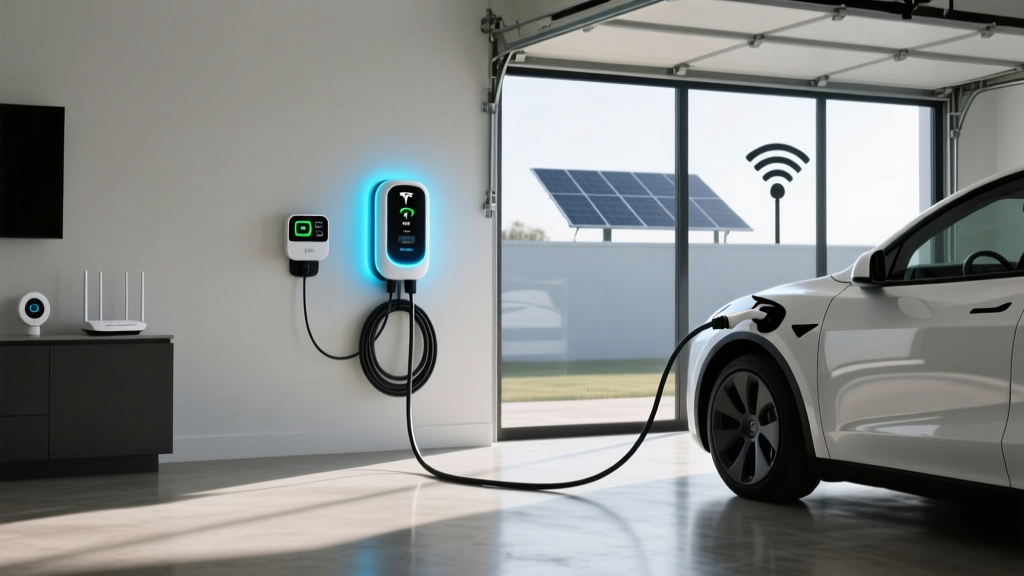
A note on smart vs. dumb chargers: a "dumb" charger (no Wi-Fi, no app) works perfectly fine for basic plug-and-charge use and costs $100–$200 less. However, smart chargers enable time-of-use scheduling (charge only when electricity is cheapest), energy monitoring, and remote start/stop — features that pay for themselves within months if your utility has TOU rates.
Safety, Code & Outdoor Installation Considerations
EV charging involves sustained high-current draw over many hours — a fundamentally different electrical load than briefly running a microwave. Safety and code compliance are not optional extras.
- Dedicated circuit: Your EV charger must be on its own dedicated breaker. Sharing a circuit with other outlets or appliances is a code violation and a fire risk.
- GFCI protection: NEC 2020 and later require GFCI (Ground Fault Circuit Interrupter) protection for outdoor receptacles used for EV charging. Hardwired installations may have different requirements depending on your jurisdiction. Many modern EVSE units have built-in ground-fault detection, which can satisfy this requirement.
- Outdoor rating: If your charger will be mounted outside (driveway, exterior wall), it must carry a NEMA 4 or NEMA 4X weatherproof rating. All units listed above meet this standard, but confirm before purchasing for outdoor use.
- Cable management: A 24-foot cable dragging on the ground degrades over time and creates a trip hazard. Look for units with integrated cable holsters or install a simple wall-mount hook.
- Permit and inspection: Most jurisdictions require an electrical permit for a new 240V circuit. The permit fee is typically $50–$300, and the inspection ensures your installation meets NEC standards. Skipping the permit may void your homeowner's insurance coverage for electrical fires.
- EVSE certification: Only purchase chargers that are UL-listed (or ETL-listed to UL standards). Uncertified chargers imported from overseas marketplaces may lack critical safety protections and will likely fail inspection.
Always hire a licensed electrician who has specific EV charger installation experience. Ask whether they'll perform a NEC Article 220 load calculation and whether they'll pull a permit. The cheapest bid often skips one or both.
Frequently Asked Questions
How much does it cost to install a home EV charger?
A typical Level 2 home charger installation costs between $700 and $2,750, including the charger unit ($250–$750), electrician labor ($300–$1,200), permit ($50–$300), and materials ($100–$500). If your home needs an electrical panel upgrade (100A to 200A), add $1,500–$4,500 to that total. Most homes with a 200A panel and a garage near the electrical panel land in the $1,000–$1,800 range.
How fast will each charging level add range?
Level 1 (120V) adds 3–5 miles per hour. Level 2 (240V) adds 12–44 miles per hour depending on amperage. DC fast charging adds 150–1,200+ miles per hour at peak power, but sessions are typically measured in minutes rather than hours — expect 10–80% in 18–35 minutes for most modern EVs. The exact rate depends on your vehicle's battery size, charge acceptance rate, and the station's power output.
Which connector/charger is compatible with my EV?
For 2026 model-year vehicles, nearly all new EVs sold in North America use the NACS (J3400) connector. This includes Tesla, Ford, GM, Hyundai, Kia, Rivian, BMW, and others. Older vehicles (2024 and prior) may use CCS1. The Nissan Leaf uses CHAdeMO but is no longer sold new in the US. For home Level 2 charging, buy a NACS charger if your vehicle has a NACS port; if you have an older CCS vehicle, use a CCS-compatible charger or a NACS-to-CCS adapter.
How much does charging cost per mile vs gas?
Charging at home on an average US electricity rate ($0.17/kWh) costs roughly $0.057 per mile for a typical EV — equivalent to paying $1.59 per gallon of gas. Off-peak rates drop this to $0.030 per mile. However, DC fast charging at $0.45–$0.55/kWh costs $0.15–$0.18 per mile, which can exceed the per-mile cost of a fuel-efficient gas car. The economic advantage of an EV is maximized by home or workplace charging.
What electrical upgrades might I need?
The most common upgrade is running a new dedicated 240V circuit from your panel to your garage or parking spot. If your panel lacks spare capacity (determined by a NEC Article 220 load calculation), you may need to upgrade from a 100A to 200A service ($1,500–$4,500) or install a smart load-management device that reduces EV charging power when other household circuits are under heavy use. Older homes with 100A panels and multiple electric appliances are the most likely candidates for a panel upgrade.
Can I charge my EV with a regular household outlet?
Yes — that's Level 1 charging (120V). It adds 3–5 miles of range per hour and works well for PHEVs with small batteries (10–18 kWh) or BEV owners who drive fewer than 30 miles per day and can charge over 8–12 hours. For BEV owners with longer commutes, Level 1 is impractically slow as a primary charging method.
Do I need a smart charger, or is a basic one fine?
A basic ("dumb") charger will charge your EV reliably. A smart charger adds scheduling (charge during off-peak hours for lower electricity rates), energy monitoring, remote control via app, and utility integration. If your utility offers time-of-use rates, a smart charger's $100–$200 premium typically pays for itself within 6–12 months through optimized charging schedules.