The North American EV market in 2026 is closer to connector unity than ever, but the transition from CCS1 and CHAdeMO to NACS has created a fragmented reality. Drivers still encounter broken CCS stalls, incompatible public chargers, adapter-dependent road trips, and confusing plug types at new installations. These EV charging interface non-standardization issues aren't theoretical — they affect daily charging reliability, trip planning, and total ownership cost.
This guide dissects the current fragmentation landscape with real-world case studies, explains every charging level and connector type with exact speeds, and walks through home installation requirements and costs so you can navigate the mess with confidence.
The Three Charging Levels: Speeds, Power, and Real-World Range Added
Before tackling connector chaos, you need the baseline numbers. Every EV charges at one of three levels, and the difference between them is measured in kW (kilowatts) — the rate of power delivery — not kWh (kilowatt-hours), which measures the total energy stored in your battery. Confusing these two is the single most common EV literacy gap.
| Level | Voltage | Max Power (kW) | Miles of Range Added Per Hour | Typical Use Case |
|---|---|---|---|---|
| Level 1 | 120V AC | 1.4 kW | 3–5 miles/hr | Overnight top-ups, PHEVs, emergency |
| Level 2 | 240V AC | 7.2–19.2 kW | 20–60 miles/hr | Home daily charging, workplace, shopping |
| DC Fast | 400–800V DC | 50–350 kW | 150–1,200+ miles/hr (peak) | Road trips, highway corridors |
A practical example: charging a Tesla Model Y Long Range (75 kWh usable battery, EPA 320 miles) from 10% to 80% takes roughly 30 hours on Level 1, about 7–8 hours on a 7.2 kW Level 2 home charger, and approximately 22–25 minutes on a 250 kW DC fast charger (accounting for the charge curve taper above 50% SoC).
Connector Compatibility in 2026: NACS, CCS1, and CHAdeMO Explained
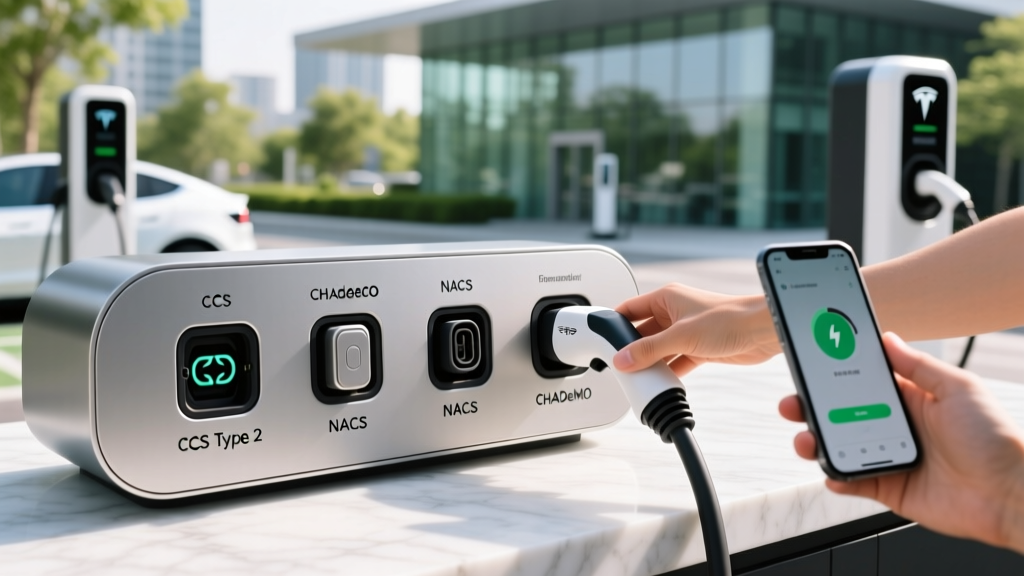
The core of the non-standardization problem: three competing DC fast-charging connector standards coexist on North American roads. Here's which vehicles use which plug, and what adapters you'll need.
| Connector | Vehicle Brands (2026 Models) | Public Network Availability | Adapter Needed? |
|---|---|---|---|
| NACS (J3400) | Tesla (all), Ford, GM, Rivian, Volvo, Polestar, Fisker, Mercedes, BMW (2025+), Hyundai/Kia (2025+), Toyota (bZ new models) | Tesla Supercharger (open to NACS), Electrify America (new stalls), ChargePoint, EVgo | CCS→NACS adapter for legacy CCS vehicles; most new EVs ship NACS-native |
| CCS1 (Combo) | Hyundai/Kia (2024 and earlier), VW ID.4 (pre-2025), BMW i4/iX (pre-2025), legacy Ford/GM models | Electrify America, EVgo, ChargePoint, Blink (legacy stalls) | NACS→CCS adapter required at Superchargers; ~$200–$300 |
| CHAdeMO | Nissan Leaf (all years), Mitsubishi Outlander PHEV (older) | Declining rapidly; some EVgo and independent stations | No reliable CHAdeMO→NACS adapter exists for DC fast charging |
For Level 2 AC charging, the J1772 connector remains the universal standard across all non-Tesla EVs, while Tesla uses its proprietary connector (now identical in shape to NACS). Every Tesla ships with a J1772 adapter, and most aftermarket Level 2 chargers include a J1772 plug with optional NACS compatibility.
Case Studies: Where Non-Standardization Hits Owners Hardest
Case Study 1: The CCS-to-NACS Adapter Road Trip (Ford F-150 Lightning Owner)
A 2023 Ford F-150 Lightning XLT (EPA 240 miles, 98 kWh usable battery, CCS1 native) owner in early 2026 faces a practical problem: Ford has opened Supercharger access, but the truck requires a Ford-provided NACS adapter (free for original owners, ~$230 replacement). On a Denver-to-Moab trip, the owner maps Supercharger stops but discovers two things: the adapter limits DC fast charging to 150 kW (not the truck's native 150 kW CCS peak, but with higher thermal overhead due to adapter resistance), and three Supercharger stalls along I-70 in Colorado have "CCS vehicle" signage restrictions that were not updated in the Tesla app. The owner successfully charges but adds 15 minutes per stop compared to a native NACS vehicle like the Rivian R1T.
Takeaway: Adapter-based charging works but introduces speed penalties, app confusion, and physical friction (the adapter adds weight and bulk to the cable connection).
Case Study 2: CHAdeMO Desert — Nissan Leaf Owner in the Midwest
A 2024 Nissan Leaf SV Plus (EPA 212 miles, 62 kWh battery, CHAdeMO DC port) owner in Iowa finds that Electrify America has removed CHAdeMO connectors from two of three corridor stations along I-80 during 2025 retrofit upgrades. EVgo maintains one CHAdeMO stall in Des Moines but it's limited to 50 kW (the Leaf can accept up to 100 kW). The owner's real-world highway range in January cold (approximately 145 miles at 70 mph in 25°F weather) requires two charging stops on a 300-mile trip where a NACS or CCS vehicle would need one. Total trip charging time: 1 hour 40 minutes vs. approximately 45 minutes in a comparable Hyundai Ioniq 5 on NACS Superchargers.
Takeaway: CHAdeMO infrastructure is in active decline. New EV buyers should avoid CHAdeMO vehicles unless they have reliable home charging and short commutes.
Case Study 3: Fleet Depot Mixed-Fleet Headache
A mid-size delivery fleet in Atlanta operates 12 Ford E-Transits (CCS1, 2022 models), 8 Tesla Semi prototypes (NACS), and 4 BrightDrop Zevo 600 vans (CCS1, 2024). Their depot charging installation requires dual-standard DC fast chargers (ABB Terra 360 units offering both CCS and NACS cables) at $85,000 per unit installed, versus single-standard units at $55,000. The fleet pays a $120,000 premium for connector diversity — a direct cost of non-standardization borne by commercial operators.
Home Charger Installation: Electrical Requirements, Costs, and Panel Upgrades
Home Level 2 charging solves most daily needs, but installation costs vary wildly based on your electrical panel's capacity. Here's the full breakdown.
Electrical requirements for a standard 48-amp Level 2 charger:
- Dedicated 240V / 60-amp circuit (NEC requires the circuit rated at 125% of continuous load, so a 48A charger needs a 60A breaker)
- 6-gauge copper wire (THHN in conduit) for runs up to 50 feet; 4-gauge for longer runs
- NEMA 14-60 outlet (for plug-in chargers) or hardwired connection (required for 48A+ units in many jurisdictions)
- GFCI breaker required in most 2023 NEC-adopting jurisdictions for garage outlets
| Component | Low Estimate | High Estimate | Notes |
|---|---|---|---|
| Level 2 Charger (equipment) | $350 | $750 | 40A–48A smart chargers; premium WiFi units cost more |
| Electrician labor (standard install) | $500 | $1,500 | Panel-adjacent install with short wire run |
| Wire, conduit, breaker | $150 | $400 | Varies by run length and local material costs |
| Permit and inspection | $50 | $250 | Required in most municipalities |
| Subtotal (standard install) | $1,050 | $2,900 | Most homes with 200A panel fall here |
| Panel upgrade (100A → 200A) | $2,000 | $5,000 | Required if existing panel lacks capacity; common in pre-1990 homes |
| Total with panel upgrade | $3,050 | $7,900 | Worst-case older-home scenario |
The panel upgrade is the hidden cost that surprises most buyers. A licensed electrician will perform a load calculation per NEC Article 220 to determine if your existing service can handle the additional 60A continuous draw. Homes with electric heating, electric water heaters, and electric dryers on a 100A or 125A panel frequently require an upgrade. NEC code compliance is non-negotiable — unpermitted EV charger installs can void home insurance claims.
Recommended Home Chargers: Power, Features, and Pricing
Based on 2026 availability, reliability data, and compatibility with the fragmented connector landscape, these are the top picks:
ChargePoint Home Flex (NACS/J1772)
- Power: Up to 12 kW (50A) on 240V hardwired; 9.6 kW (40A) on NEMA 14-50
- Connector: Ships with NACS plug (2025+ models); J1772 adapter included
- Cable length: 23 feet
- Smart features: WiFi, scheduled charging, Alexa/Google integration, energy dashboard
- Price: ~$549 (frequently on sale at $449)
- Best for: NACS-native EVs; flexible amperage settings for panel-limited homes
Wallbox Pulsar Plus (J1772 / NACS option)
- Power: Up to 11.5 kW (48A) hardwired
- Connector: J1772 standard; NACS pigtail available as $50 accessory
- Cable length: 25 feet
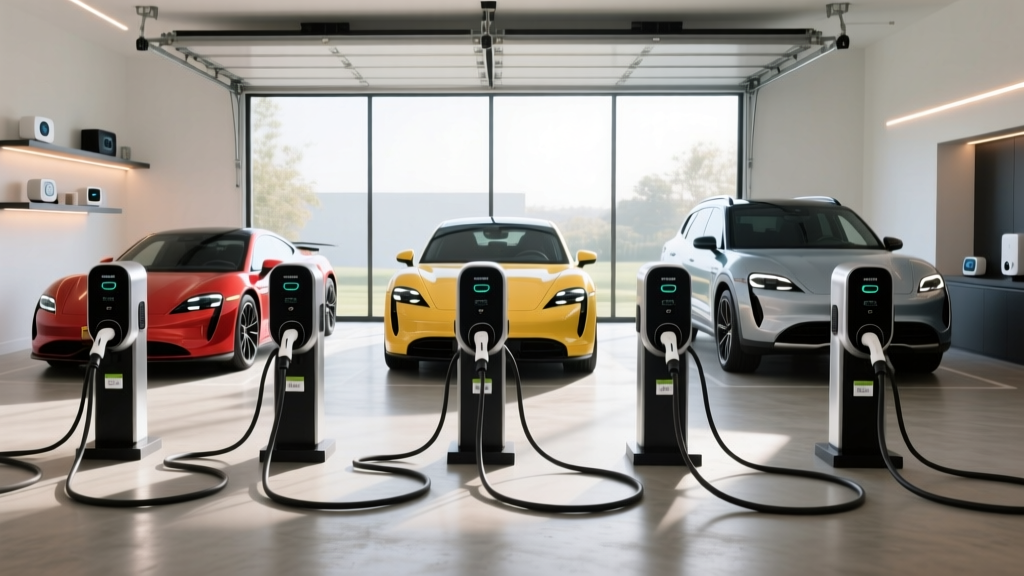
- Smart features: WiFi, Bluetooth, Power Sharing (daisy-chain two units on one circuit), load management
- Price: ~$449 (J1772); ~$499 (NACS)
- Best for: Multi-EV households; CCS/J1772 vehicles; tight budgets
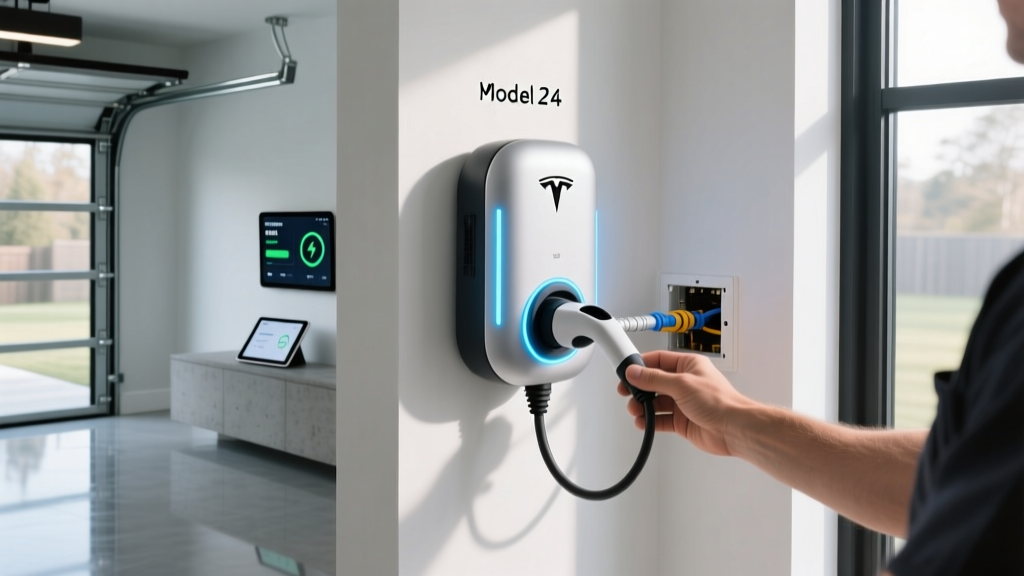
Tesla Wall Connector (NACS native)
- Power: Up to 11.5 kW (48A) on 60A circuit
- Connector: NACS native; J1772 adapter included in box
- Cable length: 24 feet
- Smart features: WiFi firmware updates, power sharing, Tesla app integration, access control
- Price: $475
- Best for: Tesla owners; cleanest NACS ecosystem integration
Charging Cost Per Mile: Home vs. Public vs. Gas
One area where standardization doesn't matter: the math of cost-per-mile is universal regardless of connector type. Here's how EV charging compares to gasoline in 2026.
| Charging Scenario | Rate ($/kWh) | Cost for 60 kWh Fill | Cost Per Mile (at 3 mi/kWh) | Equivalent MPG Gas Price |
|---|---|---|---|---|
| Home Level 2 (off-peak utility rate) | $0.08–$0.14 | $4.80–$8.40 | $0.03–$0.05 | $0.90–$1.50/gal |
| Home Level 2 (standard rate, no TOU) | $0.14–$0.20 | $8.40–$12.00 | $0.05–$0.07 | $1.50–$2.10/gal |
| Public Level 2 (ChargePoint, Blink) | $0.25–$0.49 | $15.00–$29.40 | $0.08–$0.16 | $2.40–$4.80/gal |
| DC Fast (Electrify America, EVgo) | $0.35–$0.55 | $21.00–$33.00 | $0.12–$0.18 | $3.60–$5.40/gal |
| Tesla Supercharger (member/non-member) | $0.25–$0.45 | $15.00–$27.00 | $0.08–$0.15 | $2.40–$4.50/gal |
| Gasoline (US avg, regular unleaded) | — | — | $0.11–$0.16 (at 27 MPG) | $3.00–$4.30/gal |
The data is clear: home charging on time-of-use (TOU) off-peak rates delivers 3–5× cost savings over gasoline. Public DC fast charging at peak rates can equal or exceed gas costs per mile — which is why home Level 2 installation remains the highest-ROI upgrade for any EV owner. See the EPA's EV efficiency ratings to calculate your specific vehicle's miles-per-kWh figure.
Safety, Code, and the Non-Standardization Risks
Connector fragmentation isn't just an inconvenience — it introduces safety and compliance risks:
- Adapter overheating: Third-party CCS-to-NACS adapters (non-OEM) have been flagged in NHTSA complaints for thermal events during sustained 150 kW+ sessions. Always use OEM or OEM-certified adapters. Tesla's CCS adapter and Ford's official NACS adapter are tested to UL standards; Amazon-sourced alternatives may not be.
- Weight and strain: NACS-to-CCS adapters add 2–3 lbs to the connector head, increasing cable strain on the vehicle's charge port. Repeated use without cable support can loosen port contacts over time.
- UL listing: Any Level 2 charger installed in a permitted home installation must carry a UL or ETL listing. Chargers imported directly from overseas markets (common with CHAdeMO units) may lack North American safety certifications, creating insurance liability.
- Ground fault protection: The 2023 NEC requires GFCI protection for all 240V receptacles in garages. Hardwired chargers bypass this requirement (the charger's internal protection suffices), which is one reason electricians increasingly recommend hardwiring over plug-in installations.
Frequently Asked Questions
How much does it cost to install a home EV charger?
A standard Level 2 home charger installation (48A, hardwired, panel-adjacent) costs between $1,050 and $2,900 including equipment, electrician labor, materials, and permit. If your home requires a panel upgrade from 100A to 200A service, add $2,000–$5,000. Always get a load calculation from a licensed electrician before committing.
How fast will each charging level add range?
Level 1 (120V) adds 3–5 miles per hour — adequate for PHEVs with small batteries but impractical for full BEVs. Level 2 (240V) adds 20–60 miles per hour depending on amperage (7.2 kW to 19.2 kW). DC fast charging adds 150–1,200+ miles per hour at peak rates, but only sustains peak speed between 10–50% SoC before tapering.
Which connector/charger is compatible with my EV?
Check your vehicle's charge port: Tesla, Ford (2025+), GM (2025+), Rivian, and most new 2025+ models use NACS. Hyundai, Kia, VW, and BMW models from 2024 and earlier use CCS1. The Nissan Leaf uses CHAdeMO. For Level 2 home charging, all non-Tesla EVs use J1772; Tesla uses NACS but includes a J1772 adapter. When buying a home charger, match the plug to your vehicle or ensure an adapter is included.
How much does charging cost per mile vs gas?
Home charging on off-peak utility rates costs $0.03–$0.05 per mile — roughly equivalent to $0.90–$1.50 per gallon of gas. Public DC fast charging costs $0.12–$0.18 per mile, comparable to $3.60–$5.40 per gallon. The average gasoline vehicle at 27 MPG with gas at $3.50/gallon costs about $0.13 per mile.
What electrical upgrades might I need?
The most common upgrade is a panel capacity increase from 100A or 125A to 200A, required when your existing electrical service can't support the additional 60A continuous draw of a Level 2 charger alongside existing loads (HVAC, electric dryer, water heater). Older homes (pre-1990) with original panels are most likely to need this. Some utilities offer residential energy credits that may offset electrical upgrade costs — consult IRS Publication 5695 and a tax professional for eligibility.
Will the connector situation improve?
Yes, but slowly. By 2028, virtually all new EVs sold in North America will ship with NACS, and most new DC fast-charging installations will be NACS-native. However, CCS1 and CHAdeMO vehicles sold between 2018–2025 will remain on the road for 15+ years, meaning adapter dependency and dual-standard public stations will persist through the 2030s. The non-standardization problem is resolving — but current owners must navigate the transition.