If you own a 2012 Jaguar XJL Supercharged — or you're simply using it as a benchmark for what a luxury gas sedan costs to fuel — you've probably wondered whether switching to an electric vehicle actually saves money. The answer depends almost entirely on how you charge. This guide breaks down every charging level, home installation realities, connector compatibility, and real per-mile costs so you can compare apples to kilowatt-hours.
Charging Levels Explained: Speeds, kW, and Miles Per Hour
The single most important distinction in EV charging is between kW (kilowatts), which measures power — how fast energy flows into the battery — and kWh (kilowatt-hours), which measures energy — how much total capacity the battery holds. Think of kW as the width of a hose and kWh as the size of the bucket. Charging speed is always expressed in kW; battery size is always in kWh.
| Level | Voltage / Amps | Power (kW) | Miles of Range Added Per Hour | Typical Use Case |
|---|---|---|---|---|
| Level 1 | 120V / 12A | ~1.4 kW | 3–5 mi/hr | Overnight top-up, PHEVs |
| Level 2 | 240V / 32–48A | 7.7–11.5 kW | 25–44 mi/hr | Home daily charging, workplaces |
| DC Fast Charge | 200–900V DC | 50–350 kW | 150–1,200+ mi/hr (peak) | Road trips, highway corridors |
Real-world charging time examples (10–80% State of Charge):
- 75 kWh battery (e.g., Tesla Model 3 Long Range) on a 250 kW DC fast charger: ~22–25 minutes, peaking near 250 kW then tapering above 55% SoC.
- 95 kWh battery (e.g., Hyundai Ioniq 5) on a 350 kW charger: ~18 minutes (800V architecture sustains higher power longer).
- 131 kWh battery (e.g., Ford F-150 Lightning Extended Range) on a 150 kW charger: ~40–45 minutes.
- Any of the above on a 48A Level 2 home charger (11.5 kW): 7–11 hours from 10–80%, perfectly suited to overnight charging.
A critical nuance: peak kW is not sustained kW. A vehicle that advertises "250 kW peak" may only hold that rate between 10–30% SoC before the charge curve tapers. Above 80%, charging slows dramatically to protect battery health — which is why most fast-charging recommendations stop at 80%.
How Much Does It Cost to Install a Home EV Charger?
Home Level 2 charging is where most EV owners do 80–90% of their charging. But the installation cost varies wildly based on your home's electrical panel, the distance from panel to garage, and local permitting.
| Component | Simple Install (Near Panel) | Complex Install (Far Run / Upgrade) |
|---|---|---|
| Level 2 Charger Equipment | $350–$700 | $500–$750 |
| Electrician Labor (240V/50A circuit) | $300–$600 | $800–$1,500 |
| Electrical Permit | $50–$150 | $50–$200 |
| Panel Upgrade (100A → 200A) | Not needed | $1,500–$3,000 |
| Total Range | $700–$1,450 | $2,850–$5,450 |
What Electrical Upgrades Might I Need?
A Level 2 charger drawing 48 amps requires a dedicated 60-amp circuit on a 240V line (electricians follow the NEC 80% rule: continuous loads can only use 80% of a circuit's rated capacity). If your home has an older 100-amp service panel — common in homes built before the 1990s — adding a 60A circuit may push total load beyond safe capacity, triggering a panel upgrade to 200A.
Homes built after 2000 with 200A panels typically have enough headroom. But always have a licensed electrician perform a load calculation before committing to a charger. Some utilities offer rebates that offset panel-upgrade costs — check with your local provider.
Connector Compatibility: NACS, CCS, and CHAdeMO
The connector landscape in North America has consolidated significantly. As of 2025–2026, nearly every major automaker has adopted the North American Charging Standard (NACS), originally developed by Tesla. Here's what you need to know:
| Connector | Brands Using It | Notes |
|---|---|---|
| NACS | Tesla, Ford, GM, Rivian, Volvo, Polestar, Hyundai/Kia (2025+), BMW, Mercedes, Subaru | Access to Tesla Supercharger network natively |
| CCS1 | Legacy models (pre-2025 GM, Ford, VW ID.4 pre-refresh), some Stellantis | Requires NACS adapter for Superchargers |
| CHAdeMO | Nissan Leaf (legacy), Mitsubishi Outlander PHEV (older) | Being phased out; limited new infrastructure |
If you're buying a new EV in 2026, it almost certainly has a NACS port. If you own a CCS-equipped vehicle, Tesla sells a CCS-to-NACS adapter (~$250) that grants access to the Supercharger network. For Level 2 home charging, all vehicles use the J3400 (NACS) or J1772 connector — adapters between the two are widely available and inexpensive ($40–$80).
Cost Per Mile: EV Charging vs the 2012 Jaguar XJL Supercharged
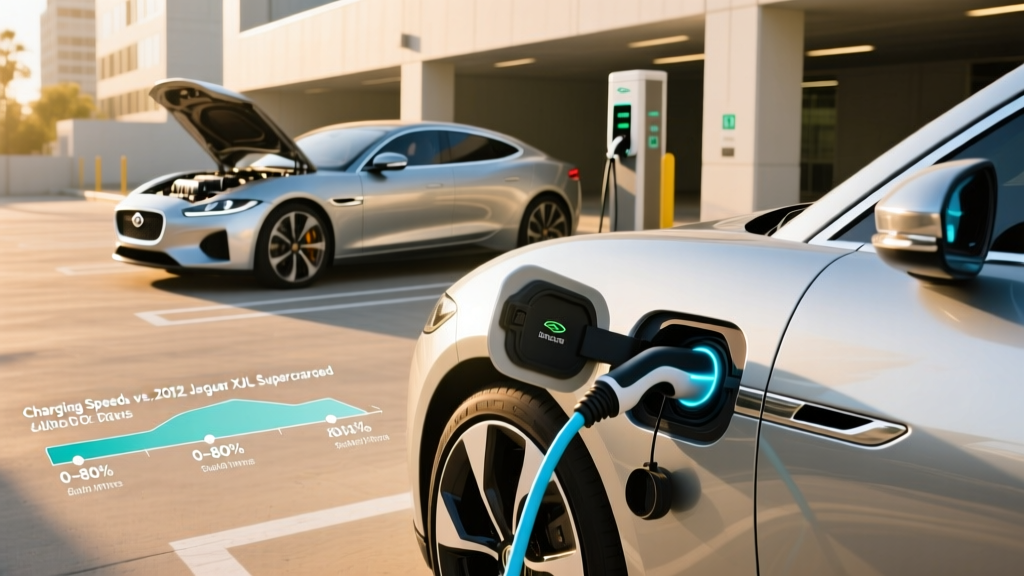
This is where the comparison gets stark. The 2012 Jaguar XJL Supercharged with its 5.0L supercharged V8 returns an EPA-estimated 18 mpg combined. Let's model real costs.
| Scenario | Rate | Efficiency | Cost Per Mile | Annual (12,000 mi) |
|---|---|---|---|---|
| 2012 Jaguar XJL Supercharged | $3.50/gal | 18 mpg combined | $0.194 | $2,333 |
| Home Level 2 (off-peak TOU) | $0.12/kWh | 3.5 mi/kWh (300 Wh/mi) | $0.034 | $411 |
| Home Level 2 (standard rate) | $0.17/kWh | 3.5 mi/kWh | $0.049 | $583 |
| Public Level 2 (ChargePoint, etc.) | $0.30/kWh | 3.5 mi/kWh | $0.086 | $1,029 |
| DC Fast Charge (Electrify America) | $0.48/kWh | 3.5 mi/kWh | $0.137 | $1,646 |
| DC Fast (Tesla Supercharger avg.) | $0.30/kWh | 3.5 mi/kWh | $0.086 | $1,029 |
Even if you exclusively used the most expensive DC fast chargers, you'd still spend roughly $687 less per year than fueling the Jaguar. But the real savings come from home charging on off-peak rates: roughly $1,900/year in fuel savings. Over five years, that's $9,500 — enough to cover a home charger installation and still come out far ahead.
For more on how the EPA calculates fuel economy and efficiency ratings, see the official data at fueleconomy.gov.
Home Charger Equipment Recommendations (2026)
Not all Level 2 chargers are equal. Here are four well-regarded options across price tiers, with their exact specifications:
Tesla Wall Connector
- Power: 11.5 kW (48A)
- Connector: NACS (J3400)
- Cable length: 24 ft
- Smart features: Wi-Fi, OTA updates, power-sharing
- Price: ~$475
- Best for: Tesla and NACS-native vehicles
ChargePoint Home Flex
- Power: Up to 12 kW (50A) — adjustable
- Connector: J1772 (NACS adapter included in 2025+ kits)
- Cable length: 23 ft
- Smart features: App scheduling, Alexa, load management
- Price: ~$599
- Best for: Mixed-vehicle households
Emporia Level 2 Charger
- Power: 11.5 kW (48A)
- Connector: J1772 (NACS adapter available)
- Cable length: 24 ft
- Smart features: Energy monitoring, solar integration, app control
- Price: ~$399
- Best for: Budget-conscious install with energy tracking
Grizzl-E Smart
- Power: 10 kW (40A)
- Connector: J1772 or NACS (select at purchase)
- Cable length: 24 ft
- Smart features: OCPP compatible, adjustable amperage
- Price: ~$499
- Best for: Cold-climate durability (rated to -40°F)
Safety, Code, and Installation Best Practices
EV charging is a high-draw, continuous electrical load — it runs at near-maximum capacity for hours. This demands proper installation:
- Dedicated circuit: Your Level 2 charger must have its own breaker — never share a circuit with other appliances.
- GFCI protection: The 2020 NEC requires GFCI (Ground Fault Circuit Interrupter) protection for outdoor EV outlets. Hardwired installations may not require a GFCI breaker, which avoids nuisance tripping — consult your electrician.
- Outdoor rating: If your charger is installed outside, ensure it carries a NEMA 4 rating (weatherproof). Most quality chargers meet this standard.
- Permit and inspection: Nearly all jurisdictions require an electrical permit for a new 240V circuit. The inspection ensures proper wire gauge, grounding, and breaker sizing. Skipping this risks fire hazard and insurance denial.
- Wire gauge: A 60A circuit typically requires 6 AWG copper wire (or 4 AWG aluminum). Your electrician will size this based on run length and local code.
For detailed NEC requirements, the National Fire Protection Association publishes the NFPA 70 (National Electrical Code), which governs EV charging installations.
Which Charging Setup Is Right for You?
Choose Your Charging Strategy
Choose home Level 2 if: You have a garage or dedicated parking spot, your electrical panel has capacity, and you drive under 60 miles daily. This covers 90%+ of EV owners and delivers the lowest per-mile cost.
Choose a panel upgrade + Level 2 if: Your home has 100A service and you want future-proofing for solar, heat pumps, or a second EV. The $1,500–$3,000 upgrade pays dividends over decades.
Rely on public DC fast charging if: You live in an apartment without charging access. Budget for $0.30–$0.48/kWh and plan routes around reliable networks (Tesla Superchargers, Electrify America). Your cost per mile will still beat the Jaguar XJL — but you'll spend $600–$1,000 more annually than a home-charging EV owner.
Stick with Level 1 if: You drive a PHEV with 25–40 miles of electric range, or you drive fewer than 20 miles per day and can tolerate 3–5 miles of range per hour of charging.
Frequently Asked Questions
How much does it cost to install a home EV charger?
A straightforward Level 2 installation (panel nearby, no upgrade needed) typically costs $700–$1,450 including equipment, electrician labor, and permit. If you need a panel upgrade from 100A to 200A or a long wire run, expect $2,850–$5,450. Always get at least two quotes from licensed electricians.
How fast will each charging level add range?
Level 1 (120V) adds roughly 3–5 miles per hour. Level 2 (240V, 48A) adds 25–44 miles per hour depending on vehicle efficiency. DC fast charging can add 150–300+ miles in 15–25 minutes, though the rate tapers significantly above 80% State of Charge.
Which connector/charger is compatible with my EV?
Nearly all new EVs sold in 2026 use the NACS (Tesla-style) connector. Older CCS-equipped vehicles can use a CCS-to-NACS adapter (~$250) for Supercharger access. For home Level 2 charging, J1772 and NACS chargers are cross-compatible via inexpensive adapters. CHAdeMO (Nissan Leaf) is being phased out.
How much does charging cost per mile vs gas?
Home charging at off-peak rates (~$0.12/kWh) costs roughly $0.034/mile for an efficient EV. The 2012 Jaguar XJL Supercharged at 18 mpg combined and $3.50/gallon costs $0.194/mile — nearly 6x more per mile. Even expensive public DC fast charging ($0.48/kWh) comes in at ~$0.137/mile, still cheaper than the Jaguar.
What electrical upgrades might I need?
The most common upgrade is a panel capacity increase from 100A to 200A ($1,500–$3,000) if your existing panel can't handle a new 60A dedicated circuit. You may also need a new conduit run if your garage is far from the panel. A licensed electrician's load calculation will determine this before any work begins.
Is it safe to charge an EV in the rain or cold?
Yes. All properly rated outdoor EV chargers carry a NEMA 4 (or higher) weatherproof rating. Connectors are designed to be weather-sealed when mated. Cold weather does slow charging speeds (lithium-ion batteries charge slower when cold), but it doesn't create a safety hazard. Many EVs offer battery preconditioning to warm the pack before a charge session.
Sources: EPA fuel economy data via fueleconomy.gov; electrical code requirements via NFPA.org; IRS Alternative Fuel Vehicle Refueling Property Credit (Form 8911) via irs.gov. Tax credit eligibility for charger installation varies by location and income — consult a tax professional.