Understanding EV Charging Levels: Speeds in kW and Miles Per Hour
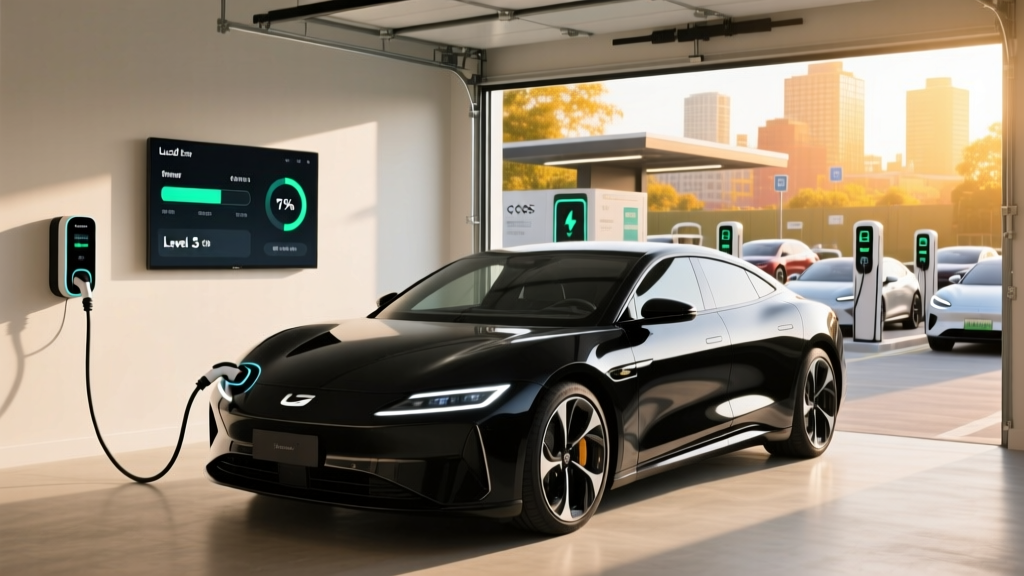
The single most important distinction in EV charging is between kW (kilowatts) and kWh (kilowatt-hours). A kilowatt is a unit of power — how fast energy flows into your battery. A kilowatt-hour is a unit of energy — how much total capacity your battery holds. Think of it like a garden hose: kW is the water pressure; kWh is the size of the bucket you're filling. A 75 kWh battery charged at 7.7 kW takes roughly 10 hours. That same battery at 150 kW (DC fast charging) can go from 10% to 80% in about 25 minutes.
Whether you're trading in a gas truck — say, an older 04 Nissan Frontier supercharged — for your first EV or you're optimizing your existing setup, understanding these three charging levels determines your daily ownership experience.
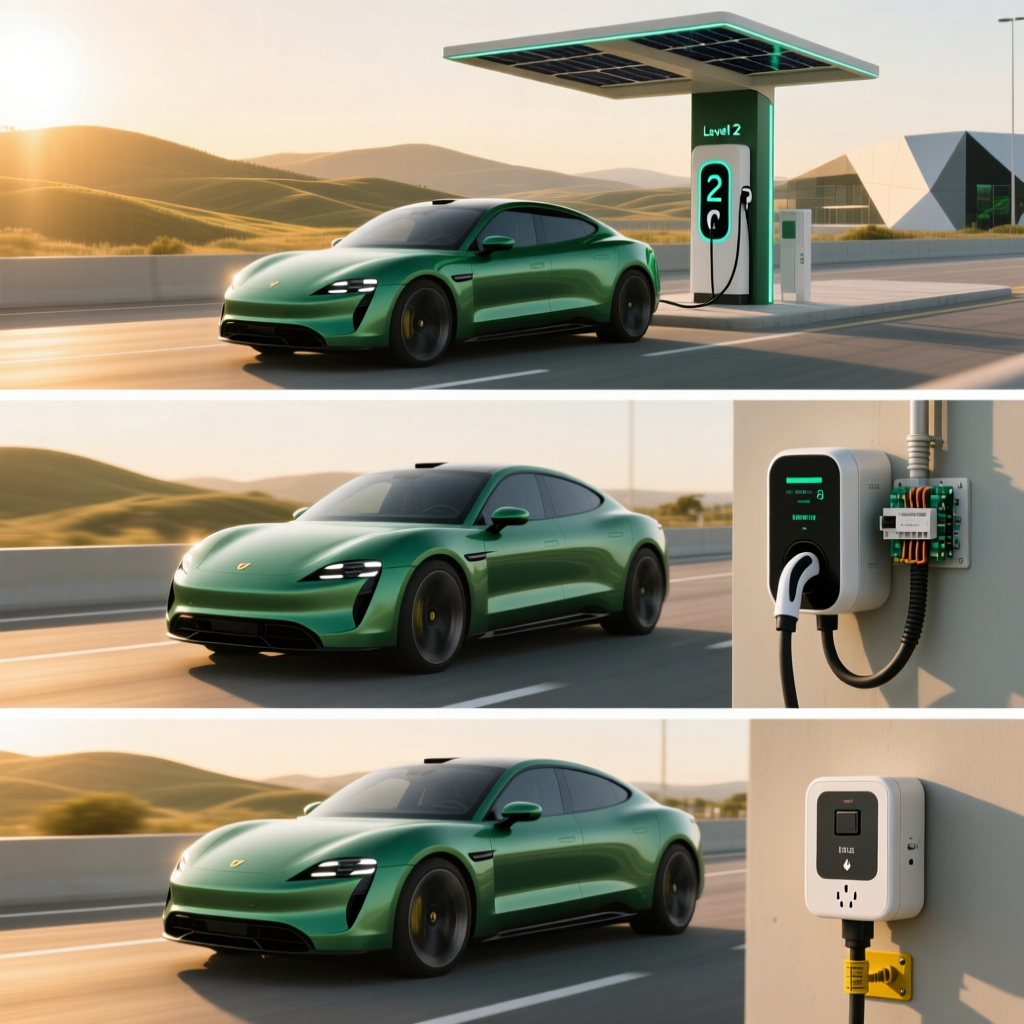
| Level | Voltage | Power (kW) | Miles of Range/Hour | Best For |
|---|---|---|---|---|
| Level 1 (120V) | 120V AC | 1.2–1.9 kW | 3–5 mi/hr | Overnight top-ups, PHEVs, low-mileage drivers |
| Level 2 (240V) | 240V AC | 3.3–19.2 kW | 12–75 mi/hr | Daily home charging, most EV owners |
| DC Fast Charge | 400–800V DC | 50–350 kW | 150–1,200 mi/hr (peak) | Road trips, quick top-ups, commercial fleets |
A critical nuance: DC fast charging speeds are peak rates, not sustained. A vehicle advertising 250 kW peak charging will typically sustain that rate only between roughly 10–40% state of charge (SoC). Above 80%, the battery management system tapers the charge rate dramatically to protect cell health. This is the charge curve, and it's why manufacturers quote 10–80% times rather than 0–100%.
Home EV Charger Installation: Electrical Requirements and Costs
Level 2 home charging is where 80%+ of all EV charging happens for owners with garage or driveway access. But installation costs vary enormously depending on your home's electrical panel, the distance from panel to charger location, and local permit requirements.
Electrical Requirements
Most Level 2 chargers require a 240V dedicated circuit, similar to what powers an electric dryer or oven. Common configurations:
- 40A circuit / 32A continuous — delivers 7.7 kW. Sufficient for most EVs; charges a 75 kWh battery overnight in ~10 hours.
- 50A circuit / 40A continuous — delivers 9.6 kW. Ideal for larger batteries (Ford F-150 Lightning 131 kWh, Rivian R1S 149 kWh).
- 60A circuit / 48A continuous — delivers 11.5 kW. Future-proofs for higher-capacity EVs and faster top-ups.
- 100A circuit / 80A continuous — delivers 19.2 kW. Requires a 200A+ main panel; used by the Ford Charge Station Pro and some Tesla Wall Connectors.
Your home's main electrical panel must have enough spare capacity. A typical 200A panel running central AC, an electric dryer, and an electric range may be near its limit. Adding a 48A EV charger could require a panel upgrade to 200A or 400A — a significant cost.
Installation Cost Breakdown
| Component | Typical Cost Range | Notes |
|---|---|---|
| Level 2 charger (hardware) | $350–$750 | Smart Wi-Fi chargers with NACS or J1772 connectors |
| Electrician labor (standard install) | $400–$1,200 | Short run from panel to garage; includes conduit, wiring, breaker |
| Electrical permit | $50–$200 | Required in most jurisdictions; inspection included |
| Panel upgrade (if needed) | $1,500–$4,000+ | 200A to 400A service upgrade; older homes most at risk |
| Long wire runs (100+ ft) | $500–$1,500 | Detached garages, carports, or chargers far from panel |
| Total (standard install, no panel upgrade) | $800–$2,150 | Most homeowners fall in this range |
| Total (with panel upgrade) | $2,500–$6,000+ | Older homes with 100A or 150A service |
Always hire a licensed electrician and pull a permit. Unpermitted electrical work can void homeowner's insurance claims and create fire hazards. The National Electrical Contractors Association and utilities like Energy.gov's home charging guide offer resources for finding qualified installers.
Which Connector Is Compatible With My EV?
The connector landscape has shifted dramatically since 2023, when Ford and nearly every major automaker committed to adopting Tesla's North American Charging Standard (NACS). As of 2026, NACS is the dominant connector for new EVs, but millions of CCS1-equipped vehicles remain on the road, and CHAdeMO persists on older Nissan Leaf models.
| Connector | Brands (2026 Models) | Notes |
|---|---|---|
| NACS (Tesla/J3400) | Tesla (all), Ford, GM, Rivian, Volvo, Polestar, Hyundai/Kia (2025+), BMW, Mercedes, Subaru (Solterra 2025+) | Smaller plug; native Tesla Supercharger access; becoming universal |
| CCS1 (Combo) | VW ID.4 (remaining stock), older Bolt EV, older Hyundai/Kia (2024 and earlier) | Legacy standard; adapters to NACS widely available (~$200–$300) |
| CHAdeMO | Nissan Leaf (all years), Mitsubishi Outlander PHEV (older) | Declining; limited DC fast-charge network support |
| J1772 (Level 2 AC) | All non-Tesla EVs (pre-2025) | Standard for Level 2 home/public AC charging; NACS vehicles include J1772 adapter |
Adapter reality check: If you own a CCS1-equipped vehicle, you can purchase a CCS-to-NACS adapter ($200–$300) to access Tesla Superchargers. Ford and GM provide these adapters at no cost to original owners. Conversely, NACS vehicles include a NACS-to-J1772 adapter for non-Tesla Level 2 public chargers. Tesla Superchargers with the Magic Dock (built-in CCS adapter) are available at select locations for non-Tesla vehicles without a separate adapter.
Cost to Charge: $/kWh Scenarios and Cost Per Mile vs Gas
One of the strongest ownership arguments for an EV is lower per-mile energy cost — but the savings depend heavily on where and when you charge.
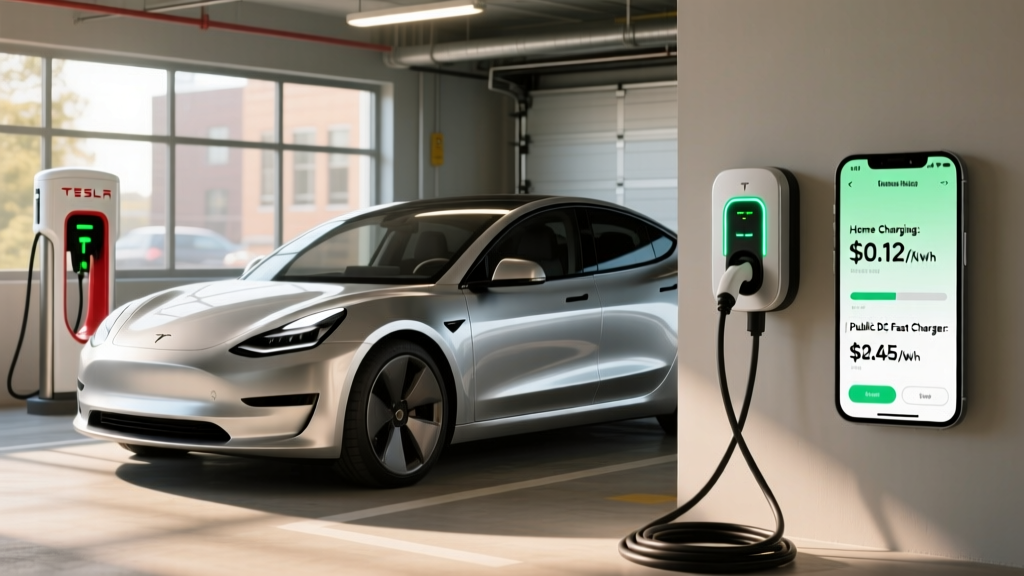
| Charging Scenario | Cost ($/kWh) | Cost per Mile (3.5 mi/kWh EV) | Equivalent Gas Price (30 MPG car) |
|---|---|---|---|
| Home off-peak (utility time-of-use) | $0.08–$0.12 | $0.023–$0.034 | $0.69–$1.02/gal |
| Home standard rate (national avg.) | $0.16–$0.18 | $0.046–$0.051 | $1.38–$1.53/gal |
| Public Level 2 (ChargePoint, etc.) | $0.25–$0.49 | $0.071–$0.140 | $2.13–$4.20/gal |
| DC fast charge (Electrify America, EVgo) | $0.35–$0.55 | $0.100–$0.157 | $3.00–$4.71/gal |
| Tesla Supercharger (avg. 2026) | $0.28–$0.36 | $0.080–$0.103 | $2.40–$3.09/gal |
Key takeaways:
- Home charging at off-peak rates delivers the equivalent of under $1/gallon gas — dramatically cheaper than any combustion vehicle.
- Exclusive DC fast charging at public rates erodes most of the cost advantage. If you cannot charge at home or work, an EV may not save you money on fuel.
- A typical driver covering 12,000 miles/year paying $0.14/kWh at home spends roughly $549/year on electricity. The same miles in a 25 MPG gas vehicle at $3.40/gal costs $1,632/year — a $1,083 annual savings.
For PHEV owners, electric-only range (typically 25–45 miles) covers most daily commuting on cheap home electricity, with the gas engine available for longer trips. The cost calculus favors PHEVs when home charging is available but DC fast charging is not needed.
Charging Time Examples for Common Battery Sizes
Charging time depends on battery capacity (kWh), the charger's power output (kW), and the vehicle's onboard charger limit. Here are real-world estimates for popular 2026 EVs:
| Vehicle | Battery (kWh usable) | Level 2 at 11.5 kW (0–100%) | DC Fast 10–80% | Peak DC kW |
|---|---|---|---|---|
| Tesla Model Y Long Range | 75 kWh (NMC) | ~7 hours | ~25 min | 250 kW |
| Hyundai Ioniq 5 (Long Range) | 77.4 kWh (NMC) | ~7.5 hours | ~18 min | 350 kW (800V) |
| Ford F-150 Lightning (Ext. Range) | 131 kWh (NMC) | ~12.5 hours | ~41 min | 150 kW |
| Chevrolet Equinox EV | 85 kWh (NMC) | ~8 hours | ~30 min | 150 kW |
| Tesla Model 3 RWD | 57.5 kWh (LFP) | ~5.5 hours | ~25 min | 170 kW |
| BMW iX xDrive50 | 105.2 kWh (NMC) | ~10 hours | ~34 min | 200 kW |
Chemistry matters for charging habits: LFP (lithium iron phosphate) batteries, used in the Tesla Model 3 RWD and some BYD models, can and should be charged to 100% regularly — Tesla recommends it. NMC (nickel manganese cobalt) batteries benefit from daily limits of 80% to slow degradation, with 100% reserved for road trips. This means an LFP pack's full rated range is available daily, while NMC owners effectively use ~80% of capacity for routine driving.
Recommended Home EV Chargers for 2026
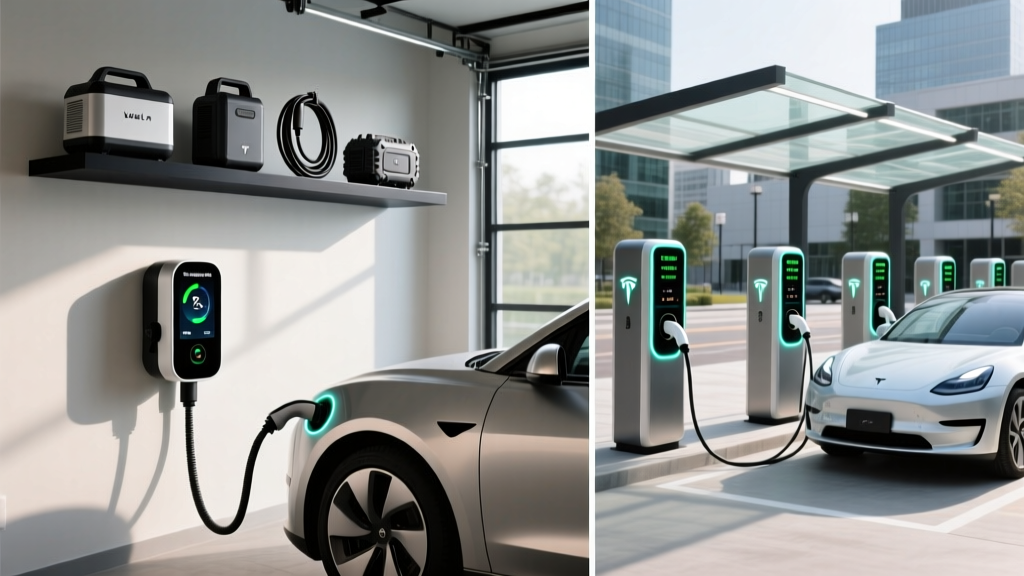
After testing and tracking reliability data across major brands, these are our top Level 2 home charger recommendations:
Tesla Wall Connector (J3400/NACS)
- Power: Up to 11.5 kW (48A) on a 60A circuit
- Connector: Native NACS; includes J1772 adapter in box
- Cable length: 24 ft
- Smart features: Wi-Fi, OTA updates, power sharing (link two units on one circuit), access control
- Price: $475
- Best for: Tesla and NACS-native vehicle owners; cleanest integration
ChargePoint Home Flex (NACS/J1772)
- Power: Up to 12 kW (50A) on a 60A circuit; adjustable down to 16A
- Connector: Available in NACS or J1772 configurations
- Cable length: 24 ft
- Smart features: Wi-Fi, Alexa/Google Home, scheduling, energy tracking, flexible amperage for older panels
- Price: $599–$649
- Best for: Multi-EV households, adjustable amperage for panel-constrained homes
Emporia Vue Level 2 Charger
- Power: Up to 11.5 kW (48A) on a 60A circuit
- Connector: J1772 (NACS adapter included)
- Cable length: 24 ft
- Smart features: Wi-Fi, solar integration (pair with Emporia Vue energy monitor), time-of-use scheduling, load management
- Price: $399
- Best for: Budget-conscious buyers, solar-equipped homes, energy monitoring enthusiasts
Grizzl-E Smart (United Chargers)
- Power: Up to 10 kW (40A) on a 50A circuit
- Connector: J1772 or NACS
- Cable length: 24 ft
- Smart features: Wi-Fi, OCPP-compatible (works with utility demand-response programs), adjustable output
- Price: $449–$499
- Best for: Cold-climate durability (rated to -40°F), outdoor installs, utility program participants
Safety, Electrical Code, and Installation Best Practices
EV charging involves sustained high-current draw — often 8–10 hours continuously. This places unique demands on your home's electrical system that differ from intermittent loads like a dryer. Key safety considerations per the National Electrical Code (NEC):
- Dedicated circuit: Your EV charger must have its own dedicated breaker — never shared with other appliances.
- Continuous load derating: NEC Article 625 requires EV chargers to be treated as continuous loads. A 48A charger requires a 60A breaker (loads must not exceed 80% of breaker rating).
- GFCI protection: 2023 NEC and later require GFCI protection for 240V EV charging outlets (NEMA 14-50). Hardwired installations may not require GFCI depending on jurisdiction — your electrician will determine compliance.
- Outdoor rating: If your charger is installed outdoors or in an unconditioned garage, ensure it carries a NEMA 4 or IP65 rating for weather resistance.
- Wire gauge: 6 AWG copper for 48A circuits; 4 AWG for 60A+ circuits over longer runs. Your electrician will calculate based on distance and local code.
- Hardwired vs. plug-in: Hardwired chargers (no plug) eliminate the NEMA outlet as a failure point and are generally preferred for permanent installations. Plug-in (NEMA 14-50) offers portability but requires a high-quality industrial-grade receptacle — cheap outlets have caused melting incidents under sustained EV loads.
If you're considering a used vehicle purchase — whether it's a classic 04 Nissan Frontier supercharged project truck for the weekends or a used Tesla Model 3 for the commute — ensuring your home electrical system is properly evaluated before buying an EV avoids costly surprises. A licensed electrician can perform a load calculation on your panel for $100–$250, often credited toward installation if you proceed.
Frequently Asked Questions
How much does it cost to install a home EV charger?
A standard Level 2 home installation (40A–60A circuit, short wire run, no panel upgrade) typically costs $800–$2,150 including the charger ($350–$750), electrician labor ($400–$1,200), and permit ($50–$200). If your home needs a panel upgrade from 100A/150A to 200A+ service, add $1,500–$4,000+. Homes with detached garages or long wire runs (100+ ft) may add $500–$1,500 in conduit and wire costs. Always get 2–3 quotes from licensed electricians.
How fast will each charging level add range?
Level 1 (120V standard outlet) adds roughly 3–5 miles of range per hour — adequate for PHEVs with small batteries or EV drivers covering under 30 miles/day. Level 2 (240V) at a typical 48A/11.5 kW adds 35–45 miles per hour for most EVs, fully recharging overnight. DC fast charging at 150–350 kW can add 150–300+ miles in 20–30 minutes, but only within the 10–80% SoC window where peak rates are sustained.
Which connector/charger is compatible with my EV?
For 2025–2026 model-year vehicles, NACS (J3400) is now standard on Tesla, Ford, GM, Rivian, Hyundai, Kia, BMW, and most others. Older vehicles (2024 and earlier, non-Tesla) typically use CCS1 — adapters to access Tesla Superchargers cost $200–$300 and are often provided free by the automaker. The Nissan Leaf uses CHAdeMO, which has declining public charger support. For Level 2 home charging, NACS vehicles include a J1772 adapter; CCS vehicles plug directly into J1772 public Level 2 stations.
How much does charging cost per mile vs gas?
At the national average residential electricity rate of ~$0.17/kWh and a typical EV efficiency of 3.5 miles/kWh, home charging costs roughly $0.049/mile. A comparable gas vehicle at 27 MPG with fuel at $3.40/gal costs $0.126/mile — more than double. However, exclusive DC fast charging at $0.45/kWh pushes EV cost to $0.129/mile, nearly matching gas. The economic case for an EV is strongest with consistent home or workplace charging access.
What electrical upgrades might I need?
The most common upgrade is a panel capacity increase. Homes with 100A or 150A main service often cannot support a 48A EV charger alongside existing large loads (central AC, electric range, dryer). A panel upgrade to 200A costs $1,500–$3,000; a 400A upgrade runs $2,500–$5,000+. An alternative is a smart load management system (e.g., Emporia Smart Load Center, Span panel) that dynamically shares capacity between the EV charger and other circuits — avoiding a panel upgrade at a cost of $300–$1,000. Your electrician's load calculation will determine which path is necessary.